Daily Carbohydrate Intake Calculator
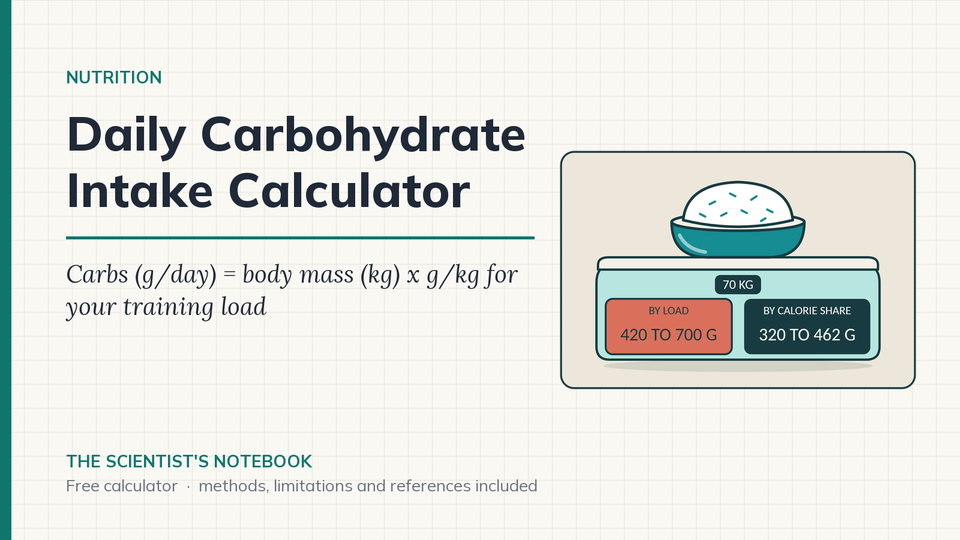
This calculator sets a carbohydrate target for the whole day, scaled to your body mass and training load. It is not a fuelling plan for the session itself.
In short: Route 1 multiplies your body mass by the g/kg range for your training load: light 3 to 5, moderate 5 to 7, high 6 to 10 and very high 8 to 12 g/kg/day. A 70 kg athlete training 1 to 3 hours a day gets 420 to 700 g. Route 2 takes a share of estimated daily energy and divides it by 4 kcal per gram.
How is the daily carbohydrate target calculated?
There are two routes. Use the first if you train on a schedule you can describe. Use the second if you want the target to follow your energy needs.
Route 1, training load. Daily carbohydrate (g) = body mass (kg) x the range for your load, in g per kg per day. The ranges are the ones in the sport nutrition literature (Burke 2011; Thomas 2016): light 3 to 5, moderate 5 to 7, high 6 to 10, very high 8 to 12. A separate loading range of 10 to 12 g/kg applies for the 36 to 48 hours before an event longer than about 90 minutes.
Route 2, energy share.
- Resting energy (kcal/day) = 10 x mass (kg) + 6.25 x height (cm) - 5 x age (years) + 5 for men, or - 161 for women (Mifflin-St Jeor).
- Total daily energy = resting energy x an activity multiplier (1.2, 1.375, 1.55, 1.725 or 1.9).
- Carbohydrate energy = total energy x the share you pick (20, 45, 55 or 65 %).
- Carbohydrate (g) = carbohydrate energy / 4, because carbohydrate is counted at 4 kcal per gram.
Worked example, route 1. A 70 kg athlete training 1 to 3 hours a day picks "high". The range is 6 to 10 g/kg, which is 420 to 700 g per day. The midpoint, 8 g/kg, is 560 g.
Worked example, route 2. A 30-year-old man, 70 kg, 175 cm, moderately active, choosing the 65 % share. Resting energy = 700 + 1093.75 - 150 + 5 = 1649 kcal. Total energy = 1649 x 1.55 = 2556 kcal. Carbohydrate energy = 2556 x 0.65 = 1661 kcal. That is 415 g per day, or 5.9 g/kg.
How do I use the result?
- Build week. If your weekly volume moves from 8 to 14 hours, the load category moves up, and so does the daily gram target. I would change the category in the calculator rather than eyeball it, because the gap between 5 and 8 g/kg is large on a 70 kg body.
- Heavy day, easy day. The ranges describe a typical day at that load. On a rest day you can sit near the bottom of your range, and on the day before and after a long session near the top.
- Before a long event. The loading line gives the 36 to 48 hour target. Pair it with the taper advisor so the extra carbohydrate arrives while training volume is falling.
- Fuelling inside the session is a different number. Burke 2011 puts intake during exercise at 30 to 60 g per hour for longer sessions and up to 90 g per hour for events beyond about 2.5 hours. For your own grams per hour during a ride or run, use the carbohydrate calculator. To see how a day of intake relates to stored fuel, try the glycogen calculator.
What are the limits?
- The g/kg ranges are consensus ranges for athletes. They are not individual prescriptions, and they were built from studies on healthy adults.
- Energy-based estimates carry an error of around 10 % or more. In a 2005 systematic review, Mifflin-St Jeor predicted resting energy within 10 % of the measured value in more people than any other equation, yet individual errors were larger than that. The five activity multipliers are a common convention rather than a measured constant.
- Mifflin-St Jeor was fitted on 498 adults aged 19 to 78 years. Outside that age range the energy route still runs but says the estimate is an extrapolation, and it refuses inputs that give a resting energy below 500 kcal/day.
- The 20 % share sits below the 45 to 65 % Acceptable Macronutrient Distribution Range for adults. It is included because people ask for it, not because it is a sport nutrition target.
- Grams include fibre. The calculator does not split fibre from digestible carbohydrate.
- Nothing here applies to someone managing diabetes or another metabolic condition. Those targets are set with a registered dietitian.
- Appetite, gut tolerance and total energy intake all limit how much of a high target you can eat. A 12 g/kg day on a 70 kg body is 840 g, which is a lot of food.
⚠️ HEALTH & TRAINING GUIDANCE
Carbohydrate needs vary with training, body size and health status. Talk to a registered dietitian or sports medicine professional before changing your intake based on these estimates, especially if you manage diabetes or another metabolic condition.
ℹ️ IMPORTANT DISCLAIMER
This calculator is for educational purposes only and does NOT constitute medical advice. Consult qualified professionals before making changes. Individual physiology varies. You assume all risk. Must be 18+.
Frequently asked questions
How many grams of carbohydrate do I need per day?
It scales with body mass and training load. The sport nutrition ranges run from 3 to 5 g/kg/day on light days to 8 to 12 g/kg/day for very heavy training (Burke 2011; Thomas 2016). For a 70 kg athlete at the high load, 6 to 10 g/kg, that is 420 to 700 g a day.
What is carbohydrate loading?
Before an event longer than about 90 minutes, the loading range is 10 to 12 g/kg/day for the 36 to 48 hours beforehand. For a 70 kg athlete that is 700 to 840 g a day. The calculator labels it as a short pre-event target, not a daily one.
Why not just use a percentage of calories?
A percentage moves with total energy, not with training load. The g/kg ranges tie the target to body mass and training hours. The energy-share route is still offered with shares of 20, 45, 55 or 65 % of energy, and it flags 20 % as below the 45 to 65 % adult range.
How accurate is the energy-share route?
It uses the Mifflin-St Jeor resting energy equation. In a 2005 systematic review it predicted resting energy within 10 % of measured values in more people than any other equation, yet individual errors were larger. The activity multipliers of 1.2 to 1.9 are a convention, not a measured constant.
Is this the same as carbohydrate during a ride?
No. This is the daily total. Burke 2011 puts intake during exercise at 30 to 60 g per hour for longer sessions and up to 90 g per hour for events beyond about 2.5 hours. That is a separate calculation.
Related calculators
- Caffeine Dose Calculator for Endurance
- Creatine Loading and Maintenance Calculator
- Fat Intake Calculator
- Fiber Intake Calculator
- All calculators on The Scientist's Notebook
References
- Burke LM, Hawley JA, Wong SH, Jeukendrup AE · 2011 · J Sports Sci · PMID 21660838 · doi
- Thomas DT, Erdman KA, Burke LM · 2016 · Med Sci Sports Exerc · PMID 26891166 · doi
- Mifflin MD et al. · 1990 · Am J Clin Nutr · PMID 2305711 · doi
- Jeukendrup A · 2014 · Sports Med · PMID 24791914 · doi
- Frankenfield D et al. · 2005 · J Am Diet Assoc · PMID 15883556 · doi
- Institute of Medicine · 2005 · Dietary Reference Intakes for Energy, Carbohydrate, Fiber, Fat, Fatty Acids, Cholesterol, Protein, and Amino Acids. National Academies Press · not indexed in PubMed · doi