Entry #004: The ergogenic potential of caffeine and sodium bicarbonate in endurance events
Entry #004: The ergogenic potential of caffeine and sodium bicarbonate in endurance events

Hi Endurance Enthusiast,

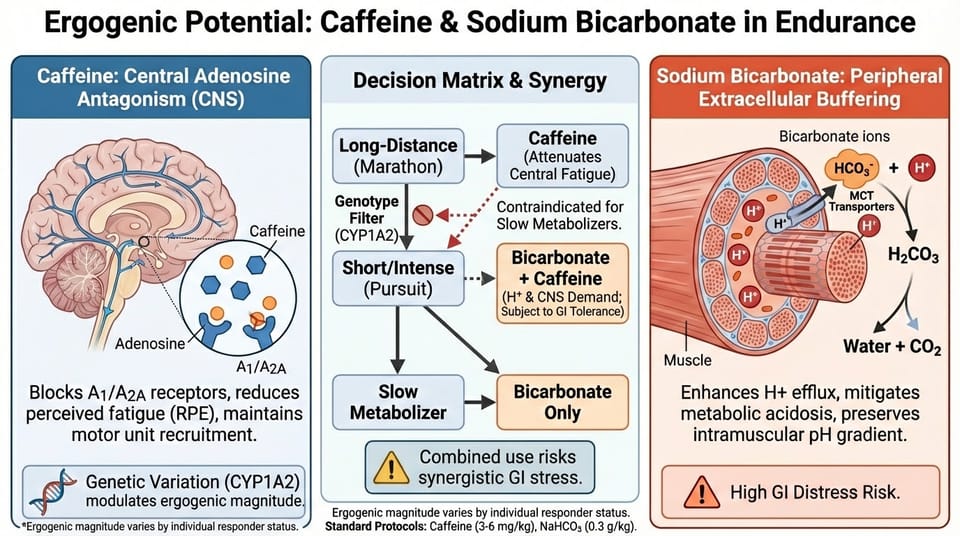
The pursuit of marginal gains in endurance performance often leads athletes toward the pharmaceutical cabinet of evidence-based ergogenic aids. Among the most rigorously studied are caffeine and sodium bicarbonate—two substances that target the physiological limiters of endurance through distinct, yet potentially complementary, pathways. While caffeine operates primarily within the central nervous system to modulate the perception of fatigue and maintain motor unit recruitment, sodium bicarbonate acts as an extracellular chemical buffer, helping to manage the accumulation of metabolic byproducts associated with high-intensity efforts. For the advanced athlete, the challenge lies in understanding the mechanistic nuances, the genetic variability in metabolism, and the logistical complexities of dosing that separate an ergogenic advantage from a performance-limiting gastrointestinal event.

Executive Summary — The Brief

  • Mechanistic Synergy: Caffeine functions as an adenosine receptor antagonist (CNS), while sodium bicarbonate increases extracellular buffering capacity (peripheral), addressing fatigue via independent mechanisms.
  • Caffeine Dosing: Ergogenic benefits are typically observed at dosages of 3–6 mg/kg of body mass, generally administered 60 minutes prior to the effort, though lower doses may also be effective.
  • Bicarbonate Dosing: Evidence suggests a threshold of ~0.3 g/kg of body mass is often required to significantly increase blood bicarbonate levels and facilitate the efflux of hydrogen ions (H+).
  • Genetic Variability: Polymorphisms in the CYP1A2 gene influence the rate of caffeine metabolism; while "fast metabolizers" (AA genotype) often derive robust benefits, the impact on "slow metabolizers" (CC genotype) is more variable and, in some cases, may be negligible or detrimental.
  • Target Duration: Bicarbonate is most effective for high-intensity efforts lasting approximately 1–10 minutes, whereas caffeine demonstrates efficacy across a broad range of endurance durations.
  • Gastrointestinal Risk: Sodium bicarbonate carries a significant risk of GI distress (bloating, nausea, osmotic diarrhea), necessitating specific co-ingestion strategies with carbohydrates and fluid to improve tolerability.

The Science at a Glance

SupplementPrimary StimulusMain AdaptationFatigue CostPrimary Risk
CaffeineAdenosine receptor antagonismReduced RPE; maintained motor unit firingPotential CNS over-arousal; sleep disruptionAnxiety; tachycardia; habituation
Sodium BicarbonateElevation of blood pH/bicarbonateEnhanced H+ efflux from muscleMetabolic alkalosisGI distress; osmotic diarrhea
CombinedDual-pathway targetingTheoretical additive performance gainIncreased physiological stressElevated risk of GI irritation

Foundational Principles

1. Adenosine Receptor Antagonism and Central Command

Caffeine's primary ergogenic pathway is the competitive antagonism of adenosine receptors (specifically A1 and A2A subtypes) in the central nervous system. During exercise, rising extracellular adenosine levels bind to these receptors, inhibiting the release of excitatory neurotransmitters such as dopamine and norepinephrine. This process contributes to the increase in perceived effort (RPE). By blocking these receptors, caffeine attenuates the signals of fatigue, allowing the athlete to maintain a higher intensity of central command—the neural drive from the motor cortex to the working musculature.

"While historical theories suggested caffeine’s primary role was enhancing fat oxidation to spare glycogen, current evidence indicates that metabolic changes are often inconsistent. The ergogenic effect is predominantly driven by CNS modulation, which shifts the threshold of perceived exertion and allows for the maintenance of higher power outputs despite peripheral fatigue signals."

Scientist’s Insight

2. The Bicarbonate Buffer and the pH Gradient

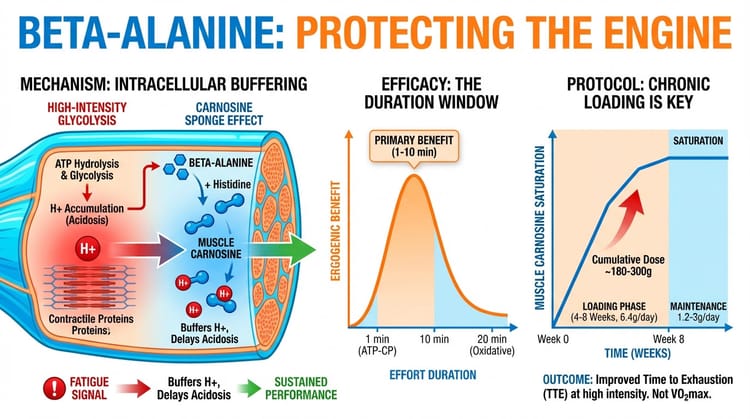
During high-intensity endurance efforts, high rates of glycolytic flux lead to a significant accumulation of hydrogen ions (H+) within the muscle cell. A reduction in intramuscular pH is associated with impaired contractile function, potentially through interference with calcium handling or enzyme activity. Sodium bicarbonate increases the concentration of bicarbonate in the extracellular fluid, thereby increasing the pH gradient between the intracellular and extracellular compartments. This gradient facilitates the efflux of H+ and lactate from the muscle fibers—likely through monocarboxylate transporters (MCTs)—helping to maintain a more favorable internal environment for muscle contraction.

"The efficacy of sodium bicarbonate is largely dependent on the degree of metabolic acidosis generated. In purely sub-threshold, steady-state exercise, endogenous buffering systems are generally sufficient. The value of exogenous bicarbonate becomes apparent when the intensity necessitates high glycolytic contributions, where the extracellular buffer acts as a 'sink' for metabolic protons."

Scientist’s Insight

The Decision Matrix (Paid Value)

Determining whether to utilize one or both supplements depends on specific event demands, individual tolerability, and physiological response.

Athlete ProfileRecommended AidLogic
Long-Distance (Marathon/Ironman)Caffeine (3-6 mg/kg)CNS fatigue is a dominant limiter; the risk of GI distress from bicarbonate often outweighs the modest buffering requirement.
High-Intensity (4km Pursuit/800m-1500m Run)Bicarbonate (0.3 g/kg) + CaffeineRequires high glycolytic flux (H+ accumulation) and maximal motor unit recruitment.
Multi-Stage RacerLow-dose Caffeine (1-2 mg/kg)Intended to maintain cognitive focus and reduce RPE while minimizing sleep disruption across consecutive days.
Slow Caffeine Metabolizer (CC Genotype)Bicarbonate Only (or Low-dose Caffeine)High-dose caffeine may lead to prolonged systemic concentrations, potentially resulting in adverse side effects for this sub-population.

The Protocol

Caffeine Administration

  1. Abstinence Consideration: Some athletes reduce habitual caffeine intake 3–5 days prior to an event to potentially re-sensitize receptors, though research suggests ergogenic effects may be maintained even without withdrawal.
  2. Timing: Ingest 3–6 mg/kg approximately 60 minutes prior to the start or before a critical high-intensity section of a race to coincide with peak plasma concentrations.
  3. Formulation: Caffeine anhydrous (capsules or powder) is generally preferred in research for its standardized dosing and rapid absorption compared to coffee, which has variable caffeine content.

Sodium Bicarbonate Administration

  1. The Dose: Standard protocols utilize approximately 0.3 g/kg of body mass (e.g., 21g for a 70kg athlete).
  2. The Window: Ingest the dose between 120 and 180 minutes before the effort to allow for peak blood bicarbonate levels and to provide time for initial GI transit.
  3. Tolerability Strategy: To mitigate osmotic stress, split the dose into smaller portions taken over 30–60 minutes. Consume with a high-carbohydrate meal (e.g., 1.5g/kg) and sufficient fluid (5–10 ml/kg) to improve gastric emptying and comfort.
  4. Practice: Given the high inter-individual variability in GI tolerance, protocols must be rigorously tested during high-intensity training sessions before competition use.

Case Study: The 40km Cycling Time Trialist

Athlete: 75kg male, highly trained, self-reported responder to caffeine.

The Event: 40km Time Trial (~55 minutes duration).

Genotype: Unknown, but history suggests a positive response to standard caffeine protocols.

The Intervention:
The athlete ingested 450mg of anhydrous caffeine (6 mg/kg) 60 minutes prior to the event. He also utilized a loading protocol of 22.5g of sodium bicarbonate (0.3 g/kg).

Observation:
Power output was elevated early in the trial; however, at approximately the 30-minute mark, the athlete experienced significant abdominal cramping and GI urgency. The inability to maintain an aerodynamic position and the physiological stress of the GI distress led to a marked decline in power output.

Analysis:
While the caffeine likely provided the intended central drive, the bicarbonate protocol caused an osmotic imbalance. This was likely due to insufficient fluid intake or a dosing window that was too narrow for the athlete's specific GI transit time, leading to a net performance decrement.

Revised Plan:
In a subsequent trial, the athlete maintained the caffeine dose but shifted the bicarbonate ingestion to 180 minutes pre-race, utilized a split-dosing strategy, and increased the carbohydrate and fluid co-ingestion. This refined protocol allowed for the achievement of higher blood bicarbonate levels without the associated GI distress, resulting in a 2.5% improvement over baseline.

Best regards,
Dr. Thomas Mortelmans

Annotated References

  1. Effects of Caffeine Intake on Endurance Running Performance A meta-analysis showing that caffeine improves time to exhaustion and time trial performance across varied training levels.
  2. Caffeine and Bicarbonate for Speed: A Meta-Analysis Quantifies potential speed improvements in high-intensity endurance events through targeted legal supplementation.
  3. ISSN Position Stand: Caffeine and Exercise Performance A comprehensive consensus document detailing caffeine's role in enhancing aerobic and anaerobic performance.
  4. ISSN Position Stand: Sodium Bicarbonate The official society stance on bicarbonate dosing (0.2–0.5 g/kg) and its efficacy in muscular endurance tasks.
  5. Caffeine, CYP1A2 Genotype, and Endurance Performance Investigates how genetic variation in caffeine metabolism may influence individual performance outcomes.
  6. Combining Caffeine and Sodium Bicarbonate: A Review Critical review indicating that while both are effective individually, evidence for additive benefits remains inconsistent.
  7. Sex Differences in the Acute Effect of Caffeine A randomized trial highlighting that the temporal pattern of peak power enhancement may differ between men and women.
  8. Caffeine Ingestion on Cycling Time Trial Performance A systematic review confirming the efficacy of caffeine specifically for cycling time trial metrics.
  9. Co-Ingestion of Caffeine and Sodium Bicarbonate on Muscular Endurance Examines the acute interaction of these two aids during resistance-based endurance tasks.
  10. Caffeine Supplementation Strategies Among Endurance Athletes Investigates real-world athlete protocols compared to laboratory-established timing and dosing.
  11. Effect of Sodium Bicarbonate on Prolonged Running Demonstrates that while bicarbonate alters blood pH, its effect on prolonged, sub-threshold running is often limited.
  12. Influence of CYP1A2 Polymorphism on Caffeine Ergogenicity Evidence regarding how specific alleles may influence the ergogenic response to caffeine.
  13. Dietary Supplements for Athletic Performance in Women Discusses the historical male bias in supplementation research and the necessity for sex-specific investigations.
  14. Sodium Bicarbonate Supplementation Umbrella Review A comprehensive review validating the performance-enhancing effects of bicarbonate across various sports.
  15. Effect of Acute Caffeine Ingestion on Endurance: Correction and Meta-Analysis A summary of the dose-response relationship of caffeine in endurance activities.

Disclaimer: This newsletter is for informational and educational purposes only and does not constitute medical advice. Supplementation with high doses of caffeine or sodium bicarbonate may carry health risks, including cardiovascular stress or severe gastrointestinal distress. Always consult with a qualified healthcare professional or sports dietitian before beginning any new supplement protocol. Performance gains are not guaranteed and vary significantly between individuals.

Read more