Entry #011: Genetic variability in VO2max responses and what it means for individualized training
Now that we have established the physiological underpinnings of aerobic capacity, we need to address the biological noise that often clouds training data: your DNA.
In the pursuit of peak performance, a common frustration arises when a standardized protocol yields divergent results among training partners. One athlete sees a 15% surge in VO2max, while another, adhering to the exact same workload, stagnates.
For decades, this was dismissed as a lack of discipline or "poor genetics." However, the current body of literature—specifically data from the landmark HERITAGE Family Study—suggests a more nuanced reality.
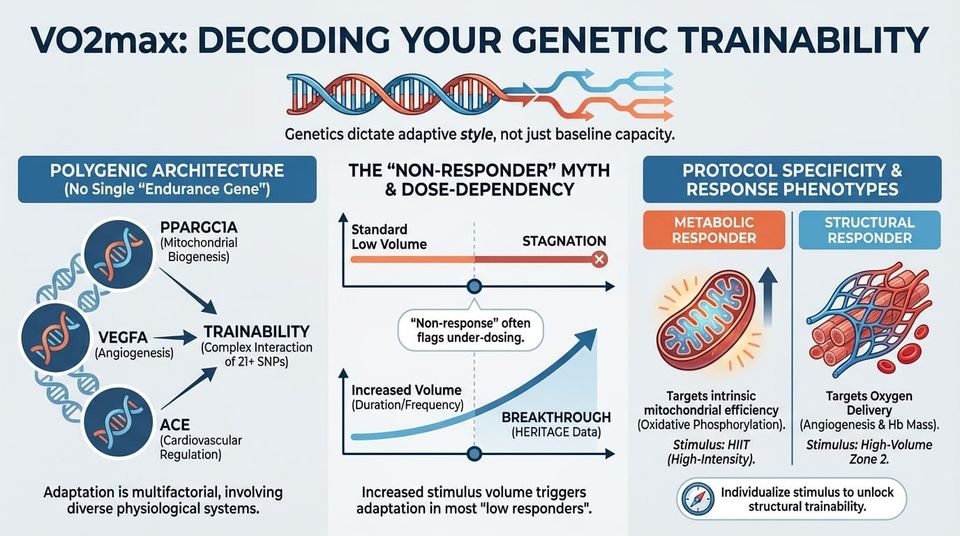
Genetics do not merely dictate your starting point; they dictate the specific style of stimulus required to force adaptation. We are moving away from the binary concept of "talent" toward a structural understanding of "trainability."
Executive Summary
- The Heritability of Trainability: While baseline VO2max is 43–72% heritable, your ability to improve that number (trainability) is approximately 47% heritable. This implies roughly half of your adaptation potential is distinct from your genetic starting point.
- The "Non-Responder" Myth: Recent rigorous investigations have effectively dismantled the concept of the "non-responder." Individuals who fail to adapt to standard moderate-volume training almost universally respond when the stimulus is increased in duration or frequency. "Non-response" is often a diagnostic marker for under-dosing.
- Polygenic Architecture: There is no single "endurance gene." Trainability is determined by a complex interaction of at least 21 single nucleotide polymorphisms (SNPs) involving mitochondrial biogenesis (PPARGC1A), angiogenesis (VEGFA), and cardiovascular regulation (ACE).
- Protocol Specificity: Adaptation heterogeneity suggests that "low responders" to intensity often require high-volume interventions, whereas others require high-intensity stimuli to trigger mitochondrial respiration improvements.
The Science at a Glance
The following table categorizes the physiological trade-offs observed between different genetic "response phenotypes." This data synthesizes findings regarding mitochondrial efficiency versus capillary density adaptations.
| Response Phenotype | Primary Limitation | Adaptation Pathway | Recommended Stimulus Bias | Fatigue Cost |
|---|---|---|---|---|
| Metabolic Responder | Mitochondrial Enzyme Activity | Increased oxidative phosphorylation efficiency (intrinsic) | High-Intensity Interval Training (HIIT) | High (Neural/Hormonal) |
| Structural Responder | Oxygen Delivery (Q & Capillaries) | Angiogenesis & Hemoglobin Mass expansion | High-Volume Low-Intensity (Zone 2) | Moderate (Glycogen/Structural) |
| "Low" Responder | Stimulus Threshold | Delayed molecular signaling (e.g., VEGF/PGC-1α) | Increased Frequency (+2 sessions/week) | High (Time/Lifestyle) |
Foundational Principles
1. The Heritability of Adaptability
It is critical to distinguish between baseline capacity and adaptive potential. The HERITAGE Family Study provided definitive evidence that these are separate heritable traits. You may inherit a mediocre baseline VO2max but possess a "High Responder" genotype that allows for massive percentage gains. Conversely, elite baseline values do not guarantee further trainability.
"The HERITAGE study found that approximately 15% of individuals responded very little to standardized training... while another 15% showed exceptional improvements... This distribution suggests a spectrum of trainability rather than a categorical distinction."
2. The Dose-Response Imperative
The most significant finding for the amateur athlete is the refutation of genetic immutability regarding training stagnation. Research by Montero and Lundby demonstrated that subjects classified as "non-responders" after 60 minutes of weekly exercise were entirely eliminated when volume was tripled to 180 minutes.
This suggests that genetic variations often dictate the threshold of stress required to activate upstream signaling pathways (like PGC-1α), rather than the inability to adapt.
3. The Mechanism of Heterogeneity
Not all VO2max gains are created equal. Some individuals improve primarily through central adaptations (stroke volume, hemoglobin mass), while others improve through peripheral adaptations (mitochondrial density, capillary-to-fiber ratio).
- Hemoglobin Mass: A 1g increase in Hb mass correlates to a ~4 ml/min increase in VO2max.
- Mitochondrial Function: Improvements here are often driven by intensity.
Understanding which system is your genetic "limiter" is the key to breaking plateaus.
If you want to see what I read to keep my own work sharp outside this newsletter, this is the list.
 Thomas Mortelmans
The Decision Matrix
Use this matrix to categorize your current training status and identify the necessary architectural shift in your programming. This replaces the need for commercial genetic testing, using physiological response as the diagnostic tool.
| Current Symptom | Likely Genetic Profile | The Prescription |
|---|---|---|
| High Power, Low Endurance (Fade after 2 hours) | ACTN3 (RR genotype): Fast-twitch dominance; lower baseline oxidative enzymes. | Volume Focus: You likely respond poorly to threshold work. Prioritize extensive Zone 2 to build capillary density without autonomic burnout. |
| High Endurance, Low Punch (Can ride forever, low VO2 ceiling) | PPARGC1A / VEGFA Favorable: High natural oxidative capacity; low anaerobic power. | Intensity Focus: Your "diesel" engine is efficient. Introduce VO2max intervals (3–5 min duration) to force central cardiac expansion. |
| Total Stagnation (No improvement in 2+ blocks) | "High Threshold" Responder: Your genetic signaling pathways are dampened at current loads. | Frequency Overload: Do not increase intensity. Add 2 additional aerobic sessions per week to increase signaling frequency. |
The Protocol: Individualized Implementation
To apply these genetic insights, we do not rely on guesses. We utilize a diagnostic block.
Phase 1: The Diagnostic Block (4 Weeks)
- Establish Baseline: Record 5-minute and 20-minute Max Power, or perform a lactate ramp test.
- Standardized Load: Execute a "polarized" distribution (80% low intensity, 20% high intensity) with a fixed volume (e.g., 6 hours/week).
- Retest: Evaluate the delta.
- <3% improvement: You are a "Low Responder" to this specific dose. Proceed to Phase 2B.
- >5% improvement: You are a "High Responder." Maintain current architecture until plateau.
I’ve added two field tools that turn hard efforts into usable constraints, not vague zones.
 Thomas Mortelmans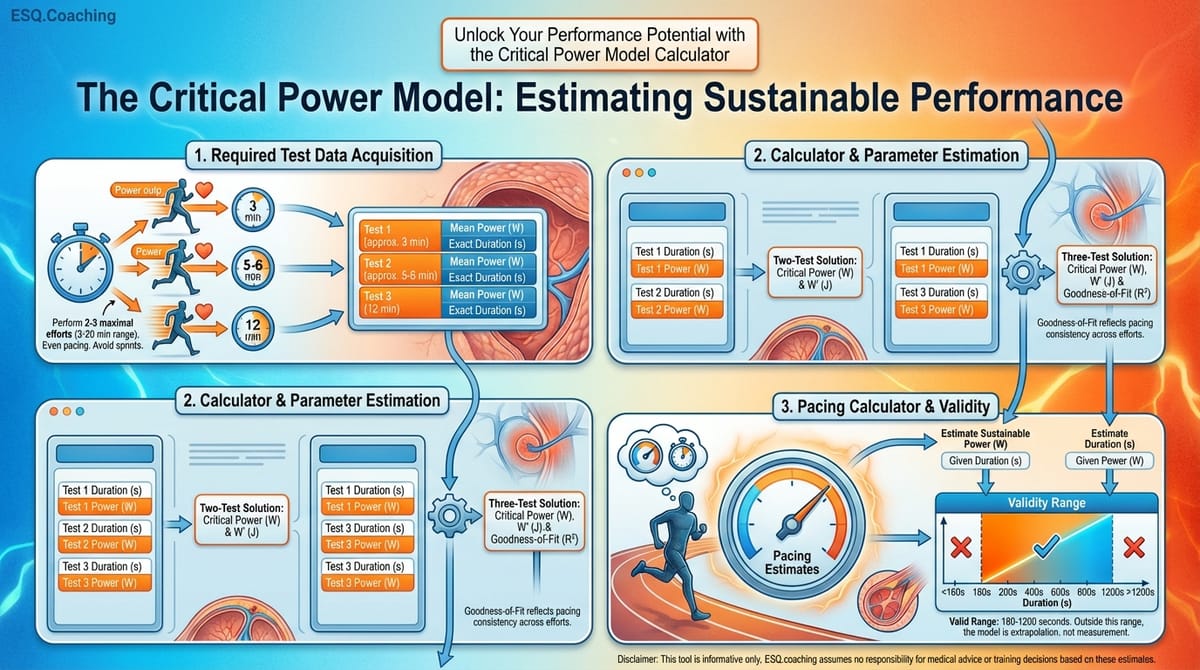
The first set applies the critical power model to two or three maximal tests and returns CP, W’, and pacing estimates within their valid time window.
No black boxes here. The outputs rise or fall directly with how evenly you pace those efforts.
 Thomas Mortelmans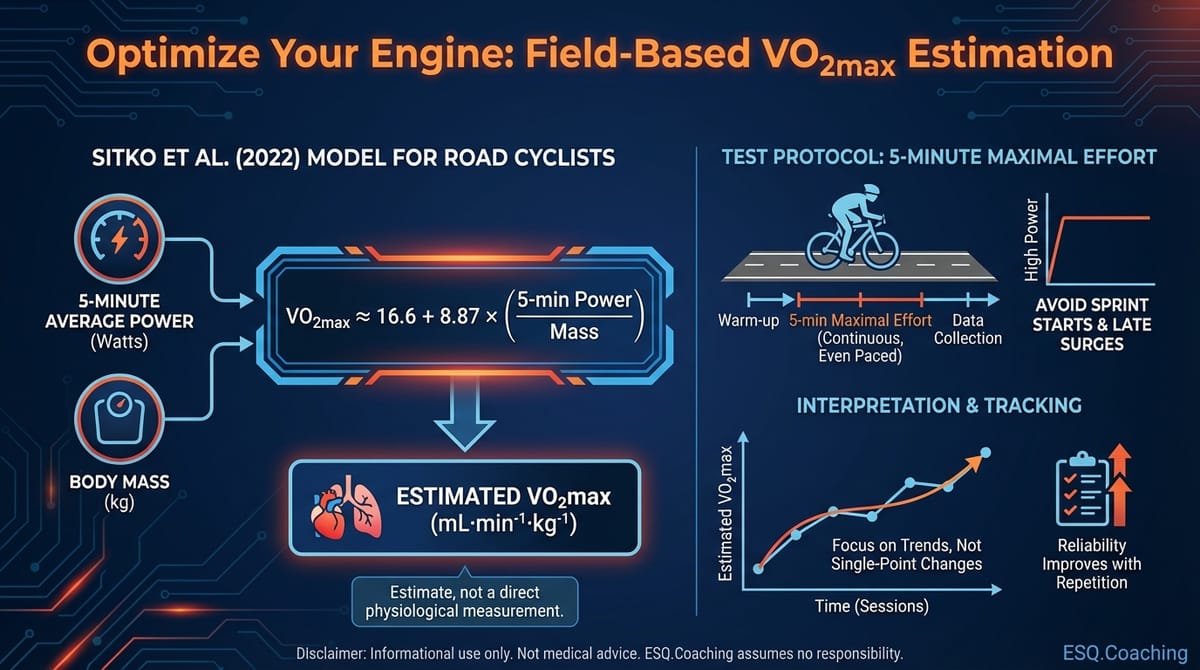
The second tool estimates VO₂max from a single 5 minute all out test, using the Sitko et al. equation derived from lab validated data.
It is a field estimate, not a lab proxy, and it behaves exactly like one.
Clean pacing and repeatability matter more than chasing a big number.
Phase 2A: The Intensity Modulation (For the "Diesel" Phenotype)
- Target: Peripheral Mitochondrial Respiration.
- Protocol: 2x per week High-Intensity Interval Training (HIIT).
- Format: 4 x 4-minute intervals at 90–95% HRmax.
- Mechanism: Targets PGC-1α upregulation to improve oxygen extraction at the muscle level.
Phase 2B: The Volume Injection (For the "Low Responder")
- Target: Angiogenesis and Hemoglobin Mass.
- Protocol: Increase frequency, not intensity.
- Format: Add two 45-minute sessions of Zone 1 (Recovery/Low Aerobic) to the week. Or, extend the long ride by 30%.
- Constraint: Maintain intensity discipline. The goal is mechanical signaling for capillary growth via shear stress, not metabolic acidosis.
Phase 3: Recovery Calibration
- Epigenetic Support: Nutrition modulates gene expression. Ensure high intake of methyl-donor nutrients (folate, B12) and polyphenols to support DNA methylation patterns required for adaptation.
- Sleep Variance: If you carry "stress-sensitive" genetic variants, sleep consistency is more critical for you than for peers. Track HRV; if baseline depresses >7% for 3 days, trigger a recovery week immediately.
Case Study: The "Non-Responder" Breakthrough
Athlete: Mark, 38-year-old cyclist.
Profile: Training 6 hours/week (Time-Crunched plan) for 2 years. VO2max stuck at 48 ml/kg/min.
The Problem: Mark assumed he had reached his "genetic ceiling." He attempted to break through by increasing intensity (more Zwift races), resulting in fatigue and a slight regression in fitness.
The Diagnosis: Mark was not a non-responder; he was a "Volume Responder" forcing an intensity stimulus. His genetic physiology likely required higher duration signaling to trigger VEGF (vascular growth) which short, intense sessions failed to provide.
The Intervention:
- Intensity Reduction: All intensity above VT2 (Threshold) was removed for 8 weeks.
- Volume Redistribution: We aggregated his training. Instead of 1 hour daily, he did 3 hours on Saturday and 3 hours on Sunday, with maintenance rides during the week. Total volume remained similar, but session duration tripled.
The Outcome:
After 8 weeks, Mark’s VO2max climbed to 53 ml/kg/min. The long-duration stimulus triggered distinct angiogenic pathways that the short, intense rides could not, effectively expanding his oxygen delivery infrastructure. This highlights that "noise" in data is often just a misapplied stimulus.
Best regards,
Dr. Thomas Mortelmans
PS: Want to help me improve? Share your anonymous thoughts here. It takes less than a minute, and I read every word.
Long events don’t fail at the start. They fail late.
This 12-week Gran Fondo plan focuses on fatigue resistance, fueling under load, and holding power deep into long efforts. Not peak numbers, but repeatable performance when it counts.
Use this if you want to finish strong instead of just finishing. View Plan here
Disclaimer
The information provided in this newsletter is for educational purposes only and does not constitute medical advice. Exercise physiology is highly individual; what works for elite populations may not apply to everyone. Always consult with a physician before making significant changes to your training, nutrition, or supplementation protocols. The Scientist's Notebook and ESQ Coaching accept no liability for injuries or health issues arising from the application of these concepts.
Annotated References
- Genes to predict VO2max trainability: a systematic review. This review highlights the polygenic nature of fitness, identifying 97 candidate genes while noting that only 13—including ACE and PPARGC1A—have been reproduced across multiple studies. Read Source
- Twin-sibling study and meta-analysis on the heritability of maximal oxygen uptake. A comprehensive meta-analysis estimating that genetic factors account for 59% to 72% of the variation in baseline VO2max, establishing the genetic "starting point." Read Source
- Responders and non-responders to aerobic exercise training: beyond the evaluation of V̇O2max. This study reveals that "non-responders" in VO2max often show robust adaptations in other physiological parameters, such as lactate threshold or movement economy. Read Source
- The Myth of the Non-Responder. An analysis of the Montero/Lundby study demonstrating that increasing training volume eliminates non-responsiveness, shifting the focus from genetics to dosage. Read Source
- Inter-individual variation in adaptations to endurance and resistance exercise training. A review of the HERITAGE data showing that roughly 50% of VO2max trainability is heritable and that maternal inheritance plays a stronger role than expected. Read Source
- Genetic variations in PPARD and PPARGC1A determine mitochondrial function. This paper establishes the mechanistic link between specific genotypes and the efficiency of mitochondrial biogenesis in response to aerobic training. Read Source
- Aerobic training increases mitochondrial respiratory capacity. Research demonstrating that training improves the intrinsic efficiency of mitochondria (respiratory capacity) independent of increases in mitochondrial mass. Read Source
- Refuting the myth of non-response to exercise training. The definitive study showing that non-response is prevalent at 60 minutes/week but non-existent at 180+ minutes/week, confirming dose-dependency. Read Source
- Genomics May Be the Key to Understanding Endurance Training. An overview of how variants in VEGFA (angiogenesis) and NOS3 (vasodilation) interact to determine an athlete's oxygen delivery capacity. Read Source
- Haemoglobin concentration and mass as determinants of exercise performance. This paper quantifies the relationship where a 1g increase in total hemoglobin mass correlates with a ~4 ml/min increase in VO2max. Read Source
- ACTN3 R577X Polymorphism in Power versus Endurance Athletes. A meta-analysis examining the "speed gene," suggesting the XX genotype is favorable for endurance due to muscle fiber type composition, though results vary. Read Source
- VO2max: what do we know, and what do we still need to know? A foundational review discussing the Fick equation and how cardiac output versus oxygen extraction contributes differentially to VO2max limits. Read Source
- Impact of Physical Activity and Exercise on the Epigenome. An exploration of how exercise induces methylation changes in DNA, proving that environmental stimuli can alter gene expression without changing the sequence. Read Source
- The HERITAGE Family Study: A Review of the Effects of Exercise Training. A retrospective on the most significant dataset in exercise genetics, confirming familial clustering of training responses. Read Source
- Epigenetic modulation by lifestyle: diet, exercise, and mindfulness. This article connects nutrition (specifically methyl donors) to the epigenetic regulation of genes involved in metabolic health and training adaptation. Read Source
Disclaimer: The content provided in this newsletter is for informational and educational purposes only and does not constitute medical advice, diagnosis, or treatment. Always seek the advice of a physician or other qualified health provider regarding any medical condition or before beginning any new diet or exercise program. The Scientist’s Notebook and ESQ Coaching accept no liability for any damages or injuries resulting from the use of this information.
Found this useful?
Get articles like this and free training calculators in your inbox every week.
Recommended reads
If this was useful, these are the other research-driven newsletters I actually read.



Member discussion