Entry #036: Nitrate, Bicarbonate, Beta-Alanine: The Big Three, and Where Each One Actually Helps
There is a shelf in my pantry that tells a small, slightly embarrassing story about endurance science. A purple bottle of beetroot concentrate that stains everything it touches.
A tub of white powder that has, on two occasions, made me want to lie down before a session rather than after it.
And a bag of beta-alanine that announces itself, twenty minutes after a scoop, as a hot tingling wave across my scalp and forearms. Three supplements, three completely different sensations, three completely different jobs inside the working muscle.
For years athletes have lumped them together as the legal performance trio, as if they were interchangeable scoops of the same magic. They are not. They share almost nothing except a track record solid enough to survive decades of skeptical meta-analysis.
This entry is about those three: dietary nitrate, usually delivered as beetroot juice, sodium bicarbonate, the humble baking soda, and beta-alanine, the amino acid precursor to muscle carnosine.
The aim is not to sell them but to lay out, as cleanly as the literature allows, what each one does at the level of the muscle cell, which efforts each one tends to help, and how big the help really is.
The honest headline is that the effects are real, modest, and stubbornly individual. They show up reliably in pooled data and then vanish in the next well-trained subject who tries them.
Endurance and high-intensity performance are limited by a small number of recurring bottlenecks. The oxygen cost of holding a pace.
The flood of hydrogen ions that turns a fast effort sour. The slow recovery between repeated maximal bursts.
Each aid leans on exactly one of those bottlenecks and helps little with the others. Nitrate works on the oxygen side. Bicarbonate and beta-alanine both work on acidity, but from opposite sides of the muscle membrane.
Matching the tool to the bottleneck is most of the game.
A companion entry handles caffeine and creatine, along with the question of stacking supplements together. Here the focus stays narrow: three aids, three mechanisms, and the duration windows where the studies say each one earns its place.
The brief
- Three aids, three separate jobs inside the muscle. Nitrate lowers the oxygen cost of effort, while bicarbonate and beta-alanine fight acidity from outside and inside the cell.
- Nitrate is an oxygen-economy tool, not a buffer. Converted to nitric oxide, it improves energy efficiency and blood flow, with the clearest benefit in efforts of roughly ten to forty minutes.
- Bicarbonate raises the buffer in the blood, not the muscle. It pulls hydrogen ions out of working fibers and shines in all-out efforts of about thirty seconds to a few minutes.
- Beta-alanine builds a buffer inside the fiber over weeks. It raises muscle carnosine slowly and helps continuous high-intensity work in the one to four minute range.
- The benefits are modest and average a few percent. Pooled improvements cluster around one to three percent, which matters at an elite start line and is invisible in a casual session.
- The fittest athletes respond least. Highly trained endurance athletes often see nitrate effects shrink toward zero, and a buffering ceiling is plausible for the others.
- Side effects are the real adherence problem. Bicarbonate brings gut distress and beta-alanine brings harmless skin tingling, and neither sensation tracks with how well the supplement works.
- Timing follows the mechanism. Nitrate and bicarbonate are taken hours before an effort, while beta-alanine is a multi-week loading project that acute dosing cannot shortcut.
Gradescale: Your physiology, decoded. Join the waitlist now.
 Thomas Mortelmans
The science at a glance
Foundational Principle 1: Nitrate becomes nitric oxide and makes oxygen go further
Dietary nitrate is an inert anion until the body goes to work on it.
Swallowed in beetroot juice or leafy greens, it is concentrated in saliva, reduced to nitrite by bacteria on the tongue, and then converted in the low-oxygen, slightly acidic environment of working tissue into nitric oxide.
That signaling molecule has two consequences that matter for endurance.
It relaxes blood vessels, nudging more flow toward the fast, glycolytic fibers recruited as intensity climbs. And it appears to improve the efficiency of the mitochondria themselves, raising the usable energy wrung from each unit of oxygen and lowering the oxygen cost of holding a given pace.
The practical signature is slightly less oxygen consumed at the same submaximal workload, which over a long effort is a meaningful saving.
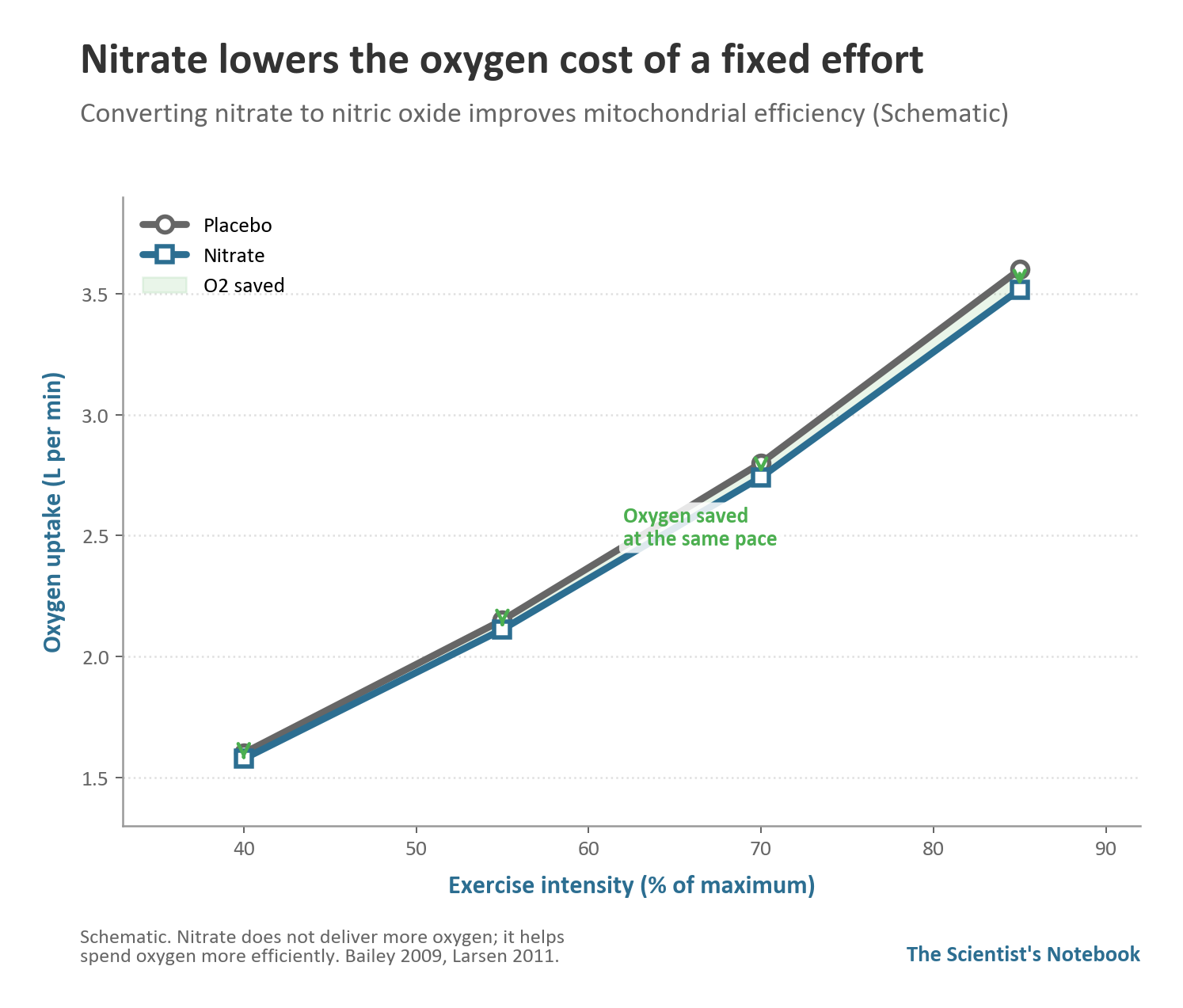
Scientist's Insight: Nitrate does not deliver more oxygen, it helps the body spend the oxygen it already has more cheaply.
Foundational Principle 2: Bicarbonate buffers the blood and drains acid from the cell
A hard, sustained effort floods the muscle with hydrogen ions, the acidic byproduct of breaking down carbohydrate without enough oxygen.
That rising acidity interferes with the enzymes of energy release and the machinery of contraction, and it is the burn every athlete recognizes at the end of a sprint.
Sodium bicarbonate does not enter the muscle cell. Instead it raises the buffering capacity of the blood and the fluid around the fibers, steepening the gradient between the acidic inside of the cell and the more alkaline outside.
That steeper gradient accelerates the transport of hydrogen ions and lactate out of the muscle, delaying the point at which internal acidity becomes limiting. A secondary effect on potassium handling helps preserve the muscle membrane's electrical excitability during intense contraction.
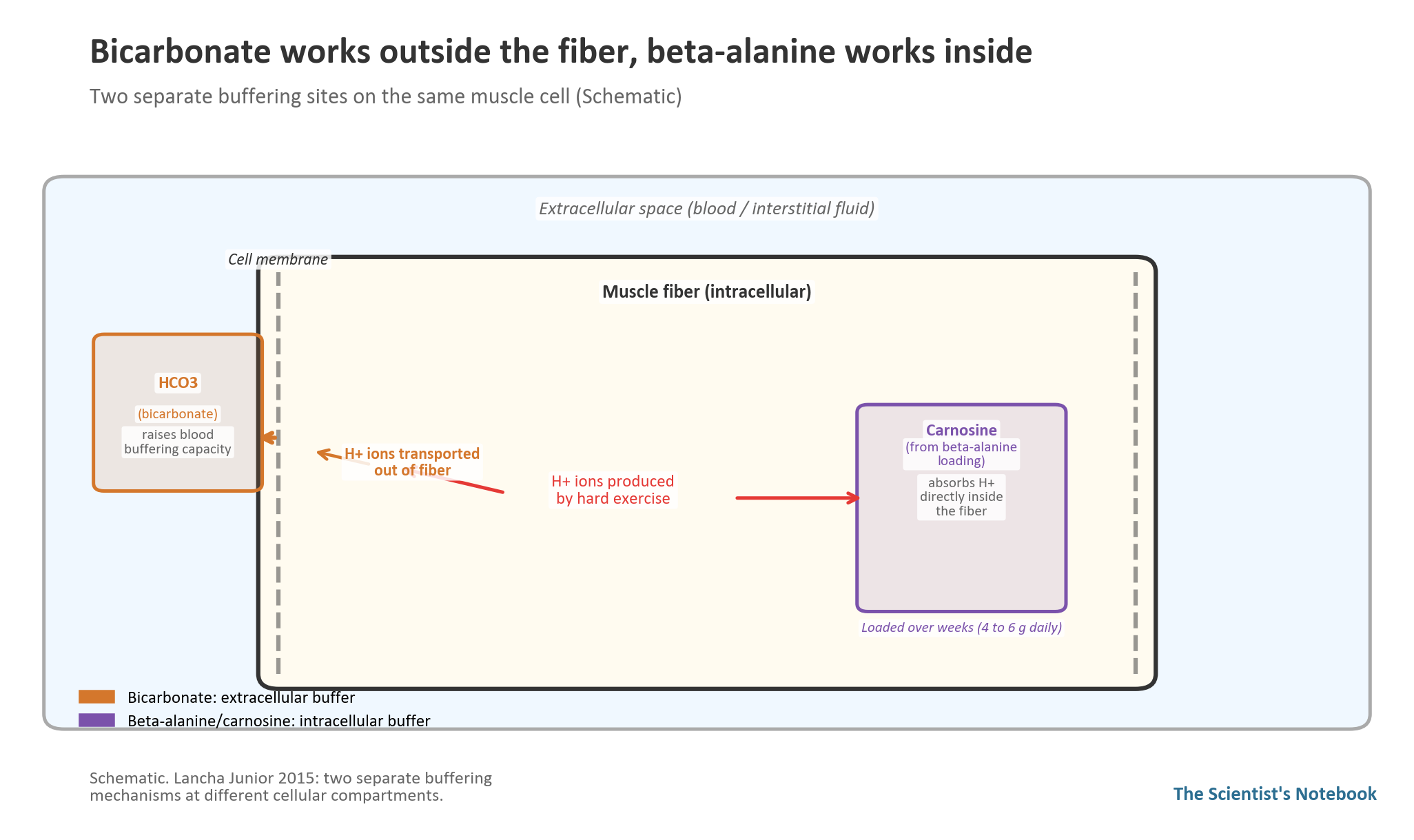
Scientist's Insight: Bicarbonate works entirely from outside the fiber, widening the door through which acid leaves the cell.
Foundational Principle 3: Beta-alanine raises carnosine, the buffer built into the muscle
Beta-alanine takes the opposite approach and acts inside the cell, but it cannot do so quickly. It is the rate-limiting building block for carnosine, a small molecule stored in skeletal muscle that soaks up hydrogen ions directly where they are produced.
The chemistry is elegant: the part of carnosine that grabs protons has its sweet spot near the acidity reached during hard exercise, making it an unusually well-tuned internal sponge. The catch is supply.
Carnosine accumulates slowly, so weeks of daily beta-alanine are needed to raise muscle stores by a fifth to as much as four-fifths. Once elevated, that larger buffer lets the fiber tolerate more acid before contraction falters, which is why the benefit appears in efforts long enough to generate serious acidity but short enough that acidity, not fuel depletion, is the limiting factor.
Scientist's Insight: Carnosine is a buffer that has to be built over weeks, stocked inside the very fibers that will later need it.
Join our Discord community:
 Thomas Mortelmans
Reading the signals
Lever 1: Effort duration decides which aid is even relevant
The data: across pooled analyses the three aids sort neatly by the duration of effort they help.
Nitrate shows its clearest signal in continuous high-intensity work and tolerance tasks, with the largest effects in the window of roughly ten to forty minutes and weaker effects on tightly paced time trials.
Bicarbonate concentrates its benefit in all-out efforts of about thirty seconds to a few minutes, the strongest trials clustered under four minutes in swimming, middle-distance running, and short-track cycling. Beta-alanine improves continuous exercise of roughly one to four minutes and retains some benefit beyond that, while showing no advantage under a minute, where the phosphate energy system rather than acidity dictates fatigue.
It also shows no clear benefit for repeated-sprint formats, where recovery depends on phosphate resynthesis rather than acid handling.
Where athletes tend to land: the responding events map onto these windows with some consistency.
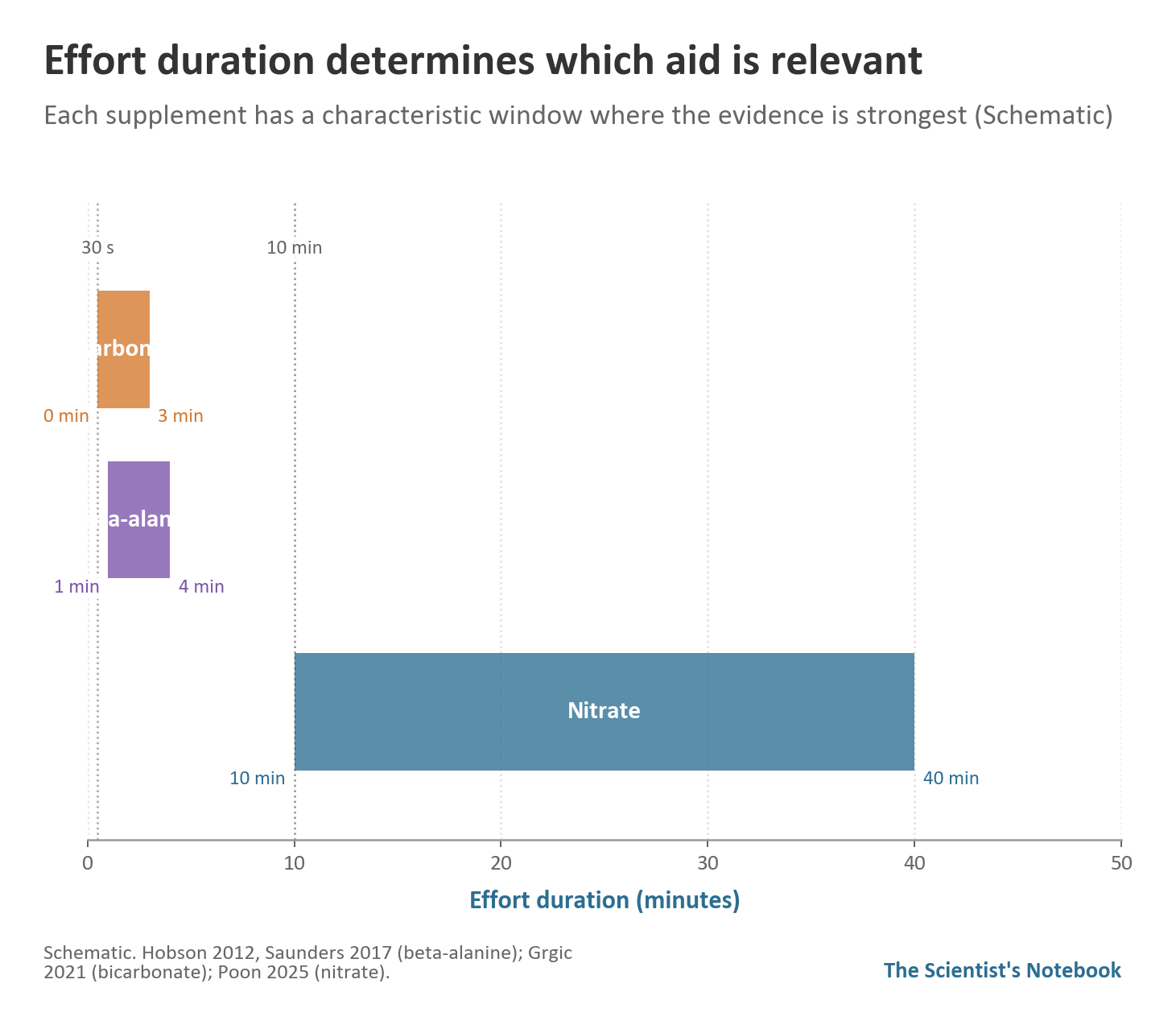
Middle-distance and short endurance specialists populate the bicarbonate and beta-alanine literature, while runners and cyclists in the ten to forty minute range populate the nitrate trials. Athletes whose events fall under thirty seconds appear with little to gain from any of the three.
Lever 2: Training status shrinks the effect, and elite athletes feel it most
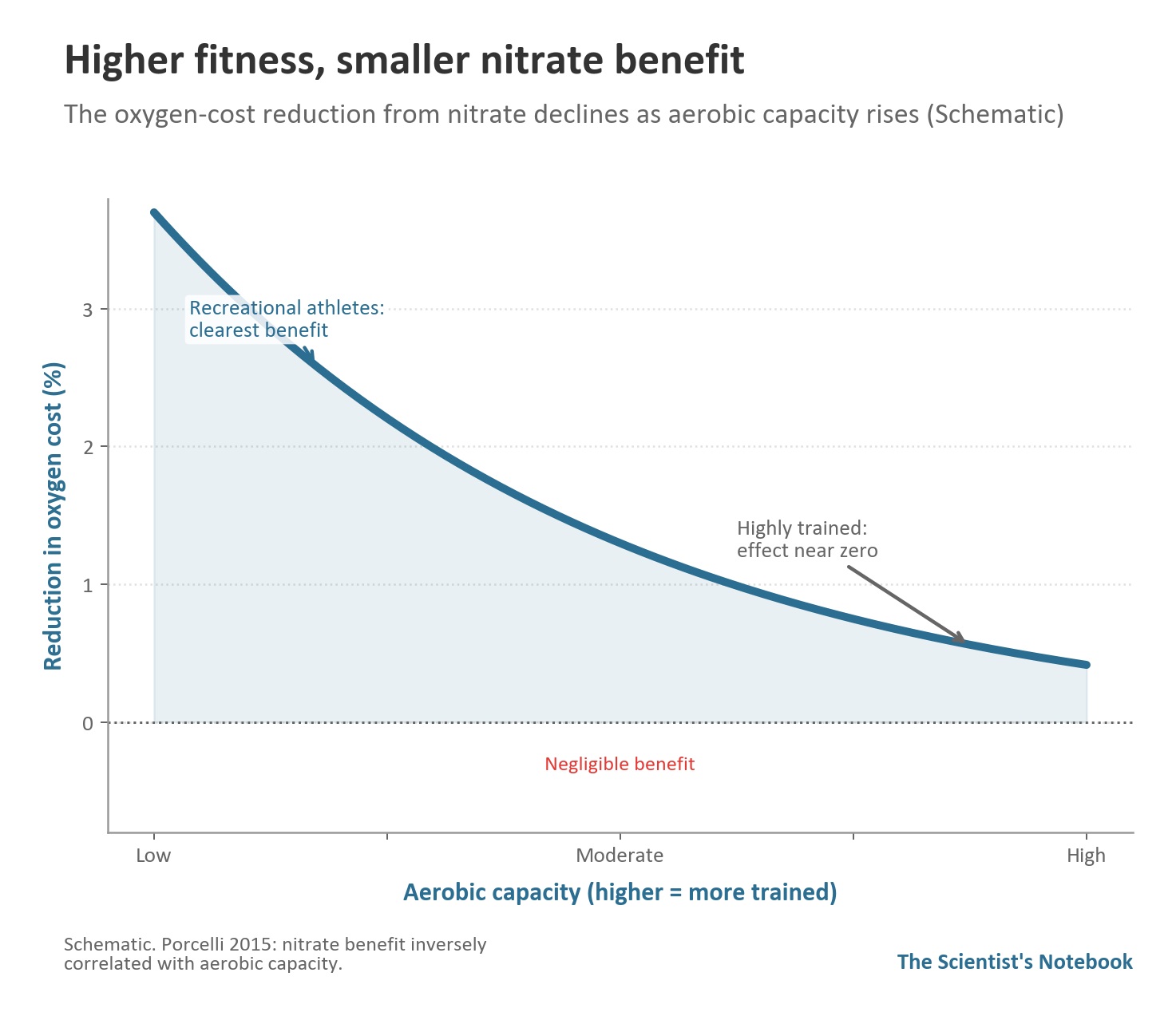
The data: responsiveness falls as fitness rises, best documented for nitrate. Across a wide range of aerobic capacity, the reduction in oxygen cost and the performance gain both correlate inversely with fitness, and in the most gifted subjects the effect drifts toward negligible.
Highly trained athletes show a smaller rise in circulating nitrite after the same dose, and their already-optimized oxygen delivery leaves less room to improve. For beta-alanine the picture is softer, with benefits across trained and untrained groups, but a ceiling in well-conditioned athletes remains plausible.
Bicarbonate has been studied less systematically across training levels, though its effect appears in both.
Where athletes tend to land: recreational and moderately trained participants account for much of the positive signal, while elite cohorts contribute many of the null results. The athletes most motivated to chase a final fraction of a percent are often the ones for whom the standard protocols deliver the least.
Lever 3: Dose, timing, and tolerance shape whether the effect survives contact with reality
The data: each aid carries a characteristic protocol and cost.
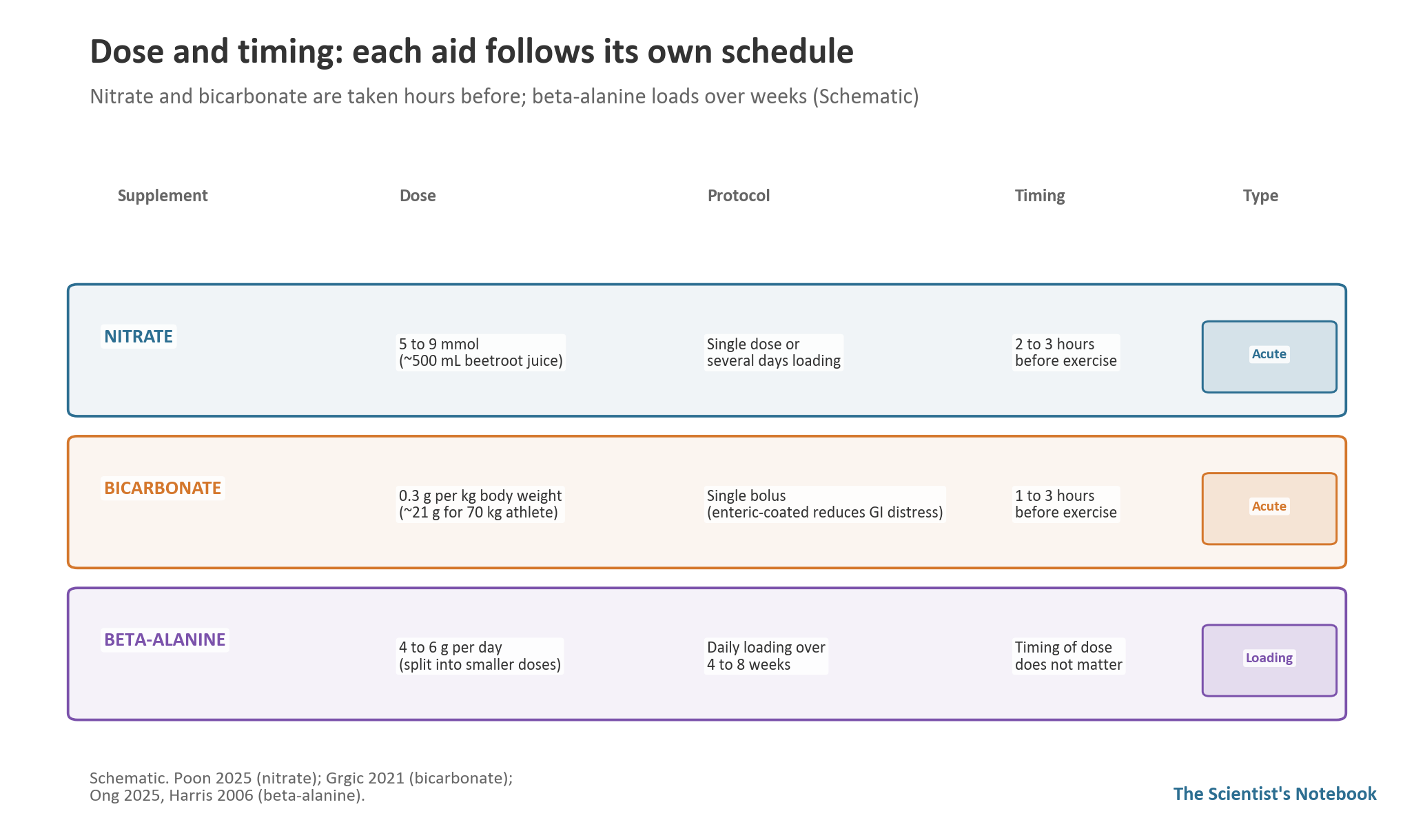
Nitrate effects appear with single doses of roughly five to nine millimoles taken two to three hours before exercise, or with several days of daily loading, with little added benefit from larger doses and a blunted response when habitual vegetable intake is already high.
Bicarbonate clusters around a single dose near three-tenths of a gram per kilogram of body mass taken one to three hours ahead, with higher doses adding gastrointestinal misery rather than performance. Beta-alanine depends on cumulative intake of about four to six grams daily over several weeks, and fragmented dosing across the day raises muscle carnosine more effectively while reducing the tingling.
The acute aids bring real tolerance issues: bicarbonate frequently causes nausea and bloating, partly mitigated by enteric-coated forms, and beta-alanine causes a harmless skin tingle that does not track with effectiveness.
Where athletes tend to land: participants who tolerate bicarbonate and time it well capture the documented gains, while those who experience gut distress often see the benefit erased by the discomfort. Beta-alanine users who split doses and persist for weeks reach the carnosine levels associated with effect, whereas short or consolidated regimens tend to fall short.
Method and a worked example
Most of the controlled studies behind these three aids share a recognizable skeleton, whether the supplement is taken once or loaded for weeks.
Method
- Screen and baseline each participant, recording aerobic capacity, training status, and habitual diet, since all three moderate the response, then set a placebo-controlled benchmark on the target task.
- Assign the supplement and a taste-matched placebo in a double-blind crossover, so each participant serves as their own control and order effects balance across the group.
- Apply the protocol that matches the aid: an acute bolus hours before testing for nitrate and bicarbonate, or a multi-week daily loading block for beta-alanine, with washout long enough to clear carryover.
- Verify that the mechanism actually moved, measuring plasma nitrite for nitrate, blood bicarbonate and pH for bicarbonate, or muscle carnosine for beta-alanine, rather than assuming the dose did its job.
- Retest under each condition and compare, reporting both the average change and the spread, because the individual variation is often as informative as the mean.
The plans you find here are built on a simple truth: Adaptation only happens when you apply the right stress, at the right time, in the right dose.
 Thomas Mortelmans
A composite case
Consider a generic middle-distance runner, unnamed and assembled from the pattern these studies show, who works through the trio across a season.
The first attempt is bicarbonate before a hard track session, and it goes badly: the dose sits heavy, the stomach rebels mid-warmup, and the session is worse than baseline. An early dip, easy to misread as proof the supplement is useless.
The second block is beta-alanine, loaded daily for weeks. Nothing happens for a long time except the tingling.
Around the midpoint a minor illness interrupts training, and the early test sessions show no clear gain.
It would be reasonable to conclude the carnosine project failed. But the mechanism was still filling in the background, slowly, the way it does.
The payoff arrives late and quietly. By the end of loading the runner holds a hard ninety-second to three-minute effort with a little more composure before the burn takes over.
The bicarbonate, retried enteric-coated and timed earlier, finally sits well and adds its small margin on race-pace intervals. Nitrate, added for the longer tempo efforts, produces the least dramatic sensation and possibly the most consistent benefit.
No single moment of transformation, just three modest, delayed, mechanism-specific nudges that only made sense once the early dip and the setback were seen as noise rather than verdict.
Where this leaves us
The most useful way to hold these three aids is as three different answers to three different questions. If the limiting problem is the oxygen cost of a long, hard effort, nitrate is the relevant lever.
If it is the acid burn of a single all-out burst lasting up to a few minutes, bicarbonate addresses it from the blood side and beta-alanine from inside the fiber, on completely different timelines.
Knowing which bottleneck is actually limiting an effort does more than any dosing chart, because an aid aimed at the wrong bottleneck does nothing no matter how perfectly it is taken.
The second thing worth holding onto is the size of the prize.
These are not transformative interventions. The pooled effects sit in the low single digits of percent, the difference between a podium and fourth place at the sharp end of sport and undetectable in everyday training.
That smallness is why the individual variation matters so much. A few percent on average can hide a meaningful gain in one person, nothing in the next, and a shrunken response in the fittest athletes who already do most of what these aids attempt.
Finally, the sensations these supplements produce are poor guides to their effects. The gut distress of bicarbonate and the skin tingling of beta-alanine are real and sometimes limiting, but neither signals that the supplement is working, and the absence of either does not signal failure.
The mechanism that matters happens quietly, in plasma nitrite, in blood pH, in muscle carnosine, well out of reach of how it feels.
Best regards,
Dr. Thomas Mortelmans
Limits of Application: The studies behind this entry skew toward young, healthy, often male and frequently recreational participants tested in laboratories, so the numbers travel imperfectly to women, masters athletes, and elite competitors, in whom several of these effects shrink.
Responses are moderated by training status, habitual diet, and individual physiology in ways group averages conceal, and supplement quality and dosing accuracy vary in the real world.
None of this is medical or coaching advice, supplements carry their own regulatory and contamination risks, and decisions about using them belong with a qualified professional who knows the individual athlete.
References
- Poon ET, et al. Dietary Nitrate Supplementation and Exercise Performance: An Umbrella Review of 20 Published Systematic Reviews with Meta-analyses. Sports Med. 2025. PMID 40085422. Pooling 180 studies, nitrate helped time-to-exhaustion, distance, and power output but had weaker effects on time trials, with chronic loading at six millimoles or more per day working best.
- Larsen FJ, et al. Dietary inorganic nitrate improves mitochondrial efficiency in humans. Cell Metab. 2011. PMID 21284982. Nitrate supplementation raised the efficiency of skeletal muscle mitochondria, and that improvement tracked the reduction in oxygen cost during exercise.
- Bailey SJ, et al. Dietary nitrate supplementation reduces the O2 cost of low-intensity exercise and enhances tolerance to high-intensity exercise in humans. J Appl Physiol (1985). 2009. PMID 19661447. Six days of beetroot juice lowered the oxygen cost of submaximal cycling and extended time to exhaustion in a hard effort.
- Porcelli S, et al. Aerobic Fitness Affects the Exercise Performance Responses to Nitrate Supplementation. Med Sci Sports Exerc. 2015. PMID 25412295. The fitter the athlete, the smaller the nitrate benefit, with the most aerobically capable subjects showing little change in oxygen cost or time-trial performance.
- Ferguson SK, et al. Microvascular oxygen pressures in muscles comprised of different fiber types: Impact of dietary nitrate supplementation. Nitric Oxide. 2014. PMID 25280991. Nitrate preferentially improved oxygen delivery to fast, glycolytic muscle, offering a mechanism for its benefit during higher-intensity exercise.
- Tian C, et al. Effects of Beetroot Juice on Physical Performance in Professional Athletes and Healthy Individuals: An Umbrella Review. Nutrients. 2025. PMID 40573069. Beetroot juice produced small population-specific effects, improving aerobic endurance more in non-athletes and strength more in professionals, with mostly negligible effect sizes.
- Grgic J, et al. International Society of Sports Nutrition position stand: sodium bicarbonate and exercise performance. J Int Soc Sports Nutr. 2021. PMID 34503527. The position stand places the ergogenic window of bicarbonate at high-intensity efforts of thirty seconds to twelve minutes, with three-tenths of a gram per kilogram the optimal single dose.
- Lancha Junior AH, et al. Nutritional Strategies to Modulate Intracellular and Extracellular Buffering Capacity During High-Intensity Exercise. Sports Med. 2015. PMID 26553493. A review contrasting beta-alanine as an intracellular buffer with bicarbonate as an extracellular one, noting their separate mechanisms and side effects.
- Hilton NP, et al. Enteric-Coated Sodium Bicarbonate Attenuates Gastrointestinal Side-Effects. Int J Sport Nutr Exerc Metab. 2020. PMID 31751936. Enteric-coated capsules reduced the gastrointestinal symptoms that often accompany bicarbonate loading, making the supplement more tolerable.
- Mundel T. Sodium bicarbonate ingestion improves repeated high-intensity cycling performance in the heat. Temperature (Austin). 2018. PMID 30574526. In hot conditions, bicarbonate preserved peak power across repeated maximal sprints, sustaining work output compared with placebo.
- Hobson RM, et al. Effects of beta-alanine supplementation on exercise performance: a meta-analysis. Amino Acids. 2012. PMID 22270875. Beta-alanine improved efforts of sixty to two hundred forty seconds and longer, with no benefit under sixty seconds and a median improvement near three percent.
- Saunders B, et al. Beta-alanine supplementation to improve exercise capacity and performance: a systematic review and meta-analysis. Br J Sports Med. 2017. PMID 27797728. Across forty studies, exercise duration was the key moderator, with the strongest effects in tasks of roughly half a minute to ten minutes.
- Harris RC, et al. The absorption of orally supplied beta-alanine and its effect on muscle carnosine synthesis in human vastus lateralis. Amino Acids. 2006. PMID 16554972. Several weeks of daily beta-alanine raised muscle carnosine substantially, establishing the slow loading kinetics behind the supplement.
- Ong SW, et al. Dosing strategies for beta-alanine supplementation in strength and power performance: a systematic review. J Int Soc Sports Nutr. 2025. PMID 40995761. Fragmented daily doses of four to six grams over five to eight weeks were more likely to improve strength and power than large single servings.
- Liang W, et al. No ergogenic effect of beta-alanine on repeated sprint ability: a systematic review and multilevel meta-analysis of randomized controlled trials. Front Nutr. 2026. PMID 41971372. Across seventeen trials, beta-alanine did not improve repeated-sprint performance, because recovery there depends on phosphate resynthesis rather than acid buffering.
---
If you have 60 seconds, I would value your anonymous feedback. You can share it here.
---
Health disclaimer
This post discusses endurance-training science for educational purposes. It is not medical advice, not a diagnosis, and not a substitute for clinical care. Individual response to training, sleep deprivation, and multi-day exertion varies substantially, and what applies to a research cohort or a world-class athlete may not apply to you. Consult a qualified physician, sports medicine specialist, or registered dietitian before changing your training, fuelling, or sleep strategy if you have a cardiovascular, metabolic, psychiatric, or sleep-related condition; are recovering from injury or illness; are pregnant; are on medication that affects heart rate, hydration, glucose regulation, or sleep; or have concerns about exercise tolerance. Ultra-endurance events impose real physiological and psychological loads. Persistent chest pain, fainting, acute confusion beyond the predictable late-race window, severe dehydration, sustained loss of coordination, or any mental-health symptoms that outlast the immediate post-event dip warrant professional care and are not signals to push through. No outcome is guaranteed. The protocols, anchors, and case material in this post are descriptive, drawn from peer-reviewed evidence and a guest contributor's lived experience, and should be treated as inputs to an informed conversation with your own coach and clinicians, not as prescriptions.
Found this useful?
Get articles like this and free training calculators in your inbox every week.
Recommended reads
If this was useful, these are the other research-driven newsletters I actually read.



Member discussion