Entry #033: The Hot Room as Recovery: What Sauna Does for the Tired Body
There is a particular kind of evening that endurance athletes know well. The hard session is done, the legs are heavy, and the body has shifted into a wired fatigue where rest feels both desperately wanted and out of reach.
The heart still sits a little high, the mind will not settle, and sleep, when it comes, is shallow.
Into this state the sauna offers something embarrassingly simple. You sit in a hot wooden room, sweat for a quarter of an hour, and a strange calm descends.
The pulse slows, the shoulders drop, and the night that follows is often deeper than it had any right to be.
The question is not whether heat feels good, which is obvious, but what heat actually does to a recovering body, and how much of the surrounding enthusiasm survives a careful reading of the evidence. The honest answer is mixed.
The short term recovery story rests mostly on small studies and plausible physiology.
The long term health story rests on some of the largest and most striking observational data in the field, data that is at once impressive and impossible to take fully at face value.
This piece sits beside two siblings and stays out of their territory.
Heat used as a deliberate training stimulus, the kind that reshapes blood volume and may or may not transfer to cool weather racing, is covered separately, as is the narrow story of how repeated heat expands blood plasma.
The focus here is recovery and health.
How a sauna shifts the nervous system back toward rest, what the cell does when it is heated, why frequent users appear to live longer and stay sharper, how the dry Finnish room compares with steam, infrared, and a hot bath, and where the real risks sit.
The goal is to describe the landscape as it is, bright patches and fog alike, and to resist flattening a complicated picture into a tidy prescription.
The brief
- Heat shifts the nervous system back toward rest, but only after you cool down. During the session the heart races and the sympathetic side dominates, while the cool down that follows is when parasympathetic activity rebounds and the calm arrives.
- The clearest recovery signals are perceptual and sleep related. Athletes report feeling more recovered and less sore, and a session can deepen early sleep, even when objective performance markers do not always agree.
- Heat is a cellular stressor that triggers a protective repair response. Elevated tissue temperature switches on heat shock proteins and nitric oxide signaling, a hormetic pattern where a controlled small stress provokes adaptations that protect against larger ones.
- The long term health associations are large, consistent, and observational. Frequent users in long Finnish cohorts show much lower cardiovascular and all cause mortality, lower dementia incidence, and fewer respiratory diagnoses, with a clear dose response.
- Observational does not mean causal. People who sauna four to seven times weekly differ from those who rarely do in income, leisure, fitness, and social ties, and statistical adjustment never fully removes that shadow.
- Heat modalities are not interchangeable. A hot bath raises core temperature and cardiac output the most, the dry Finnish sauna sits in the middle, and infrared runs the mildest, reshaping who each suits and when.
- Timing matters for athletes near competition. A hot traditional sauna right after hard training has blunted next day performance in some athletes, while the gentler infrared modality tends not to carry that cost.
- The genuine risks are dehydration and cardiovascular strain. Substantial fluid loss, the danger of mixing heat with alcohol, and real contraindications in unstable heart disease keep this a powerful stimulus, not a free lunch.
The plans you find here are built on a simple truth: Adaptation only happens when you apply the right stress, at the right time, in the right dose.
 Thomas Mortelmans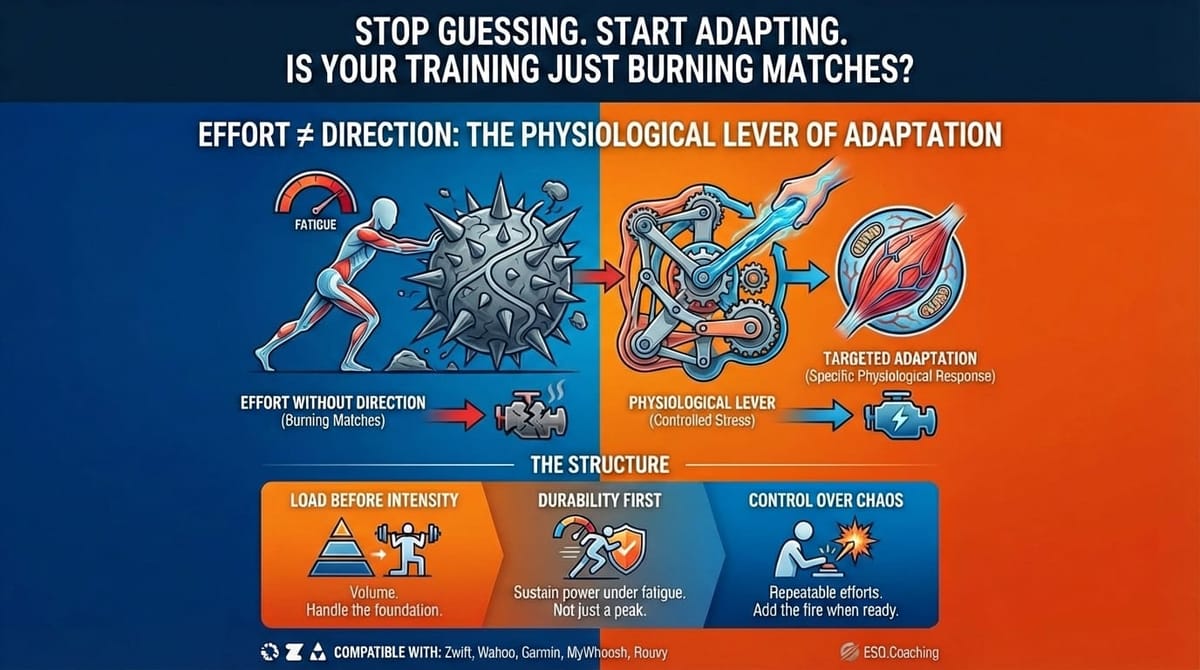
The science at a glance
Foundational Principle 1: Recovery is the swing back toward the parasympathetic, and the cool down owns it
The nervous system has two broad gears. One mobilizes the body for effort, raising heart rate and tensing the system for action.
The other governs rest and repair, the gear a tired athlete needs to find.
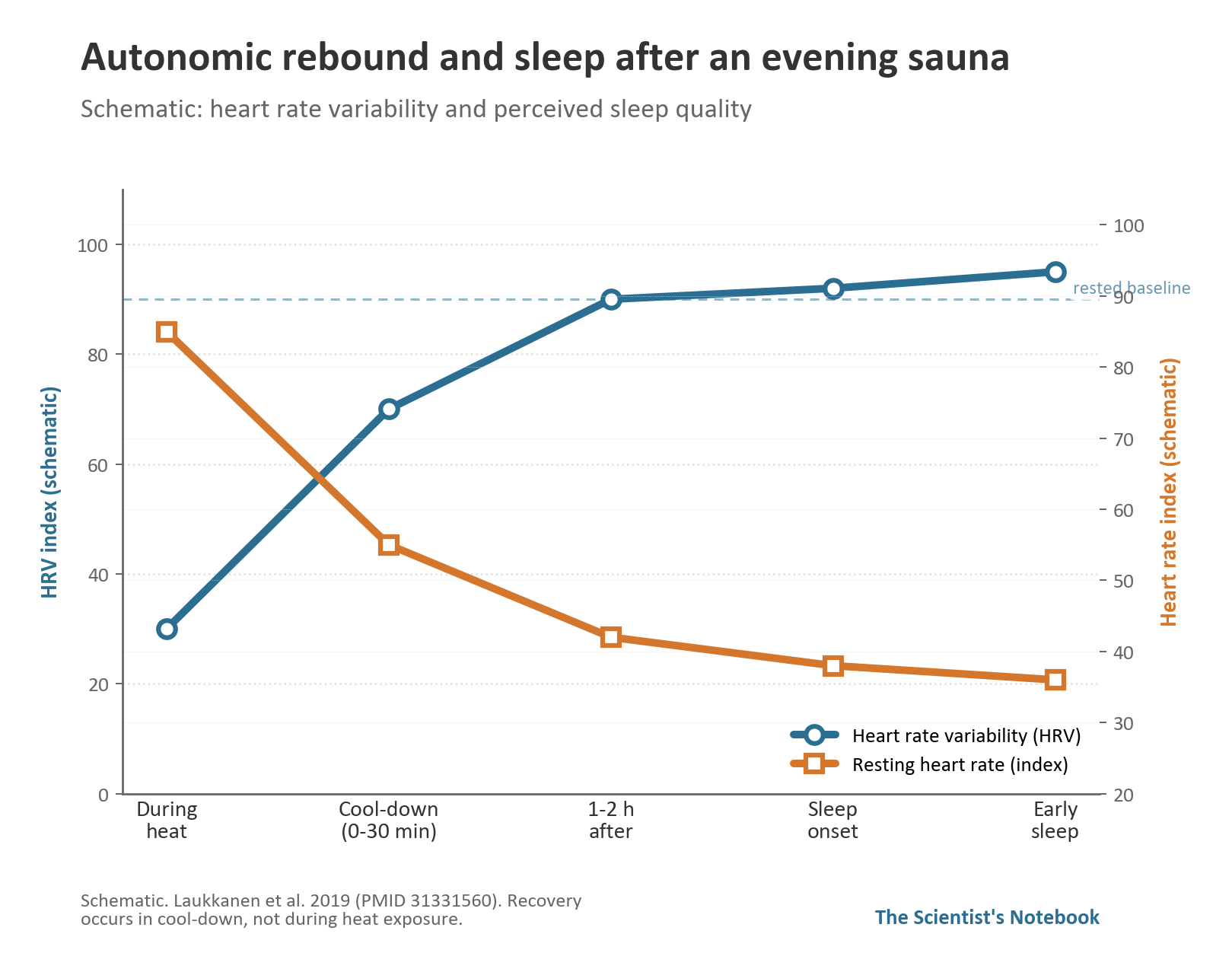
A sauna does something counterintuitive. While the body sits in the heat, the stressful gear is firmly engaged, the heart rate climbs steeply, and the markers of restful vagal control are suppressed. The recovery does not happen in the heat.
It happens in the minutes after, during the cool down, when heart rate variability rebounds, the restful branch reasserts itself, and resting heart rate settles lower than before.
This is why a sauna feels like agitation followed by release, a deliberate stress that buys a deeper rebound on the far side.
Scientist's Insight: The sauna does not relax you while you are in it, it sharpens the contrast that lets the nervous system rebound once you step out.
Foundational Principle 2: Heat is a cellular alarm that calls in the repair crew
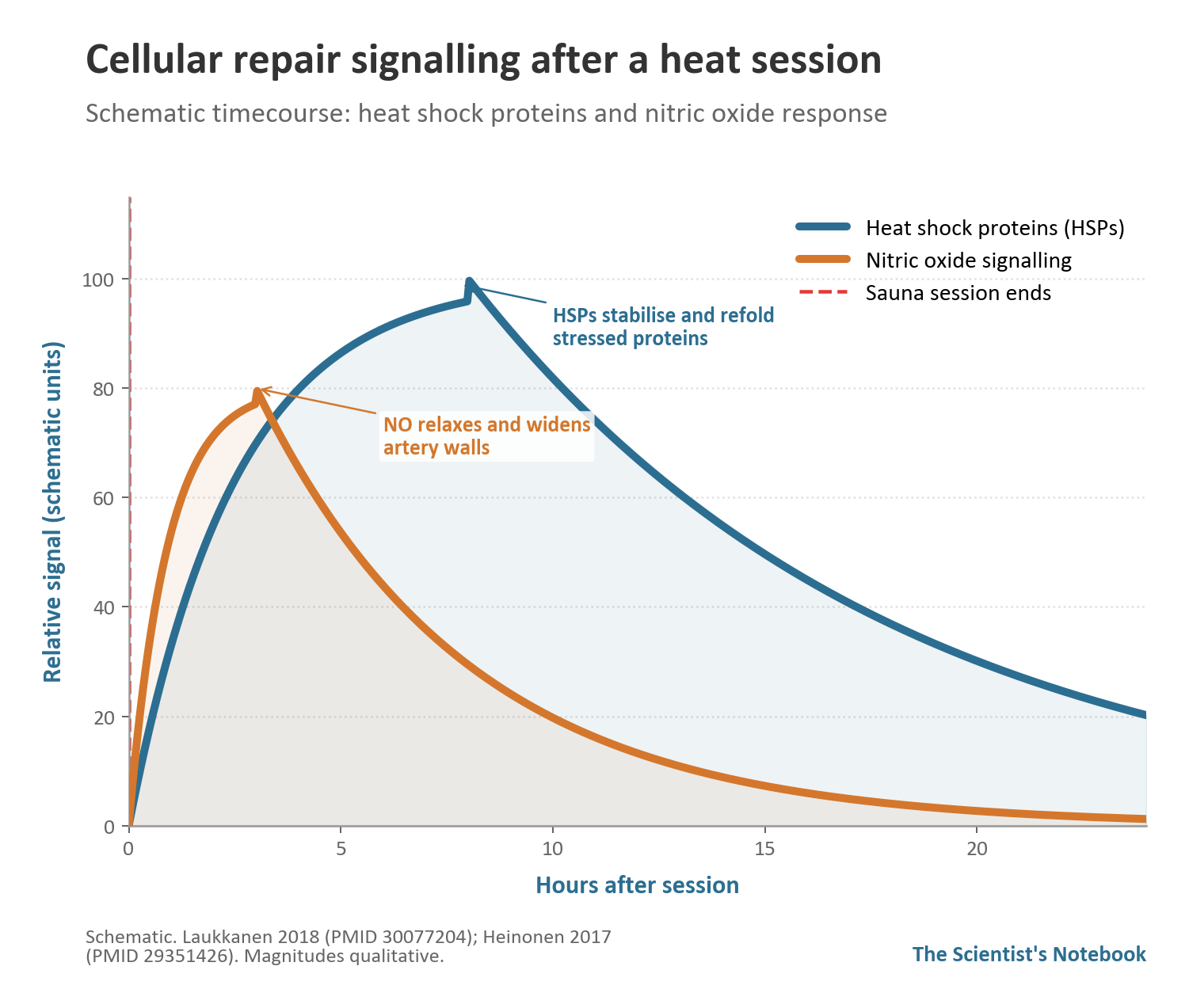
Raising tissue temperature is not a passive event for a cell. Beyond a threshold it threatens the folded shape of proteins, and the cell responds by manufacturing molecular chaperones known as heat shock proteins, which stabilize and refold stressed proteins and keep them from clumping.
The same heat raises the shearing force of blood against vessel walls, prompting their lining to release nitric oxide, the molecule that relaxes and widens arteries and keeps the endothelium healthy.
This is the molecular heart of the idea that heat is hormetic. A controlled, survivable dose of thermal stress provokes a protective response that leaves the system more resilient, the same logic by which exercise works, plausibly linking a single session to both the sense of repair and the longer arc of vascular protection.
Scientist's Insight: The cell treats heat as a manageable threat, and the repair machinery it summons is much of why heat resembles a medicine rather than a comfort.
Foundational Principle 3: The dose lives in the core, not in the room
A thermometer on the wall describes the environment, not the stimulus. What the body adapts to is the rise in its own core temperature and the cardiovascular work of defending it.
This explains why modalities that advertise wildly different wall temperatures can produce overlapping or surprisingly divergent internal effects.
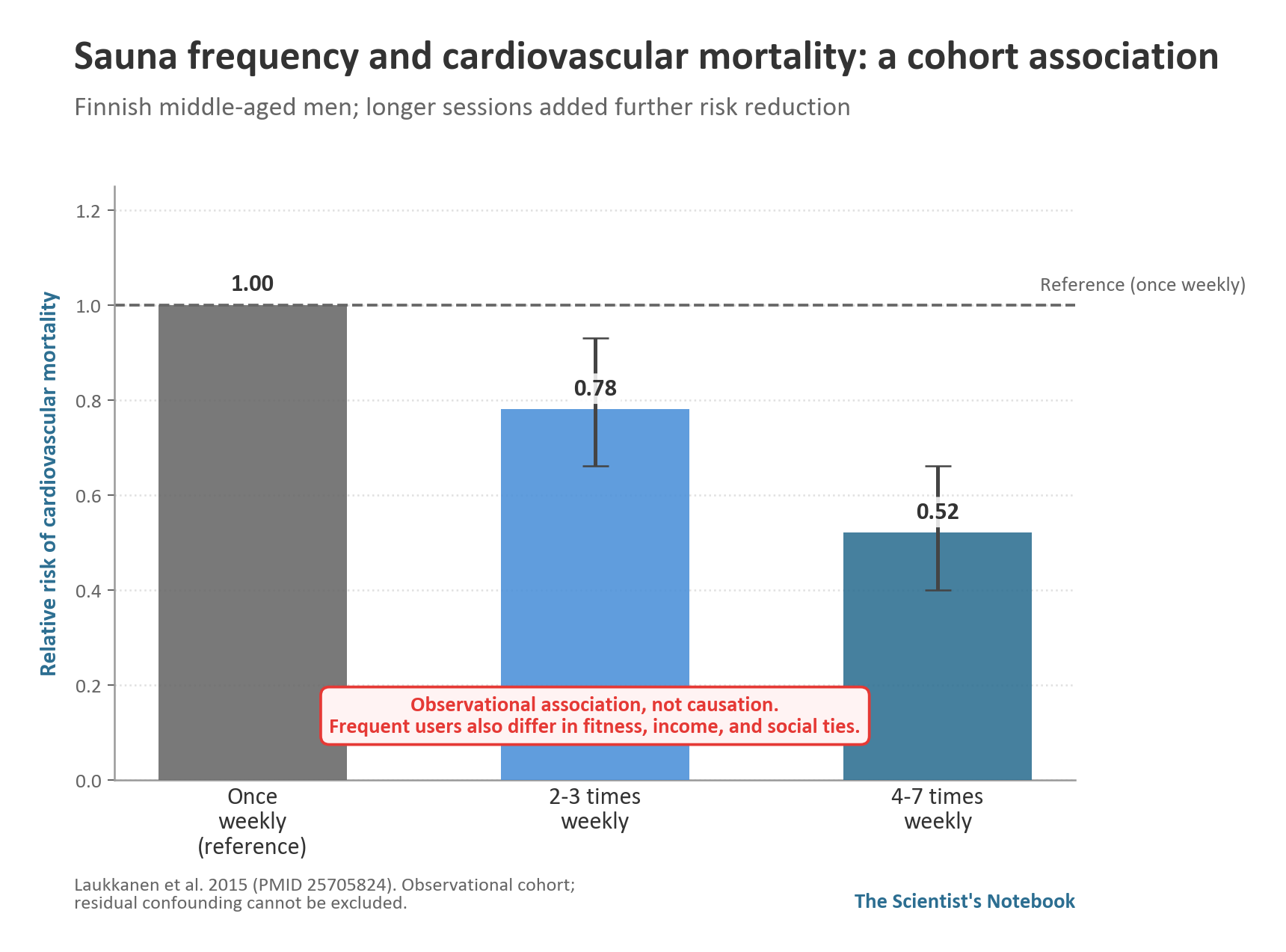
A bath at a modest number of degrees can drive core temperature up faster than a dry room at a far higher reading, because water carries heat into the body far more efficiently than hot air.
The internal dose, the climb in core temperature and the cardiac output recruited to handle it, is the currency that matters. Reading benefit off the room temperature alone is a common and misleading habit.
Scientist's Insight: The body cannot read the wall thermometer, it only knows how hot its core became and how hard the heart worked to manage it.
Gradescale: Your physiology, decoded. Join the waitlist now.
 Thomas Mortelmans
Reading the signals
Lever 1: Heat modality and the internal dose it delivers
The data: A controlled comparison of three common modalities in healthy adults measured how each raised core temperature and cardiac output in normal use. Hot water immersion produced the largest rise in core temperature, around one degree, and the largest increase in cardiac output.
The traditional dry sauna sat in the middle. Far infrared, run at its lower temperatures, produced the smallest response, with a negligible change in core temperature and the gentlest cardiovascular load, and was the only one that did not provoke a measurable immune response.
The dry Finnish sauna, with its high air temperatures and low humidity, carries by far the deepest research base, while steam rooms and infrared cabins remain understudied.
Where athletes tend to land: Those chasing the strongest thermal stimulus gravitate toward the hot bath or traditional sauna, while individuals with heat intolerance or respiratory sensitivity cluster around infrared, which tolerates longer, milder exposures.
Lever 2: Timing relative to hard training and competition
The data: The same heat that aids recovery is itself a stress, and stacking it onto prior training can backfire when peak performance is imminent.
Competitive swimmers who took a hot traditional sauna immediately after an intense session performed measurably worse in an all out swim test the next morning than after a placebo, and felt more stressed. Infrared tells a softer story.
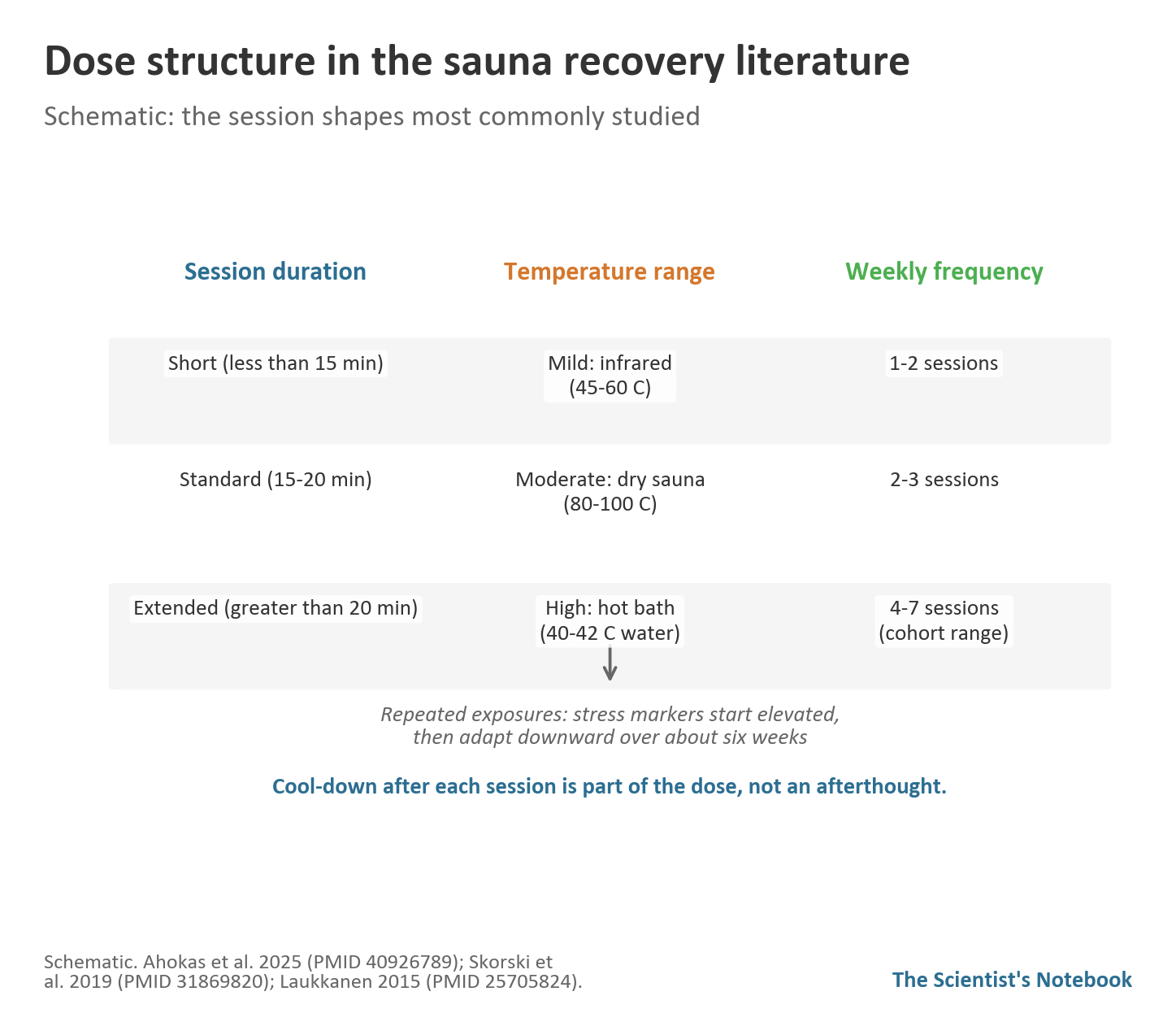
Team sport athletes using post exercise infrared over several weeks showed attenuated soreness and preserved or improved power without that next day penalty, alongside a stress response that started elevated and adapted downward over six weeks.
Where athletes tend to land: Those with competition or hard sessions inside a day tend toward lighter infrared or skip heat entirely, while those in a recovery window with no imminent demand reach for the deeper traditional heat.
Lever 3: How much weight the long term health data can bear
The data: The headline associations are genuinely large.
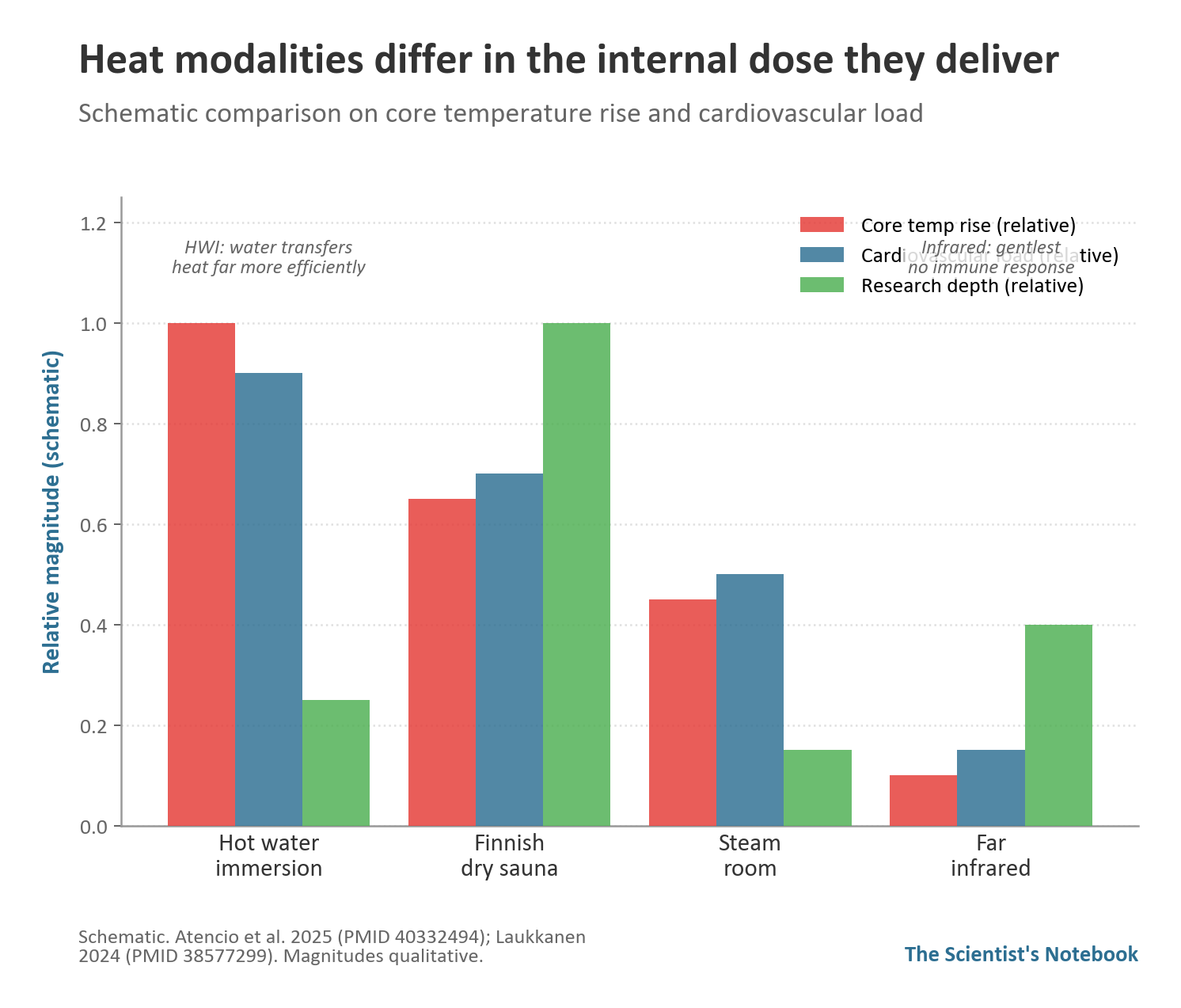
In a long Finnish cohort of middle aged men, those who used the sauna four to seven times weekly had roughly half the cardiovascular and sudden cardiac death rate of once weekly users, with longer sessions adding further risk reduction, and the same cohort showed lower dementia incidence and fewer respiratory diagnoses, all dose dependent.
Yet every finding is observational. Frequent users differ systematically from infrequent users in fitness, affluence, leisure time, and social ties, and while the analyses adjust for many such factors, residual confounding cannot be excluded.
The smaller pool of randomized work, such as trials combining sauna with exercise, supports favorable changes in blood pressure and fitness but cannot reproduce the dramatic mortality numbers.
Where athletes tend to land: Some treat the cohort findings as strong encouragement to make heat a habit, while more cautious readers hold the mortality figures at arm's length and lean on the smaller controlled evidence for what heat can be said to cause.
Method and a worked example
The recovery and health literature is built from a handful of recurring study shapes, and seeing them clarifies what the evidence can say.
Method
- Establish a baseline by recording resting and post exercise heart rate, heart rate variability, perceived recovery and soreness, and where relevant a performance test, so any later shift traces to the heat rather than fitness drift.
- Apply the heat as a defined dose, a fixed number of minutes at a set modality and temperature, often immediately after training, while tracking the internal load through core temperature and fluid loss.
- Capture the rebound by measuring heart rate variability and resting heart rate through the cool down and into the following night, since the parasympathetic recovery emerges after the session rather than during it.
- Repeat the exposure across days or weeks to separate a one off response from an adaptation, watching for stress markers that start elevated and then normalize as the body adapts.
- For the health associations, abandon the trial and follow a large population for decades, recording sauna habits at the outset and counting disease and death, accepting confounding for the scale needed to see rare outcomes.
Join our Discord community:
 Thomas Mortelmans
A composite case
Consider a generic masters runner in a heavy training block, drawn from no single study. She adds a fifteen minute sauna sit after her two hardest sessions each week.
The first week is unconvincing. The heat feels like one more thing to endure on tired legs, her heart pounds in the room, and she sleeps no better.
Privately she suspects the whole thing is wellness theater.
The shift, when it comes, is quiet. Around the third week she notices that the hour after the sauna has a particular stillness, her resting pulse sitting lower in the evening, and the first stretch of her sleep feeling more solid.
Encouraged, she overreaches, sitting too long on a day she was already dehydrated from a long run, and leaves lightheaded and faintly nauseated, a setback that teaches her the fluid cost is real.
She scales back, drinks deliberately before and after, and settles into a rhythm.
The payoff is modest and delayed rather than dramatic. Her power numbers do not leap, and she cannot honestly say the sauna made her faster.
What she can say is that the heavy block felt more survivable, that she recovered with a little more ease, and that she slept better through the hardest weeks. That is the realistic shape of the recovery story, an accumulation of small margins rather than one decisive effect, easier to feel than to measure.
Where this leaves us
Sauna for recovery occupies an unusual position in the evidence.
The short term effects are real but gentle, expressed most clearly in how the nervous system rebounds during the cool down, in deeper early sleep, and in the simple fact that athletes feel more recovered, with the harder performance markers offering quieter support.
The cellular story, heat shock proteins and nitric oxide answering a controlled thermal stress, gives that felt benefit a plausible mechanism and links it to the longer arc of vascular health.
The long term health associations are where the topic becomes both striking and treacherous. The mortality and dementia numbers from the large Finnish cohorts are among the most arresting in lifestyle medicine, and they are also observational, shadowed by the truth that the person who saunas often differs in many ways from the person who rarely does.
The mechanism is believable and the dose response is suggestive, but suggestive is not proven, and the smaller controlled trials deliver real but far more modest effects.
The practical landscape, then, is a powerful and pleasant stimulus whose recovery benefits are best read as small reliable margins and whose health benefits are best read as promising and incompletely established.
Heat is not interchangeable across modalities, it is not free of cost, and it is no substitute for the training and sleep that do the heavy lifting of recovery.
Best regards,
Dr. Thomas Mortelmans
Limits of Application: This entry summarizes population level physiology and epidemiology drawn largely from healthy and mostly male adults, much of it from a single Finnish cohort, and individual responses vary with fitness, age, sex, hydration, and cardiovascular status.
The long term health associations are observational and cannot establish that sauna use causes the outcomes described, and the magnitudes cited are averages rather than guarantees.
Heat exposure carries real risk, including dehydration and cardiovascular strain, and unstable heart disease, recent cardiac events, and pregnancy are among the situations where it can be hazardous.
Nothing here is medical advice or a personal prescription, and anyone with a cardiovascular or other medical condition should consult a qualified professional before deliberate heat exposure.
References
- Laukkanen T, Khan H, Zaccardi F, Laukkanen JA. Association between sauna bathing and fatal cardiovascular and all-cause mortality events. JAMA Intern Med. 2015. PMID 25705824. Landmark Finnish cohort showing frequent and longer sauna sessions track with substantially lower cardiovascular and all cause mortality in a dose dependent pattern.
- Laukkanen T, Kunutsor S, Kauhanen J, Laukkanen JA. Sauna bathing is inversely associated with dementia and Alzheimer's disease in middle-aged Finnish men. Age Ageing. 2017. PMID 27932366. Prospective cohort linking more frequent sauna use to markedly lower incidence of dementia and Alzheimer's disease over a long follow up.
- Kunutsor SK, Laukkanen T, Laukkanen JA. Sauna bathing reduces the risk of respiratory diseases: a long-term prospective cohort study. Eur J Epidemiol. 2017. PMID 28905164. Cohort analysis associating frequent sauna bathing with fewer diagnoses of pneumonia and chronic respiratory disease.
- Kunutsor SK, Laukkanen T, Laukkanen JA. Longitudinal associations of sauna bathing with inflammation and oxidative stress: the KIHD prospective cohort study. Ann Med. 2018. PMID 29897261. Found that frequent sauna use was associated with lower systemic inflammatory markers, suggesting one plausible pathway for its health associations.
- Laukkanen JA, Laukkanen T, Kunutsor SK. Cardiovascular and Other Health Benefits of Sauna Bathing: A Review of the Evidence. Mayo Clin Proc. 2018. PMID 30077204. Comprehensive review of sauna health benefits, proposed mechanisms including endothelial function and autonomic modulation, and contraindications.
- Kunutsor SK, Laukkanen JA. Does the Combination of Finnish Sauna Bathing and Other Lifestyle Factors Confer Additional Health Benefits? A Review of the Evidence. Mayo Clin Proc. 2023. PMID 37270272. Review arguing that sauna bathing may augment the benefits of other healthy behaviors such as physical activity and fitness.
- Laukkanen JA, Kunutsor SK. The multifaceted benefits of passive heat therapies for extending the healthspan: A comprehensive review with a focus on Finnish sauna. Temperature (Austin). 2024. PMID 38577299. Review comparing Finnish sauna against other passive heat modalities and summarizing their proposed cytoprotective and anti-inflammatory mechanisms.
- Laukkanen T, Lipponen J, Kunutsor SK, et al. Recovery from sauna bathing favorably modulates cardiac autonomic nervous system. Complement Ther Med. 2019. PMID 31331560. Showed that heart rate variability and parasympathetic activity rebound during the cool down period after a sauna session, lowering resting heart rate.
- Heinonen I, Laukkanen JA. Effects of heat and cold on health, with special reference to Finnish sauna bathing. Am J Physiol Regul Integr Comp Physiol. 2017. PMID 29351426. Review of acute cardiovascular responses to heat and the endothelial, blood pressure, and microvascular mechanisms thought to mediate sauna's benefits.
- Lee E, Kolunsarka I, Kostensalo J, et al. Effects of regular sauna bathing in conjunction with exercise on cardiovascular function: a multi-arm, randomized controlled trial. Am J Physiol Regul Integr Comp Physiol. 2022. PMID 35785965. Randomized trial finding that adding post-exercise sauna to regular exercise further lowered systolic blood pressure and improved fitness markers.
- Atencio JK, Reed EL, Wiedenfeld Needham K, et al. Comparison of thermoregulatory, cardiovascular, and immune responses to different passive heat therapy modalities. Am J Physiol Regul Integr Comp Physiol. 2025. PMID 40332494. Direct comparison showing hot water immersion produced the largest core temperature and cardiac output rise, traditional sauna intermediate, and far infrared the smallest.
- Ahokas EK, Hanstock HG, Kyrolainen H, Ihalainen JK. Effects of repeated use of post-exercise infrared sauna on neuromuscular performance and muscle hypertrophy. Front Sports Act Living. 2025. PMID 40104529. Six week trial in female team sport athletes finding post-exercise infrared sauna supported power production without impairing training adaptation.
- Ahokas EK, Kyrolainen H, Ihalainen JK, Hanstock HG. Salivary cortisol response to post-exercise infrared sauna declines over time. Temperature (Austin). 2025. PMID 40926789. Showed that the elevated stress and cortisol response to post-exercise infrared sauna in female athletes adapted downward over six weeks of regular use.
- Skorski S, Schimpchen J, Pfeiffer M, et al. Effects of Postexercise Sauna Bathing on Recovery of Swim Performance. Int J Sports Physiol Perform. 2019. PMID 31869820. Found that a hot traditional sauna immediately after intense training worsened next morning swim performance and raised perceived stress.
- Janssen CW, Lowry CA, Mehl MR, et al. Whole-Body Hyperthermia for the Treatment of Major Depressive Disorder: A Randomized Clinical Trial. JAMA Psychiatry. 2016. PMID 27172277. Randomized sham-controlled trial reporting that a single whole-body heat session reduced depressive symptoms with effects persisting for weeks.
---
If you have 60 seconds, I would value your anonymous feedback. You can share it here.
---
Health disclaimer
This post discusses endurance-training science for educational purposes. It is not medical advice, not a diagnosis, and not a substitute for clinical care. Individual response to training, sleep deprivation, and multi-day exertion varies substantially, and what applies to a research cohort or a world-class athlete may not apply to you. Consult a qualified physician, sports medicine specialist, or registered dietitian before changing your training, fuelling, or sleep strategy if you have a cardiovascular, metabolic, psychiatric, or sleep-related condition; are recovering from injury or illness; are pregnant; are on medication that affects heart rate, hydration, glucose regulation, or sleep; or have concerns about exercise tolerance. Ultra-endurance events impose real physiological and psychological loads. Persistent chest pain, fainting, acute confusion beyond the predictable late-race window, severe dehydration, sustained loss of coordination, or any mental-health symptoms that outlast the immediate post-event dip warrant professional care and are not signals to push through. No outcome is guaranteed. The protocols, anchors, and case material in this post are descriptive, drawn from peer-reviewed evidence and a guest contributor's lived experience, and should be treated as inputs to an informed conversation with your own coach and clinicians, not as prescriptions.
Found this useful?
Get articles like this and free training calculators in your inbox every week.
Recommended reads
If this was useful, these are the other research-driven newsletters I actually read.

Member discussion