Entry #032: Sleep and Endurance: The Recovery Window You Cannot Train Around
You finish a hard week. The legs are heavy, the long ride or run sits in the log, and the plan says recover.
So you eat well, foam roll, maybe sit in cold water for a few minutes. Then you stay up two hours past your usual bedtime answering messages, and the next morning the easy session feels strangely costly.
The heart rate runs high at a pace that should feel like nothing, the mood is flat, and the body seems to have skipped the repair shift it was meant to work overnight.
That repair shift is sleep, the one recovery tool almost every athlete underuses while obsessing over the rest. Training breaks the body down on purpose.
The adaptation, the actual fitness, is built afterward, and much of that rebuilding happens in the dark hours when growth hormone surges, glycogen refills, the immune system resets, and the brain consolidates the motor patterns practiced during the day.
Skip enough of those hours and the stimulus still lands but the response thins out. The central question this entry resolves is simple to ask and surprisingly rich to answer.
What does sleep actually do for an endurance athlete, and what does the evidence on sleep loss and sleep extension really show, as opposed to the folklore that every poor night ruins a race or that more sleep is always magic?
Some effects are large and fast, some are modest and easy to overstate, and the direction of benefit is not always what intuition predicts.
This entry walks through that picture. It covers what sleep restores at the cellular and hormonal level, what breaks when sleep is cut, what extension and napping have produced in controlled work, and where the real-world effects turn out smaller or stranger than the headlines suggest.
The goal is a clearer model of why the night before, and the months of nights before it, belong in the same conversation as intervals and fuel.
The brief
If you read nothing else, here is the shape of sleep and endurance performance as the research describes it.
- Sleep is an active recovery process, not idle downtime. The deepest stages drive the bulk of overnight growth hormone release, refill muscle and brain glycogen, and run the immune and tissue-repair programs that turn a training stimulus into adaptation.
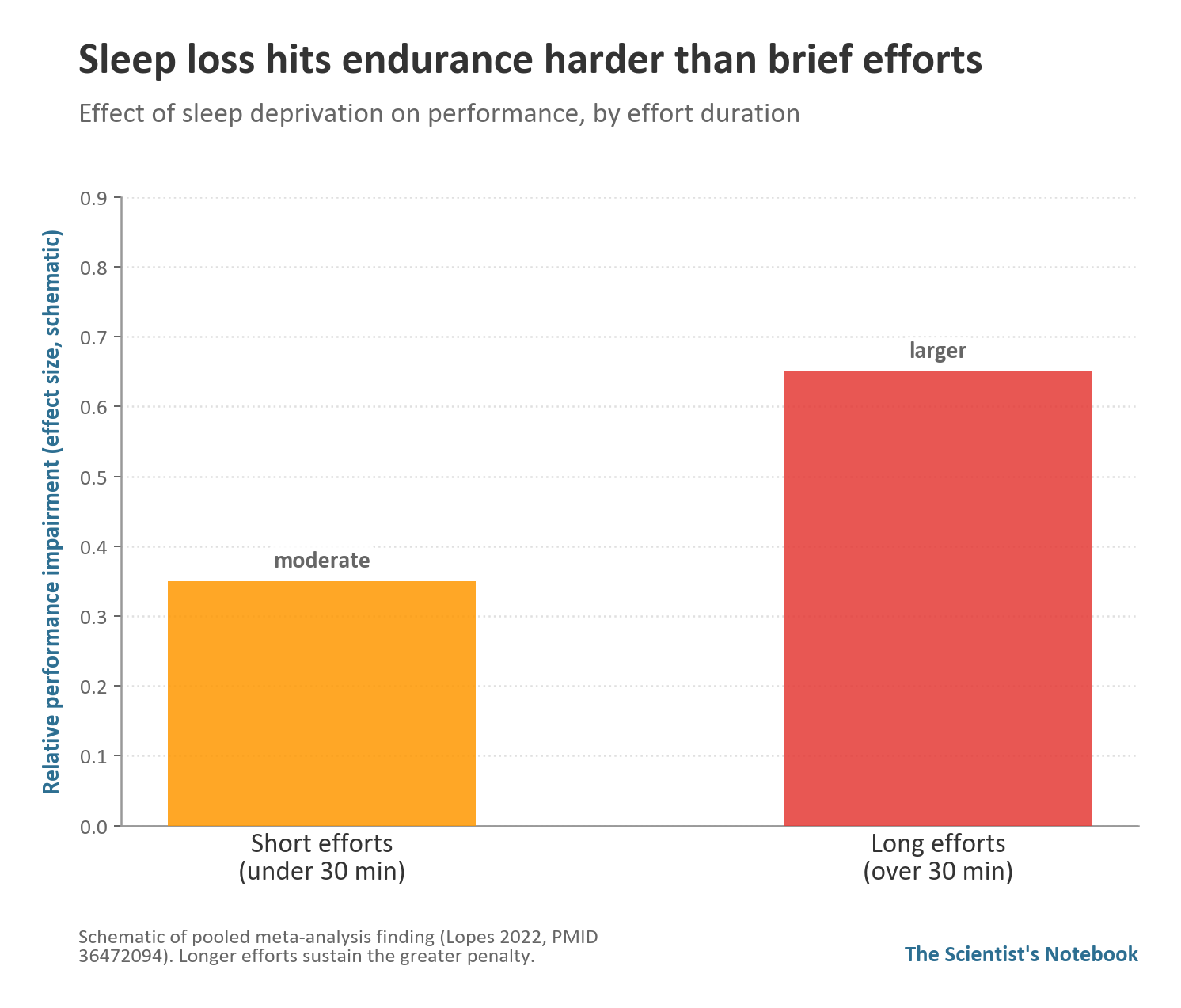
- Sleep loss erodes endurance more than it erodes raw strength. Pooled evidence places the hit to endurance performance at a moderate effect overall, and longer efforts past roughly half an hour are the ones that suffer most when sleep is short.
Join our Discord community:
 Thomas Mortelmans
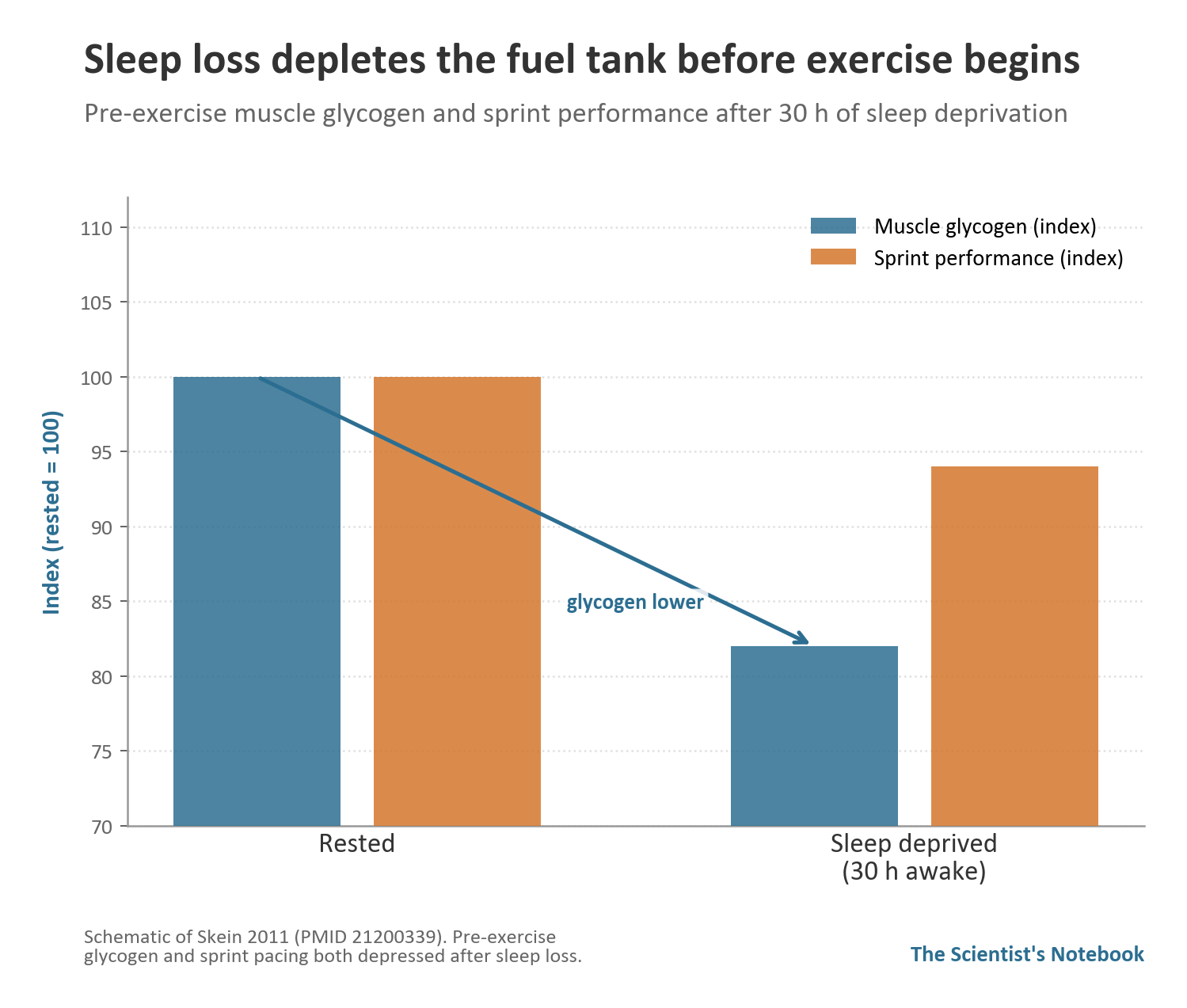
- The fuel system takes a direct hit. After a single bout of severe sleep loss, muscle glycogen sits markedly lower before exercise, sprint times slow, and pacing sags, which ties part of the performance drop to a depleted tank rather than weak willpower.
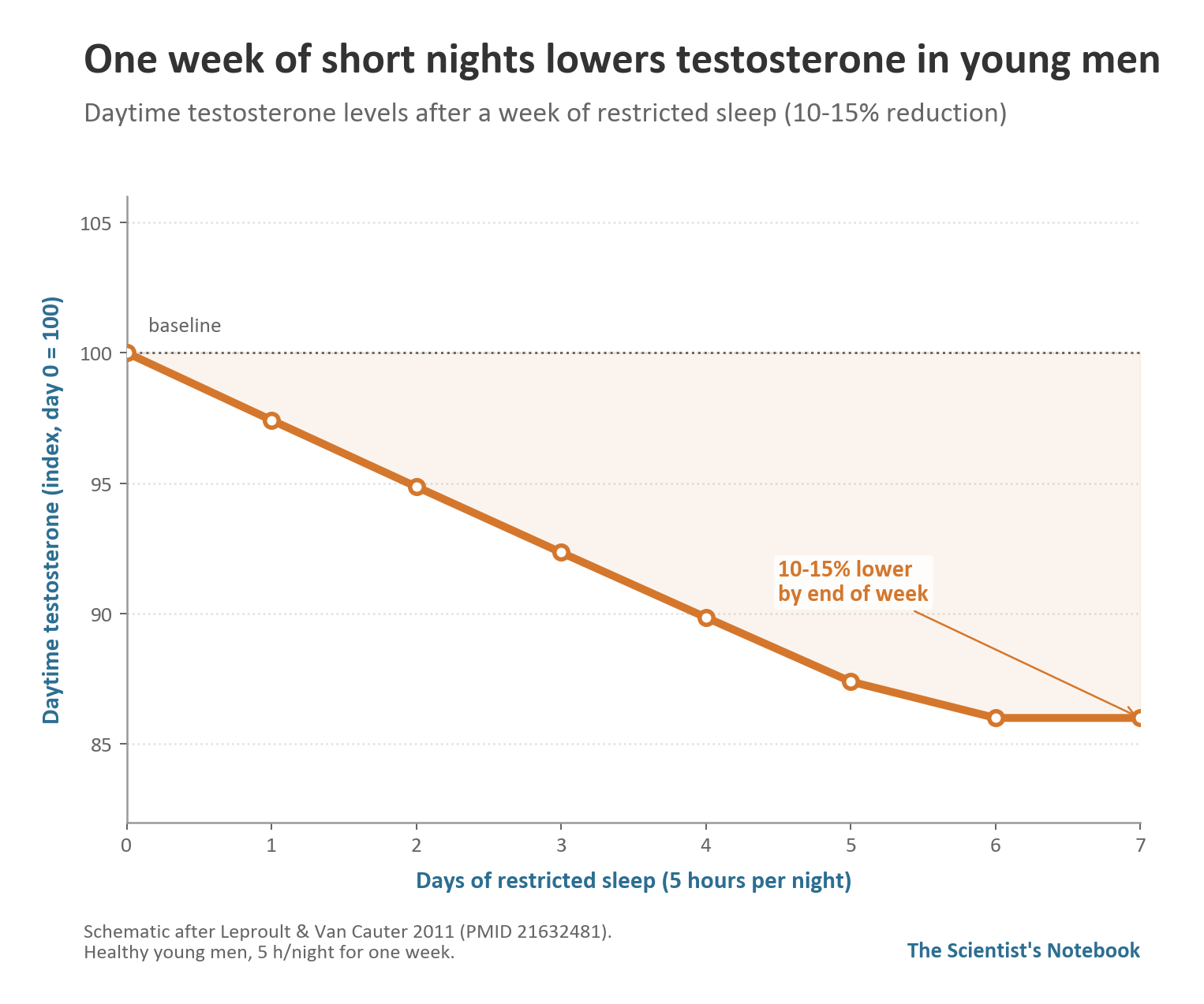
- Hormones tilt toward breakdown. A week of short nights measurably lowers daytime testosterone in young men, while sleep loss nudges cortisol and inflammatory signaling upward, a combination that works against repair.
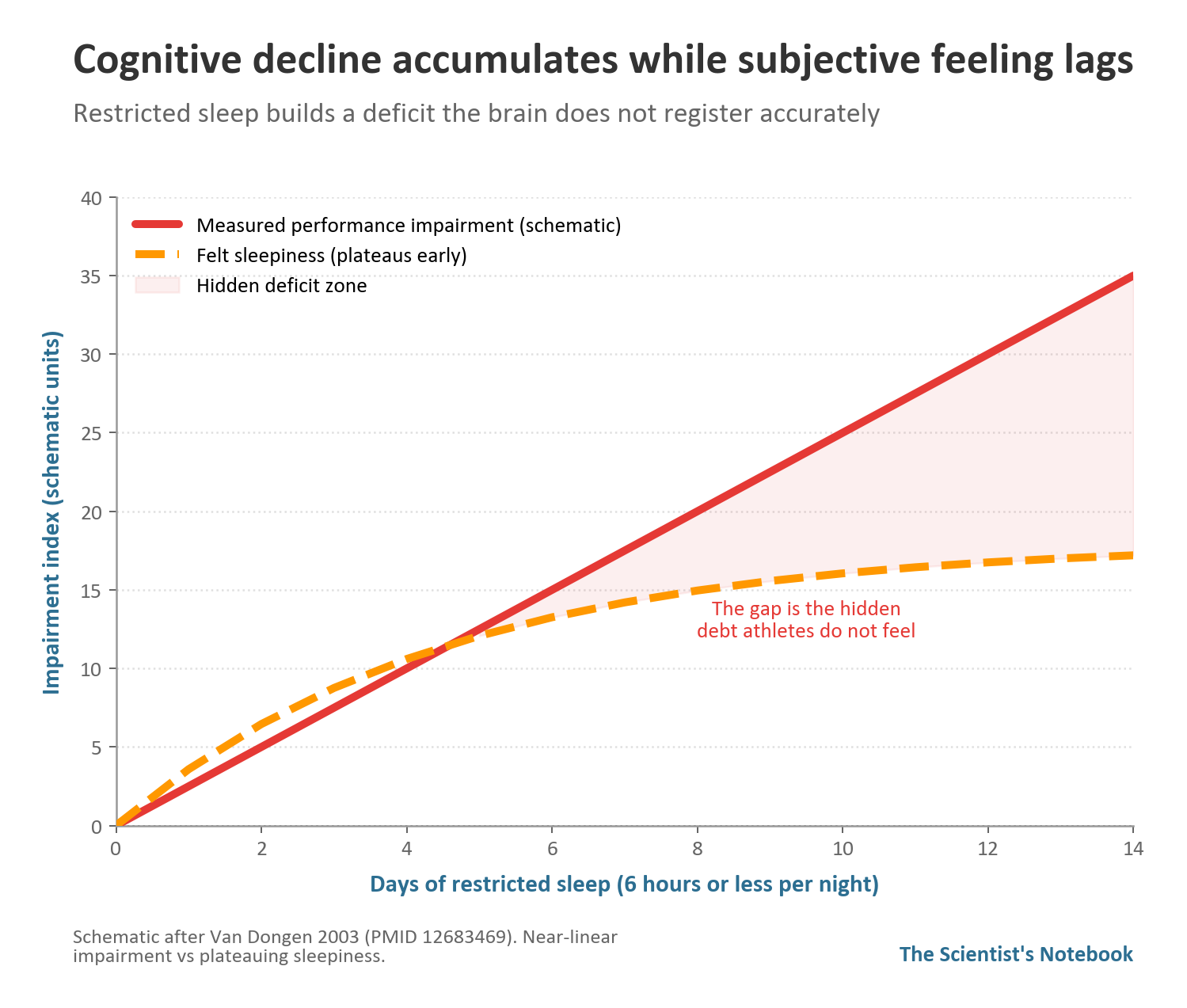
- The brain is the first thing to wobble. Reaction time, attention, and decision quality degrade in near-linear step with accumulated sleep debt, and people routinely feel fine while measurably slowing down.
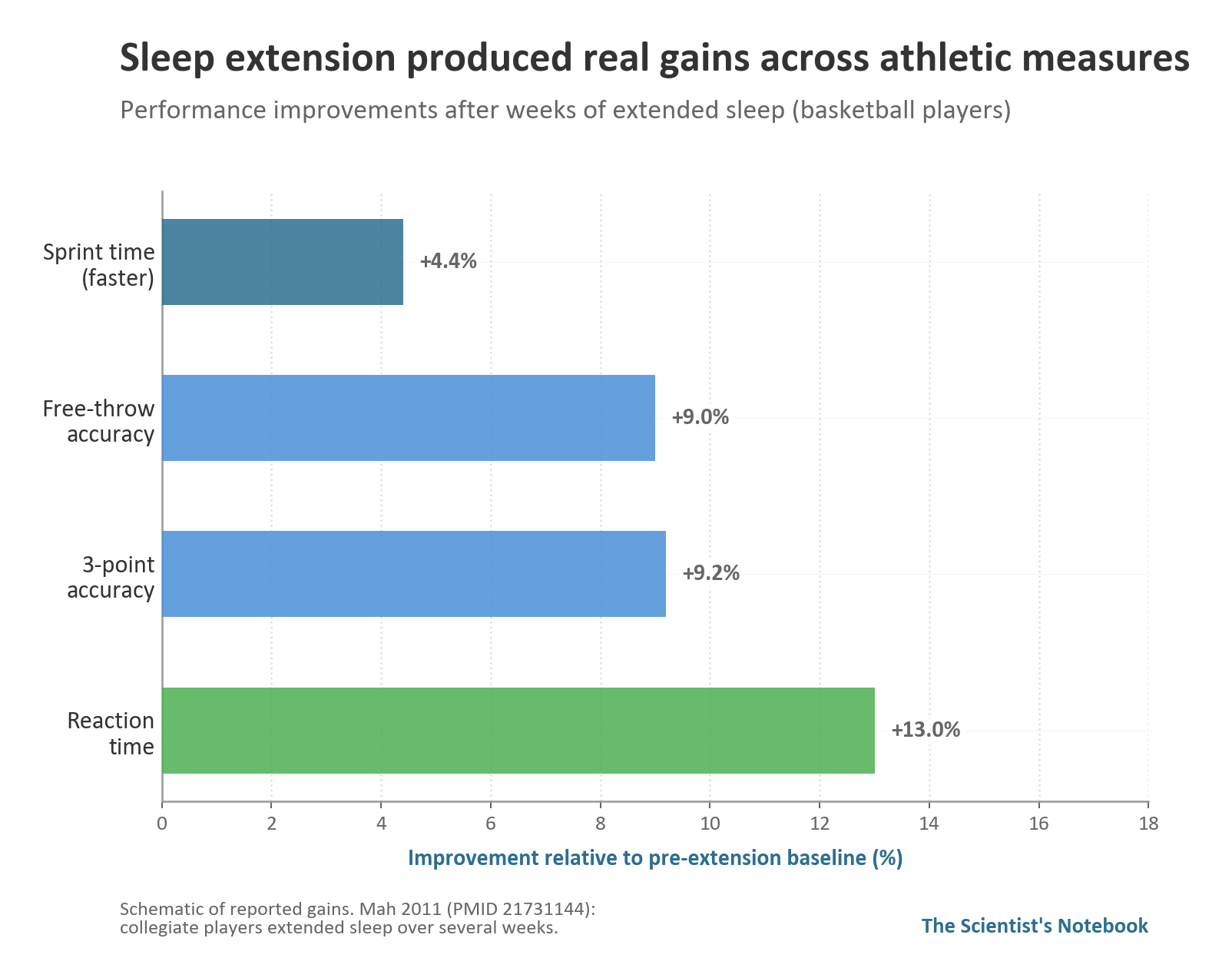
- Extending sleep has produced real gains. Athletes who banked extra hours over several weeks ran faster timed sprints, shot more accurately, and reacted quicker, which suggests many habitually train in a mild sleep deficit. Tools like Gradescale fold subjective recovery and readiness signals alongside objective training load, so sleep sits inside the same whole-athlete picture rather than off to the side.
Gradescale: Your physiology, decoded. Join the waitlist now.
 Thomas Mortelmans
- Real-world effects are often smaller than the dread suggests. One poor night before a race tends to dent stress-sensitive performance more than gross physical capacity, and in some ultra-endurance settings less sleep during the event has tracked with faster finishing rather than slower.
- The right dose is personal. Population targets hover near seven to nine hours, but individual need ranges widely, and chronotype shifts when an athlete sleeps and performs best.
The science at a glance
Sleep is not one thing. It cycles between lighter and deeper stages and between non-dreaming and dreaming sleep, and the early hours of the night skew toward the deep, physically restorative stages while the later hours carry more of the dreaming sleep tied to learning.
That architecture matters, because cutting a night short does not trim every function evenly. It tends to amputate the back end of the night, which is exactly where some of the consolidation lives.
Three principles capture most of what an endurance athlete needs to understand.
Principle 1: The Anabolic Window Is Mostly Nocturnal
The body does its heaviest repair while the lights are off.
A large fraction of daily growth hormone is released in pulses during deep slow-wave sleep, concentrated in the first hours after sleep onset, and that surge largely depends on sleep actually happening rather than on the clock alone.
Growth hormone and the broader anabolic environment of sleep support protein synthesis, tissue repair, and the restoration of energy stores spent during the day. Push the body into wakefulness when it expects deep sleep and the nocturnal hormone surge flattens.
The practical translation is that the overnight period is the single longest uninterrupted recovery block an athlete gets, and its quality is set by how much deep sleep the night contains.
Scientist's Insight: The session breaks you down, but the rebuild is scheduled for the dark. Most of the anabolic signaling is queued for the first deep cycles, which is why the front half of the night is not optional padding.
Principle 2: Sleep Refills the Tank and Resets the Brain
Deep sleep is also when fuel and cognition recover. Glycogen, the stored carbohydrate that powers hard efforts, is drawn down during waking and exercise, and short sleep blunts the body's capacity to refill it.
The consequence shows up as earlier reliance on carbohydrate and a tank that starts the next session lower than it should.
In parallel, the brain runs a cleaning cycle during sleep that clears metabolic byproducts built up during the day, and one sleepless night is enough to measurably raise the burden of one such waste protein in key brain regions. Memory and motor skill consolidate overnight too, so the technical work practiced today is partly locked in tonight.
Sleep, in other words, is doing metabolic, neural, and janitorial work at the same time.
Scientist's Insight: A short night is not just tiredness. It is a half-refilled glycogen store, a brain that skipped part of its overnight cleaning, and motor learning that never fully filed itself away.
Principle 3: Loss Tilts the Whole System Toward Breakdown
When sleep is restricted, the hormonal and inflammatory balance shifts in the wrong direction for an athlete.
Even a week of short nights lowers daytime testosterone in healthy young men, and sleep loss tends to raise cortisol and pro-inflammatory signaling while suppressing parts of immune defense. The net effect is a more catabolic internal state, one in which the body is primed to break tissue down rather than build it up, and one in which infection risk climbs. None of this requires dramatic, total sleep deprivation. The most useful finding from controlled restriction work is that moderate, repeated short nights accumulate a real cost that the person often does not feel, which is precisely what makes chronic under-sleeping so easy to ignore.
Scientist's Insight: The damage of under-sleeping is quiet. The body tilts toward breakdown and the defenses thin while the athlete still feels fine, which is exactly why the deficit goes unpaid.
Reading the signals
The research does not hand athletes a rulebook, but it does describe where different qualities tend to land as sleep changes. Three observational levers organize the evidence, each describing what the data show rather than what anyone should do.
Lever 1: The Restriction Lever
The data: pooled across many controlled studies, sleep deprivation produces a moderate negative effect on endurance performance, and the longer the effort, the larger the penalty, with efforts past roughly thirty minutes more affected than short ones.
Cognitive function deteriorates in near-linear step with accumulated wakefulness, and a fortnight of short nights can leave people performing like they pulled consecutive all-nighters while feeling only mildly off.
Where athletes tend to land is a graded slope rather than a switch: a single short night before a hard session trims endurance modestly and dents attention more, while repeated restriction stacks a deficit that grows quietly. The fuel layer lands here too.
After severe acute sleep loss, pre-exercise muscle glycogen sits substantially lower and sprint pacing fades, which is where part of the endurance cost originates.
Lever 2: The Extension and Nap Lever
The data: when athletes deliberately added hours over several weeks, timed sprints got faster, shooting accuracy rose, reaction time sharpened, and mood improved, a pattern implying many carried a hidden deficit before extending.
Reviews of sleep interventions converge on extension and napping as the strategies with the most consistent performance signal, while other tweaks show weaker or mixed results.
Where athletes tend to land with daytime naps depends on duration and timing: afternoon naps, including ones in the twenty-five to forty-five minute range, have improved repeated-effort running performance and lowered perceived exertion, with longer naps generally producing larger benefits when nighttime sleep was short.
The recurring signal is that added sleep helps most when there was a deficit to repay.
Lever 3: The Real-World Expectation Lever
The data: the dread around one bad pre-race night often outruns the measured effect. A single night of poor sleep tends to impair stress-sensitive and reactive performance more than gross physical capacity, and the perception of ruin can become self-fulfilling through anxiety.
The ultra-endurance setting is stranger still: across several event studies, athletes who slept less during the race sometimes finished faster, with in-race sleep behaving more as a marker of flagging capacity than a cause of it, even as pre-race sleep and naps protected cognition.
Where athletes tend to land also depends on individual need and chronotype, since population sleep targets span a wide band and morning and evening types differ in when their best work appears. The honest read is that chronic sleep habits move performance more reliably than any single night.
Method and a worked example
Understanding the sleep evidence means understanding how it was gathered, because several different designs sit behind the numbers.
- Controlled deprivation and restriction. Participants are kept awake for a fixed span, or held to short nights for one to two weeks, then tested on physical and cognitive tasks against a rested baseline. This design isolates the dose-response curve, and it is where the near-linear decline in attention and the accumulating, often-unfelt cost of moderate restriction were established.
- Mechanistic probes. Smaller studies sample muscle, blood, or brain to find the why behind the what. One measured muscle glycogen and sprint performance after a long bout of sleep loss and found both depressed. Others tracked overnight hormones or imaged the brain before and after a sleepless night, pinning specific losses on specific mechanisms rather than vague fatigue.
- Extension and nap trials. Athletes bank extra hours over several weeks, or take a structured afternoon nap, while sport-specific performance is logged. These trials surfaced the faster sprints, sharper accuracy, and quicker reaction times that follow added sleep, and they are why extension and napping carry the strongest practical signal.
- Field and observational work. Wearables and sleep diaries track athletes through training, competition, travel, and ultra-endurance events, capturing real-world patterns that lab studies cannot, including the counterintuitive finding that less in-race sleep sometimes accompanies faster finishing.
Consider a generic recreational runner stacking a hard training week. Monday and Tuesday go fine, eight hours each, sessions crisp.
Then work spills over, and three nights land near six hours. The runner notices almost nothing at first, which is the trap: sleepiness barely moves while the deficit quietly accrues.
By Thursday's tempo, the legs feel ordinary but perceived effort runs high and the splits drift, partly because the glycogen tank never topped off and partly because attention has dulled. The decline is not linear with the lost hours; it lurks, then surfaces on the hardest session.
Friday brings a frustrating workout that reads as lost fitness but is mostly recovery debt. Then the weekend opens up, the runner sleeps nine hours twice, and Sunday's long run feels transformed, not because fitness returned overnight but because the debt was partly repaid.
The honest version of this story has no clean dose-response line.
It has a hidden cost that builds faster than it announces itself, a single great night that helps less than two consistent ones, and a body that responds to the weekly trend far more than to any single entry in the log.
Where this leaves us
Sleep earns its place beside training and fuel because it is where adaptation is actually assembled.
The deep early hours drive the anabolic surge and refill the tank, the brain consolidates the day's skills and clears its waste, and the hormonal balance either tilts toward repair or toward breakdown depending on how much sleep the night contained.
Loss costs endurance more than raw strength, costs attention first of all, and accumulates a quiet debt that the person rarely feels in the moment.
Extension and naps can repay that debt and have produced measurable gains, while the dread of a single bad pre-race night usually outruns its true effect. The trend across weeks matters more than any one night.
Best regards,
Dr. Thomas Mortelmans
Limits of Application: The figures here are central tendencies from heterogeneous studies, many small, spanning team-sport athletes, endurance athletes, students, and healthy young men, with women underrepresented in much of the older work.
Effects vary with training status, age, sex, sport, the exact sleep protocol, and how performance was measured, so any single number is a signpost rather than a personal forecast.
Much of the cleanest mechanistic work comes from short windows and laboratory deprivation that rarely matches the partial, messy sleep loss of real life, and the most striking ultra-endurance findings come from observational settings where cause and marker are hard to separate.
This entry describes what the literature observes about populations; it is not medical, clinical, or individualized coaching guidance, and it does not account for sleep disorders, illness, or health conditions that change the calculus entirely.
References
- Fullagar HHK, Skorski S, Duffield R, et al. Sleep and athletic performance: the effects of sleep loss on exercise performance, and physiological and cognitive responses to exercise. Sports Med. 2015. PMID 25315456. Broad review showing sleep loss reduces sport-specific performance and shifts physiological and cognitive responses toward impairment.
- Lopes TR, Pereira HM, Bittencourt LRA, Silva BM. How much does sleep deprivation impair endurance performance? A systematic review and meta-analysis. Eur J Sport Sci. 2022. PMID 36472094. Pooled 31 studies to find a moderate negative effect of sleep deprivation on endurance, larger for efforts longer than thirty minutes.
- Skein M, Duffield R, Edge J, et al. Intermittent-sprint performance and muscle glycogen after 30 h of sleep deprivation. Med Sci Sports Exerc. 2011. PMID 21200339. Sleep loss lowered pre-exercise muscle glycogen and slowed sprint and pacing performance in team-sport athletes.
- Van Dongen HPA, Maislin G, Mullington JM, Dinges DF. The cumulative cost of additional wakefulness: dose-response effects on neurobehavioral functions and sleep physiology from chronic sleep restriction and total sleep deprivation. Sleep. 2003. PMID 12683469. Chronic restriction to six hours or less produced cognitive deficits rivaling total deprivation, while subjects felt largely unaware of the decline.
- Leproult R, Van Cauter E. Effect of 1 week of sleep restriction on testosterone levels in young healthy men. JAMA. 2011. PMID 21632481. One week of short nights significantly lowered daytime testosterone in healthy young men.
- Shokri-Kojori E, Wang GJ, Wiers CE, et al. Beta-Amyloid accumulation in the human brain after one night of sleep deprivation. Proc Natl Acad Sci U S A. 2018. PMID 29632177. A single night of sleep deprivation raised brain amyloid burden, evidence of impaired overnight clearance of metabolic waste.
- Mah CD, Mah KE, Kezirian EJ, Dement WC. The effects of sleep extension on the athletic performance of collegiate basketball players. Sleep. 2011. PMID 21731144. Extending sleep over several weeks produced faster timed sprints, better shooting accuracy, quicker reaction time, and improved mood.
- Cunha LA, Costa JA, Marques EA, et al. The Impact of Sleep Interventions on Athletic Performance: A Systematic Review. Sports Med Open. 2023. PMID 37462808. Across 25 trials, increasing sleep through extension or napping was the most effective intervention for improving physical and cognitive performance.
- Boukhris O, Hill DW, Ammar A, et al. Longer Nap Duration During Ramadan Observance Positively Impacts 5-m Shuttle Run Test Performance Performed in the Afternoon. Front Physiol. 2022. PMID 35222079. Afternoon naps improved repeated shuttle-run performance and lowered perceived exertion, with a longer nap outperforming a shorter one.
- Trommelen J, van Loon LJC. Pre-Sleep Protein Ingestion to Improve the Skeletal Muscle Adaptive Response to Exercise Training. Nutrients. 2016. PMID 27916799. Protein eaten before sleep is digested overnight and raises overnight muscle protein synthesis, supporting the adaptive response to training.
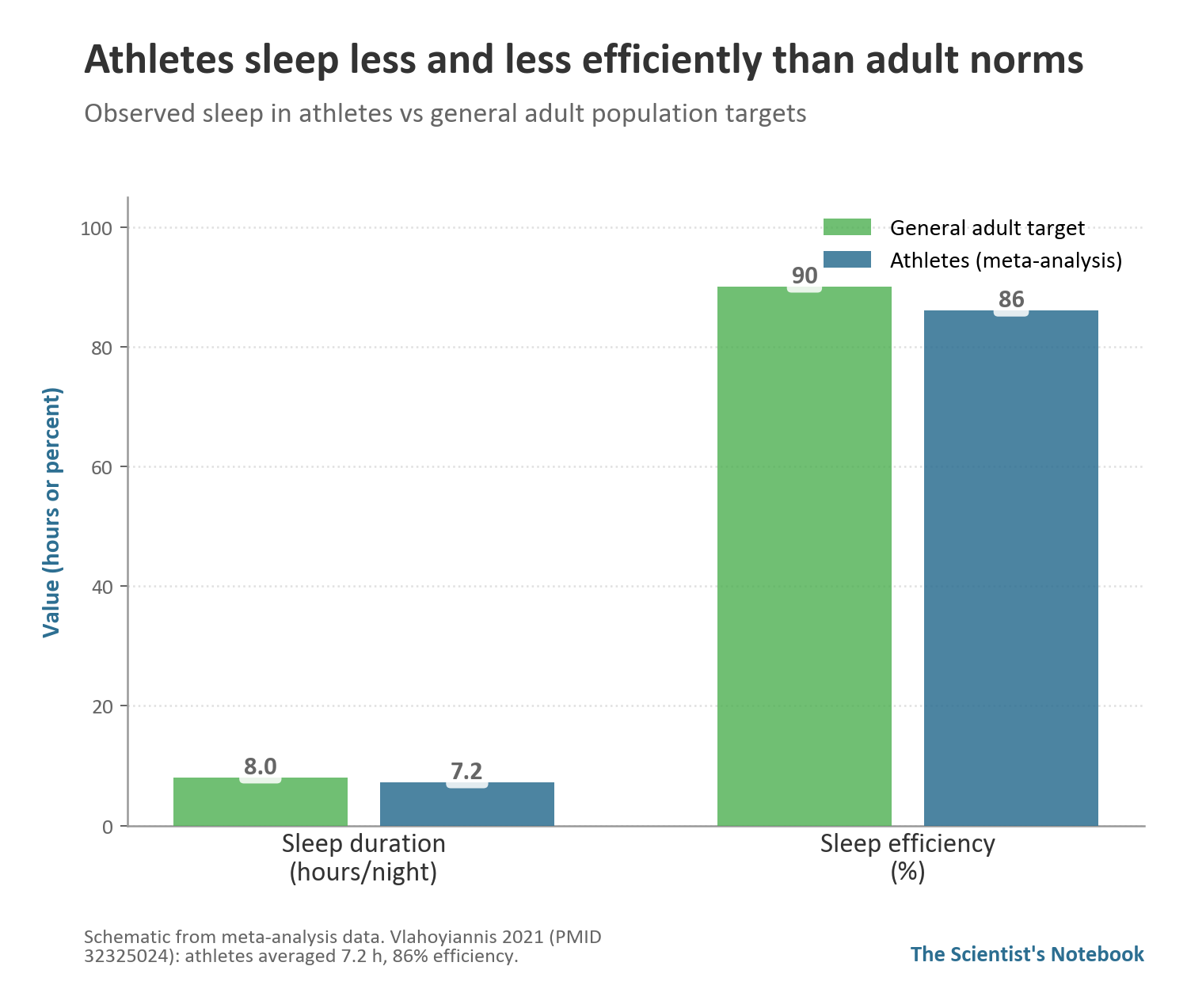
- Vlahoyiannis A, Aphamis G, Bogdanis GC, et al. Deconstructing athletes' sleep: A systematic review of the influence of age, sex, athletic expertise, sport type, and season on sleep characteristics. J Sport Health Sci. 2021. PMID 32325024. Athletes averaged about 7.2 hours per night with 86 percent efficiency, both below general adult norms, with worse efficiency in young athletes and heavy training blocks.
- Miles KH, Clark B, Fowler PM, et al. What are the sleep characteristics of elite female athletes? A systematic review with meta-analysis. Biol Sport. 2022. PMID 35959341. Elite female athletes slept adequately at baseline but showed frequent pre-competition and post-training sleep disturbances and high individual variability.
- Walsh NP, Halson SL, Sargent C, et al. Sleep and the athlete: narrative review and 2021 expert consensus recommendations. Br J Sports Med. 2021. PMID 33144349. Expert consensus that athletes are prone to short, fragmented sleep and that an individualized rather than one-size-fits-all sleep target is warranted.
- Milewski MD, Skaggs DL, Bishop GA, et al. Chronic lack of sleep is associated with increased sports injuries in adolescent athletes. J Pediatr Orthop. 2014. PMID 25028798. Adolescent athletes sleeping under eight hours per night were about 1.7 times more likely to be injured than those sleeping more.
- Herxheimer A, Petrie KJ. Melatonin for preventing and treating jet lag. Cochrane Database Syst Rev. 2002. PMID 11279722. Cochrane review finding melatonin effective for reducing jet lag across five or more time zones, with doses between 0.5 and 5 mg.
---
If you have 60 seconds, I would value your anonymous feedback. You can share it here.
---
Health disclaimer
This post discusses endurance-training science for educational purposes. It is not medical advice, not a diagnosis, and not a substitute for clinical care. Individual response to training, sleep deprivation, and multi-day exertion varies substantially, and what applies to a research cohort or a world-class athlete may not apply to you. Consult a qualified physician, sports medicine specialist, or registered dietitian before changing your training, fuelling, or sleep strategy if you have a cardiovascular, metabolic, psychiatric, or sleep-related condition; are recovering from injury or illness; are pregnant; are on medication that affects heart rate, hydration, glucose regulation, or sleep; or have concerns about exercise tolerance. Ultra-endurance events impose real physiological and psychological loads. Persistent chest pain, fainting, acute confusion beyond the predictable late-race window, severe dehydration, sustained loss of coordination, or any mental-health symptoms that outlast the immediate post-event dip warrant professional care and are not signals to push through. No outcome is guaranteed. The protocols, anchors, and case material in this post are descriptive, drawn from peer-reviewed evidence and a guest contributor's lived experience, and should be treated as inputs to an informed conversation with your own coach and clinicians, not as prescriptions.
Found this useful?
Get articles like this and free training calculators in your inbox every week.
Recommended reads
If this was useful, these are the other research-driven newsletters I actually read.

Member discussion