Entry #019: The influence of humidity on sports performance
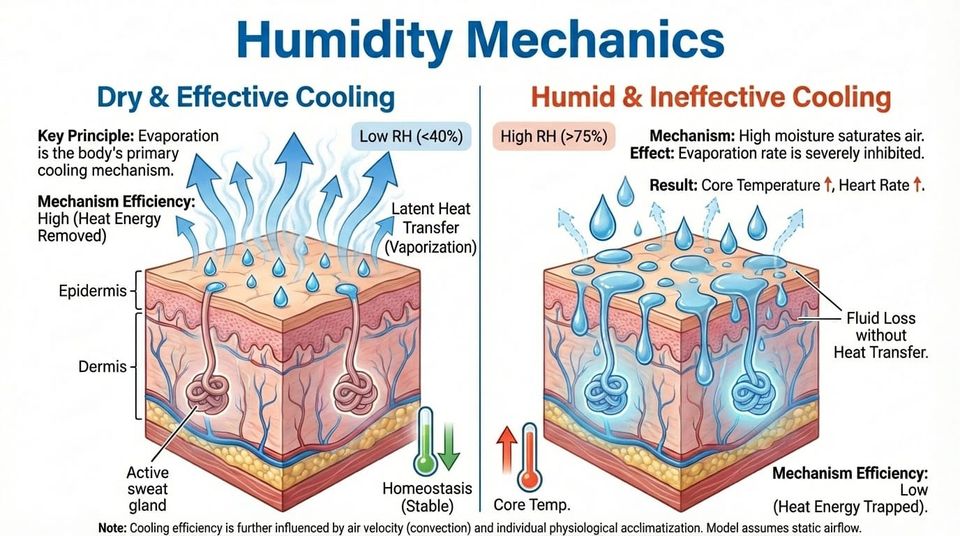
Scope and Context
This overview is for endurance coaches and athletes preparing for performance in hot, humid environments. It specifically addresses conditions where high humidity prevents sweat evaporation, limiting the body's ability to cool itself. The advice applies to activities lasting longer than 30–60 minutes, such as running, cycling, triathlon, and team sports.
We assume athletes have basic monitoring tools like heart rate monitors and can adjust training schedules. While these physiological principles apply to everyone, risks are significantly higher for athletes who are less fit or not used to the heat.
This guidance focuses on the specific challenges of humidity, which are distinct from dry heat.
Quantitative Anchors

Physiological Impairment Ranges:
- Humidity-Specific Decrement: High humidity can lower time-trial performance by roughly 3–5%, separate from the effects of heat alone.
- Total Performance Delta: Combined heat and humidity typically result in performance reductions of 2% to 8% depending on event duration and athlete speed.
- VO2max Reduction: Aerobic capacity can decline by 5% to 15% in severe conditions because the heart struggles to supply blood to both muscles and skin.
- Thermoregulatory Efficiency: In dry heat, the body manages core temperature well. However, when humidity is high, core temperature rises much faster because sweat cannot evaporate effectively.
 Thomas Mortelmans
Critical Thresholds:
- Skin Temperature: When skin temperature is high (typically >35°C / 95°F), the cooling difference between the skin and the body's core shrinks, leading to rapid heat storage.
- Hydration Limits: Losing more than 2% of body weight due to sweating consistently impairs aerobic performance.
- Sweat Rates: Athletes often sweat 1.5–2.0 L/hr in humid conditions; heavy sweaters may exceed this.
- Acclimation Timeline: Adaptations begin in 3–5 days; about 70% of adaptation is achieved in 1 week; maximal adaptation takes 10–14 days.
- Adaptation Decay: Benefits begin to fade after 2–3 weeks of non-exposure; substantial loss occurs within 4 weeks.
Operational Limits:
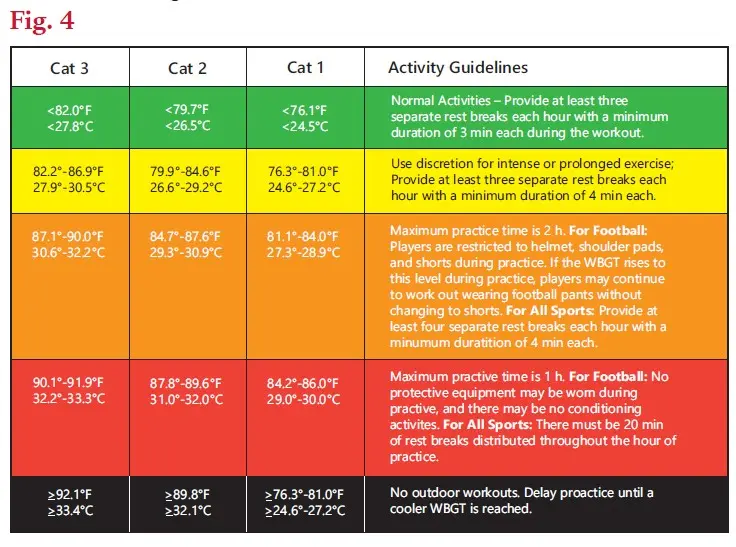
- WBGT Threshold: >28°C (82°F) indicates elevated risk requiring modification; >32°C (90°F) often necessitates cessation.
- Pacing Adjustment: Elite endurance athletes may require power output reductions of 15–20% to maintain physiological stability in extreme humidity.
The fundamental constraint in humid performance is the competition for blood flow between metabolic demand (muscle oxygenation) and thermoregulation (skin cooling). In dry heat, evaporation is efficient, so skin blood flow yields cooling. In high humidity, the air is saturated with moisture; sweat accumulates rather than evaporates. Consequently, increasing sweat rate—a typical body response—depletes blood volume without providing the intended cooling benefit.
Practitioners must accept that cardiac output is the limiting factor. As blood pools in the skin to attempt cooling, less blood returns to the heart. To maintain blood pressure, heart rate increases (cardiovascular drift). Once maximum heart rate is approached, the heart cannot pump enough blood per beat (stroke volume drops), and power output must decrease. Therefore, maintaining 'normal' power or pace targets in high humidity is physiologically impossible without risking rapid core temperature escalation.
Trade-offs favor early conservation. Because the effects of thermal strain are cumulative and worsen with dehydration, going out too hard early in a session dramatically speeds up fatigue. Waiting for thirst is rarely a valid option in these conditions; the high sweat rates driven by humidity require a proactive fluid strategy to prevent the compounding negative effects of severe dehydration (>2% loss) on an already strained cardiovascular system.
Acclimation Protocols

Effective preparation requires a dedicated block of heat exposure. Active acclimation involves 60–90 minute sessions at intensities sufficient to elevate core temperature and stimulate profuse sweating. This should be scheduled 2–3 weeks prior to competition, with a taper (7–10 days out) to shed fatigue while retaining adaptations. Passive strategies (sauna/hot bath) are viable alternatives for athletes in cool climates, though active exposure is slightly more effective.
Execution and Pacing
Derated pacing is the approach described in the literature. Instead of targeting specific external outputs (watts/pace), execution should be governed by internal load caps (heart rate or RPE). A conservative start is strongly emphasised in the literature; reported protocols reduce power output by 15–20% initially, with adjustments made based on thermal comfort and heart rate drift. Pre-cooling (ice slurry ingestion, cold water immersion) can be used to lower baseline core temperature, effectively buying time before critical thermal limits are reached.
Hydration Strategy

Fluid intake must aim to minimize body mass loss (keeping it <2%), but it must be capped by the stomach's ability to absorb fluid (typically 1.0–1.2 L/hr maximum). Beverages should contain 0.5–0.7g/L of sodium to support retention and blood volume. Drinking only pure water is less effective and carries a risk of hyponatremia. Cooling the body externally (dousing with water) is encouraged to mimic the evaporative heat loss that the environment is preventing.

Risk and Limitations
The primary failure mode in humid conditions is the assumption that mental toughness can override physiological thermal limits. Pushing beyond cardiovascular constraints leads to exertional heat illness, not adaptation.
There is significant inter-individual variability; sweat rates can vary by >50% between similar athletes, and 'standard' hydration plans may lead to dangerous over- or under-drinking (hyponatremia vs. dehydration).
Acclimation is transient. Adaptations decay rapidly (within 2–4 weeks), so timing is a critical point of failure; acclimating too early without maintenance renders the protocol useless. Furthermore, acclimating to dry heat provides incomplete protection for humid heat.
Finally, safety guidelines based on WBGT are absolute boundaries; ignoring them places athletes at risk of catastrophic medical events regardless of fitness level. Special populations (children, unacclimatized individuals) face disproportionately higher risks and require stricter monitoring.
Until next time!
Cheers,
Dr. Thomas Mortelmans
PS: Curious to know what you liked today.Tap here for a 45-second anonymous survey. I read every single note!
Summary Tables
Contextual conditions and physiological impact
| Condition or Variable | Quantitative Range | Expected Physiological Consequence | Primary System Affected |
|---|---|---|---|
| Absolute Humidity | High (High water vapor pressure) | Suppression of evaporative cooling; sweat accumulation | Thermoregulatory / Skin |
| Skin Temperature | High (>35°C / 95°F) | Exacerbated performance loss due to reduced cooling gradient | Cardiovascular |
| Body Mass Loss | >2% | Measurable decline in aerobic power; increased cardiac drift | Cardiovascular / Metabolic |
| WBGT | 28–32°C (82–90°F) | High risk of heat illness; mandatory intensity reduction | Systemic Safety |
Decision levers and adaptation options
| Adjustable Lever | Direction of Adjustment | Typical Magnitude | Decision Rationale |
|---|---|---|---|
| Power/Pace Targets | Decrease | -15% to -20% (Elite/Long duration) | Prevent hitting critical core temp early |
| Fluid Intake | Increase | Limit loss to <2% (Cap ~1.2 L/hr) | Mitigate plasma volume drop |
| Acclimation Block | Add | 5–14 days duration | Induce plasma expansion and sweat efficiency |
| Sodium Intake | Increase | 0.5–0.7 g/L in fluids | Prevent hyponatremia; improve retention |
Monitoring signals and decision thresholds
| Monitoring Signal | Typical Quantitative Range | Interpretation | Suggested Decision Response |
|---|---|---|---|
| Heart Rate Drift | Disproportionate rise vs. power | Cardiovascular instability / venous pooling | Reduce intensity immediately |
| Sweat Rate | >1.5–2.0 L/hr | High fluid turnover; dehydration risk | Aggressive fluid/sodium replacement |
| Body Mass Delta | >2% loss post-exercise | Inadequate in-session hydration | Increase fluid intake rate in future sessions |
| WBGT | >32°C (90°F) | Extreme environmental stress | Cessation or relocation of training |
Disclaimer
The information provided in this newsletter is for educational purposes only and does not constitute medical advice. Exercise physiology is highly individual; what works for elite populations may not apply to everyone. Always consult with a physician before making significant changes to your training, nutrition, or supplementation protocols. The Scientist's Notebook and ESQ Coaching accept no liability for injuries or health issues arising from the application of these concepts.
References
- Gatorade Sports Science Institute: Hydration and Aerobic Performance Impact of Environment.Summary: Discusses the effect of hydration on athletic performance in various environmental conditions.
- Precision Hydration: Humidity and Hydration Performance.Summary: Explores the impact of humidity on hydration needs and performance in athletes.
- Aspetar Sports Medicine Journal: Prolonged Exercise in the Heat.Summary: Provides insights on physiological responses to prolonged exercise in hot environments.
- USA Football: Heat and Hydration Guidelines.Summary: Offers guidelines for managing heat and hydration among athletes, emphasizing safety and performance.
- National Center for Biotechnology Information: Heat Acclimation Study.Summary: Investigates the physiological adaptations that occur with heat acclimation.
- National Institute for Occupational Safety and Health: Recommendations for Heat Acclimatization.Summary: Provides official recommendations for heat acclimatization in occupational settings.
- Climatic Health and Environmental Monitoring: Effects of Mental Fatigue on Endurance Performance in the Heat.Summary: Examines how mental fatigue affects endurance performance in hot conditions.
- Public Library of Science: Hydration Strategies in High Humidity.Summary: Analyzes various hydration strategies to optimize performance in humid conditions.
Found this useful?
Get articles like this and free training calculators in your inbox every week.
Recommended reads
If this was useful, these are the other research-driven newsletters I actually read.


Member discussion