Entry #030: The two lactate thresholds (LT1/LT2) — The Dual-Threshold Metabolic Architecture
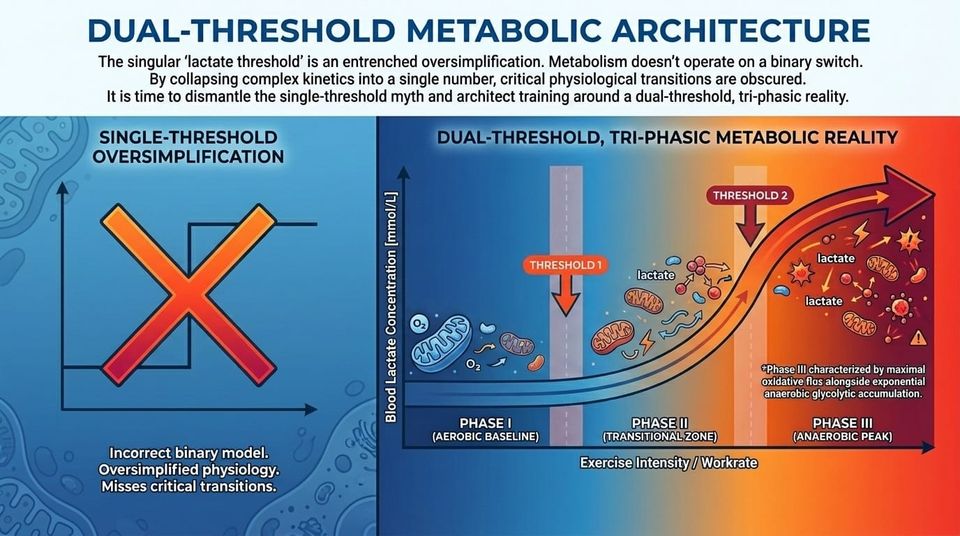
As an endurance practitioner, you have likely structured training around a singular metric: the lactate threshold. This pervasive concept—often anchored to a fixed blood lactate concentration or a generalized power output—remains one of the most entrenched oversimplifications in sports science.
The biological reality is that human metabolism does not operate on a binary switch. By collapsing complex metabolic kinetics into a single number, we obscure the critical physiological transitions that dictate adaptation, fatigue, and performance.
It is time to dismantle the single-threshold myth and architect training around the dual-threshold, tri-phasic metabolic reality.
Executive Summary – The Brief
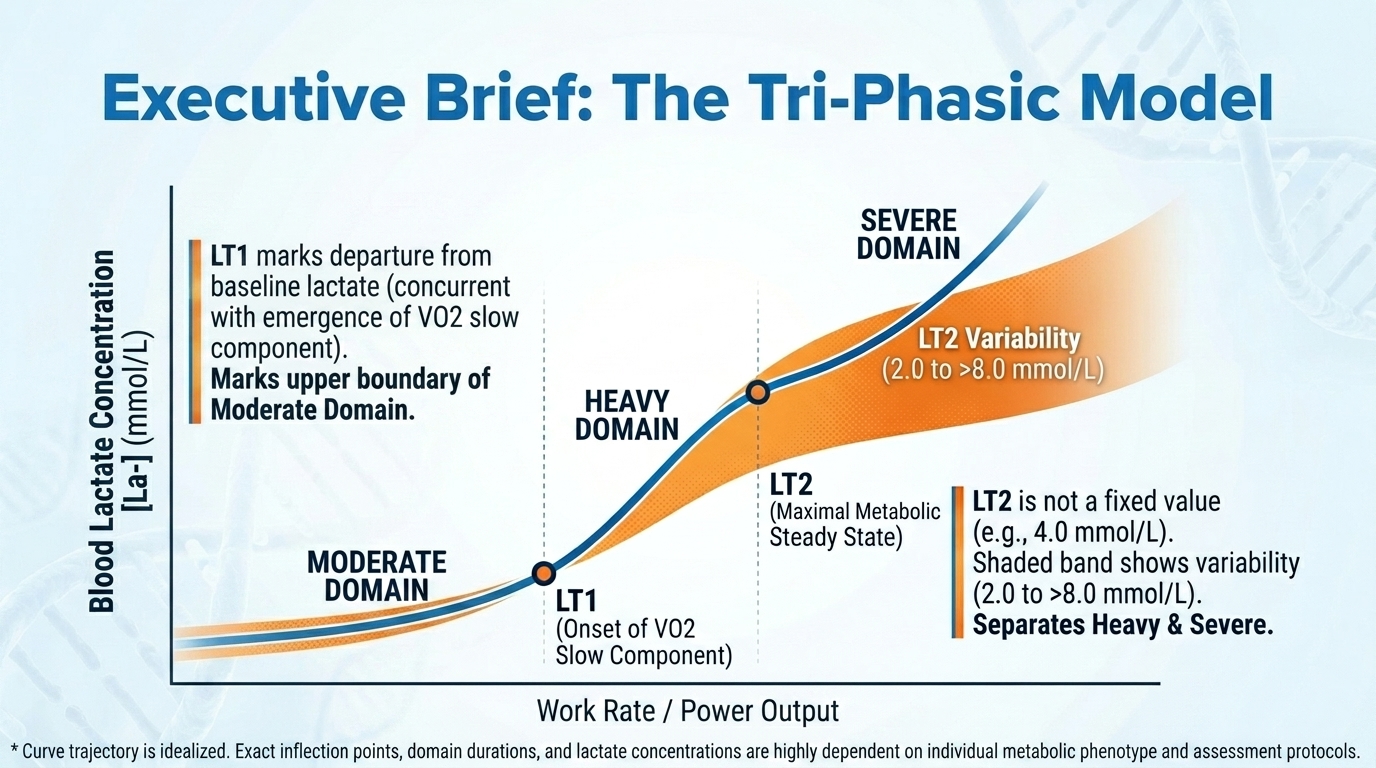
• The singular 'lactate threshold' is a pedagogical relic; endurance physiology operates across three distinct metabolic domains demarcated by two separate thresholds (LT1 and LT2).
• LT1 marks the departure from baseline blood lactate concentration, driven by increased glycolytic flux and the progressive recruitment of less-efficient higher-threshold motor units, marking the intensity where the VO2 slow component first emerges.
• LT2 represents the maximal metabolic steady state, the critical boundary where the systemic rate of lactate appearance permanently exceeds systemic clearance capacity.
• Fixed blood lactate concentrations (e.g., 2.0 or 4.0 mmol/L) fail to account for profound inter-individual variability, with actual LT2 values ranging from 2.0 to over 8.0 mmol/L in trained populations, making fixed anchors physiologically invalid.
• Methodological noise—including stage duration, sampling site, and mathematical curve-fitting models—significantly alters threshold identification and subsequent zone prescription.
• Effective training architecture must target specific metabolic domains (Moderate, Heavy, Severe) rather than a singular threshold to elicit precise peripheral and central adaptations.
The Science at a Glance
• The historical search for a singular 'anaerobic threshold' led to decades of nomenclatural confusion, yielding over 25 distinct definitions in the scientific literature.
• Early models relied on fixed blood lactate concentrations, such as the Onset of Blood Lactate Accumulation (OBLA) at 4.0 mmol/L.
• However, contemporary exercise physiology recognizes a tri-phasic model of intensity, separated by two distinct inflection points.
• The first lactate threshold (LT1) separates the Moderate and Heavy exercise domains.
• The second lactate threshold (LT2) separates the Heavy and Severe domains.
• Treating these distinct physiological events as a single metric systematically misaligns training prescription, as each domain dictates entirely different substrate utilization rates, motor unit recruitment patterns, and autonomic stress responses.
 Thomas Mortelmans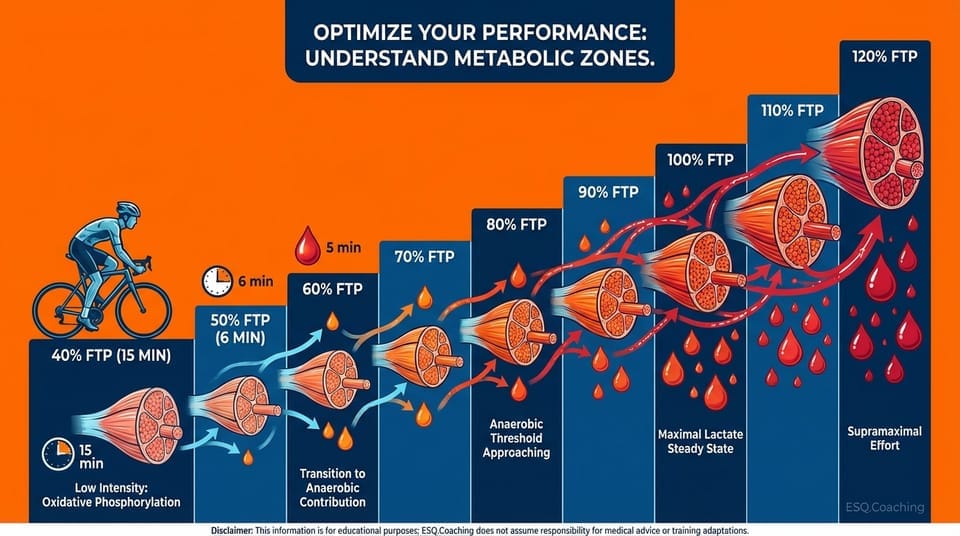
Foundational Principles
Principle 1: LT1 and the Loss of Mechanical Efficiency
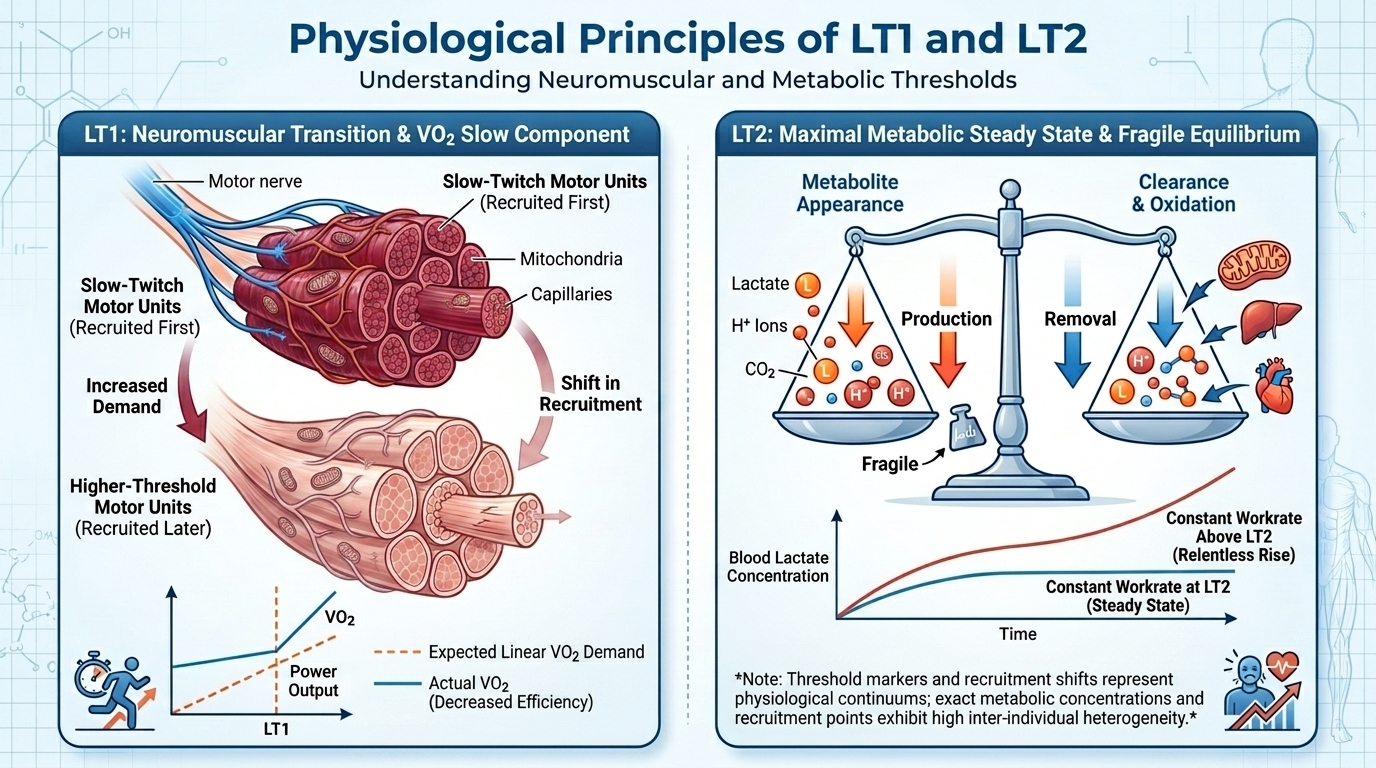
LT1 is not merely a metabolic marker; it is a neuromuscular transition. As intensity increases, the required power output begins to exceed the capacity of the currently active slow-twitch fibers, necessitating the progressive recruitment of higher-threshold motor units. These additional fibers possess higher glycolytic capacity but lower oxidative efficiency, leading to the initial rise in blood lactate above baseline.
The appearance of the VO2 slow component above LT1 is a critical indicator of declining mechanical efficiency. The system requires progressively more oxygen to sustain the same power output, reflecting the metabolic cost of recruiting less-efficient motor units and the rising ATP demand of ion pump activity.
Principle 2: LT2 and the Maximal Metabolic Steady State
• LT2 defines the highest intensity at which the rate of lactate appearance in the blood equals the rate of clearance by oxidative tissues and the liver.
• Below LT2, blood lactate and oxygen consumption eventually stabilize in a delayed steady state.
• Above LT2, the system enters the Severe domain, characterized by a relentless upward trajectory of blood lactate, oxygen consumption, and intramuscular acidosis until task failure.
LT2 is a fragile equilibrium. It is not the point where lactate becomes 'toxic,' but rather the precise intensity where the systemic capacity to buffer, shuttle, and oxidize circulating metabolites is overwhelmed. Time-to-exhaustion at this intensity is highly variable, dictated by the individual's anaerobic work capacity (W') and tolerance to homeostatic disruption.
The Decision Matrix
To determine if your training architecture is compromised by single-threshold thinking, evaluate your physiological responses against the following diagnostic criteria. This matrix helps classify whether your prescribed intensity zones align with your actual metabolic domains.
Diagnostic Logic for LT1 Misalignment
• If 'easy' endurance sessions require more than 24 hours of autonomic recovery (measured via HRV or resting heart rate), your presumed LT1 is likely set too high, pushing you into the Heavy domain.
• If you experience progressive cardiac drift exceeding standard physiological variation (e.g., >10 percent) during steady-state work under thermoneutral conditions, you are likely operating above your true LT1.
Diagnostic Logic for LT2 Misalignment
• If you cannot sustain your prescribed 'threshold' power or pace for at least 40 minutes in a rested state, your LT2 estimate is artificially inflated, likely contaminated by anaerobic glycolytic contribution during short testing protocols.
• If your blood lactate fails to stabilize during extended 20- to 30-minute steady-state intervals at your presumed LT2, you have crossed into the Severe domain.
Self-Classification
Athletes must classify their testing methodology. If your zones are derived from a fixed percentage of maximum heart rate or a standardized 20-minute field test without lactate validation, you are operating on probabilistic models, not physiological reality. Direct measurement with individualized curve-fitting is required to resolve these discrepancies.
The Protocol
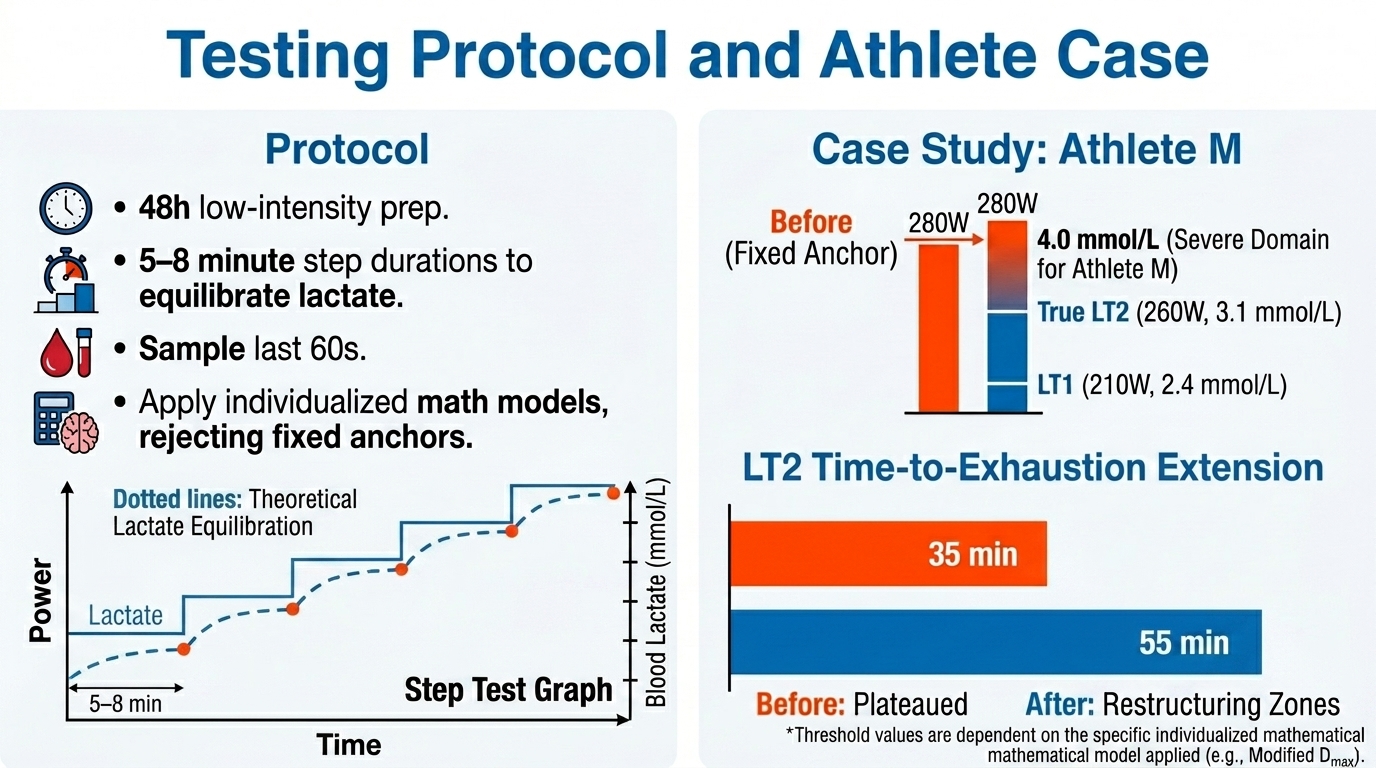
Transitioning from a single-threshold model to a precise dual-threshold architecture requires rigorous testing methodology. Short-stage protocols systematically underestimate lactate accumulation due to delayed diffusion kinetics.
1. Standardize the pre-test environment, ensuring 48 hours of low-intensity training and consistent carbohydrate availability to minimize baseline glycogen variance.
2. Execute an incremental step-test using extended stage durations of 5 to 8 minutes. This duration is non-negotiable for achieving lactate equilibration between the working muscle and the blood compartment.
3. Sample blood lactate during the final 60 seconds of each stage, ensuring rigorous contamination control at the sampling site.
4. Plot the lactate curve and apply specific mathematical modeling for each point—such as an individualized baseline-plus method for LT1 and the Modified D-max method for LT2. Discard any reliance on fixed 2.0 or 4.0 mmol/L anchors to identify these independent inflection points.
5. Map the identified LT1 and LT2 values to power, pace, and heart rate to establish the boundaries of your Moderate, Heavy, and Severe training domains.
Case Study
• Athlete M, a well-trained cyclist, plateaued after two seasons of prescribing 'threshold' intervals based on a fixed 4.0 mmol/L blood lactate value, which corresponded to 280 watts.
• A rigorous dual-threshold assessment revealed that Athlete M's actual LT2 occurred at 3.1 mmol/L (260 watts).
• Conversely, 280 watts pushed him into the Severe domain (5.5 mmol/L).
• By anchoring training to the fixed 4.0 mmol/L metric, Athlete M was chronically accumulating excessive autonomic stress and failing to achieve the desired maximal steady-state adaptations.
• Furthermore, his LT1 was identified at a surprisingly high 2.4 mmol/L (210 watts).
• By restructuring his architecture to respect his unique physiological inflection points—lowering his LT2 interval intensity and slightly raising his LT1 base intensity—Athlete M improved his fractional utilization of VO2max and extended his time-to-exhaustion at LT2 from 35 to 55 minutes.
• This non-linear adaptation highlights the critical necessity of individualized metabolic mapping over generalized population metrics.
Limits of Application
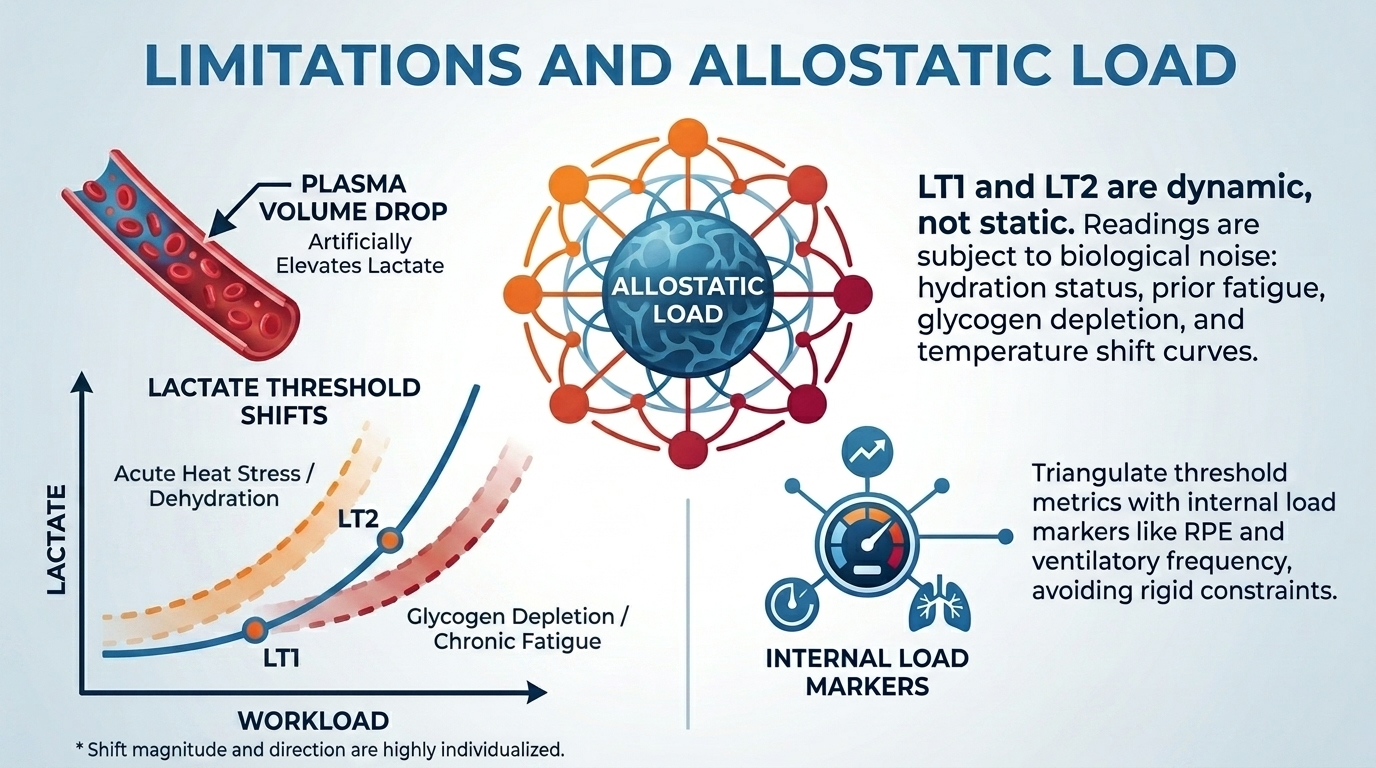
The dual-threshold model, while vastly superior to single-metric paradigms, remains subject to biological and methodological noise. Blood lactate concentration is highly sensitive to hydration status; a reduction in plasma volume will artificially elevate lactate concentration readings independent of metabolic flux.
Furthermore, prior training fatigue, muscle glycogen depletion, and ambient temperature can shift the lactate curve leftward or rightward on any given day. Practitioners must recognize that LT1 and LT2 are not static physiological monuments but dynamic variables that fluctuate with daily allostatic load.
Therefore, threshold metrics should be triangulated with internal load markers, such as perceived exertion and ventilatory frequency, rather than applied as rigid, absolute constraints.
Best regards,
Dr. Thomas Mortelmans
References
1. LT1, LT2, and the scientific basis of heart rate zones for runners
2. What is Lactate and Lactate Threshold
3. Anaerobic Threshold: Its Concept and Role in Endurance Sport
4. Joe Friel's Quick Guide to Setting Zones
5. Challenging the Accuracy of a Single-test Lactate Threshold Protocol in Collegiate Rowers
9. Changes in onset of blood lactate accumulation (OBLA) and muscle enzymes after training at OBLA
10. Lactate threshold concepts: how valid are they?
12. Blood Lactate Measurements and Analysis during Exercise: A Guide for Clinicians
13. The origin of the maximal lactate steady state (MLSS)
14. Lactate threshold predicting time-trial performance: impact of heat and acclimation
15. All You Need to Know About LT and VO2 Max
16. Relationship Between Critical Power and Different Lactate Threshold Markers in Recreational Cyclists
17. Increased Blood Lactate Level Deteriorates Running Economy in World Class Endurance Athletes
18. Lactate kinetics at the lactate threshold in trained and untrained men
20. FTP (Functional Threshold Power) or Lactate Threshold in Cycling?
Disclaimer
The information provided in this newsletter is for educational purposes only and does not constitute medical advice. Exercise physiology is highly individual; what works for elite populations may not apply to everyone. Always consult with a physician before making significant changes to your training, nutrition, or supplementation protocols. The Scientist's Notebook and ESQ Coaching accept no liability for injuries or health issues arising from the application of these concepts.
Found this useful?
Get articles like this and free training calculators in your inbox every week.
Recommended reads
If this was useful, these are the other research-driven newsletters I actually read.





Member discussion