Snippet #028: Capillary Density and the Last Mile of Oxygen Delivery
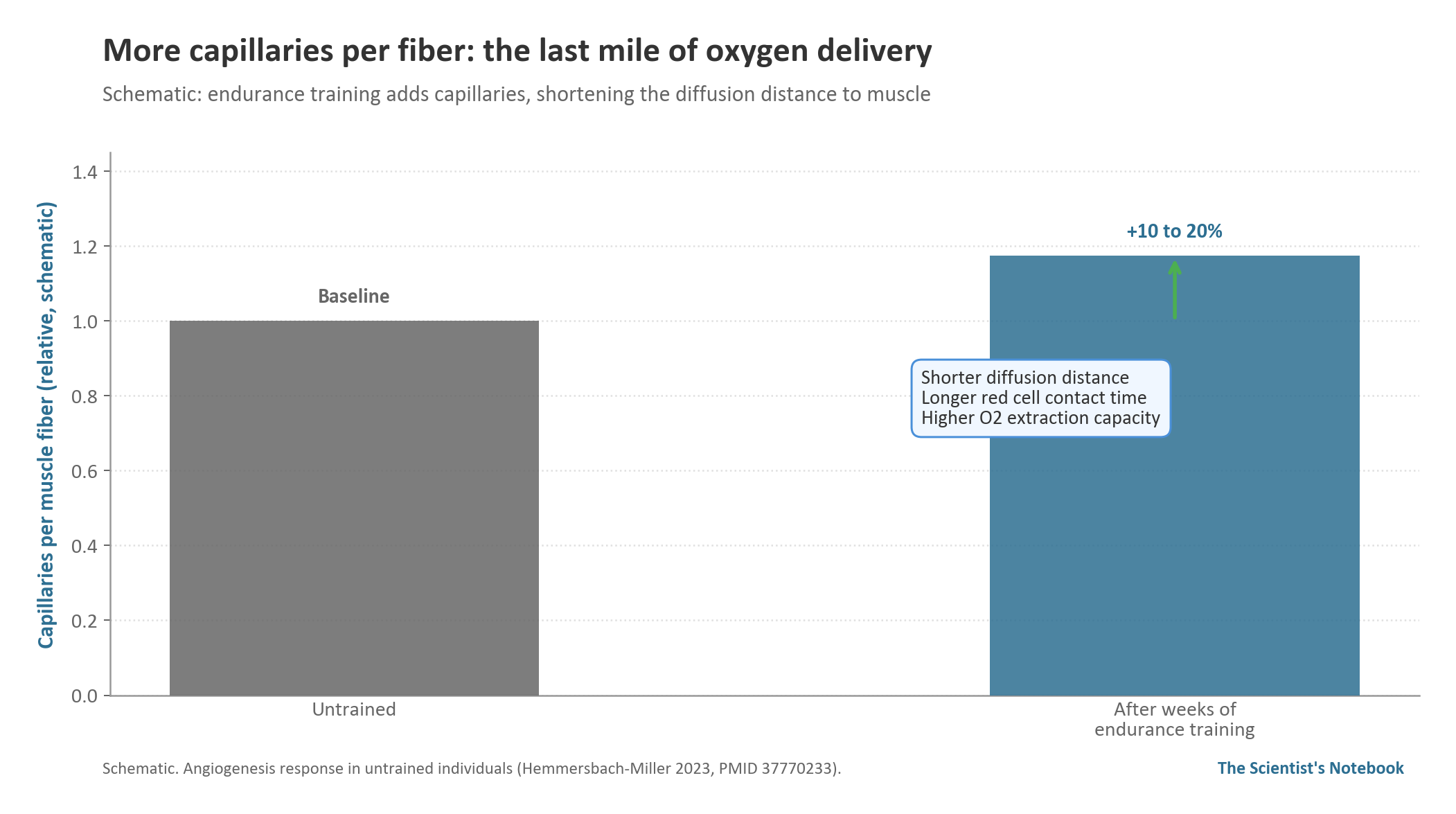
Endurance training stimulates angiogenesis, the growth of new capillaries (the smallest blood vessels) around muscle fibers. Studies show the number of capillaries per fiber increases by around 10 to 20 percent within a few weeks in untrained individuals.
More capillaries per fiber shorten the diffusion distance oxygen must travel from blood into muscle, and lengthen the time red blood cells spend in contact with the tissue.
The result is a higher capacity for the muscle to extract oxygen, a quantity physiologists call the arteriovenous oxygen difference.
This peripheral adaptation is as consequential to endurance capacity as the central pump. Research reports that capillarization is associated with measurable improvements in oxygen extraction during exercise in humans.
A well-supplied muscle extracts more oxygen per liter of blood, reducing the demand on the heart to compensate by pumping more volume.
Capillary growth is associated with weeks to months of consistent training, with faster early gains in untrained people and slower ongoing growth in well-trained endurance athletes. Both animal and human evidence indicate the adaptation reverses with detraining.
---
If you have 60 seconds, I would value your anonymous feedback. You can share it here.
---
### Health disclaimer
This post discusses endurance-training science for educational purposes. It is not medical advice, not a diagnosis, and not a substitute for clinical care. Individual response to training, sleep deprivation, and multi-day exertion varies substantially, and what applies to a research cohort or a world-class athlete may not apply to you. > Consult a qualified physician, sports medicine specialist, or registered dietitian before changing your training, fuelling, or sleep strategy if you have a cardiovascular, metabolic, psychiatric, or sleep-related condition; are recovering from injury or illness; are pregnant; are on medication that affects heart rate, hydration, glucose regulation, or sleep; or have concerns about exercise tolerance. > Ultra-endurance events impose real physiological and psychological loads. Persistent chest pain, fainting, acute confusion beyond the predictable late-race window, severe dehydration, sustained loss of coordination, or any mental-health symptoms that outlast the immediate post-event dip warrant professional care and are not signals to push through. > No outcome is guaranteed. The protocols, anchors, and case material in this post are descriptive, drawn from peer-reviewed evidence and a guest contributor's lived experience, and should be treated as inputs to an informed conversation with your own coach and clinicians, not as prescriptions.
Found this useful?
Get articles like this and free training calculators in your inbox every week.
Recommended reads
If this was useful, these are the other research-driven newsletters I actually read.

Member discussion