Max Heart Rate Calculator
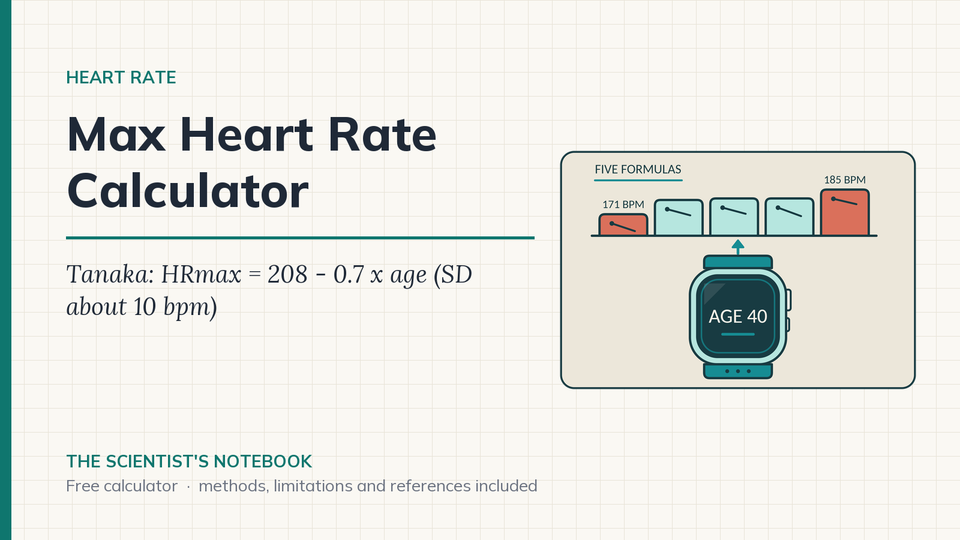
Every heart-rate zone starts with a maximum, and most of us never measured ours. This calculator lays five published age equations side by side so you can see how far apart they land and how much scatter sits behind every one of them.
In short: The max heart rate calculator puts five published age equations side by side: Fox 220 − age, Tanaka 208 − 0.7 × age, Gellish, Nes and Gulati. Each estimate carries a range of plus and minus 10.8 bpm, the standard error Nes and colleagues reported in 3,320 healthy adults. At age 40 the five equations span 171 to 185 bpm.
How is maximum heart rate estimated from age?
All five equations use age in years as the only input and return a maximum heart rate in beats per minute (bpm). The result is rounded to a whole beat.
- Fox: HRmax = 220 − age
- Tanaka: HRmax = 208 − 0.7 × age, from a meta-analysis of 351 studies (18,712 subjects) and a lab check in 514 healthy adults
- Gellish: HRmax = 207 − 0.7 × age, from 908 maximal tests in 132 adults followed for up to 25 years
- Nes: HRmax = 211 − 0.64 × age, from 3,320 healthy adults in the HUNT Fitness Study, with a standard error of 10.8 bpm
- Gulati: HRmax = 206 − 0.88 × age, derived in 5,437 asymptomatic women
The range next to each estimate is the estimate plus and minus 10.8 bpm, one standard error of an age equation (Nes 2013). Roughly two out of three people with that age would be expected to land inside it if the scatter is close to normal. The other third land outside.
Worked example. Age 40:
- Fox: 220 − 40 = 180 bpm
- Tanaka: 208 − 0.7 × 40 = 208 − 28 = 180 bpm
- Gellish: 207 − 28 = 179 bpm
- Nes: 211 − 0.64 × 40 = 211 − 25.6 = 185.4, which rounds to 185 bpm
- Gulati: 206 − 0.88 × 40 = 206 − 35.2 = 170.8, which rounds to 171 bpm
The equations span 171 to 185 bpm, a 14 bpm spread, wider than the 10.8 bpm of individual scatter. With the Tanaka estimate of 180 bpm, the optional percent-of-maximum bands come out as 90 to 107, 108 to 125, 126 to 143, 144 to 161 and 162 to 180 bpm for 50, 60, 70, 80 and 90 percent starts. Those ten-percent steps are a coaching convention, not a published standard.
How do I use a maximum heart rate estimate?
- Sanity-check a field peak. If a hard hill repeat or race finish gave you a peak well above the estimate, that is not a sensor fault by default. A peak 15 bpm above the Tanaka value at 40 is about 1.4 standard errors out, unusual but well inside what the data allow. Check the reading against a chest strap before you rebuild zones on it.
- Seed your zones, then replace them. Use the estimate to get a first set of heart-rate zones while you collect real data. Enter your resting rate and a measured maximum in the heart-rate zones calculator once you have one.
- Find out why your watch disagrees with a friend's. Devices pick different equations, and many use 220 − age. That equation matches Tanaka at age 40, sits 6 bpm above it at 20 and 6 bpm below it at 60. Compare against the table before blaming the sensor. The Zone 2 heart-rate calculator shows how much that choice moves an easy-day ceiling.
How accurate are age-based maximum heart rate equations?
- Individual maximum heart rate scatters by about 10 bpm around any age equation (standard error 10.8 bpm, Nes 2013).
- In 99 graded treadmill tests, all nine equations tested had wide limits of agreement with measured maximum heart rate, and the authors recommend graded-test data where available (Shookster 2020). Gulati, Nes and two others differed significantly from the measured mean in that sample.
- Nes and colleagues reported that three earlier equations underestimated measured maximum heart rate in people older than 30.
- Tanaka found no difference between men and women and none by activity level. Gulati found a slope of 0.88 beats per minute per year in women, steeper than the 0.7 in Tanaka, and reported that the male-based 220 − age overestimates maximum heart rate for age in women. The evidence does not settle which is right for any one woman.
- Beta-blockers and other rate-slowing medicines lower measured maximum heart rate. Age equations do not describe people who take them.
- A predicted maximum is a population average. It is not a target to reach, and a true maximal effort is best done with qualified supervision.
⚠️ HEALTH & TRAINING GUIDANCE
An age-based estimate can be 10 beats or more away from your own maximum. Do not try to reach it to check it. Consult a sports medicine professional before maximal testing or before making changes based on these estimates, and stop and get medical help for chest pain, fainting or unusual breathlessness.
ℹ️ IMPORTANT DISCLAIMER
This calculator is for educational purposes only and does NOT constitute medical advice. Consult qualified professionals before making changes. Individual physiology varies. You assume all risk. Must be 18+.
Frequently asked questions
Which maximum heart rate formula is the most accurate?
None of them can be called correct for one person. Individual maximum heart rate scatters by about 10 bpm around any age equation (standard error 10.8 bpm, Nes 2013). In 99 graded treadmill tests, all nine equations tested had wide limits of agreement with measured maximum heart rate, and the authors recommend graded-test data where available (Shookster 2020).
Is 220 minus age accurate?
It is a population average like the others. It matches Tanaka's 208 − 0.7 × age at age 40, sits 6 bpm above it at 20 and 6 bpm below it at 60. Nes and colleagues also reported that three earlier equations underestimated measured maximum heart rate in people older than 30.
Should women use a different maximum heart rate formula?
The evidence is mixed. Gulati derived 206 − 0.88 × age in 5,437 asymptomatic women and reported that 220 − age overestimates maximum heart rate for age in women. Tanaka pooled 351 studies and found no difference between men and women. The calculator shows all five equations instead of picking one for you.
How do I replace the estimate with my real maximum heart rate?
Use the estimate to seed your zones, then replace it with a measured peak, for example from a hard hill repeat or race finish, checked against a chest strap. A true maximal effort is best done with qualified supervision. Age equations do not describe people who take beta-blockers or other rate-slowing medicines.
Related calculators
- Fitness Age Calculator
- Heart Rate Recovery Calculator
- Heart-Rate Zones Calculator
- Zone 2 Heart Rate Calculator
- All calculators on The Scientist's Notebook
References
- Tanaka H, Monahan KD, Seals DR. · 2001 · Journal of the American College of Cardiology · PMID 11153730 · doi
- Gellish RL et al. · 2007 · Medicine & Science in Sports & Exercise · PMID 17468581 · doi
- Nes BM et al. · 2013 · Scandinavian Journal of Medicine & Science in Sports · PMID 22376273 · doi
- Gulati M et al. · 2010 · Circulation · PMID 20585008 · doi
- Fox SM, Naughton JP, Haskell WL. · 1971 · Annals of Clinical Research · PMID 4945367
- Shookster D et al. · 2020 · International Journal of Exercise Science · PMID 33042384 · doi