Zone 2 Heart Rate Calculator
"Zone 2" gets used for three different things: a heart-rate percentage, a coaching rule of thumb and a physiological threshold. This calculator shows the first two side by side and lets you check them against the third if you have a measured first threshold.
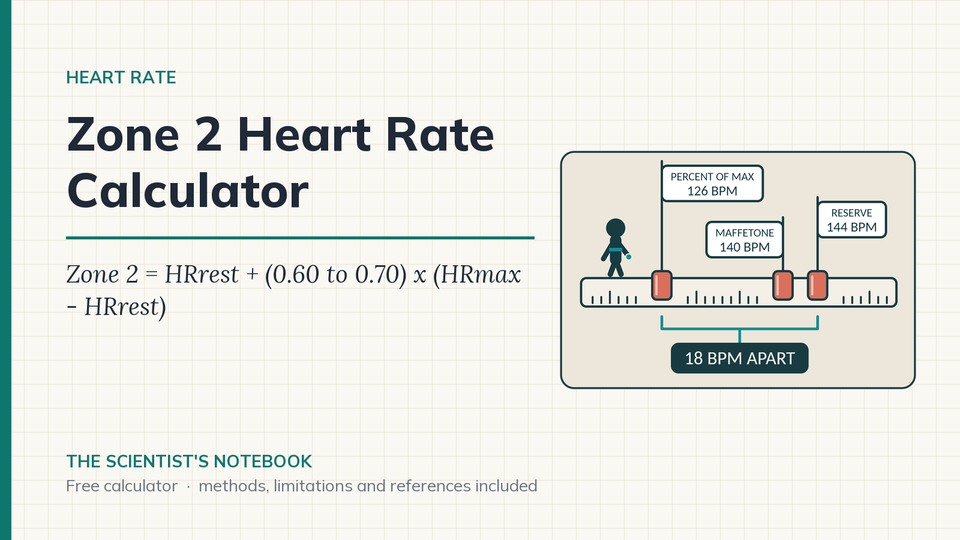
In short: The Zone 2 heart rate calculator shows three common bands side by side: 60 to 70% of heart-rate reserve, 60 to 70% of maximum heart rate, and the Maffetone rule of thumb of 180 minus age. For a 40-year-old with a resting rate of 60 bpm their tops land 18 bpm apart, so you can also check them against your measured first threshold.
How is a Zone 2 heart rate calculated?
You pick a method, and the calculator also shows every other method you gave it enough inputs for. All results are whole beats per minute (bpm).
- Heart-rate reserve: low = HRrest + 0.60 × (HRmax − HRrest), high = HRrest + 0.70 × (HRmax − HRrest)
- Percent of maximum: low = 0.60 × HRmax, high = 0.70 × HRmax
- Maffetone rule of thumb: low = 180 − age − 10, high = 180 − age (age in years). This comes from a coaching book, not a PubMed-indexed study, and I leave out his health-status adjustments.
- HRmax is a value you measured, or the Tanaka equation 208 − 0.7 × age when you give an age instead.
- First threshold (optional): the heart rate at your first lactate or ventilatory threshold (LT1 or VT1) from a lab test. The calculator reports how far the top of the band sits above or below it.
Worked example. A 40-year-old with a resting rate of 60 bpm and no measured maximum:
- HRmax = 208 − 0.7 × 40 = 180 bpm; reserve = 180 − 60 = 120 bpm
- Reserve method: 60 + 0.6 × 120 = 132 up to 60 + 0.7 × 120 = 144 bpm
- Percent of maximum: 0.6 × 180 = 108 up to 0.7 × 180 = 126 bpm
- Maffetone: 180 − 40 − 10 = 130 up to 180 − 40 = 140 bpm
The tops of the three bands land 18 bpm apart (126 to 144) and the bottoms 24 bpm apart (108 to 132). That gap is the honest answer to "what is my Zone 2 heart rate": it depends on whose definition you use. If a lab test put this athlete's first threshold at 140 bpm, the reserve band would end 4 bpm above it.
How do I use my Zone 2 range?
- Start from the lowest ceiling, adjust by feel. In the example the three bands share no common range, and the lowest ceiling is 126 bpm. Run easy sessions under it first, then use breathing and the ability to speak in full sentences to decide whether the band is too low or too high for you on the day.
- Turn the number into a test. A lab measurement of your first threshold replaces the guesswork. Enter that heart rate and the calculator tells you which formula was closest for you. The lactate threshold calculator covers the threshold side of this.
- Connect it to fuel. In a group of 55 endurance-trained men the intensity of maximal fat oxidation averaged 62.5% of VO2max, with a standard deviation of 9.8 percentage points (Achten and Jeukendrup 2003). That is a population average, and individuals ranged widely. The FatMax calculator shows the curve. For zones across the whole range use the heart-rate zones calculator.
Why do Zone 2 formulas disagree?
- Zone 2 has no single definition. In the physiological sense it sits below the first lactate or ventilatory threshold. A review of intensity methods found some evidence that LT1, the gas-exchange threshold and the ventilatory threshold separate the moderate and heavy domains, and little merit in fixed percentages of maximal values such as HRmax (Jamnick 2020).
- The 60 to 70% fractions are a convention. They are not a result from a cohort study.
- Seiler's 2010 summary of nationally or internationally competitive endurance athletes put about 80% of sessions at low intensity, with blood lactate near or below 2 mmol/L. That figure counts sessions and does not translate to a heart rate.
- In 26 elite male cyclists, 60% of VO2max sat at 73% of HRmax (Lounana 2007). In such athletes the whole 60 to 70% of HRmax band sits below 60% of VO2max.
- Fat oxidation and blood lactate were inversely related in professional athletes (r = −0.97), but that does not make one number a target (San-Millán and Brooks 2018).
- Age equations scatter by about 10.8 bpm (Nes 2013). Medicines that slow the heart, heat, altitude, caffeine and poor sleep move heart rate at a given effort.
⚠️ HEALTH & TRAINING GUIDANCE
Individual results vary significantly, and formula heart-rate bands may not apply if you take medicine that changes heart rate. Consult a sports medicine professional before making changes based on these estimates, and stop and get medical help for chest pain, fainting or unusual breathlessness.
ℹ️ IMPORTANT DISCLAIMER
This calculator is for educational purposes only and does NOT constitute medical advice. Consult qualified professionals before making changes. Individual physiology varies. You assume all risk. Must be 18+.
Frequently asked questions
What is my Zone 2 heart rate?
It depends on whose definition you use. For a 40-year-old with a resting rate of 60 bpm and an estimated maximum of 180 bpm, the reserve method gives 132 to 144 bpm, percent of maximum gives 108 to 126 bpm and Maffetone gives 130 to 140 bpm. In the physiological sense Zone 2 sits below your first lactate or ventilatory threshold.
Is Zone 2 a fixed percentage of maximum heart rate?
No. A review of intensity methods found some evidence that the first lactate threshold, the gas-exchange threshold and the ventilatory threshold separate the moderate and heavy domains, and little merit in fixed percentages of maximal values such as HRmax (Jamnick 2020). The 60 to 70% fractions are a convention, not a result from a cohort study.
Does the Maffetone 180 minus age formula work?
It is a coaching rule of thumb from a book, not a PubMed-indexed study, and the calculator leaves out his health-status adjustments. Treat it as one convention among three. If a lab test gives you a first-threshold heart rate, enter it and the calculator shows how far the top of your chosen band sits above or below it.
Is Zone 2 the same as the intensity of maximal fat oxidation?
Not exactly. In 55 endurance-trained men the intensity of maximal fat oxidation averaged 62.5% of VO2max with a standard deviation of 9.8 percentage points (Achten and Jeukendrup 2003), so individuals ranged widely. Fat oxidation and blood lactate were inversely related in professional athletes (r = −0.97), but that does not make one number a target.
Related calculators
- Fitness Age Calculator
- Heart Rate Recovery Calculator
- Heart-Rate Zones Calculator
- Max Heart Rate Calculator
- All calculators on The Scientist's Notebook
References
- Jamnick NA et al. · 2020 · Sports Medicine · PMID 32729096 · doi
- Seiler S. · 2010 · International Journal of Sports Physiology and Performance · PMID 20861519 · doi
- Seiler KS, Kjerland GØ. · 2006 · Scandinavian Journal of Medicine & Science in Sports · PMID 16430681 · doi
- San-Millán I, Brooks GA. · 2018 · Sports Medicine · PMID 28623613 · doi
- Achten J, Jeukendrup AE. · 2003 · International Journal of Sports Medicine · PMID 14598198 · doi
- Lounana J et al. · 2007 · Medicine & Science in Sports & Exercise · PMID 17277600 · doi
- Tanaka H, Monahan KD, Seals DR. · 2001 · Journal of the American College of Cardiology · PMID 11153730 · doi
- Nes BM et al. · 2013 · Scandinavian Journal of Medicine & Science in Sports · PMID 22376273 · doi
- Karvonen MJ, Kentala E, Mustala O. · 1957 · Annales Medicinae Experimentalis et Biologiae Fenniae · PMID 13470504
- Maffetone P. · 2010 · The Big Book of Endurance Training and Racing (Skyhorse) · not indexed in PubMed