Fitness Age Calculator
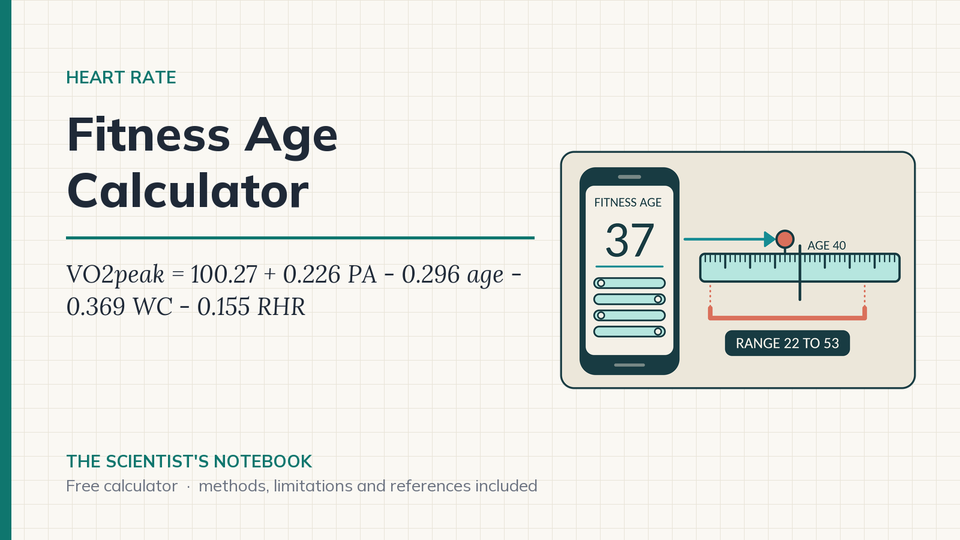
Fitness age translates a VO2peak into the age at which an average healthy person of your sex has the same aerobic capacity. If you have not been tested, this calculator estimates VO2peak from five answers using a model fitted to Norwegian adults. If you already know your VO2max, enter it and skip the estimate.
In short: Fitness age is the age at which an average healthy person of your sex has your VO2peak. This calculator estimates VO2peak from age, waist, resting heart rate and activity with the HUNT model (Nes 2011), or uses a VO2max you enter. In the worked example a 40-year-old man gets a fitness age of 37, with a range between 22 and 53.
How does the calculator work out a fitness age?
Step 1, VO2peak. The non-exercise model from the HUNT Study (Nes et al. 2011) predicts treadmill VO2peak in mL/kg/min from age in years, waist circumference in cm, resting heart rate in beats per minute and a physical activity index PA:
- Men:
VO2peak = 100.27 + 0.226 x PA - 0.296 x age - 0.369 x waist - 0.155 x resting HR - Women:
VO2peak = 74.736 + 0.198 x PA - 0.247 x age - 0.259 x waist - 0.114 x resting HR
The activity index multiplies three answers, giving a score from 0 to 45: sessions per week (under once = 0, once = 1, 2 to 3 = 2, almost daily = 3), session length (under 30 minutes = 1, 30 minutes or more = 1.5) and effort (easy = 1, some heavy breathing and sweating = 5, all out = 10). Training less than once a week scores zero. The answer weights follow the coding of NTNU's online fitness calculator. Only the 0 to 45 scale and the two equations could be checked in print, in Peterman et al. (2020). The calculator accepts ages 20 to 90, a waist of 40 to 200 cm, a resting heart rate of 25 to 120 bpm and a known VO2max of 10 to 95 mL/kg/min. If the inputs give an estimate outside 10 to 95 mL/kg/min, it asks you to check them instead of showing a fitness age.
Step 2, fitness age. The reference comes from the HUNT3 Fitness Study, which published mean VO2max for healthy men and women by decade of age; it fell by about 3.5 mL/kg/min per decade (Loe et al. 2013). I fitted a least-squares line through the five decade means from 20-29 to 60-69, taking the middle of each decade, which gives the average VO2max at a given age: 63.105 - 0.369 x age for men and 50.61 - 0.294 x age for women. The line also lands within 0.3 mL/kg/min of the 70-plus group at age 75. Solving it for age gives fitness age = (63.105 - VO2peak) / 0.369 for men and (50.61 - VO2peak) / 0.294 for women. The result is rounded and reported between 20 and 90 years, the age span of the reference sample.
Worked example. A 40-year-old man has a 90 cm waist and a resting heart rate of 60 bpm, and trains 2 to 3 times a week for 30 minutes or more at a moderate effort. PA = 2 x 1.5 x 5 = 15. VO2peak = 100.27 + 0.226 x 15 - 0.296 x 40 - 0.369 x 90 - 0.155 x 60 = 49.3 mL/kg/min, which is 14.1 METs. Fitness age = (63.105 - 49.31) / 0.369 = 37.4, shown as 37, three years below his calendar age. The model has a standard error of 5.70 mL/kg/min, so the calculator also shows the range for 43.6 to 55.0 mL/kg/min: a fitness age between 22 and 53.
How should I use my fitness age?
- Treat it as a prompt to test properly. The range usually spans about three decades, so a lab or field test will tell you more. The VO2max calculator estimates VO2max from performance data, and you can type that value in here.
- Track direction, not the decimal. The waist and resting heart rate terms move as you train and change body composition. Re-enter them every couple of months and look at the VO2peak line, not just the age.
- Set intensity from a measured number. Once you know your VO2max, use the training zones calculator to turn it into zones, and use the age-grade calculator to see how your race times compare across ages.
What are the limits of a fitness age estimate?
- The error is large. The model explained 61 % of the variance in VO2peak in men and 56 % in women, with standard errors of 5.70 and 5.14 mL/kg/min in about 4,260 healthy Norwegian adults (Nes 2011). One standard error equals about 15 years of fitness age for men and 17 for women. A single fitness age without its range overstates the precision.
- It cannot see elite fitness. The activity index stops at 45, and the sample was healthy general-population adults with a mean age near 48. The model was not built to separate a keen recreational athlete from a national-level one, so expect a less accurate result if you train a lot.
- The reference is Norwegian, healthy and treadmill-based. HUNT3 measured peak oxygen uptake while running on a treadmill, so a cycling test, a watch estimate or a field formula does not read on the same scale (Loe 2013).
- The waist and heart-rate inputs are noisy. Resting heart rate varies with sleep, illness, caffeine and stress. Measure waist the same way each time.
- Fitness age is a restatement of VO2peak. It adds a familiar unit, not new information. Higher estimated fitness was associated with lower all-cause and cardiovascular mortality in adults under 60 in a 24-year follow-up of about 37,000 healthy Norwegians (Nes 2014). That describes groups of people. It does not say what will happen to you, and it does not show that raising the number changes risk.
⚠️ HEALTH & TRAINING GUIDANCE
Individual results vary significantly. Fitness age is a population comparison, not a medical test. Consult a physician or sports medicine professional before starting vigorous exercise or making changes based on these estimates.
ℹ️ IMPORTANT DISCLAIMER
This calculator is for educational purposes only and does NOT constitute medical advice. Consult qualified professionals before making changes. Individual physiology varies. You assume all risk. Must be 18+.
Frequently asked questions
How accurate is a fitness age from the HUNT model?
The model explained 61 % of the variance in VO2peak in men and 56 % in women, with standard errors of 5.70 and 5.14 mL/kg/min (Nes 2011). One standard error equals about 15 years of fitness age for men and 17 for women, so the calculator shows a range next to the single number.
Can I enter a measured VO2max instead?
Yes. If you enter a VO2max from 10 to 95 mL/kg/min, the calculator skips the estimate and places that value on the reference line. Use peak oxygen uptake from a treadmill test if you can, because the HUNT3 reference means were measured during treadmill running (Loe 2013).
How is the activity index scored?
Sessions per week score 0 to 3, session length 1 or 1.5, and effort 1, 5 or 10. The three answers are multiplied, so the index runs from 0 to 45, and training less than once a week scores zero. The weights follow NTNU's online fitness calculator. Only the 0 to 45 scale could be checked in print.
What does a fitness age younger than my real age mean?
Your VO2peak matches the average healthy person of your sex at a younger age in the HUNT reference sample. Fitness age restates VO2peak in years and adds no new information. Higher estimated fitness was associated with lower mortality in adults under 60 (Nes 2014), but that describes groups of people, not what will happen to you.
Related calculators
- Heart Rate Recovery Calculator
- Heart-Rate Zones Calculator
- Max Heart Rate Calculator
- Zone 2 Heart Rate Calculator
- All calculators on The Scientist's Notebook