Heart-Rate Zones Calculator
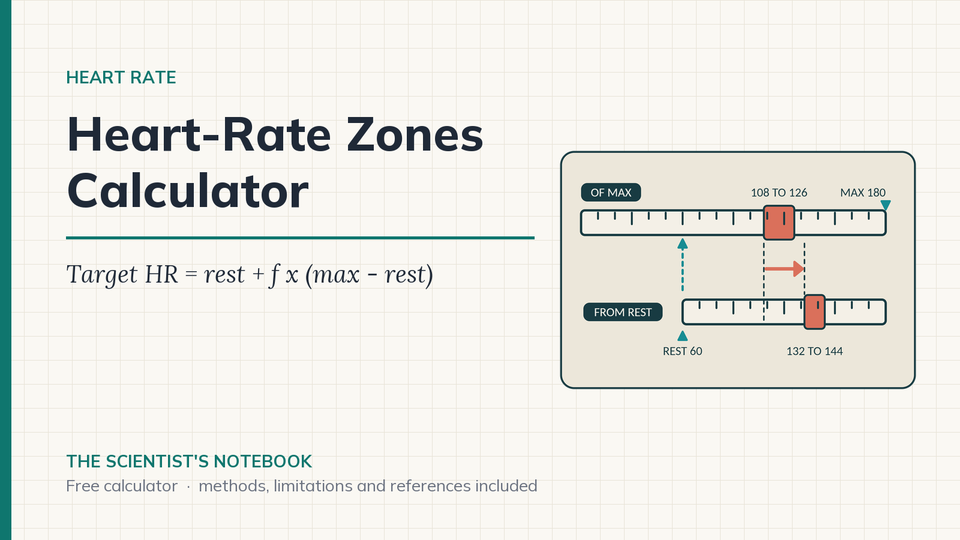
Heart-rate zones are only as good as the two numbers they are built on: your maximum and your resting rate. This calculator turns both into Karvonen reserve zones, lines them up against the ACSM intensity categories, and lets you add your own measured thresholds for a three-zone split.
In short: The heart-rate zones calculator uses the Karvonen method: each zone edge is your resting heart rate plus a fraction of your reserve, which is your maximum minus your resting rate. It builds five bands from 50 to 100% of reserve, shows the ACSM intensity categories on both the reserve and percent-of-maximum scales, and adds a three-zone split when you enter measured thresholds.
How are heart-rate zones calculated?
The Karvonen method adds a fraction of your heart-rate reserve to your resting rate. Reserve is the gap between what your heart does at rest and what it does flat out.
- Reserve = HRmax − HRrest (bpm)
- Target HR = HRrest + f × Reserve (bpm), rounded to whole beats
- f = 0.50, 0.60, 0.70, 0.80, 0.90 and 1.00 for the five-band layout (fraction of reserve, no unit)
- HRmax = a value you measured, or an age equation: Tanaka 208 − 0.7 × age, Fox 220 − age, Gellish 207 − 0.7 × age, Nes 211 − 0.64 × age, Gulati 206 − 0.88 × age (derived in women). Age is in years.
Each band runs from its lower edge to one beat below the next edge, so no heart rate belongs to two zones. The same reserve and maximum also give the ACSM intensity categories on two scales: light starts at 30% of reserve or 57% of maximum, moderate at 40% or 64%, vigorous at 60% or 77%, and near-maximal at 90% or 96%.
Worked example. A 40-year-old with a resting rate of 60 bpm and no measured maximum, using the Tanaka equation:
- HRmax = 208 − 0.7 × 40 = 180 bpm
- Reserve = 180 − 60 = 120 bpm
- Zone 1 (50 to 60%): 60 + 0.5 × 120 = 120 up to 131 bpm
- Zone 2 (60 to 70%): 132 to 143 bpm
- Zone 3 (70 to 80%): 144 to 155 bpm
- Zone 4 (80 to 90%): 156 to 167 bpm
- Zone 5 (90 to 100%): 168 to 180 bpm
On the ACSM scale the same person lands in the moderate category from 108 to 131 bpm on reserve, but from 115 to 138 bpm on percent of maximum. The two scales disagree by several beats because a percent of reserve is not a percent of maximum. That gap is expected, not an error.
If you add a first and second threshold heart rate from a lactate or gas-exchange test, the calculator also gives the three-zone split used in the polarized-training literature: below the first threshold, between the two, and above the second.
How do I use my heart-rate zones?
- Pace long easy sessions. Use the Zone 1 to Zone 2 band as a ceiling for aerobic base work, then check it against how breathing feels. If the numbers and the feel disagree by more than a few beats, trust the feel and re-measure your maximum. The Zone 2 heart-rate calculator goes deeper on that band.
- Set up a three-zone week. With measured thresholds, count the minutes you spend in each of the three zones. Seiler's 2010 review of national and international level athletes found about 80% of sessions at low intensity (blood lactate near 2 mmol/L or below) and about 20% dominated by high-intensity work. Note that this counts sessions, not minutes. It describes what those athletes did, not a rule for you.
- Cross-check your device. Many watches default to percent of maximum, not reserve. Enter the same two numbers here and compare. If the zones differ by 10 beats or more, the method is the reason, not a fault in either tool. For power-based zones use the training zones calculator, and for threshold work see the lactate threshold calculator. If you only have an age, start with the max heart rate calculator.
What are the limits of formula zones?
- An age equation is a population average. Nes and colleagues reported a standard error of 10.8 bpm in 3,320 healthy adults, so any zone edge built on it can be off by roughly that much.
- The five-band percentages are a coaching convention. I could not find a cohort study that validated ten-percent steps of reserve as separate physiological zones.
- The ACSM categories were written for general exercise prescription. In 26 elite male cyclists, 60% of VO2max sat at 73% of HRmax, above the 70% the 1998 ACSM scale implied, so for highly trained athletes the category edges can sit below the physiology (Lounana 2007).
- Heart-rate reserve tracks the reserve in oxygen uptake closely (regression slope 1.003), but percent of VO2max reads higher than percent of reserve at and below 65% of reserve (Lounana 2007).
- Medicines that slow the heart, arrhythmias, heat, altitude, dehydration and caffeine all move heart rate at a given effort. Cardiac drift also pushes heart rate up over a long steady session.
- Wrist optical sensors lose accuracy at high intensity and in the cold. A chest strap is the better reference.
⚠️ HEALTH & TRAINING GUIDANCE
Formula heart-rate zones can sit 10 beats or more from your own physiology, and they may not apply if you take medicine that changes heart rate. Consult a sports medicine professional before making changes based on these estimates. Stop and get medical help for chest pain, fainting or breathlessness out of proportion to the effort.
ℹ️ IMPORTANT DISCLAIMER
This calculator is for educational purposes only and does NOT constitute medical advice. Consult qualified professionals before making changes. Individual physiology varies. You assume all risk. Must be 18+.
Frequently asked questions
How are heart-rate zones calculated from heart-rate reserve?
Reserve is your maximum minus your resting heart rate. Each zone edge is the resting rate plus a fraction of the reserve, rounded to whole beats. For a 40-year-old with a resting rate of 60 bpm and a Tanaka maximum of 180 bpm, the reserve is 120 bpm and Zone 2 (60 to 70% of reserve) runs from 132 to 143 bpm.
Why do percent of maximum and percent of reserve give different zones?
Percent of maximum ignores your resting heart rate, while the reserve method adds a share of the reserve to it. For the same 40-year-old, the ACSM moderate category runs from 108 to 131 bpm on reserve but from 115 to 138 bpm on percent of maximum. The gap is expected, not an error.
How accurate are zones built on an age-predicted maximum heart rate?
An age equation is a population average. Nes and colleagues reported a standard error of 10.8 bpm in 3,320 healthy adults, so every zone edge built on it can be off by roughly that much. If you have a measured maximum, enter it instead of your age.
What is the three-zone split?
If you enter a first and second threshold heart rate from a lactate or gas-exchange test, the calculator gives three zones: below the first threshold, between the two, and above the second. Seiler's 2010 review of national and international level athletes found about 80% of sessions at low intensity. That counts sessions, not minutes.
Related calculators
- Fitness Age Calculator
- Heart Rate Recovery Calculator
- Max Heart Rate Calculator
- Zone 2 Heart Rate Calculator
- All calculators on The Scientist's Notebook
References
- Karvonen MJ, Kentala E, Mustala O. · 1957 · Annales Medicinae Experimentalis et Biologiae Fenniae · PMID 13470504
- Garber CE et al. · 2011 · Medicine & Science in Sports & Exercise · PMID 21694556 · doi
- Seiler S. · 2010 · International Journal of Sports Physiology and Performance · PMID 20861519 · doi
- Tanaka H, Monahan KD, Seals DR. · 2001 · Journal of the American College of Cardiology · PMID 11153730 · doi
- Nes BM et al. · 2013 · Scandinavian Journal of Medicine & Science in Sports · PMID 22376273 · doi
- Gellish RL et al. · 2007 · Medicine & Science in Sports & Exercise · PMID 17468581 · doi
- Gulati M et al. · 2010 · Circulation · PMID 20585008 · doi
- Swain DP, Leutholtz BC. · 1997 · Medicine & Science in Sports & Exercise · PMID 9139182 · doi
- Lounana J et al. · 2007 · Medicine & Science in Sports & Exercise · PMID 17277600 · doi
- Seiler KS, Kjerland GØ. · 2006 · Scandinavian Journal of Medicine & Science in Sports · PMID 16430681 · doi