Heart Rate Recovery Calculator
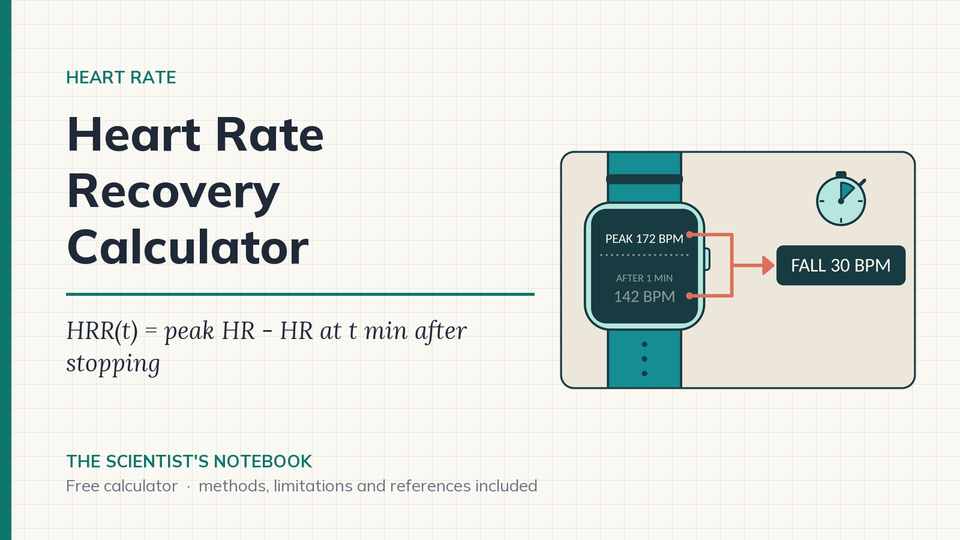
Heart-rate recovery is how many beats per minute your heart rate falls after you stop. This calculator works out the fall at 1 and 2 minutes and shows where it sits against the cutoffs used in two published cohort studies, which describe populations and not you.
In short: Heart-rate recovery is your peak heart rate minus your heart rate 1 or 2 minutes after you stop. A peak of 172 bpm and 142 bpm one minute later is a fall of 30 bpm. The calculator shows where each fall sits against the Cole cohort cutoffs of 12 bpm at 1 minute and 42 bpm at 2 minutes, which describe groups of people, not you.
How is heart-rate recovery calculated?
Recovery is a subtraction. Take your peak heart rate at the end of the effort and your heart rate a fixed time after you stop.
- HRR(t) = peak HR − HR at t minutes after stopping (bpm), for t = 1 and t = 2
- 1-minute cutoff: a fall of 12 bpm or less, the definition used by Cole and colleagues in 2,428 adults referred for clinical exercise testing (mean age 57, 63% men)
- 2-minute cutoff: a fall of 42 bpm or less, the definition used in a second Cole cohort of 5,234 adults without cardiovascular disease who had a submaximal test
In the first cohort, 26% of participants were at or below the 1-minute cutoff, and over 6 years the adjusted relative risk of death in that group was 2.0 (95% CI 1.5 to 2.7). In the second, 312 people died over 12 years and the adjusted relative risk for a 2-minute fall of 42 bpm or less was 1.55 (95% CI 1.22 to 1.98). Those are group-level associations in a clinical cohort and a population sample. They do not tell you anything about one measurement taken after a ride or a run.
Worked example. Peak heart rate 172 bpm. One minute later you read 142 bpm; two minutes later, 124 bpm.
- 1-minute fall = 172 − 142 = 30 bpm, which is above the 12 bpm cutoff
- 2-minute fall = 172 − 124 = 48 bpm, which is above the 42 bpm cutoff
Many online tools also label 1-minute falls as excellent, good, fair or poor using edges of 25 and 18 bpm. I could not trace those two numbers to a published source, so they are not used here. Only the cutoffs that come from the cohort papers are.
How do I use my heart-rate recovery?
- Track your own trend, not a verdict. A systematic review of 13 studies found heart-rate recovery related to training status in athletes, with the caveat that age, temperature and the intensity and length of the preceding effort confound comparisons (Daanen 2012). Buchheit makes the same point for heart-rate measures in general: read a change against the measurement error and the smallest change that matters (Buchheit 2014). Repeat the same test, on similar days, and look at the direction over weeks.
- Standardise the protocol. Same end-of-effort target, same cool-down (stand still, or the same slow walk), same posture, same strap. A recovery number after a 40-minute tempo run and one after a 30-second sprint are different measurements. For zones to build the effort around, use the heart-rate zones calculator.
- Read it next to other signals. Morning heart-rate variability, resting heart rate, sleep and how the session felt each add context that a single recovery number lacks. The HRV calculator compares a rolling average with your own baseline.
What are the limits of the cohort cutoffs?
- The cutoffs come from adults referred for clinical exercise testing (mean age 57 in the first cohort) and from a population-based sample, not from endurance athletes, and neither used a field test.
- Cool-down protocol matters. Active recovery (walking) and passive recovery (standing or sitting) can produce different heart-rate curves, so only compare like with like.
- Beta-blockers and other rate-slowing medicines change recovery, and so do arrhythmias. The cutoffs cannot be read without that context.
- A single reading varies with hydration, heat, sleep, caffeine, illness and how hard the preceding effort was. Methods of quantifying post-exercise autonomic recovery have different strengths and weaknesses, and their reproducibility needs more attention (Peçanha 2017).
- This tool is not a medical test and does not say anything about your health. If you have symptoms such as chest pain, fainting or palpitations, stop exercising and seek medical help.
⚠️ HEALTH & TRAINING GUIDANCE
Individual results vary significantly, and these cohort cutoffs describe groups of people, not you. Consult a healthcare professional about any concern about your heart, and stop and get medical help for chest pain, fainting or palpitations.
ℹ️ IMPORTANT DISCLAIMER
This calculator is for educational purposes only and does NOT constitute medical advice. Consult qualified professionals before making changes. Individual physiology varies. You assume all risk. Must be 18+.
Frequently asked questions
Is there a good or bad heart-rate recovery number?
Not one you can apply to yourself. The two published cutoffs, a 1-minute fall of 12 bpm or less (Cole 1999) and a 2-minute fall of 42 bpm or less (Cole 2000), come from cohort studies of adults having clinical exercise testing and of a population sample. The 25 and 18 bpm tier edges used by many online tools could not be traced to a published source, so this calculator does not use them.
How do I measure heart-rate recovery?
Note your heart rate at the end of a hard effort, stop, and read it again at 1 and 2 minutes. Keep the protocol the same every time: the same end-of-effort target, the same cool-down (stand still, or the same slow walk), the same posture and the same strap. A recovery after a 40-minute tempo run and one after a 30-second sprint are different measurements.
What did the Cole cohort studies report?
In 2,428 adults referred for clinical exercise testing, 26% had a 1-minute fall of 12 bpm or less, and over 6 years that group had an adjusted relative risk of death of 2.0. In 5,234 adults without cardiovascular disease, 312 people died over 12 years and the adjusted relative risk for a 2-minute fall of 42 bpm or less was 1.55. These are group-level associations, not a statement about one person.
Can athletes use heart-rate recovery to track training?
As a trend, with care. A systematic review of 13 studies found heart-rate recovery related to training status in athletes, but age, temperature and the intensity and length of the preceding effort make comparisons hard (Daanen 2012). Read a change against the measurement error and the smallest change that matters (Buchheit 2014), and look at the direction over weeks.
Related calculators
- Fitness Age Calculator
- Heart-Rate Zones Calculator
- Max Heart Rate Calculator
- Zone 2 Heart Rate Calculator
- All calculators on The Scientist's Notebook
References
- Cole CR et al. · 1999 · New England Journal of Medicine · PMID 10536127 · doi
- Cole CR et al. · 2000 · Annals of Internal Medicine · PMID 10744592 · doi
- Daanen HA et al. · 2012 · International Journal of Sports Physiology and Performance · PMID 22357753 · doi
- Buchheit M. · 2014 · Frontiers in Physiology · PMID 24578692 · doi
- Peçanha T et al. · 2017 · International Journal of Cardiology · PMID 27836300 · doi