The athletes at the end of the alphabet
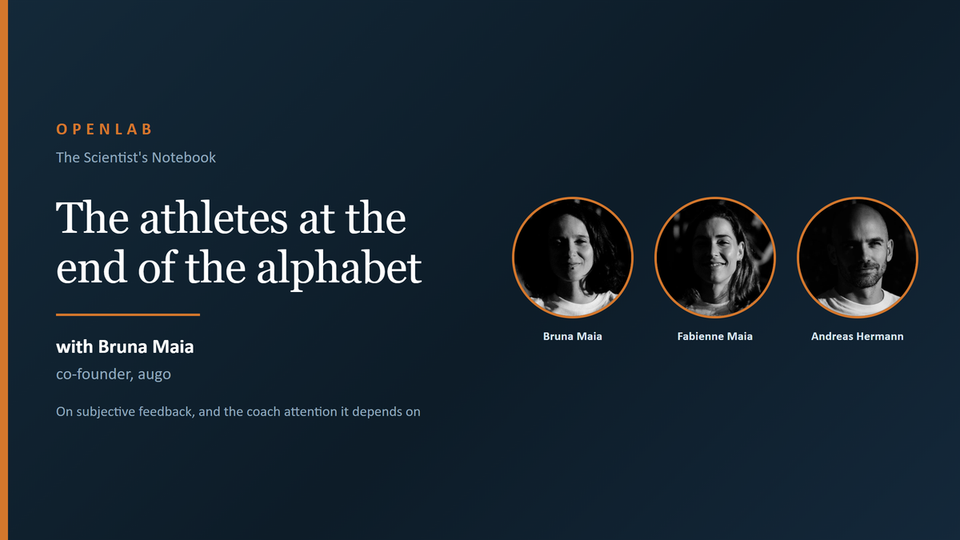
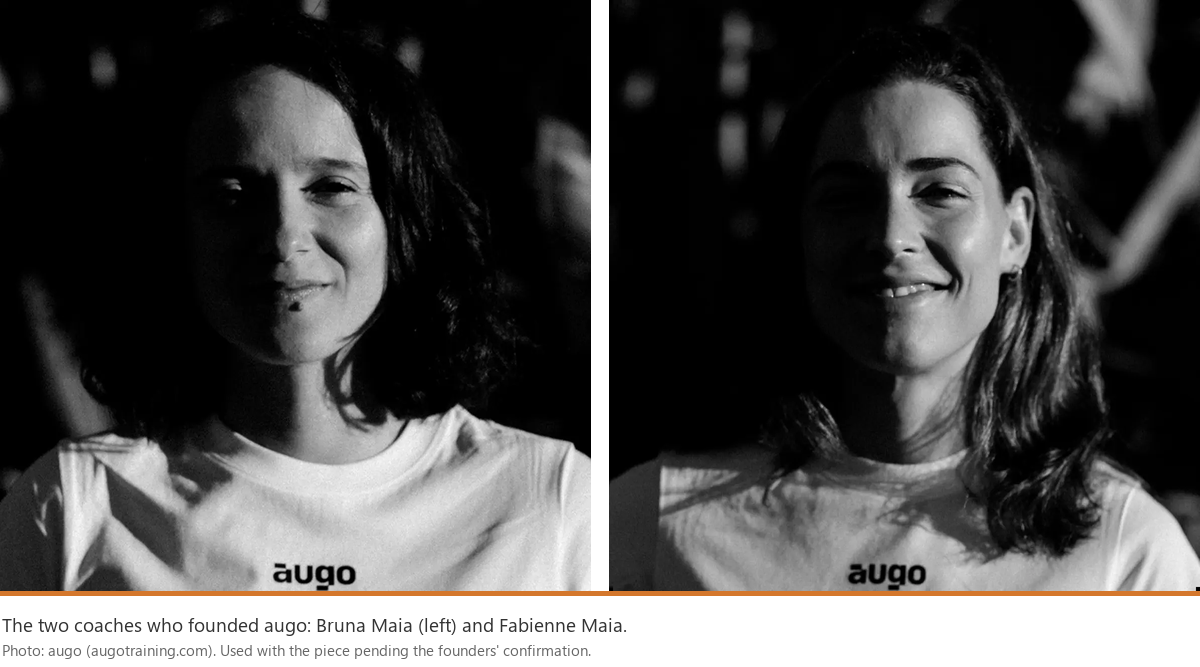
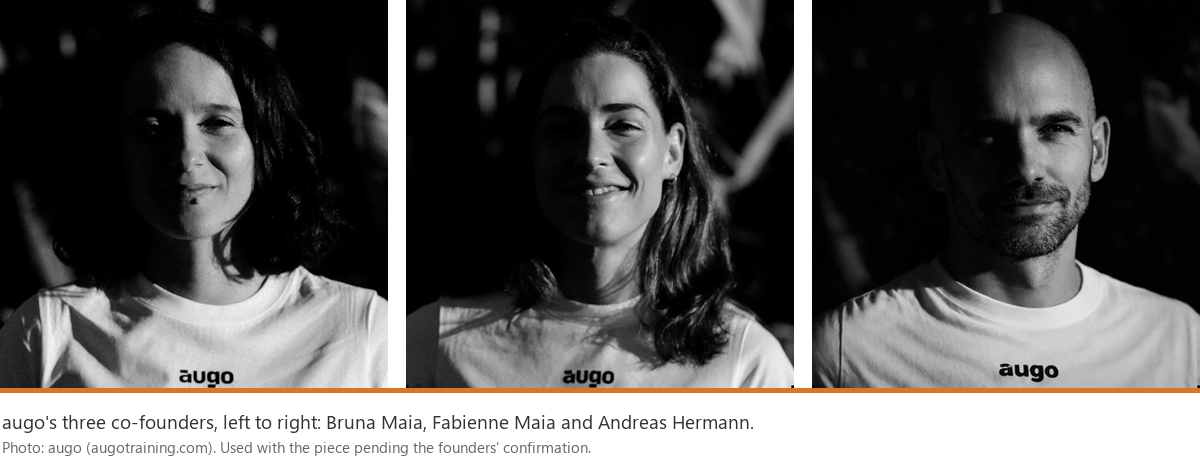
Bruna Maia is a runner, a data scientist and an electrical engineer. She played tennis at international level for a decade, burned out on it, and found running in 2013 as a way back into movement she actually enjoyed. Nine marathons followed, with a personal best of 3:14, plus a 54 km race and two 70.3 triathlons. She started coaching amateur runners in 2021, and founded her own practice, Jornada Endurance.
In September 2024, on day seven of a ten-day silent meditation retreat, she decided to build the coaching platform she had been describing to herself for years. augo, the coach-facing assistant she founded with Fabienne Maia, came out of that decision. Andreas Hermann, a computer scientist and former sportstech CTO, joined as a third co-founder in late 2025. Bruna also co-hosts the Human Endurance Podcast. Roughly 550 coaches and athletes use augo today.
Why this topic:
Since 2021 Bruna has been on both sides of the same problem: collecting how athletes feel, and then trying to actually read it. That is a measurement problem and an attention problem at once, and the second one gets far less airtime.
Every Monday, Bruna opened her coaching platform and worked down her athlete list from the top. Not by who had a race in nine days. Not by who had gone quiet. Alphabetically, because the software offered no other order. She would read one workout at a time, looking for what the athlete had written about how it felt, then move to a messaging app to see whether anything more had been said there. The reading itself was fine. What was not fine was what happened to her somewhere around the fourth athlete, and what that did to everyone whose surname started late.
It was fine for the first 3-4 athletes. Afterwards I could feel my energy start to drift and I wasn't as sharp anymore. Athletes at the bottom of the alphabet always got the less energized version of this, and many times I missed critical signals for injury, worry, etc. I didn't feel like a good coach when this happened.
The brief
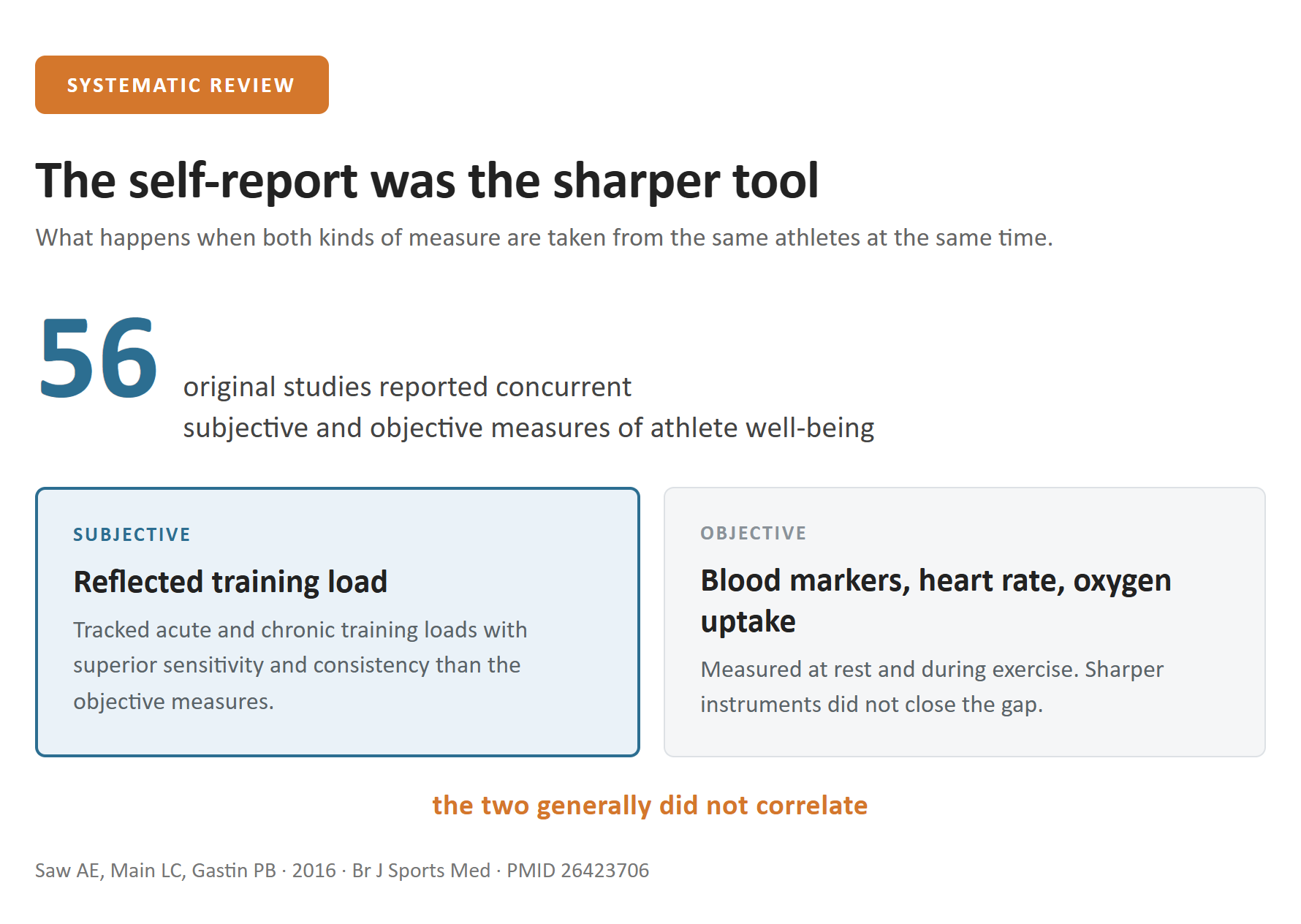
- Across 56 studies comparing them head to head, subjective self-reported measures and objective markers of athlete well-being generally did not correlate, and the subjective ones tracked training load over both short and long timescales with better sensitivity (Saw 2016).
- The signal a coach most needs is therefore the one a watch cannot produce, which puts the burden on asking well and reading consistently.
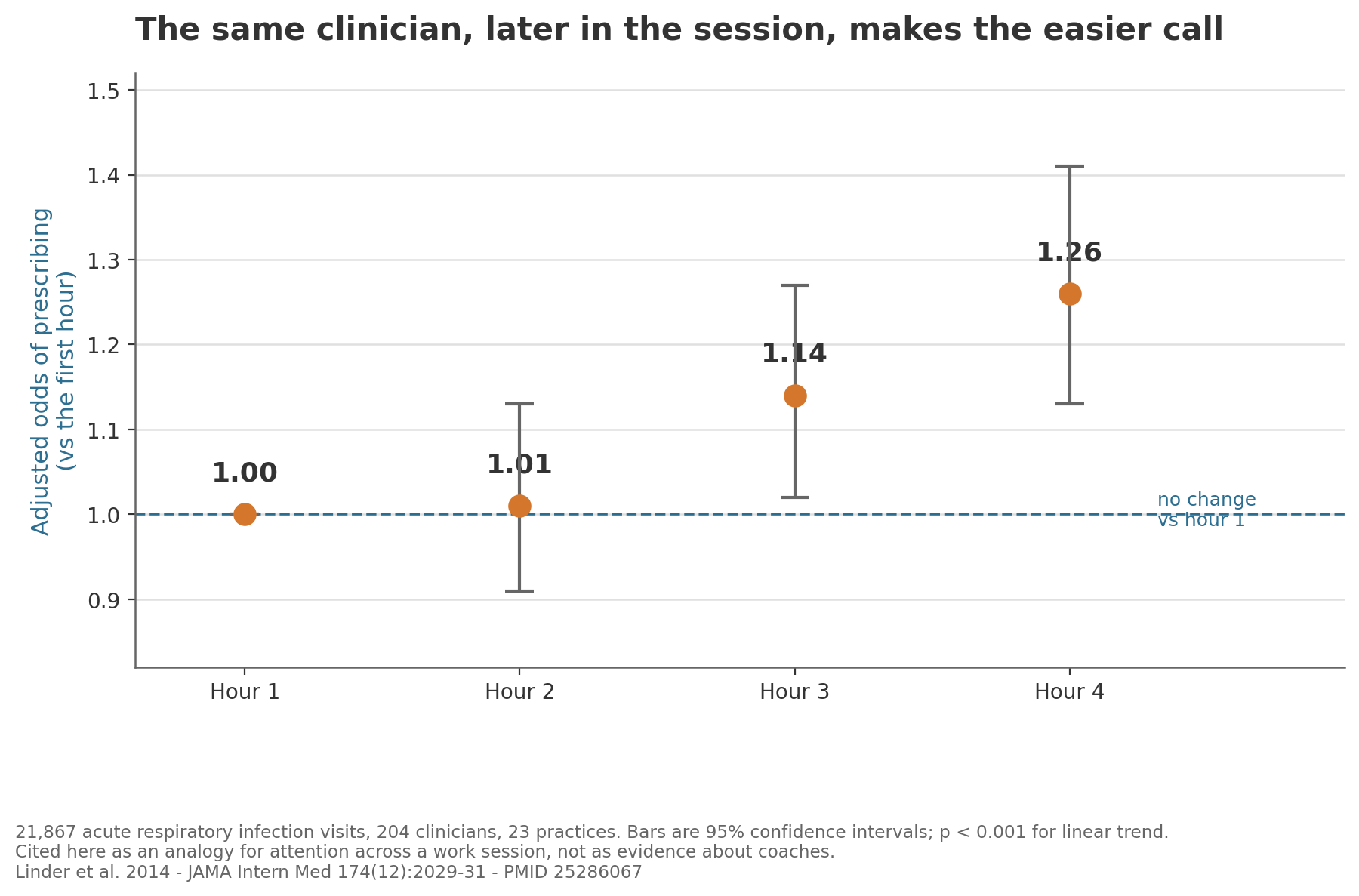
- Attention is not flat across a work session. In 21,867 primary-care visits, the adjusted odds that a clinician wrote a prescription rose to 1.26 by the fourth hour of a four-hour session compared with the first (Linder 2014). Different profession, same shape of problem.
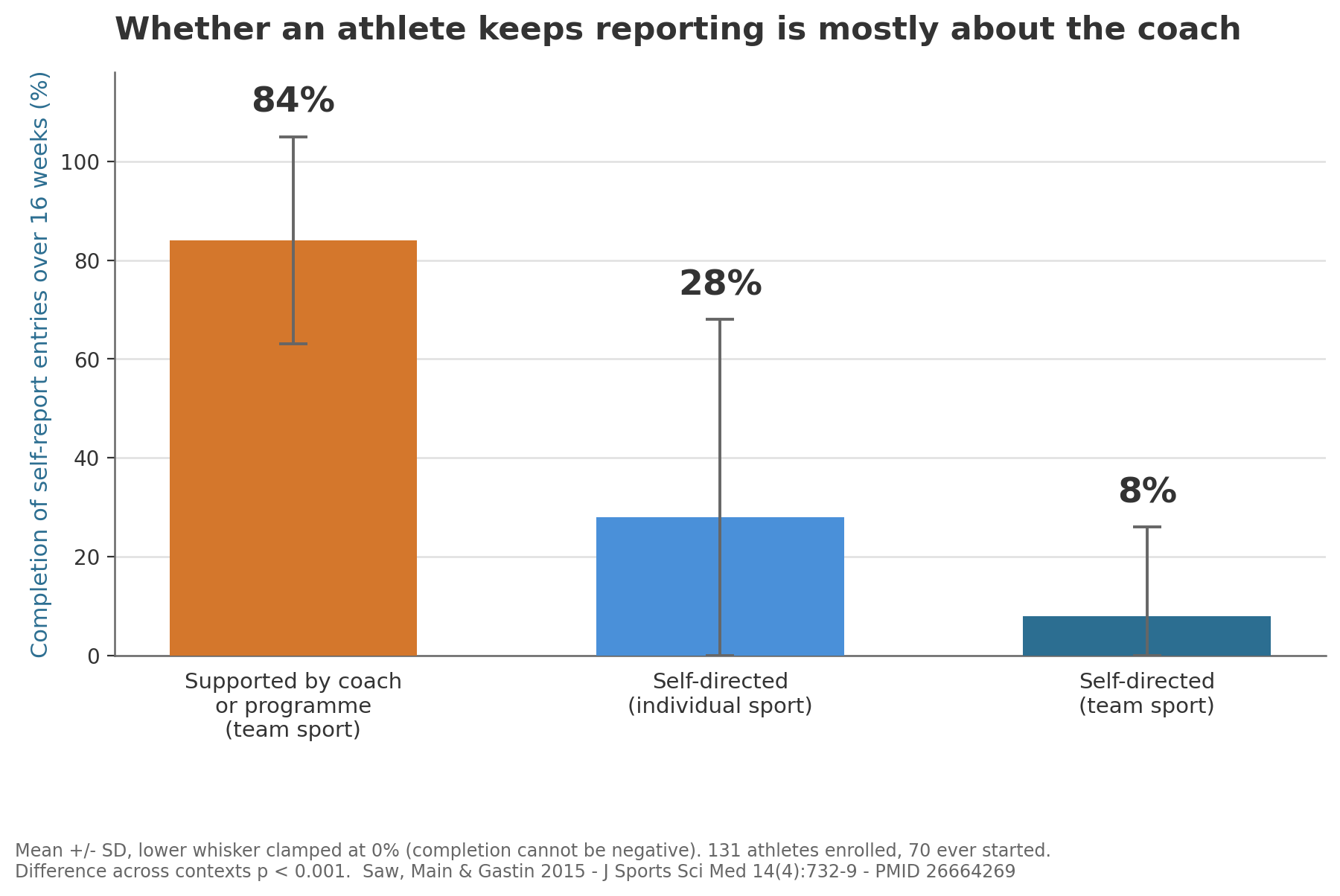
- Compliance with a self-report measure is not mainly about the athlete's discipline. Team-sport athletes actively supported by their coach hit 84% completion; athletes left to self-direct managed 28% in individual sport and 8% in team sport (Saw 2015b).
- When athletes perceive that a coach either ignores their reports or over-reacts to them, interview data show they start reporting dishonestly (Neupert 2019). The feedback loop is the data-quality mechanism.
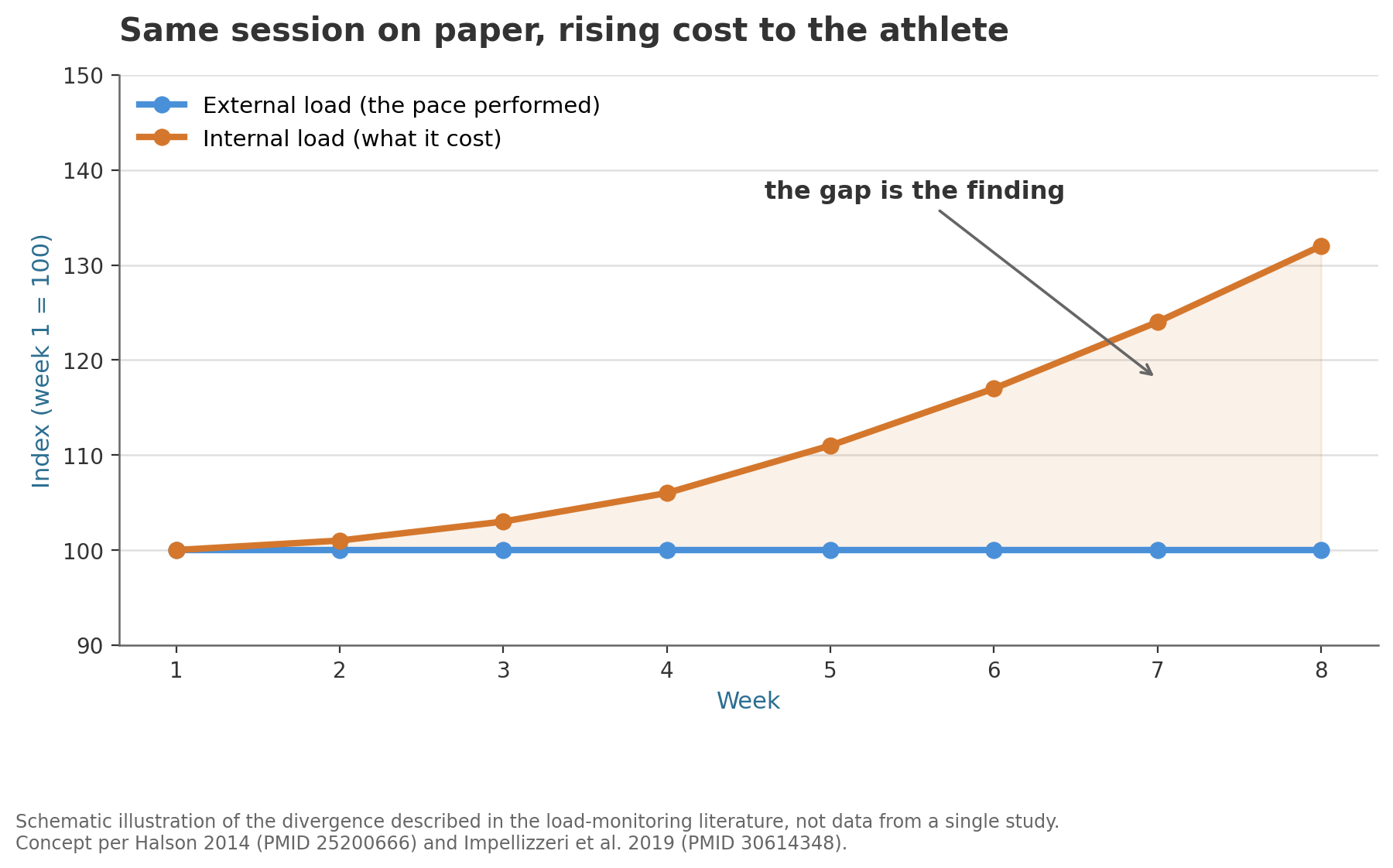
- A pace inside the easy band paired with a moderate-to-high perceived effort is not noise. That gap between what was done and what it cost is the thing worth reading.
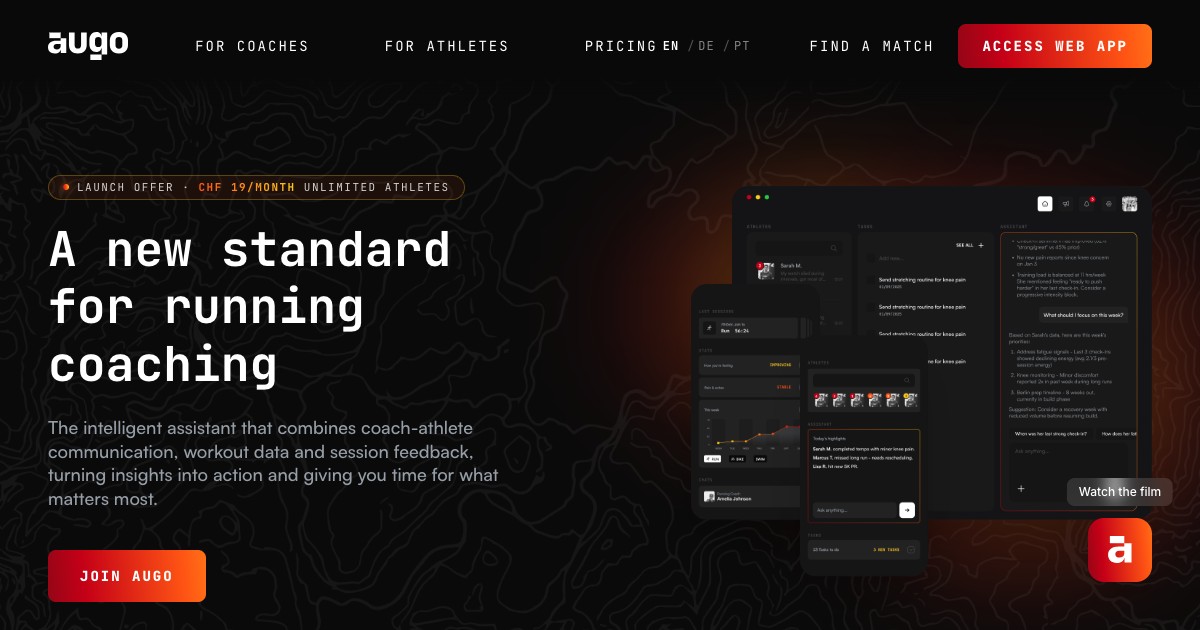
- augo's stated design line is retrieval rather than recommendation, which keeps the interpretation where the accountability already sits.
The science at a glance
Bruna's Monday had two failures stacked on top of each other, and only one of them was about software. The first was that the most useful information in her athletes' week was scattered across a workout comment, a chat thread and whatever someone happened to mention on a call. The second was that her capacity to read it carefully ran out before her athlete list did.
Wednesday through Friday, I'd hunt through scattered session feedback, trying to remember who felt great when and who was struggling. The platforms treat these insights like afterthoughts, burying them in calendars where they disappear forever.
Bruna Maia (augo's Substack)
The research is unusually blunt about which of those two data streams matters. Across 56 studies that measured both at once, subjective and objective markers of well-being generally did not track each other, and the subjective measures responded to increases and decreases in training load with more sensitivity and more consistency than the objective ones (Saw 2016). Sharper tools did not close the gap. The self-report was the sharper tool.
 Bruna and Fabi
That result is easy to misread as a licence to stop measuring things. It isn't. It says that when the questionnaire and the biomarker disagree, the questionnaire has usually earned more trust about how the athlete is coping, which is a narrower and more useful claim.
Foundational Principles:
The first principle is that a perceived-effort number is a measurement, not a mood. Session-based ratings of perceived exertion were validated more than twenty years ago against a heart-rate-derived standard across steady-state work, intervals and court sport, and they held up across all three (Foster 2001). The number is noisy in the way all measurements are noisy, and it carries information the external record does not.
Scientist's Insight: the reason it carries extra information is that external load and internal load are two different constructs, not two versions of the same one (Impellizzeri 2019). One describes the work performed, the other describes what that work cost the person performing it. A gap between them is a practical indicator that an athlete is accumulating fatigue (Halson 2014), which means the disagreement is the finding.
The two coaches see the same gap constantly, in the population where it is loudest.
I see this all the time with my beginners: Run paces are within range for "easy" but their RPE is moderate to high. You have to dig deeper to understand if this is just the newbie never feeling like running is easy or if they are actually pushing too hard and their zones might be off or maybe it was just too hot that day.
The second principle is that self-report degrades when nobody visibly reads it. Among national-team sprint athletes, the main driver of poor adherence was not effort or forgetfulness. It was the absence of any feedback from staff on data the athletes had already handed over (Neupert 2019). Worse, athletes who felt that their reports triggered disproportionate changes to training responded by reporting dishonestly, which turns an unread questionnaire into an actively misleading one.

Scientist's Insight: This makes data quality a property of the coach's behavior rather than the athlete's character. An unanswered questionnaire and an over-answered one fail in the same direction, and both failures are invisible in the data itself. The numbers keep arriving. They just stop being true.
What the data actually shows
What follows is what the literature reports and where athletes tend to cluster, not a set of instructions. Bruna's quoted words are her own and keep her framing.
Consistency outranks precision
The data: compliance with an athlete self-report measure varies far more with the social context around it than with the measure itself. Over 16 weeks, team-sport athletes supported by their coach or programme completed 84% of entries. Athletes using the same measure on their own initiative completed 28% in individual sports and 8% in team sports. Only 70 of 131 interested athletes ever started (Saw 2015b).
Where athletes tend to land: the ones who keep answering are usually the ones receiving something back, and they cite the output they get as the reason they continue. Self-directed athletes cite low burden and personally relevant content instead (Saw 2015b).
Bruna's stated priority is the same ordering.
To be clear about the importance of the subjective data and how it allows coaches to make better decisions, so you encourage athletes to answer this consistently (without consistency it's not as useful).
The individual baseline carries the meaning
The data: individualization of monitoring cannot be over-emphasized, because the within-athlete change is what moves with training load, not the between-athlete comparison (Halson 2014).
Where athletes tend to land: some report at the top of the scale by default, some at the middle, and the informative event is the departure from their own pattern rather than the absolute value.
Understand that athletes report differently. Some will always say they are "great", and a "normal" answer might be a red flag. Some will always answer "normal" and a "great" day is an outlier.
Under-reporting is the common failure, not over-reporting
The data: athletes shade their reports toward what they expect will keep training intact, particularly where they read the response as disproportionate (Neupert 2019).
Where athletes tend to land: the distortion runs toward looking fine.
Generally athletes try to mask their problems as much as possible, which in fact creates a problem in the other direction.
What the data does NOT show: that any current self-report system separates a stoic athlete from a genuinely comfortable one. That inference still sits with whoever knows the person.
Join our Discord community:
 Thomas Mortelmans
A visible response is what keeps the data honest
The data: perceived opacity in how monitoring data changes a training plan is among the primary causes of poor adherence, alongside insufficient feedback (Neupert 2019). Buy-in and reinforcement sit alongside the design of the measure itself (Saw 2015a).
Where athletes tend to land: reporting persists where athletes can point to something that changed because of what they wrote.
If they see their coach react to their own feedback, asking more in depth questions as follow-up, and/or adjusting training based on the feedback shared.
The protocol
This is the shape of Bruna's own weekly practice, described so it can be compared against rather than copied.
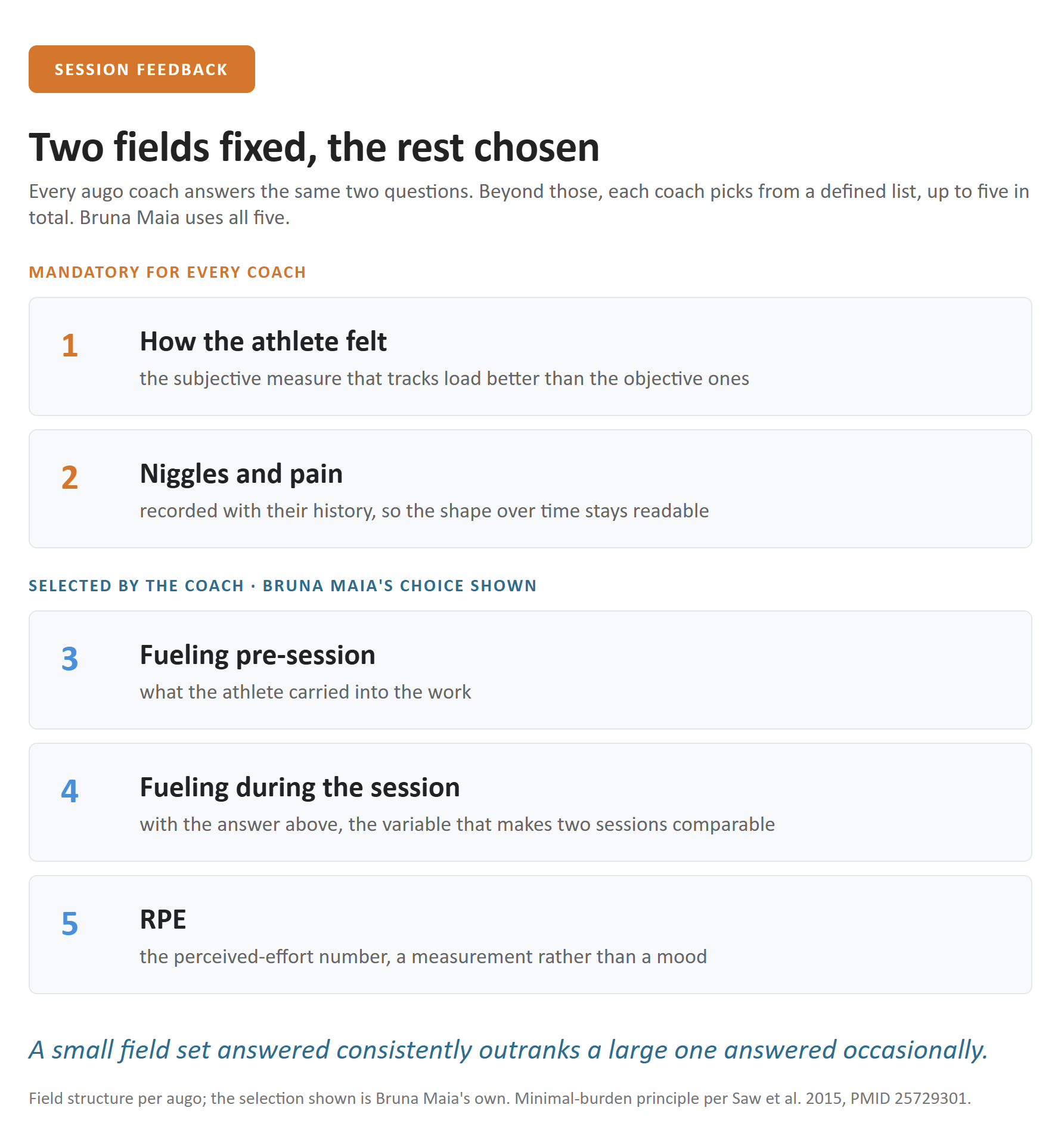
- A small set of fields per session, two of them fixed. augo makes how the athlete felt and whether there were niggles or pain mandatory for every coach, then lets each coach select the rest from a defined list, up to five questions in total. Bruna's own three, alongside the two mandatory ones, are fueling pre-session, fueling during the session, and RPE, which takes her to the cap. The implementation research points the same way: quality data with minimal burden (Saw 2015a).
- The same fields every session, so the athlete's own baseline becomes readable over weeks rather than guessed at in the moment.
- Pain and niggles recorded with their history, not just their presence, so that the shape over time is available later.
- A visible response of some kind, whether a follow-up question or an adjustment, since that response is what sustains honest reporting (Neupert 2019).
- Interpretation left with the coach.
The platform's two mandatory fields and the two fueling questions she adds are, in her words, one category rather than two.
How the athlete felt, if there were any niggles/pains, and nutrition before and during are non-negotiable. I need to know these variables to understand the athlete's ability to absorb training and compare workouts with one another fairly.
On what a system would need to surface, Bruna's answer is deliberately unglamorous.
It's really simple: Niggle evolution (when it started, when did it get better or worse). Not rocket science: Simply recording feel and niggles overtime will give a coach this information.
She is also explicit about the trade she would accept to get it. Most alerting systems are tuned the other way, toward suppressing false positives.
I'd be fine with many false alarms, as long as it prevents me from missing the real alarm
The part of this I keep returning to is not the measurement claim, which is well established, but the ordering claim underneath it. A coach reading twelve athletes on a Monday is not the same reader at athlete eleven as at athlete two, and no amount of better questionnaire design fixes that. It is a scheduling problem wearing a data problem's clothes.
Best regards,
Bruna Maia and Dr. Thomas Mortelmans
A note on our guest and the release of a very exciting feature
Bruna Maia is a data scientist and electrical engineer who coaches runners, and she co-founded augo with Fabienne Maia after running that Monday routine by hand for years. The question she keeps returning to is where the boundary sits: which decisions belong to software, and which stay with the person accountable for the athlete. You can find her work at augo, her writing at augo's Substack, and her coaching at Jornada Endurance.
On 9 September 2026, the day this piece runs, augo adds workout creation and an MCP connector to Claude and ChatGPT, which the company describes as the move from an assistant for endurance coaches to a platform covering the whole coaching workflow. It runs free for 14 days, then $9 per athlete per month. augo has also said coaches will be able to write their own session-feedback questions rather than selecting from the current list.
augo is meant to be an AI for retrieval. It won't give recommendations unless the coach asks it to. This is by design: We want the coach to be the decision-maker, not the AI.
Limits and caveats
The clinician study is an analogy, not evidence about coaches (Linder 2014). Nobody has run the equivalent study on coaches reviewing athletes, so the alphabet effect described here is one practitioner's account sitting next to a quantified finding from a different profession. Its authors are explicit that scheduled time was a proxy and that other accumulating factors could contribute. The self-report literature is also drawn largely from supported, high-performance settings, where the athlete has a programme around them (Saw 2015b).
The compliance numbers deserve the same care. The 84% is team-sport athletes who were supported; the study never reports a supported individual-sport group, which is the group closest to the runners Bruna actually coaches. So 84 against 8 is a within-team-sport contrast, and the spread behind those means is wide: 84 ± 21, 28 ± 40, 8 ± 18, from the 70 of 131 interested athletes who started at all. The direction of the finding is the part to carry over, not the figure.
Disclosure: I was a guest on Bruna and Fabienne's Human Endurance Podcast, and I build training analytics myself, so this is a conversation between people working on adjacent problems rather than a neutral review.
References
- Saw AE, Main LC, Gastin PB. Monitoring the athlete training response: subjective self-reported measures trump commonly used objective measures: a systematic review. Br J Sports Med. 2016;50(5):281-91. PMID 26423706. Reviewed 56 studies that measured subjective and objective well-being at the same time; the two generally did not correlate, and the subjective measures tracked training-load changes more sensitively.
- Saw 2015a. Saw AE, Main LC, Gastin PB. Monitoring athletes through self-report: factors influencing implementation. J Sports Sci Med. 2015;14(1):137-46. PMID 25729301. Interviews across 20 sport programmes identifying what makes self-report monitoring stick, split between the measure itself and the social environment around it.
- Saw 2015b. Saw AE, Main LC, Gastin PB. Impact of Sport Context and Support on the Use of a Self-Report Measure for Athlete Monitoring. J Sports Sci Med. 2015;14(4):732-9. PMID 26664269. Followed 131 athletes over 16 weeks; coach-supported athletes completed 84% of entries against 28% and 8% for self-directed athletes.
- Neupert EC, Cotterill ST, Jobson SA. Training-Monitoring Engagement: An Evidence-Based Approach in Elite Sport. Int J Sports Physiol Perform. 2019;14(1):99-104. PMID 29952658. Interviews with nine national-team sprinters found poor adherence traced to staff not feeding back on the data, and disproportionate training changes producing dishonest reporting.
- Halson SL. Monitoring training load to understand fatigue in athletes. Sports Med. 2014;44(Suppl 2):S139-47. PMID 25200666. Review of load-monitoring tools concluding that dissociation between external and internal load may reveal an athlete's fatigue state, and that individualization matters more than tool choice.
- Impellizzeri FM, Marcora SM, Coutts AJ. Internal and External Training Load: 15 Years On. Int J Sports Physiol Perform. 2019;14(2). PMID 30614348. Refines the framework separating the work an athlete performs from the physiological cost of performing it.
- Impellizzeri FM, et al. Understanding Training Load as Exposure and Dose. Sports Med. 2023. PMID 37022589. Recasts external load as exposure and internal load as dose, borrowing the vocabulary of occupational epidemiology.
- Linder JA, Doctor JN, Friedberg MW, et al. Time of day and the decision to prescribe antibiotics. JAMA Intern Med. 2014;174(12):2029-31. PMID 25286067. Across 21,867 visits by 204 clinicians, adjusted odds of prescribing rose to 1.26 by the fourth hour of a session versus the first. Cited here only as an analogy for attention across a work session.
- Gabbett TJ. The training-injury prevention paradox: should athletes be training smarter and harder? Br J Sports Med. 2016;50(5):273-80. PMID 26758673. Argues that under-training also raises injury risk, and that load has to be measured frequently and over months to be interpretable.
- Foster C, Florhaug JA, Franklin J, et al. A new approach to monitoring exercise training. J Strength Cond Res. 2001;15(1):109-15. PMID 11708692. Validated session ratings of perceived exertion against a heart-rate-derived standard across steady-state, interval and court exercise.
- Maia B. Why I'm building augo. augo's Substack, 12 July 2025. Bruna's founding account, including the silent retreat, the alphabetical Monday review and the athlete she calls Ana.
- augo. The intelligent platform for endurance coaches. Product site carrying the named features referred to here, including the daily attention view, session-feedback trends, workout creation and the connector to Claude and ChatGPT.
- Human Endurance Podcast. Bruna Maia and Fabienne Maia's podcast, where much of their coaching thinking is on the record.
- Startupticker. KI-Tool erleichtert Ausdauersport-Coaches weltweit die Arbeit. 2025. German-language profile of the company covering its founding, its beta cohort of roughly 150 coaches and its third co-founder.
- Jornada Endurance. Bruna's own coaching practice, which is the setting for the Monday-morning routine described here, and which she describes in her Substack founding post. No separate site for the practice is cited.
Is subjective athlete feedback more useful to a coach than device data?
Across 56 studies that measured both at once, subjective self-reported measures of athlete well-being generally did not correlate with objective markers, and the subjective measures tracked training load over both short and long timescales with better sensitivity. The practical constraint is not the measure but the reading: among team-sport athletes, compliance reaches 84% when a coach visibly responds and falls to 8% when they self-direct.
Frequently asked questions
Do subjective measures beat objective ones for monitoring athletes?
A systematic review of 56 studies found subjective and objective measures generally did not correlate, with subjective measures responding to training-load changes more sensitively and consistently.
Why do athletes stop filling in wellness questionnaires?
Interviews with national-team athletes identified lack of feedback from staff as the main driver of poor adherence. Athletes who felt training changes were disproportionate reported dishonestly instead.
What does it mean when easy pace feels hard?
A gap between external load (the pace performed) and internal load (its perceived cost) is a documented indicator of accumulating fatigue, though it can also reflect heat, inexperience or misset zones.
Which session-feedback fields matter most?
In this coach's practice: how the athlete felt and whether there were niggles or pain, both mandatory on her platform, plus three she chooses herself, fueling pre-session, fueling during the session and RPE. Implementation research favours a small field set with minimal burden.
If you have 60 seconds, I would value your anonymous feedback. You can share it here.
Health disclaimer
This post discusses endurance-training science for educational purposes. It is not medical advice, not a diagnosis, and not a substitute for clinical care. Individual response to training, sleep deprivation, and multi-day exertion varies substantially, and what applies to a research cohort or a world-class athlete may not apply to you. Consult a qualified physician, sports medicine specialist, or registered dietitian before changing your training, fuelling, or sleep strategy if you have a cardiovascular, metabolic, psychiatric, or sleep-related condition; are recovering from injury or illness; are pregnant; are on medication that affects heart rate, hydration, glucose regulation, or sleep; or have concerns about exercise tolerance. Ultra-endurance events impose real physiological and psychological loads. Persistent chest pain, fainting, acute confusion beyond the predictable late-race window, severe dehydration, sustained loss of coordination, or any mental-health symptoms that outlast the immediate post-event dip warrant professional care and are not signals to push through. No outcome is guaranteed. The protocols, anchors, and case material in this post are descriptive, drawn from peer-reviewed evidence and a guest contributor's lived experience, and should be treated as inputs to an informed conversation with your own coach and clinicians, not as prescriptions.
Found this useful?
Get articles like this and free training calculators in your inbox every week.
Recommended reads
If this was useful, these are the other research-driven newsletters I actually read.



Member discussion