Snippet #035: Phosphocreatine: The Muscle's Instant ATP Battery
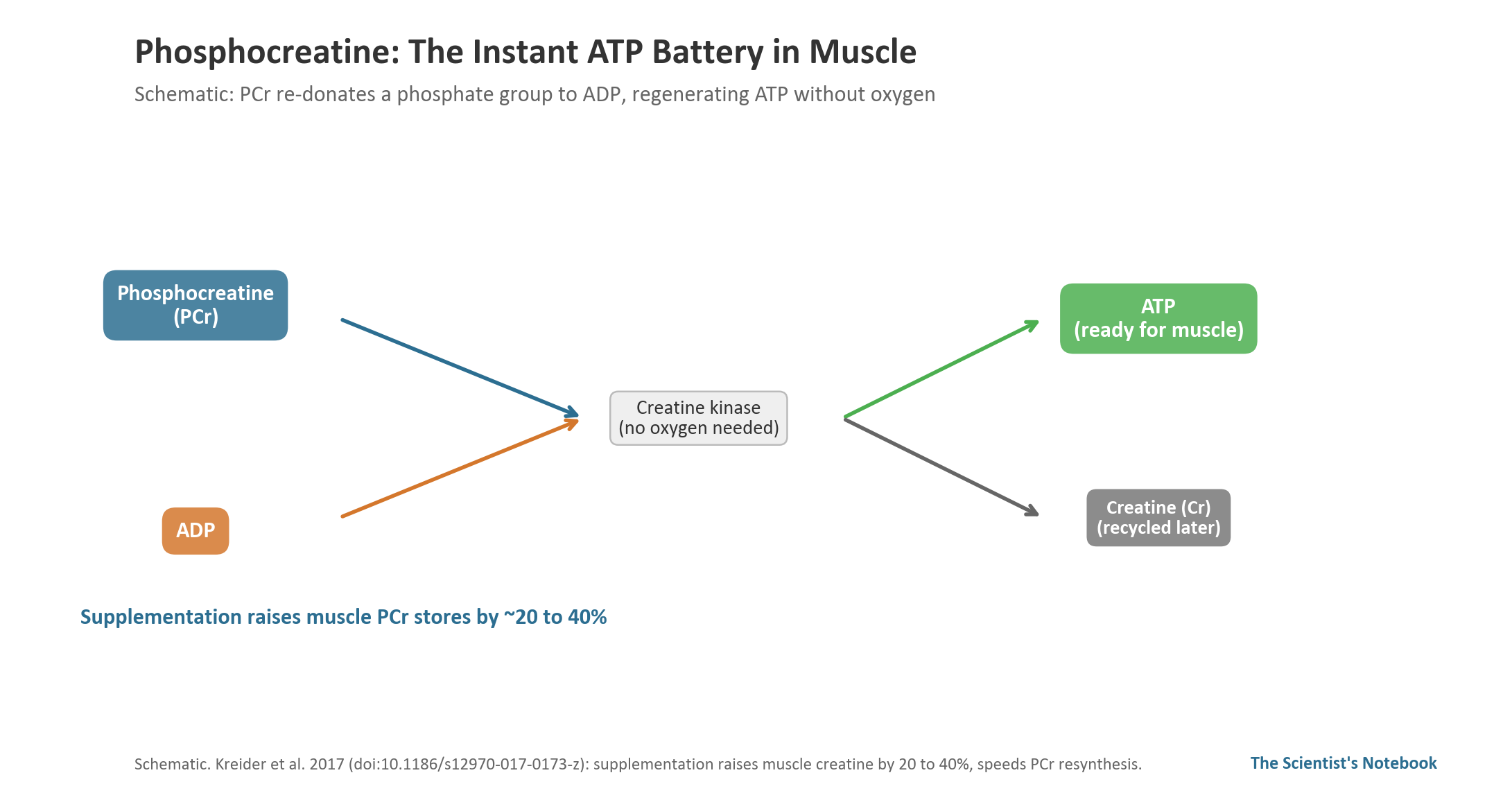
Creatine accumulates in muscle mainly as phosphocreatine (PCr), a high-energy compound that rapidly re-donates a phosphate group to adenosine diphosphate, regenerating ATP within the first seconds of intense effort. This reaction, catalyzed by creatine kinase, runs without oxygen, the body's fastest ATP-resynthesis route.
Supplementation raises muscle creatine stores by roughly 20 to 40 percent and speeds PCr resynthesis during recovery between efforts, as summarized in Kreider et al. 2017.
For athletes doing repeated high-intensity bursts (sprints, surges, heavy lifts), a fuller PCr reservoir means each successive effort starts with more immediate fuel available.
The position stand reports that high-intensity and repetitive exercise performance generally rises by about 10 to 20 percent after creatine loading, scaling with the rise in muscle PCr.
Steady aerobic efforts at moderate intensity rely more heavily on oxidative phosphorylation, so PCr's contribution is smaller there and performance gains are correspondingly modest.
Response is not uniform: a meaningful minority of people show little increase in muscle creatine stores with supplementation, likely because high baseline levels leave less room to load.
An early body-mass gain from water retention (around one to two kilograms) is relevant for weight-bearing sports where power-to-weight ratio matters.
---
If you have 60 seconds, I would value your anonymous feedback. You can share it here.
---
### Health disclaimer
This post discusses endurance-training science for educational purposes. It is not medical advice, not a diagnosis, and not a substitute for clinical care. Individual response to training, sleep deprivation, and multi-day exertion varies substantially, and what applies to a research cohort or a world-class athlete may not apply to you. > Consult a qualified physician, sports medicine specialist, or registered dietitian before changing your training, fuelling, or sleep strategy if you have a cardiovascular, metabolic, psychiatric, or sleep-related condition; are recovering from injury or illness; are pregnant; are on medication that affects heart rate, hydration, glucose regulation, or sleep; or have concerns about exercise tolerance. > Ultra-endurance events impose real physiological and psychological loads. Persistent chest pain, fainting, acute confusion beyond the predictable late-race window, severe dehydration, sustained loss of coordination, or any mental-health symptoms that outlast the immediate post-event dip warrant professional care and are not signals to push through. > No outcome is guaranteed. The protocols, anchors, and case material in this post are descriptive, drawn from peer-reviewed evidence and a guest contributor's lived experience, and should be treated as inputs to an informed conversation with your own coach and clinicians, not as prescriptions.
 Thomas Mortelmans
Related reading
Thomas Mortelmans
Related reading
Keep going
Every number in this piece is one you can compute from your own rides and runs, with the formula and the source shown alongside it.
Training plans built on the same evidence base:
Thomas MortelmansJoin our Discord community:
Thomas MortelmansFound this useful?
Get articles like this and free training calculators in your inbox every week.
Recommended reads
If this was useful, these are the other research-driven newsletters I actually read.



Member discussion