Open Lab #010: Preventative strategy and training methodology to prevent ACL Injuries - RevaCenter
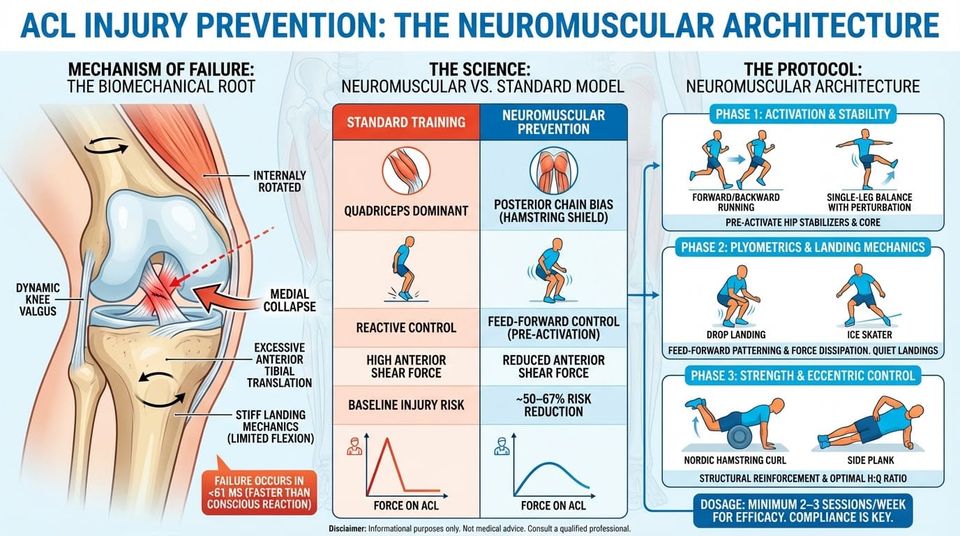
We spend a disproportionate amount of time obsessing over engine displacement—VO2max, lactate thresholds, and mitochondrial density—while often neglecting the chassis that carries it. Today, we need to address a structural failure point that remains catastrophically prevalent: the Anterior Cruciate Ligament (ACL) rupture.
The data suggests that the majority of these injuries are not distinct "accidents" but rather the inevitable downstream consequence of biomechanical latency. When the mechanical load applied to the knee joint exceeds the tensile strength of the ligament before the musculature can intervene, the system fails. The goal of this briefing is to move beyond the simplistic view of "bad luck" and provide you with the neuromuscular architecture required to dampen these loads.
 Thomas Mortelmans
Related reading
To help us in this discission, we are counting on the expert advice and guidance from Miel Moelans and Elien Schoofs, founders of RevaCenter; a physiotherapy practice where return to sport takes center stage.

Executive Summary
- Efficacy of Intervention: Multicomponent neuromuscular training (NMT) programs can reduce ACL injury risk by approximately 50% in general populations and up to 67% in noncontact scenarios for females.
- The "Universal" Advantage: Universal implementation of prevention protocols is statistically more cost-effective and impactful than screening-based isolation strategies.
- Biomechanical Root Cause: The primary mechanisms of failure are dynamic knee valgus (medial collapse), excessive anterior tibial translation, and "stiff" landing mechanics with limited knee flexion.
- The Hamstring Shield: Quadriceps dominance is a significant risk factor; high-threshold eccentric hamstring strength is required to counteract anterior tibial shear forces.
- Dosage Dependency: A minimum frequency of 1.5 to 2 sessions per week is required for efficacy, though 4–5 sessions yield optimal neuroplastic adaptation.
The Science at a Glance
The following table summarizes the physiological trade-offs between standard training approaches and those integrating specific neuromuscular prophylactics.
| Feature | Standard "Engine Building" Model | Neuromuscular Prevention Model | Physiological Outcome |
|---|---|---|---|
| Primary Stimulus | Metabolic conditioning & concentric force | Eccentric braking & proprioception | Prevention Model increases joint stiffness (stability) without metabolic cost. |
| Landing Mechanics | Often neglected; "stiff" landings | Soft, flexed-knee strategies | Standard: Force absorbed by ligaments. Prevention: Force dampened by muscle architecture. |
| Muscle Recruitment | Quadriceps Dominant (Anterior Chain) | Posterior Chain (Hamstring/Glute) Bias | Standard: Increases anterior shear on tibia. Prevention: Hamstrings act as an ACL agonist, pulling tibia posterior. |
| Reaction Time | Reactive (conscious correction) | Feed-forward (subconscious pre-activation) | Prevention: Engages stabilizers before ground contact (<60ms window). |
| Injury Risk | Baseline (High in pivot sports) | Reduced by ~50–67% | Prevention: Significant reduction in catastrophic failure rates. |
Foundational Principles
1. The "Window of Vulnerability" and Feed-Forward Control
A critical concept in ACL dynamics is the timeframe of injury. Ruptures typically occur within 61 milliseconds of initial ground contact. This is significantly faster than the human voluntary reaction time. Therefore, we cannot rely on "reacting" to a bad landing. Prevention relies on feed-forward mechanisms—neuromuscular patterns ingrained deep in the motor cortex that pre-activate stabilizing musculature before the foot hits the ground. If the muscles are not tense prior to impact, the ligament bears the full load.
2. The Quadriceps Paradox and Hamstring Agonism
While the quadriceps are essential for propulsion, they are technically antagonists to the ACL. Strong quadriceps contraction creates an anterior pull on the tibia (anterior tibial translation), stressing the ACL. The hamstrings are the primary dynamic defense; they provide a posterior pull that unloads the ligament. A "Quad-Dominant" athlete with weak eccentric hamstring strength is essentially driving a car with a massive engine and no brakes. The ratio of Hamstring-to-Quadriceps strength (H:Q ratio) is a vital metric for structural integrity.
3. The Hormonal and Biomechanical Intersection
We must acknowledge biological reality: female athletes face a 2–11x higher risk profile. This is multifactorial, involving wider pelvic geometry (increasing Q-angle) and hormonal fluctuations. Specifically, the hormone relaxin (peaking days 21–24 of the menstrual cycle) and estrogen (pre-ovulatory) can increase ligament laxity and decrease collagen production. While we cannot alter anatomy, we can build a "neuromuscular splint" through strength training to compensate for temporary reductions in passive tissue stiffness.
Thomas Mortelmans
"The implementation of universal training programs saves approximately $100 per athlete per season while reducing ACL injury incidence from 3% to 1.1%. The debate between 'screening' versus 'training' is largely settled: the most efficient resource allocation is not finding the needle in the haystack, but treating the whole haystack. We treat the risk as a population-level neuromuscular deficit, not an individual anomaly."
Scientist’s Insight
The Decision Matrix
Identify your current athlete profile to determine your primary preventative focus.
| Profile Category | Symptomology / Markers | Risk Level | Training Focus |
|---|---|---|---|
| The "Stiff" Lander | Audible "thud" on landings; minimal knee flexion (<30°); upright trunk. | High | Landing Mechanics: Focus on "quiet" landings, increasing hip/knee flexion to dissipate force through muscles. |
| The Valgus Collapser | Knees cave inward (kissing knees) during squats or jump landings; weak hip abductors. | Severe | Glute Medius/Max Activation: Banded distractions, single-leg stability, and verbal cues to drive knees outward. |
| The Quad-Dominant | Massive anterior thigh development; poor posterior chain engagement; inability to perform a Nordic Curl. | Moderate | Eccentric Hamstring Load: Nordic curls, RDLs, and posterior-chain dominant plyometrics. |
| The Hyper-Mobile | History of subluxations; general joint laxity; distinct menstrual cycle tracking (females). | Variable | Strength & Stiffness: Heavy resistance training to build active stiffness; potentially reduced ballistic load during high-relaxin phases. |
The Protocol: Neuromuscular Architecture
This protocol is derived from the synthesis of the FIFA 11+, PEP, and current best-practice neuromuscular literature. It is designed to be integrated into a warm-up, requiring 15–20 minutes, performed 2–3 times per week.
Phase 1: Activation & Dynamic Stability (5 Minutes)
Goal: Pre-activation of the hip stabilizers and increase in core temperature.
- Forward/Backward Running: Maintain neutral trunk, avoid hip drop.
- Walking Lunges with Rotation: Focus on keeping the front knee tracking over the second toe (no valgus).
- Single-Leg Balance (Perturbation): Stand on one leg; partner or band provides gentle resistance. Fight rotational forces.
Phase 2: Plyometrics & Landing Mechanics (10 Minutes)
Goal: Feed-forward patterning and force dissipation.
Note: Quality > Quantity. Any rep with "caving knees" is a failed rep.
- Drop Landings (Bilateral): Step off a 30cm box. Stick the landing. Hold for 2s. Quiet, soft, knees wide.
- Single-Leg Hops (Sagittal Plane): Hop forward, stick landing. Focus on preventing lateral trunk sway.
- Ice Skaters (Frontal Plane): Lateral bound to single-leg landing. Key for preventing valgus torque.
Phase 3: Strength & Eccentric Control (5 Minutes)
Goal: Structural reinforcement and H:Q ratio optimization.
- Nordic Hamstring Curls: The gold standard. Partner holds ankles; lower torso slowly. Assist push-up to return. (3 sets x 5 reps).
- Side Planks / Copenhagen Planks: Trunk stability correlates with knee stability.
- Walking Heel-Calf Raises: Propulsive ankle stiffness.
Implementation Note: Compliance is the primary driver of success. A mediocre program done 3x/week outperforms a perfect program done sporadically.
Case Study: The Non-Linear Path of "Sarah"
Hypothetical narrative based on aggregate clinical data.
Background: Sarah, a 19-year-old collegiate midfielder (168cm, 61kg), presented with no prior major knee injuries but complained of anterior knee pain. Screening using the Landing Error Scoring System (LESS) revealed a score of 6 (High Risk), characterized by significant dynamic valgus and a stiff, upright landing strategy.
The Intervention:
We implemented a 20-minute neuromuscular warm-up replacing her standard static stretching routine.
- Weeks 1-4: Focus was purely on "technique acquisition." Sarah struggled with the Nordic curls, unable to control the eccentric phase for more than 10 degrees. Landing mechanics were cue-dependent (she needed verbal reminders to "soften the knees").
- The "Noise": In Week 5, Sarah reported high fatigue and "loose joints" (coinciding with the ovulatory phase). Performance metrics on the single-leg hop test regressed by 10%. Instead of forcing progression, we reduced plyometric volume and increased isometric holds to maintain neuromuscular drive without high dynamic load.
- Weeks 6-12: Nordic capability improved; she could control the descent to 45 degrees. Feed-forward mechanics began to set in—video analysis showed her knees naturally aligning over her toes during unplanned cutting movements in practice.
Outcome:
At re-testing (Week 12), Sarah’s LESS score dropped to 2 (Low Risk). Her isokinetic testing showed a 15% increase in eccentric hamstring torque. While we cannot guarantee she will never suffer an injury, we have mathematically shifted the probability in her favor by altering her biological chassis.
When Prevention Does Not Hold
Everything above shifts a probability. It does not remove the event. Neuromuscular training moves the odds substantially, and a proportion of well-prepared athletes still rupture the ligament, because landing mechanics are one input into a collision that also involves an opponent, a surface and a moment of bad luck. A prevention piece that stops at the point of injury leaves the reader at exactly the moment the question gets harder.
The first question that follows a rupture is usually taken as settled: the knee gets reconstructed. The trial evidence is less certain than the reflex.
The KANON trial randomised 121 young, active adults with an acute ACL tear in a previously uninjured knee to one of two strategies. Both arms received the same structured rehabilitation. One arm had an early reconstruction on top of it; the other had rehabilitation with a reconstruction available later if the knee needed one. At two years the change in the combined KOOS score was 39.2 points in the early-surgery arm and 39.4 in the optional-surgery arm, a between-group difference of 0.2 points with a confidence interval running from minus 6.5 to 6.8 (Frobell 2010). Of the 59 people assigned to the optional arm, 36 had reached two years without an operation.
The five-year follow-up held. By then 30 of those 59 had gone on to surgery, so roughly half the optional arm was still managing without one. The change in KOOS was 42.9 points against 44.9, and the two arms did not separate on any subscale, on quality of life, on activity level, on the number of knees needing meniscus surgery, or on radiographic osteoarthritis at five years (Frobell 2013).
Three things are worth holding onto about that result. The comparison was not surgery against nothing: every participant rehabilitated, under supervision, to a structured programme. The cohort was young, active, and carrying an acute isolated tear, which is not every presentation. And the deferred arm kept the operation available, so the finding describes a sequence in which surgery stays on the table rather than a decision to rule it out.
Read that way, the trial says something quite specific about the work described earlier in this piece. Rehabilitation is the constant across both arms. It is what carries the knee whether or not a graft is ever placed, and the qualities it builds, eccentric hamstring control, landing mechanics, single-leg stability, are the same qualities this protocol builds before anything has happened. The distinction between prevention and rehabilitation is largely a distinction in timing.
Which treatment path suits a particular knee is a clinical decision, made by the treating surgeon and physiotherapist with the imaging, the examination and the athlete's own goals in front of them. What the evidence supports is that the decision is a real one, with more than one defensible answer, and that it is worth asking about rather than assuming.
Best regards,
Miel Moelans, Elien Schoofs and Dr. Thomas Mortelmans

Annotated References
- Evidence-Based Best-Practice Guidelines for Preventing Anterior Cruciate Ligament Injuries through Neuromuscular Training
This review establishes that multicomponent neuromuscular training programs are effective in reducing ACL injury rates by approximately 50% in general athletic populations. - Prevention and Screening Programs for Anterior Cruciate Ligament Injuries
This cost-effectiveness analysis demonstrates that universal training implementation is economically superior to screening-based strategies, saving approximately $100 per athlete. - Effectiveness of Neuromuscular Training Based on Trunk Control and Hip Strength
Research highlighting that core and trunk stability exercises significantly improve lower limb biomechanics, reducing lateral trunk motion that contributes to knee valgus. - ACL Injury Prevention Tips and Exercises
A clinical overview from the Hospital for Special Surgery emphasizing the importance of soft landings and knee alignment in injury prevention. - Prevention of Anterior Cruciate Ligament Injury - NATA Position Statement
The National Athletic Trainers' Association confirms that prophylactic training requires a minimum frequency of 2–3 times per week to be effective. - Neuromuscular Training to Target Deficits Associated with Second ACL Injury Risk
This study identifies biomechanical deficits such as hip internal rotation moments that predict re-injury risk, suggesting specific targets for secondary prevention. - Effects of Training Intervention on Prevention of Knee Joint Injuries
A meta-analysis of over 28,000 participants showing that training frequencies of 4–5 times per week yield the highest protective effects against knee injuries. - A Controlled Trial of the Effects of Neuromuscular Training on Physical Performance
Evidence that neuromuscular training not only prevents injury but also enhances performance metrics like vertical jump and agility. - Recommendations for Plyometric Training after ACL Reconstruction
This paper outlines a four-stage plyometric progression framework essential for safely returning athletes to high-demand sports. - Preventive Interventions on ACL Injury Reduction Based on LESS Scores
Validates the use of the Landing Error Scoring System (LESS) as a field-based tool to identify high-risk movement patterns. - Lower Extremity Landing Biomechanics in Both Sexes After Exercise
This study discusses how fatigue alters landing biomechanics, often increasing the risk profile in athletes as the match or training session progresses. - Does the FIFA 11+ Injury Prevention Program Reduce the Incidence of ACL Injury in Male Soccer Players
A key study confirming the efficacy of the FIFA 11+ warm-up program in reducing injury rates in male collegiate soccer players. - Hidden Challenges Facing Female Youth Athletes
An exploration of the unique physiological and hormonal risk factors, including the effects of puberty and the menstrual cycle, on female injury rates. - Proprioceptive Reweighting and Postural Control Following ACL Reconstruction
Discusses the persistent proprioceptive deficits after surgery, emphasizing the need for sensory-motor retraining. - Effect of Injury Prevention Programs that Include the Nordic Hamstring Exercise
Demonstrates that including the Nordic Hamstring Exercise reduces hamstring injury rates by 51% and supports ACL protection through eccentric strength. - Real-time Biofeedback is More Effective than Sham Feedback for Neuromuscular Training
Research supporting the use of visual feedback technologies to accelerate the learning of safe movement patterns. - A Randomized Trial of Treatment for Acute Anterior Cruciate Ligament Tears
The KANON trial. 121 young, active adults randomised to structured rehabilitation plus early reconstruction, or structured rehabilitation with reconstruction available later. At two years the combined KOOS change was 39.2 against 39.4 points, and 36 of the 59 in the optional arm had not had an operation. Frobell RB et al, N Engl J Med 2010;363(4):331-42. PMID 20660401. - Treatment for Acute Anterior Cruciate Ligament Tear: Five Year Outcome of Randomised Trial
Five-year follow-up of the same cohort, with one patient lost. 30 of 59 in the optional arm had gone on to surgery. The arms did not separate on KOOS, quality of life, activity level, meniscus surgery, or radiographic osteoarthritis. Frobell RB et al, BMJ 2013;346:f232. PMID 23349407.
Disclaimer: The content provided in this newsletter is for informational and educational purposes only and does not constitute medical advice, diagnosis, or treatment. Always seek the advice of your physician, physical therapist, or other qualified health provider with any questions you may have regarding a medical condition or training program. Participation in any exercise program carries an inherent risk of injury. The Scientist’s Notebook and ESQ Coaching assume no liability for any physical injury or damage sustained as a result of the information presented herein.
Thomas Mortelmans
Related reading
Keep going
Every number in this piece is one you can compute from your own rides and runs, with the formula and the source shown alongside it.
Training plans built on the same evidence base:
Thomas MortelmansJoin our Discord community:
Thomas MortelmansPS: Your thoughts mean the world to me. Tell me how I did today in under 60 seconds (it is 100 percent anonymous).
Found this useful?
Get articles like this and free training calculators in your inbox every week.
Recommended reads
If this was useful, these are the other research-driven newsletters I actually read.
Member discussion