Entry #040: Training in the Furnace: How Heat Acclimation Rebuilds the Endurance Engine
Every endurance athlete knows the feeling of a body in revolt on a hot day. The pace that felt easy in spring becomes a slog by midsummer.
The heart rate creeps upward at a fixed effort, the legs flood with heat, and the finishing kick simply is not there. For a long time the obvious response was to dread the heat and hide from it.
A quieter idea took hold in the laboratory over the past two decades, and it inverts that instinct. The heat that wrecks a race can, in deliberate and repeated doses, become one of the more powerful training stimuli in endurance sport.
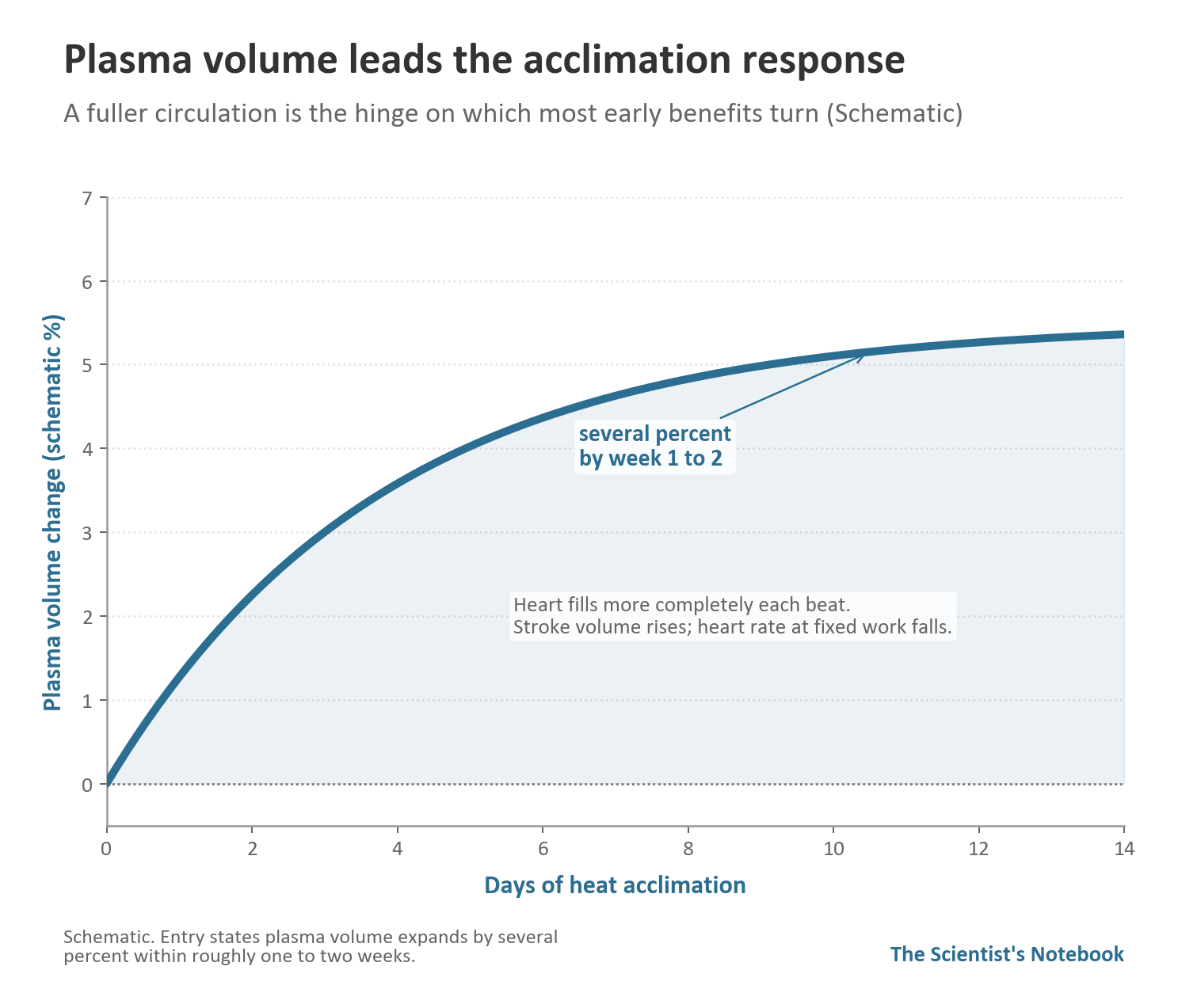
The story begins with blood. Repeated thermal strain prompts the body to add fluid to the circulation, expanding plasma volume within the first week.
That single change ripples outward. A fuller circulation fills the heart more completely, lets each beat eject more blood, and frees up the flow needed to cool the skin without starving the muscle.
Layered on top are changes in how early and how heavily an athlete sweats, how readily the skin vessels open, and how the brain reads thermal discomfort. Together they describe a body that has learned to defend its core temperature with far less strain.
The more provocative claim is that some of these gains travel home. An athlete who acclimates to the heat and then competes in cool air may carry an enlarged blood volume and, after longer protocols, more total hemoglobin into that cool race.
Whether that translates into faster temperate performance has become one of the genuinely contested questions in the field, and it deserves an honest hearing rather than a marketing slogan.
This entry sits alongside a separate piece on sauna use for recovery. The focus here is narrower and more specific: heat as a training tool.
How the protocols are built, what the plasma and the heart and the sweat glands actually do, why the adaptations fade so quickly yet return so fast, and where the evidence for a cool weather payoff is strong and where it remains unsettled.
Gradescale: Your physiology, decoded. Join the waitlist now.
 Thomas Mortelmans
The brief
- Plasma volume leads the response. Within roughly one to two weeks of repeated heat exposure, blood plasma expands by several percent, and this hypervolemia underpins most of the early cardiovascular and thermoregulatory benefits.
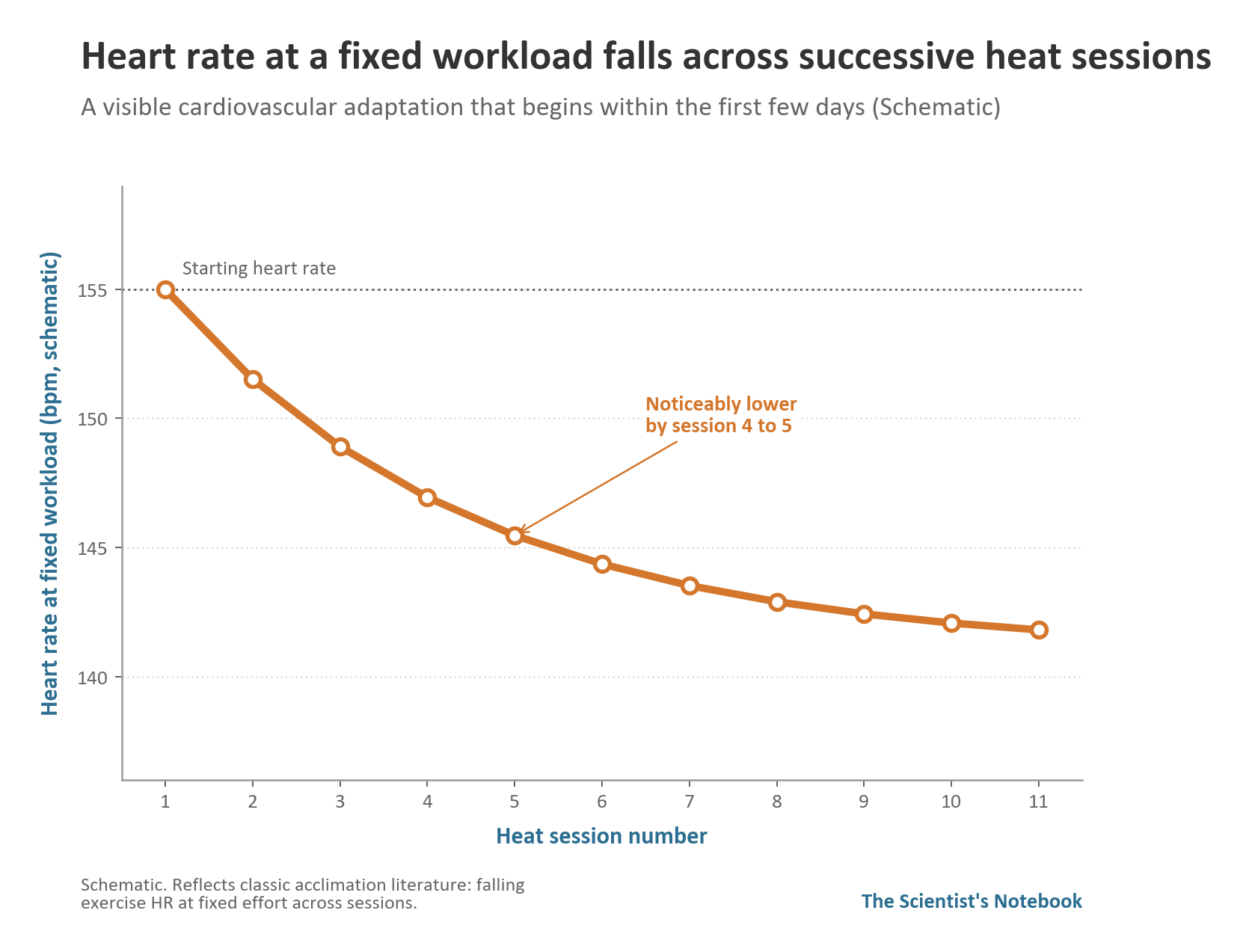
- The heart works less for the same job. As acclimation proceeds, heart rate at a fixed workload falls steadily, reflecting greater stroke volume from a fuller circulation and improved cardiovascular stability under combined exercise and heat strain.
- Sweating and skin blood flow are retuned, not just amplified. The body begins sweating earlier and more abundantly, the skin vessels open at a lower core temperature, and these are local functional improvements rather than a larger maximal plumbing capacity.
- Longer protocols recruit the blood factory. Stretching heat training across three to five weeks can raise total hemoglobin mass by a few percent, an adaptation that resembles part of the altitude response while athletes keep training at full intensity.
- The cool weather transfer is real but contested. Some controlled work shows clear gains in temperate conditions, while other rigorous studies find the benefit modest or absent, and the disagreement appears to hinge on training status, protocol, and how performance is measured.
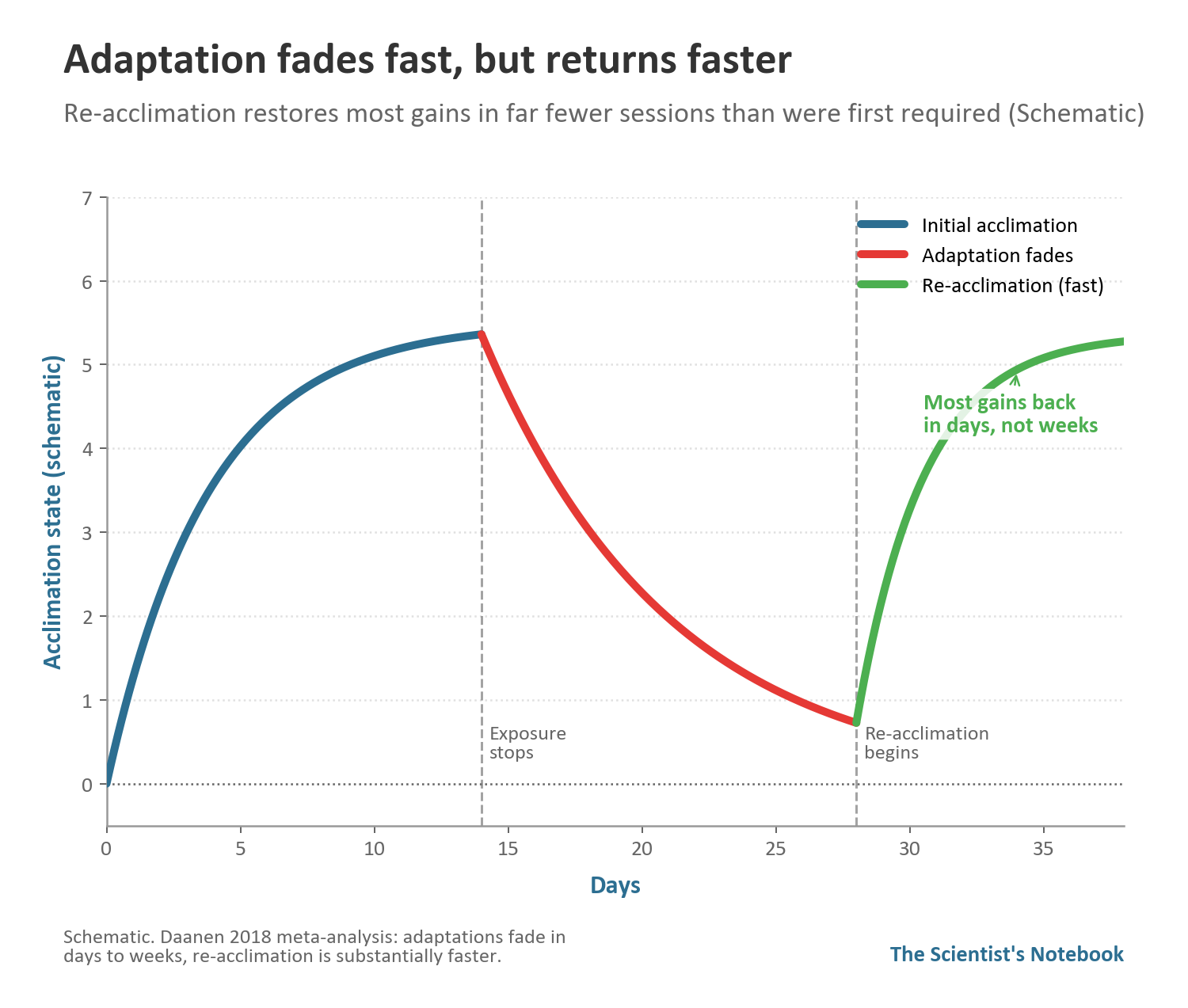
- Adaptations decay fast and return faster. Heat tolerance fades within days to weeks once exposure stops, yet re-acclimation restores most of it in a fraction of the original number of sessions.
- Active heat work outperforms passive heat for performance. Exercising in the heat produces the most robust and consistent performance changes, while passive heating offers a gentler, less disruptive route to some of the same blood adaptations.
- Individual response varies widely. Baseline fitness, body size, and sex all shape how quickly the adaptations appear, which is why fixed calendar prescriptions describe an average athlete who may not exist.
The science at a glance
Foundational Principle 1: The body defends its core temperature, and heat training shifts that defense
Exercise generates heat as a byproduct of muscular work, and in a warm environment the gradient that normally carries that heat away to the surroundings collapses.
The body is then forced to rely almost entirely on evaporating sweat, while simultaneously diverting blood to the skin and to the working muscle. This is a genuine competition for a finite circulation, and it is the central reason performance falls apart in the heat.
Classic work in hot dry conditions showed that exhaustion during prolonged exercise in the heat coincides with the core temperature reaching a high ceiling, near forty degrees, rather than with any failure of the heart or muscle to deliver oxygen.
 Thomas Mortelmans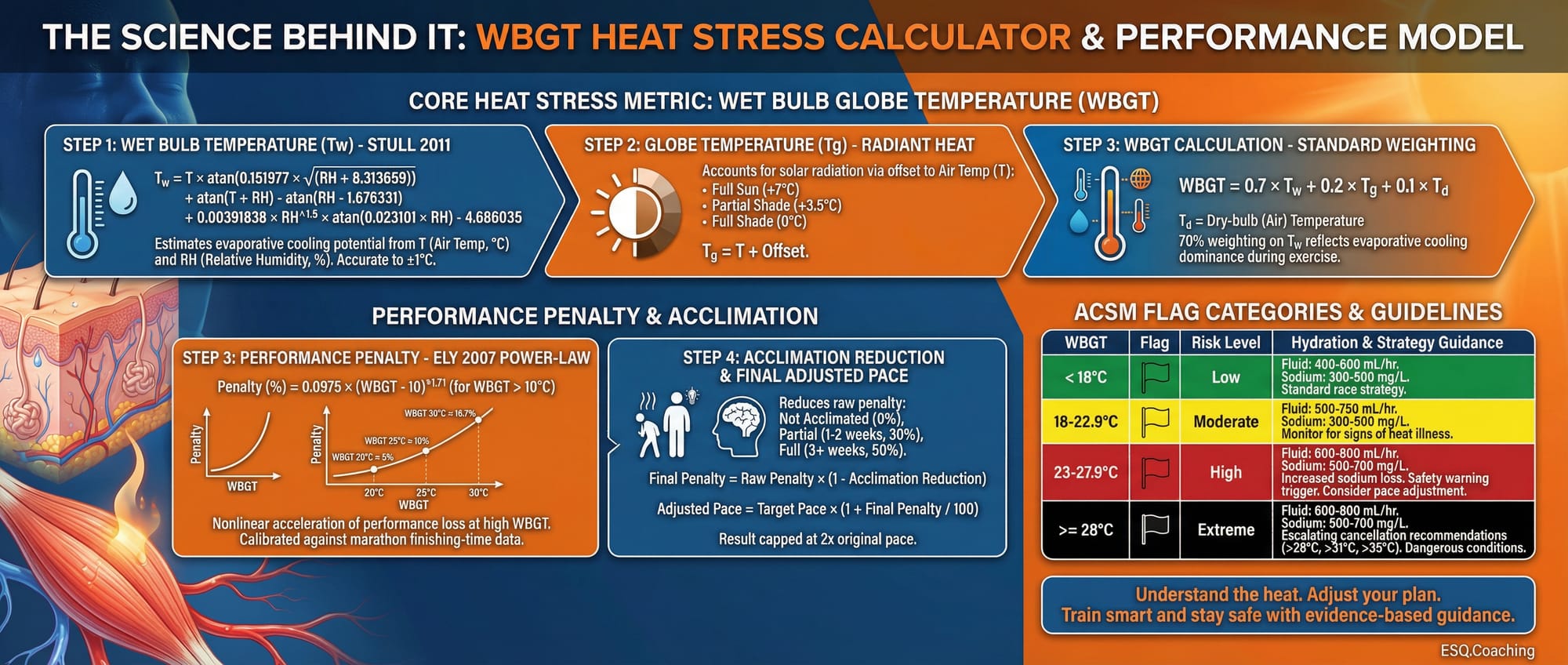
The constraint is thermal, not strictly circulatory. Repeated heat exposure addresses the problem at its root by lowering the core temperature an athlete carries at a given effort and by widening the margin before that ceiling is reached.
Scientist's Insight: The limiter in the heat is the body's own thermal accounting, so the most effective intervention is one that changes the accounting itself rather than masking the symptoms.
Foundational Principle 2: Blood volume is the hinge on which the adaptations turn
The earliest and most reliable structural change is an expansion of plasma volume. A larger fluid compartment fills the heart more completely between beats, which raises stroke volume and lets the heart deliver the same output at a lower rate.
That same expanded volume supplies the skin circulation needed for cooling without robbing the muscle. The classic hot dry acclimation studies traced rising cardiac output across successive heat exposures back to this plasma expansion and the larger stroke volume it permits.
Because the change is one of absolute blood volume, its influence does not stop at the door of the heat chamber.
This is the mechanistic seed of the cool weather transfer argument, and it is why so much attention falls on how much plasma, and later how much hemoglobin, an athlete actually gains.
Scientist's Insight: Almost every downstream benefit of heat training, from a calmer heart rate to a possible cool weather payoff, can be read as a consequence of a fuller circulation.
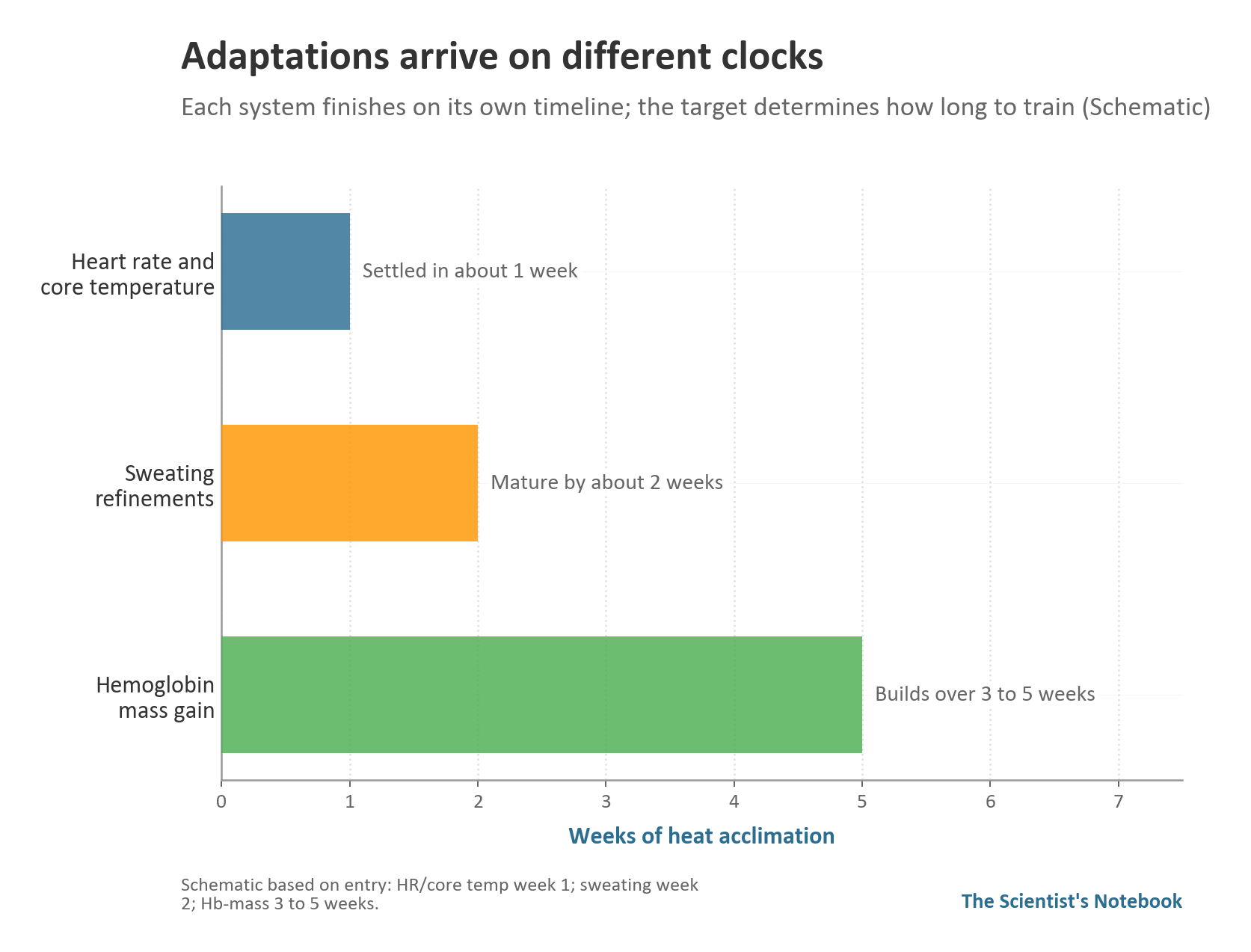
Foundational Principle 3: Adaptation is a portfolio of systems on different clocks
Heat acclimation is not a single switch. Heart rate and core temperature responses settle quickly, often substantially within the first week.
Sweating refinements, including a lower sweat sodium concentration and a more even distribution across the body, mature more slowly and may need closer to two weeks. The blood forming response that raises total hemoglobin mass operates on a still longer timescale of several weeks.
At the cellular level, protective heat shock proteins rise after exposure and help explain why some adaptation persists even as the visible markers fade.
This staggered timing matters because it means the answer to how long an athlete should heat train depends entirely on which adaptation is the target.
Scientist's Insight: Asking when heat acclimation is complete is the wrong question, because different systems finish their adaptation on different calendars.
Reading the signals
Lever 1: Protocol mode and how the thermal dose is delivered
The data: Three broad approaches appear in the literature. Active acclimation, meaning exercise performed in a hot environment, consistently produces the most robust performance and physiological changes, with larger effects than passive heating when performance in the heat is the outcome.
Thomas Mortelmans
Related reading
A refinement of the active approach holds the athlete at a target core temperature rather than a fixed workload, and comparisons of this controlled hyperthermia method against fixed intensity work have been largely equivocal, with one analysis finding the two methods raised the protective heat shock response to the same degree.
Passive routes, including hot water immersion and wearing thermal clothing during otherwise temperate training, can drive plasma and hemoglobin changes, and controlled work in trained cyclists found that a heat chamber, a heat suit, and a heat suit combined with immersion improved performance in the heat to a statistically indistinguishable degree.
Where athletes tend to land: Those whose primary goal is a hot competition gravitate toward active exercise in conditions that resemble the target race, while athletes constrained by climate or training load more often reach for passive or thermal clothing methods that preserve their existing sessions.
Lever 2: Duration and the adaptation the calendar is buying
The data: Short protocols of roughly five days reliably lower heart rate and core temperature, capturing the centrally driven early adaptations.
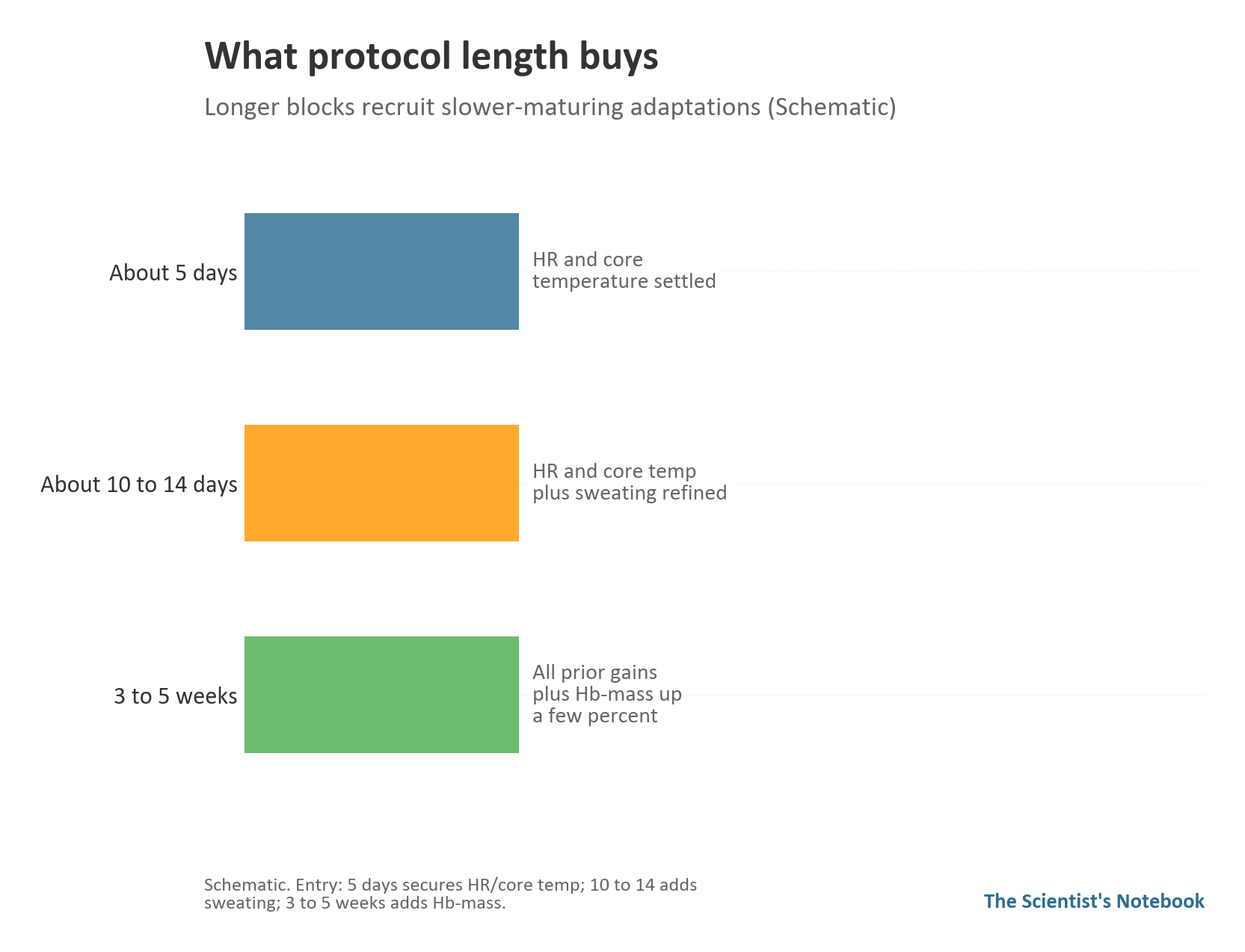
Medium protocols of about ten to fourteen days add the slower sweating refinements, and the meta-analytic record indicates that regimens beyond two weeks yield the largest overall adaptations.
Extending the work to three to five weeks is what recruits the blood forming response, with controlled studies in elite cyclists reporting hemoglobin mass gains in the range of a few percent.
The same body of work shows that highly fit athletes tend to adapt faster, compressing the timeline that less trained individuals require.
Where athletes tend to land: Athletes facing a near term hot race favor compact blocks that secure the cardiovascular gains, while those planning months ahead and chasing the hematological payoff commit to the longer multi week exposure.
Lever 3: The contested cool weather payoff
The data: This is the genuinely unsettled question.
A frequently cited controlled trial in trained cyclists reported that ten days of heat acclimation improved time trial output and aerobic power in both hot and cool conditions, alongside expanded plasma volume and higher cardiac output, and attributed the temperate gain to those blood changes.
Other rigorous studies, including work in elite athletes anchored on hemoglobin mass, find the temperate signal smaller, inconsistent, or protocol dependent, and reviews note that the effect is harder to demonstrate as training status rises and control conditions tighten.
The mechanistic case rests on absolute gains in blood volume and oxygen carriage that should in principle benefit any environment, yet the empirical record does not speak with one voice.
Where athletes tend to land: Some treat heat training as a general conditioning stimulus for cool races on the strength of the positive trials, while more cautious athletes and coaches view the temperate benefit as plausible but unproven and reserve heat work for genuinely hot targets.
Method and a worked example
- Establish a clean baseline by measuring resting and exercise heart rate, core temperature, and a performance test in standardized conditions, so that any later change can be attributed to the heat exposure rather than to drift in fitness or hydration.
- Apply the heat stimulus, most often as submaximal exercise at roughly half of maximal aerobic intensity in a hot chamber, typically near forty degrees, for sixty to ninety minutes per session across consecutive days, with some designs instead clamping core temperature at a target to standardize the internal strain.
- Track the dose by recording core temperature, heart rate, and sweat losses each session, since the adaptation tracks the internal thermal load rather than the room temperature alone, and a fitter athlete may need more external heat to reach the same internal strain.
- Reassess at intervals, comparing post protocol heart rate, core temperature, plasma volume, and where relevant total hemoglobin mass against baseline, ideally with a control group performing matched work in cool conditions to separate the heat effect from the training effect.
- Probe the decay and re-induction by retesting after a layoff, which is how the literature established that adaptations fade over days to weeks yet return in far fewer sessions than were first required.
A composite case
Consider a recreational marathoner, neither elite nor untrained, preparing for a warm autumn race. She begins a two week block of indoor cycling in a heated room, sixty minutes a day.
The first three sessions are miserable. Her heart rate is high, she feels lightheaded, and she privately doubts the whole project.
This is the realistic part that tidy summaries omit: the early days feel worse before anything feels better.
Around the fourth and fifth day something shifts. Her heart rate at the same effort has dropped noticeably, and she starts sweating earlier and more freely.
Encouraged, she pushes a session too hard on day seven, cuts it short with a pounding head, and has to back off. The adaptation curve is not a smooth ramp.
Thomas Mortelmans
Related reading
After a short easier stretch she resumes and by day twelve her core temperature at the end of the session is meaningfully lower than it was at the start of the block, and the same pace simply feels more manageable.
Then life interrupts. A work trip removes her from the heat for nine days, and she fears the block was wasted.
On her return the first two reintroduction sessions restore most of what felt lost, far quicker than the original two weeks.
Her experience mirrors the published pattern: a rapid early gain, a non linear middle with a setback, a fast decay during the gap, and a faster recovery on re-exposure.
Whether her cool weather sessions also feel easier is the part she cannot fully attribute, which is fitting, because the literature cannot fully attribute it either.
Where this leaves us
Heat training is one of the few interventions that rebuilds the endurance engine from the blood outward.
The expansion of plasma volume calms the heart and supplies the skin, the sweating and skin blood flow responses are retuned to engage sooner, and over longer protocols the body adds genuine oxygen carrying capacity.
These adaptations sit on different clocks, fade quickly once the stimulus is removed, and return with surprising speed when it resumes. For competition in the heat, the evidence is mature and consistent.
For the dream of a free cool weather upgrade, the evidence is real in places and stubbornly mixed in others, and the honest position is interest tempered by genuine uncertainty.
What keeps the field interesting is exactly this tension. The mechanism predicts a benefit that the better controlled studies do not always deliver, which usually means the truth lives in the details of who is training, how, and for how long.
Best regards,
Dr. Thomas Mortelmans
Limits of Application: This entry describes population level physiology drawn from studies of healthy, mostly trained adults, and individual responses vary with fitness, body size, sex, and acclimation history.
Heat exposure carries real risk of heat illness, the magnitudes cited are averages rather than guarantees, and none of this constitutes medical advice or a personal training prescription.
Anyone considering deliberate heat exposure, particularly with a cardiovascular condition or in a hot humid climate, should consult an appropriately qualified professional first.
References
- Périard JD, Eijsvogels TMH, Daanen HAM. Exercise under heat stress: thermoregulation, hydration, performance implications, and mitigation strategies. Physiol Rev. 2021. PMID 33829868. Comprehensive review of how the body responds to exercise heat stress and the countermeasures, including acclimation, that protect performance.
- Lorenzo S, Halliwill JR, Sawka MN, Minson CT. Heat acclimation improves exercise performance. J Appl Physiol. 2010. PMID 20724560. Controlled trial reporting that ten days of heat acclimation improved cycling performance and aerobic power in both hot and cool conditions.
- Sawka MN, Leon LR, Montain SJ, Sonna LA. Integrated physiological mechanisms of exercise performance, adaptation, and maladaptation to heat stress. Compr Physiol. 2011. PMID 23733692. Integrative account of systemic heat acclimation and cellular thermotolerance and how they protect performance and organs.
- Nielsen B, Hales JR, Strange S, Christensen NJ, Warberg J, Saltin B. Human circulatory and thermoregulatory adaptations with heat acclimation and exercise in a hot, dry environment. J Physiol. 1993. PMID 8487204. Classic study linking rising cardiac output across heat exposures to plasma volume expansion and identifying high core temperature as the exhaustion trigger.
- Lorenzo S, Minson CT. Heat acclimation improves cutaneous vascular function and sweating in trained cyclists. J Appl Physiol. 2010. PMID 20864556. Demonstrated that heat acclimation improves skin microvascular function and sweating without changing maximal skin blood flow.
- Périard JD, Racinais S, Sawka MN. Adaptations and mechanisms of human heat acclimation: applications for competitive athletes and sports. Scand J Med Sci Sports. 2015. PMID 25943654. Review of the physiological adaptations to heat acclimation and their application to athletic competition, including temperate transfer.
- Tyler CJ, Reeve T, Hodges GJ, Cheung SS. The effects of heat adaptation on physiology, perception and exercise performance in the heat: a meta-analysis. Sports Med. 2016. PMID 27106556. Meta-analysis quantifying the physiological, perceptual, and performance effects of heat adaptation and the influence of regimen length.
- Daanen HAM, Racinais S, Périard JD. Heat acclimation decay and re-induction: a systematic review and meta-analysis. Sports Med. 2018. PMID 29129022. Quantified the loss of heat adaptation over time and the substantially faster pace of re-acclimation.
- Garrett AT, Goosens NG, Rehrer NJ, Patterson MJ, Cotter JD. Induction and decay of short-term heat acclimation. Eur J Appl Physiol. 2009. PMID 19727796. Showed that a five day controlled hyperthermia protocol induced adaptations that persisted about one week but not two.
- Racinais S, Alonso JM, Coutts AJ, et al. Consensus recommendations on training and competing in the heat. Br J Sports Med. 2015. PMID 26069301. Expert consensus statement identifying heat acclimatization as the primary intervention for optimizing performance in hot conditions.
- Lundby C, Hamarsland H, Hansen J, et al. Hematological, skeletal muscle fiber, and exercise performance adaptations to heat training in elite female and male cyclists. J Appl Physiol. 2023. PMID 37262101. Found that five weeks of heat training raised hemoglobin mass and improved thermoneutral performance similarly in female and male elite cyclists.
- Rønnestad BR, Urianstad T, Hamarsland H, et al. Heat training efficiently increases and maintains hemoglobin mass and temperate endurance performance in elite cyclists. Med Sci Sports Exerc. 2022. PMID 35394464. Reported that heat chamber and heat suit training raised hemoglobin mass and that reduced sessions maintained the gain.
- Mee JA, Gibson OR, Doust J, Maxwell NS. A comparison of males' and females' temporal patterning to short- and long-term heat acclimation. Scand J Med Sci Sports. 2015. PMID 25943676. Showed sex differences in the timing of thermoregulatory adaptation, with females often requiring longer protocols for equivalent stability.
- Gibson OR, Mee JA, Taylor L, Tuttle JA, Watt PW, Maxwell NS. Isothermic and fixed-intensity heat acclimation methods elicit equal increases in Hsp72 mRNA. Scand J Med Sci Sports. 2015. PMID 25943677. Found that controlled hyperthermia and fixed intensity protocols raised the protective heat shock response to the same degree.
- Febbraio MA, Snow RJ, Stathis CG, Hargreaves M, Carey MF. Effect of heat stress on muscle energy metabolism during exercise. J Appl Physiol. 1994. PMID 7896628. Showed that acute heat stress increases muscle glycogenolysis and anaerobic metabolism during submaximal exercise, motivating the metabolic case for acclimation.
---
If you have 60 seconds, I would value your anonymous feedback. You can share it here.
---
Health disclaimer
This post discusses endurance-training science for educational purposes. It is not medical advice, not a diagnosis, and not a substitute for clinical care. Individual response to training, sleep deprivation, and multi-day exertion varies substantially, and what applies to a research cohort or a world-class athlete may not apply to you. Consult a qualified physician, sports medicine specialist, or registered dietitian before changing your training, fuelling, or sleep strategy if you have a cardiovascular, metabolic, psychiatric, or sleep-related condition; are recovering from injury or illness; are pregnant; are on medication that affects heart rate, hydration, glucose regulation, or sleep; or have concerns about exercise tolerance. Ultra-endurance events impose real physiological and psychological loads. Persistent chest pain, fainting, acute confusion beyond the predictable late-race window, severe dehydration, sustained loss of coordination, or any mental-health symptoms that outlast the immediate post-event dip warrant professional care and are not signals to push through. No outcome is guaranteed. The protocols, anchors, and case material in this post are descriptive, drawn from peer-reviewed evidence and a guest contributor's lived experience, and should be treated as inputs to an informed conversation with your own coach and clinicians, not as prescriptions.
Keep going
Every number in this piece is one you can compute from your own rides and runs, with the formula and the source shown alongside it.
Training plans built on the same evidence base:
Thomas MortelmansJoin our Discord community:
Thomas MortelmansFound this useful?
Get articles like this and free training calculators in your inbox every week.
Recommended reads
If this was useful, these are the other research-driven newsletters I actually read.
Member discussion