Snippet #007: Depleting Cellular Energy Stores Triggers Mitochondrial Growth
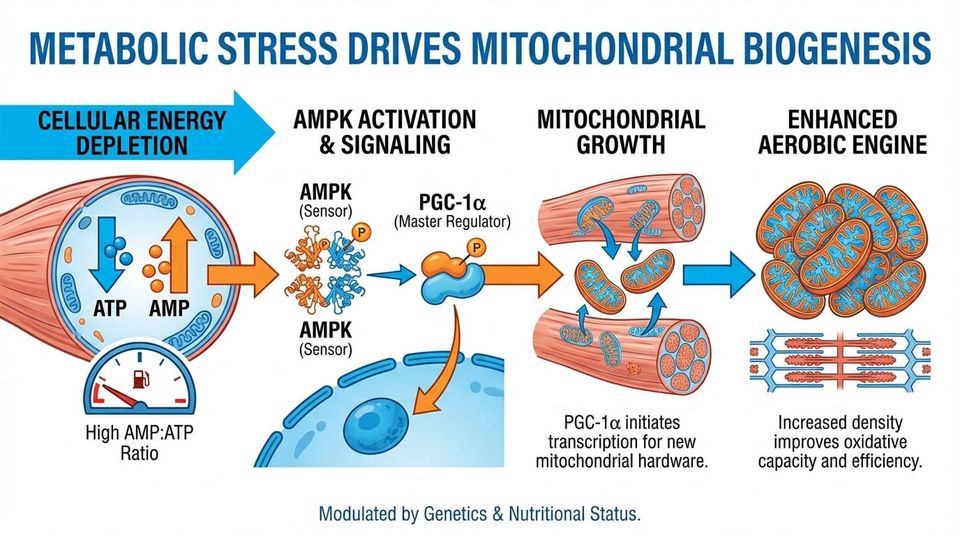
Endurance adaptations begin when the muscle cell detects that it is effectively running out of immediate fuel. As exercise continues, the ratio of spent energy molecules (AMP) to usable energy (ATP) rises, activating a specific sensor protein known as AMPK. This sensor acts like a sensitive fuel gauge, signaling a master regulator (PGC-1α) to initiate the genetic transcription required to build new mitochondria. Consequently, the temporary metabolic stress of energy depletion serves as the necessary biological catalyst that commands the muscle to upgrade its oxidative hardware.
Understanding this signaling pathway illustrates why training must sufficiently disturb cellular energy balance to force an adaptation. By responding to this stress with increased mitochondrial density, the body builds a more efficient aerobic engine capable of sustaining higher work rates before relying heavily on anaerobic metabolism.
 Thomas Mortelmans
While this mechanism is the fundamental driver of aerobic development, individual responsiveness to these signals can vary based on genetic predisposition and nutritional status during training.
This Margin Snippet is drawn from Entry #002 of The Scientist’s Notebook. The interaction between aerobic and anaerobic energy systems during endurance efforts
PS: One quick favor?Let me know your thoughts anonymously. It takes a minute, and your feedback goes straight to my inbox!
Jäger, S., Handschin, C., St-Pierre, J., & Spiegelman, B. M. (2007).
AMP-activated protein kinase (AMPK) action in skeletal muscle via direct phosphorylation of PGC-1α.
Proceedings of the National Academy of Sciences, 104(29), 12017–12022.
Found this useful?
Get articles like this and free training calculators in your inbox every week.
Recommended reads
If this was useful, these are the other research-driven newsletters I actually read.


Member discussion