Snippet #031: Why Humid Air Kills Performance Even in Moderate Heat
Sweat cools the body only when it evaporates, and evaporation depends on the water vapor pressure difference between skin and air. High humidity raises the moisture content of the air, collapsing that gradient, so sweat drips off rather than evaporating and evaporative heat loss falls.
Core temperature then climbs faster than the air temperature alone would predict.
A controlled crossover study found that doubling absolute humidity at 36°C impaired 20-km cycling time-trial performance by 3.4%, while raising air temperature from 18 to 27°C at constant humidity produced no meaningful change (Jenkins et al., 2023, Experimental Physiology).
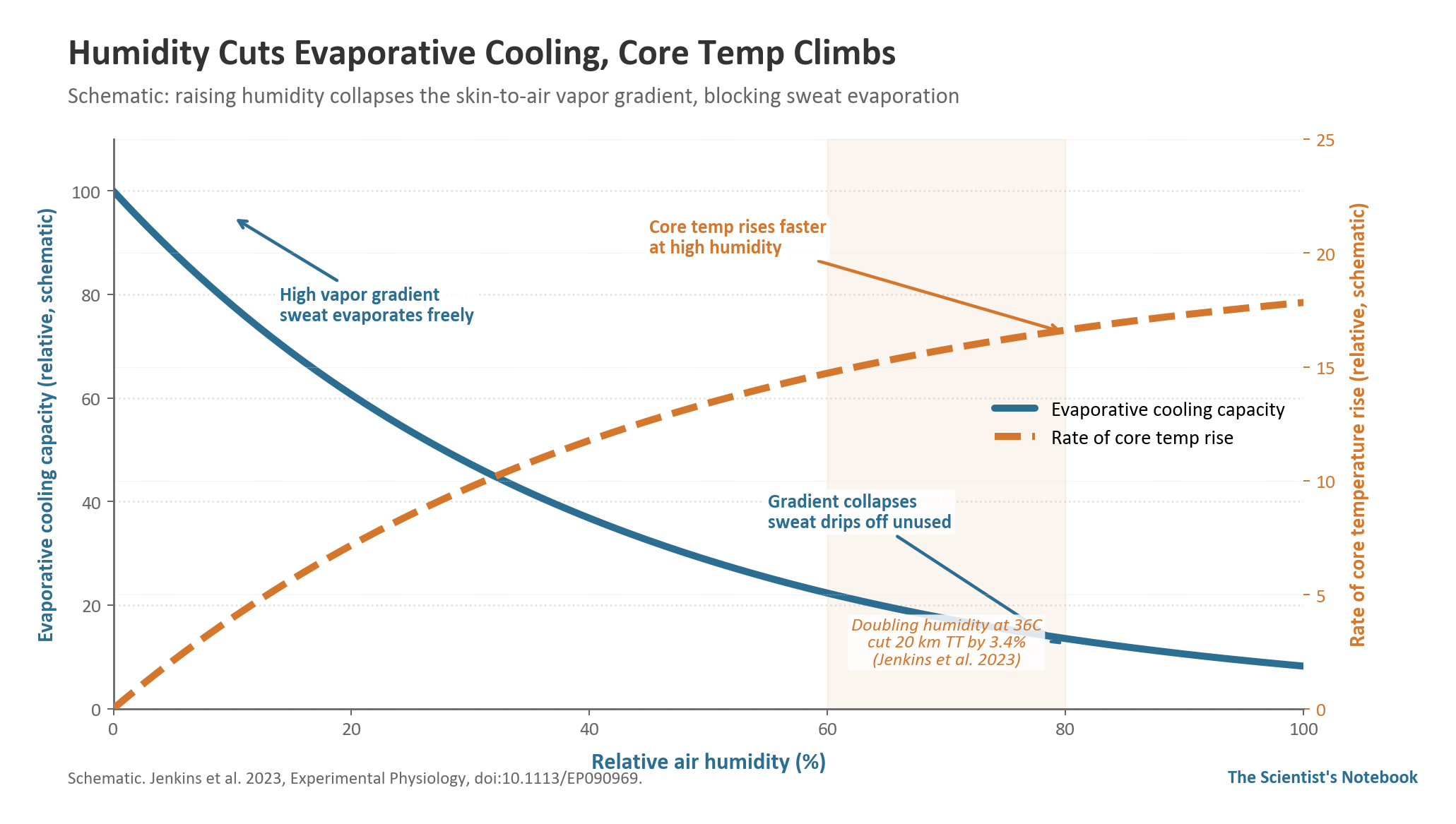
The data show that cardiovascular strain rises as the body redirects blood to the skin in a futile attempt to shed heat the air will not absorb.
Sustainable power or pace is associated with a drop that can feel disproportionate to the thermometer reading, because the limiting factor is vapor pressure, not temperature.
The effect is moderated by airflow, which partially restores the evaporation gradient, and by prior heat acclimation; individual differences in sweat rate also shape the magnitude of impairment.
---
If you have 60 seconds, I would value your anonymous feedback. You can share it here.
---
### Health disclaimer
This post discusses endurance-training science for educational purposes. It is not medical advice, not a diagnosis, and not a substitute for clinical care. Individual response to training, sleep deprivation, and multi-day exertion varies substantially, and what applies to a research cohort or a world-class athlete may not apply to you. > Consult a qualified physician, sports medicine specialist, or registered dietitian before changing your training, fuelling, or sleep strategy if you have a cardiovascular, metabolic, psychiatric, or sleep-related condition; are recovering from injury or illness; are pregnant; are on medication that affects heart rate, hydration, glucose regulation, or sleep; or have concerns about exercise tolerance. > Ultra-endurance events impose real physiological and psychological loads. Persistent chest pain, fainting, acute confusion beyond the predictable late-race window, severe dehydration, sustained loss of coordination, or any mental-health symptoms that outlast the immediate post-event dip warrant professional care and are not signals to push through. > No outcome is guaranteed. The protocols, anchors, and case material in this post are descriptive, drawn from peer-reviewed evidence and a guest contributor's lived experience, and should be treated as inputs to an informed conversation with your own coach and clinicians, not as prescriptions.
Found this useful?
Get articles like this and free training calculators in your inbox every week.
Recommended reads
If this was useful, these are the other research-driven newsletters I actually read.
Member discussion