Snippet #032: Muscle Memory Is Written in Your DNA's Dimmer Switches

DNA methylation works like a set of dimmer switches sitting on top of your genes, turning each one down or up without rewriting the gene itself.
When untrained people did seven weeks of resistance training, the training stripped these dimmers off a cluster of muscle genes, brightening them.
After seven weeks of doing nothing, once muscle size had drifted back to baseline, five of those genes stayed switched bright: a chemical memory that the muscle had once trained (Turner et al. 2019).
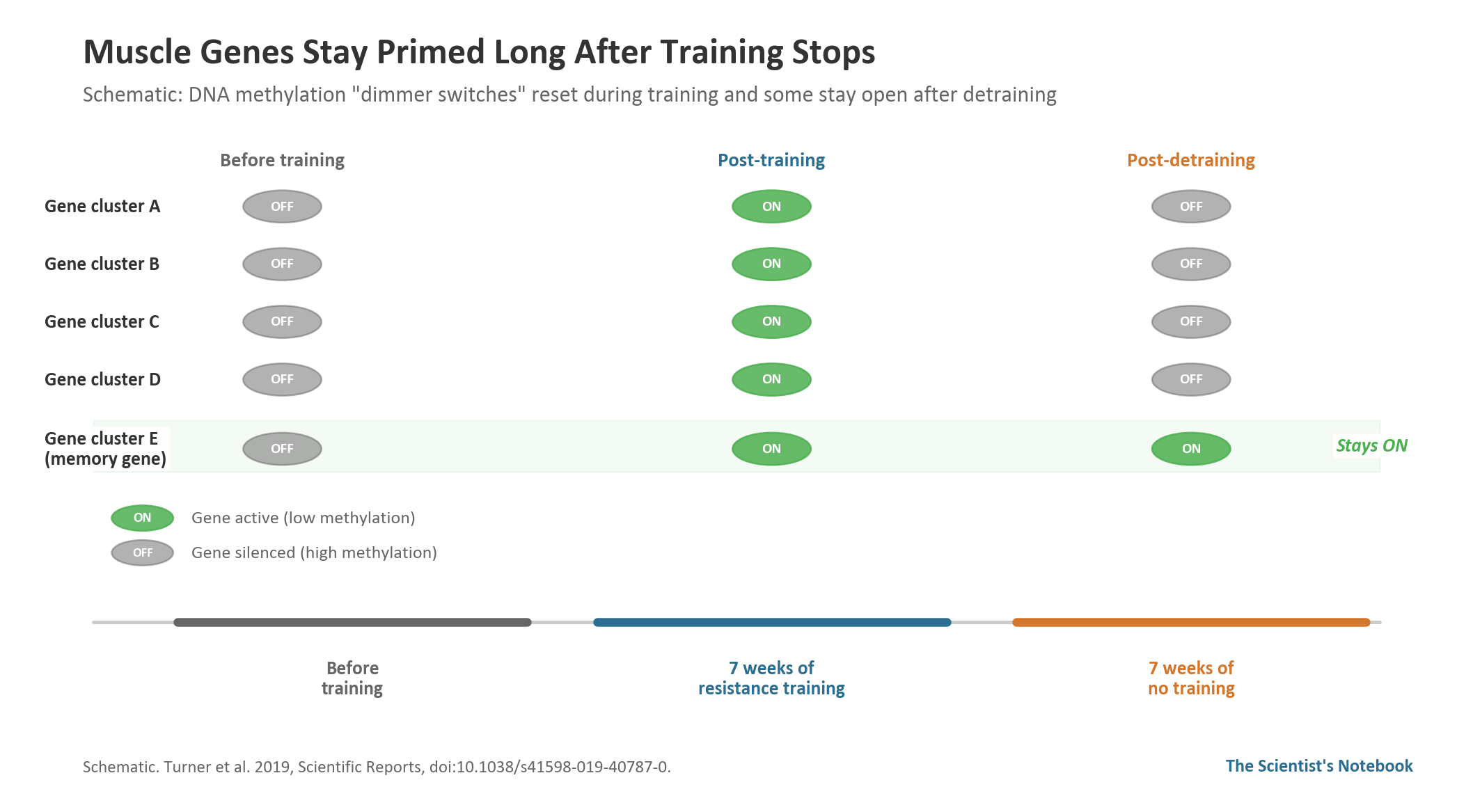
This retained signature is a plausible basis for the familiar feeling of coming back faster after a layoff. Genes that are already primed get re-read quickly, so a muscle with a training history can bring its building machinery online sooner than one starting from scratch.
Years of consistency are not only stored as fitness you can lose.
These findings come from short windows of weeks, in small samples, and mostly from resistance rather than endurance training.
The older idea that extra muscle nuclei are kept forever is contested, so a methylation memory is the better-supported account, though how long it lasts is still unknown.
---
If you have 60 seconds, I would value your anonymous feedback. You can share it here.
---
### Health disclaimer
This post discusses endurance-training science for educational purposes. It is not medical advice, not a diagnosis, and not a substitute for clinical care. Individual response to training, sleep deprivation, and multi-day exertion varies substantially, and what applies to a research cohort or a world-class athlete may not apply to you. > Consult a qualified physician, sports medicine specialist, or registered dietitian before changing your training, fuelling, or sleep strategy if you have a cardiovascular, metabolic, psychiatric, or sleep-related condition; are recovering from injury or illness; are pregnant; are on medication that affects heart rate, hydration, glucose regulation, or sleep; or have concerns about exercise tolerance. > Ultra-endurance events impose real physiological and psychological loads. Persistent chest pain, fainting, acute confusion beyond the predictable late-race window, severe dehydration, sustained loss of coordination, or any mental-health symptoms that outlast the immediate post-event dip warrant professional care and are not signals to push through. > No outcome is guaranteed. The protocols, anchors, and case material in this post are descriptive, drawn from peer-reviewed evidence and a guest contributor's lived experience, and should be treated as inputs to an informed conversation with your own coach and clinicians, not as prescriptions.
Found this useful?
Get articles like this and free training calculators in your inbox every week.
Recommended reads
If this was useful, these are the other research-driven newsletters I actually read.

Member discussion