Snippet #033: What Your Muscle Oxygen Sensor Is Actually Reading
Near-infrared spectroscopy (NIRS) shines near-infrared light through skin into muscle and reads how much hemoglobin and myoglobin is carrying oxygen. The ratio is reported as muscle oxygen saturation (SmO2), a local signal reflecting the real-time balance between oxygen delivery and oxygen consumption beneath the sensor.
When demand outpaces supply, SmO2 drops; when delivery recovers, it rises. The speed of re-oxygenation after a hard effort is associated with local oxidative and microvascular recovery capacity.
A systematic review of 57 exercise studies by Perrey and Ferrari confirms NIRS as a meaningful marker of skeletal muscle oxidative capacity across sport activities (Perrey & Ferrari, Sports Med, 2018).
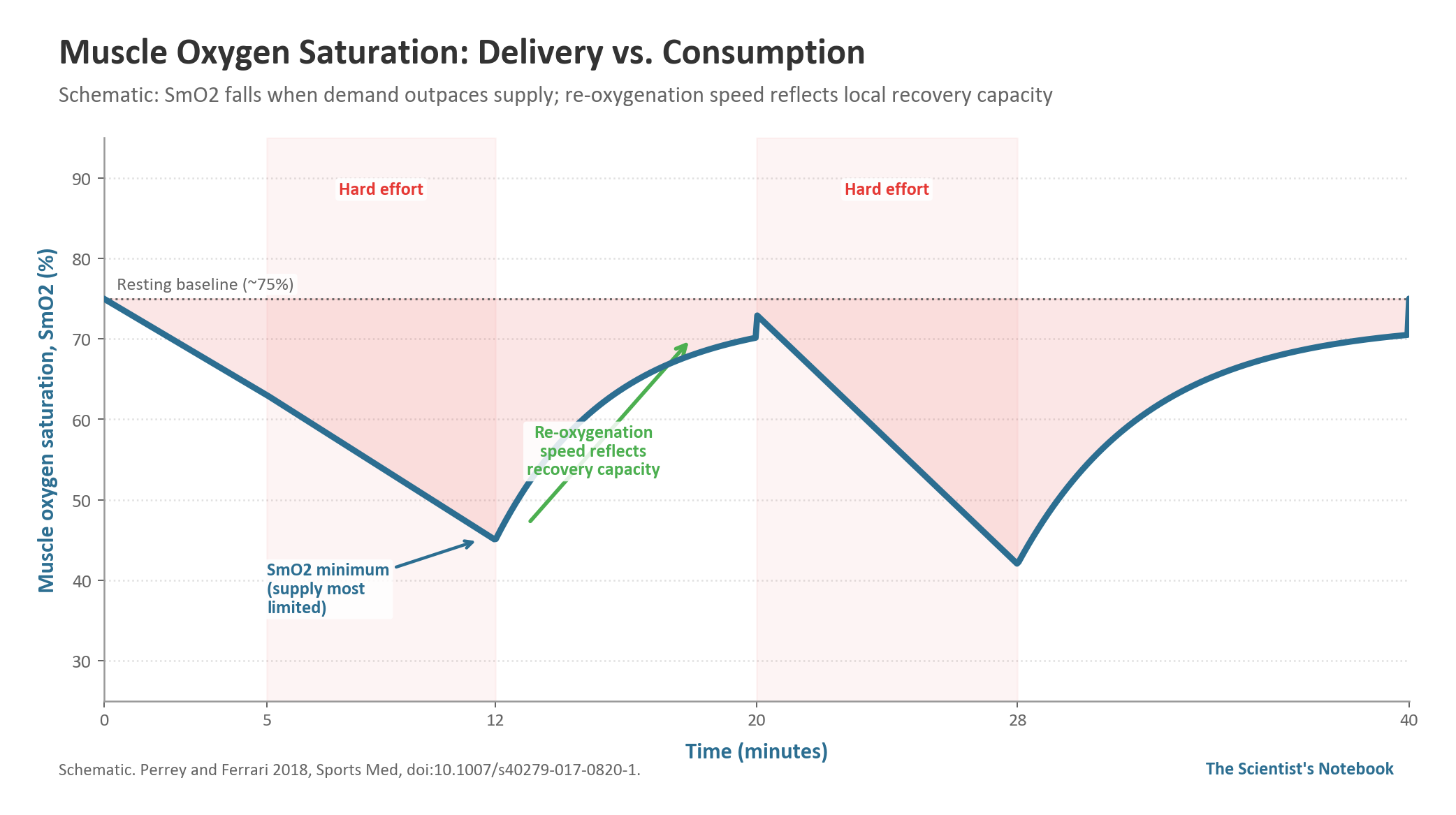
SmO2 captures what whole-body gas exchange cannot: whether the muscle under the sensor is receiving enough oxygen relative to its workload.
Two athletes can show the same VO2 at a given power while one muscle group is severely desaturating. Re-oxygenation rate between intervals is associated with aerobic fitness and capillary density.
SmO2 is a local, not systemic, measure. Adipose tissue thickness attenuates the signal, sensor placement shifts the tissue sampled, and motion artifacts corrupt readings. A vastus lateralis reading says nothing reliable about the calf or cardiovascular system.
---
If you have 60 seconds, I would value your anonymous feedback. You can share it here.
---
### Health disclaimer
This post discusses endurance-training science for educational purposes. It is not medical advice, not a diagnosis, and not a substitute for clinical care. Individual response to training, sleep deprivation, and multi-day exertion varies substantially, and what applies to a research cohort or a world-class athlete may not apply to you. > Consult a qualified physician, sports medicine specialist, or registered dietitian before changing your training, fuelling, or sleep strategy if you have a cardiovascular, metabolic, psychiatric, or sleep-related condition; are recovering from injury or illness; are pregnant; are on medication that affects heart rate, hydration, glucose regulation, or sleep; or have concerns about exercise tolerance. > Ultra-endurance events impose real physiological and psychological loads. Persistent chest pain, fainting, acute confusion beyond the predictable late-race window, severe dehydration, sustained loss of coordination, or any mental-health symptoms that outlast the immediate post-event dip warrant professional care and are not signals to push through. > No outcome is guaranteed. The protocols, anchors, and case material in this post are descriptive, drawn from peer-reviewed evidence and a guest contributor's lived experience, and should be treated as inputs to an informed conversation with your own coach and clinicians, not as prescriptions.
Found this useful?
Get articles like this and free training calculators in your inbox every week.
Recommended reads
If this was useful, these are the other research-driven newsletters I actually read.
Member discussion