Snippet #030: Cold Water After Lifting Can Quietly Undercut Long-Term Muscle Gains
Cold water immersion after resistance training is associated with blunted satellite cell activity and reduced phosphorylation of p70S6 kinase, a protein that signals muscle growth.
In a 12-week randomized trial, athletes who used cold water immersion after every session gained less strength and smaller increases in type II muscle fiber size than those who used active recovery instead (Roberts et al. 2015).
The data show that cold exposure appears to suppress the cellular signals that drive long-term adaptation.
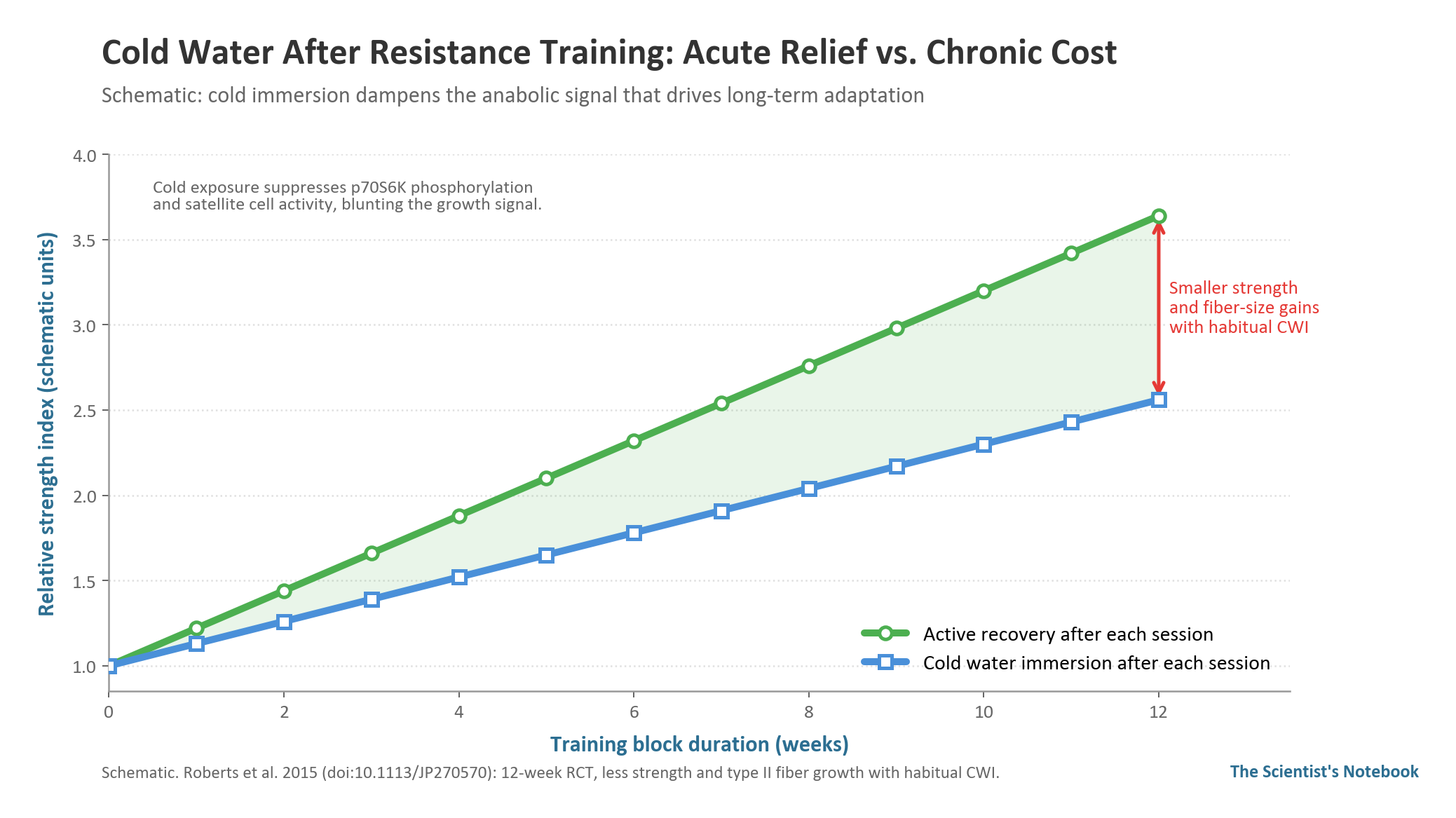
The distinction the research draws is between acute and chronic use. Cold water immersion is still associated with faster perceived recovery and reduced soreness in the short term, giving it real value between same-day sessions.
The problem is habitual use after every session, where the cumulative dampening of anabolic signaling appears to translate into measurably smaller gains over a training block.
The effect is clearest for strength and hypertrophy outcomes; evidence for endurance-specific adaptations such as mitochondrial density or aerobic capacity is more mixed.
The Roberts et al. trial studied resistance-trained men, so how closely the findings translate to female athletes or purely endurance-focused populations remains an open question.
---
If you have 60 seconds, I would value your anonymous feedback. You can share it here.
---
### Health disclaimer
This post discusses endurance-training science for educational purposes. It is not medical advice, not a diagnosis, and not a substitute for clinical care. Individual response to training, sleep deprivation, and multi-day exertion varies substantially, and what applies to a research cohort or a world-class athlete may not apply to you. > Consult a qualified physician, sports medicine specialist, or registered dietitian before changing your training, fuelling, or sleep strategy if you have a cardiovascular, metabolic, psychiatric, or sleep-related condition; are recovering from injury or illness; are pregnant; are on medication that affects heart rate, hydration, glucose regulation, or sleep; or have concerns about exercise tolerance. > Ultra-endurance events impose real physiological and psychological loads. Persistent chest pain, fainting, acute confusion beyond the predictable late-race window, severe dehydration, sustained loss of coordination, or any mental-health symptoms that outlast the immediate post-event dip warrant professional care and are not signals to push through. > No outcome is guaranteed. The protocols, anchors, and case material in this post are descriptive, drawn from peer-reviewed evidence and a guest contributor's lived experience, and should be treated as inputs to an informed conversation with your own coach and clinicians, not as prescriptions.
Found this useful?
Get articles like this and free training calculators in your inbox every week.
Recommended reads
If this was useful, these are the other research-driven newsletters I actually read.
Member discussion