Entry #042: The Invisible Engine: What Strength Training Really Does for Endurance Athletes

The conversation about strength training for endurance athletes used to be short. For most of the twentieth century the prevailing wisdom held that a barbell belonged to sprinters and throwers, while distance runners and cyclists should fear it.
Lifting heavy was thought to add useless bulk, blunt aerobic adaptation, and steal recovery from the only training that mattered, which was more miles and more watts.
That belief was rooted in a real observation: when you train hard for two opposing goals at once, the body sometimes seems to compromise on both. The question is whether that compromise is large enough to matter, and whether it can be managed.
What the modern literature describes is not a tradeoff but a complement. Heavy resistance work and explosive jumping change the nervous system and connective tissue in ways pure aerobic training cannot reach.
The muscle learns to produce force faster and more efficiently, the tendon learns to store and return energy with less waste, and the most fatigue prone fiber types are nudged toward a more durable profile.
None of these adaptations show up on a stopwatch during the lifting session itself. They show up later, in the final third of a long race, in the surge over a climb, in the kick to the line.
They are, in a real sense, invisible until the moment they are needed.
This entry tells the broader strength story rather than the narrow one. A separate piece already explores running economy in depth, so economy appears here only briefly as one downstream benefit.
The wider picture includes maximal force and the rate at which it can be expressed, the durability of effort late in an event, the way connective tissue absorbs load, and the long debated interference effect that scared a generation of coaches away from the weight room.
It also includes a quieter point, that most of these gains arrive with very little added muscle size.
The aim throughout is to describe what the research observes rather than to prescribe what any individual should do. Endurance athletes differ enormously in event, training history, age, and tolerance for load, and the literature reflects that variety.
What follows is an account of the mechanisms, the effects, and the honest limits of the evidence, so a reader can understand why a sport built on aerobic endurance has quietly made room for the heavy and the explosive.
Gradescale: Your physiology, decoded. Join the waitlist now.
 Thomas Mortelmans

The brief
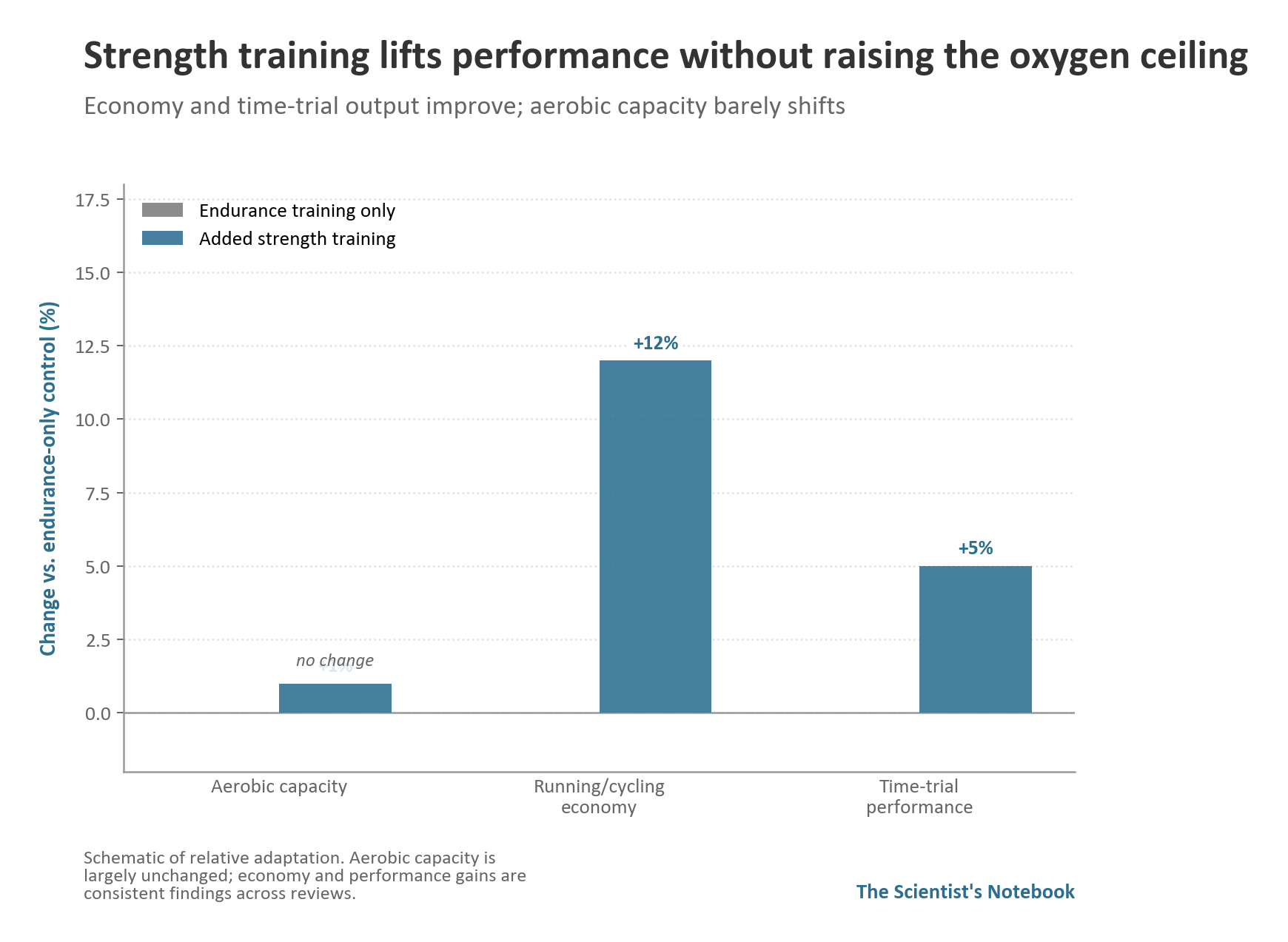
- Strength training improves endurance performance through the nervous system, not the engine. Resistance work leaves maximal oxygen uptake largely unchanged yet still improves performance, because it sharpens force production and movement efficiency rather than aerobic capacity.
- Rate of force development is the underrated lever. How quickly a muscle can express force inside a brief ground contact matters more for a runner than how much force it can eventually produce, and explosive work targets this directly.
- Heavy and explosive training do different jobs. Maximal loads above eighty percent of a single repetition maximum drive neural recruitment and tendon stiffness, while lighter, faster work and plyometrics build the speed of force application and the stretch shortening cycle.
- The interference effect is real but modest and modifiable. Combining heavy aerobic and resistance training can slightly blunt strength and size gains, yet appropriate spacing, modality choice, and load management shrink that penalty substantially.
- Fatigue resistance improves late in an event. A more durable fiber profile and stiffer tendons help preserve efficient mechanics during the final stretch, when fatigue normally degrades them most.
- Hypertrophy is usually minimal in endurance athletes. The added force tends to come from neural adaptation and fiber type shifts rather than large increases in muscle cross sectional area, so the feared weight gain rarely materializes.
- Injury resistance benefits depend on supervision. Pooled trial evidence suggests exercise based prevention helps most when programs are properly coached and progressed, and far less when they are unsupervised.
- The benefits generalize across sex and age. Men and women adapt in similar relative proportions, and older athletes may gain the most, because strength work counters the age related loss of the powerful, fast fiber types.
The science at a glance
Foundational Principle 1: Force and the speed of force matter more than size
The first thing heavy lifting changes in an endurance athlete is the nervous system.
Within a few weeks, motor units fire faster and more in unison and the threshold for recruiting them drops, which is why early strength gains arrive long before any visible change in muscle bulk.
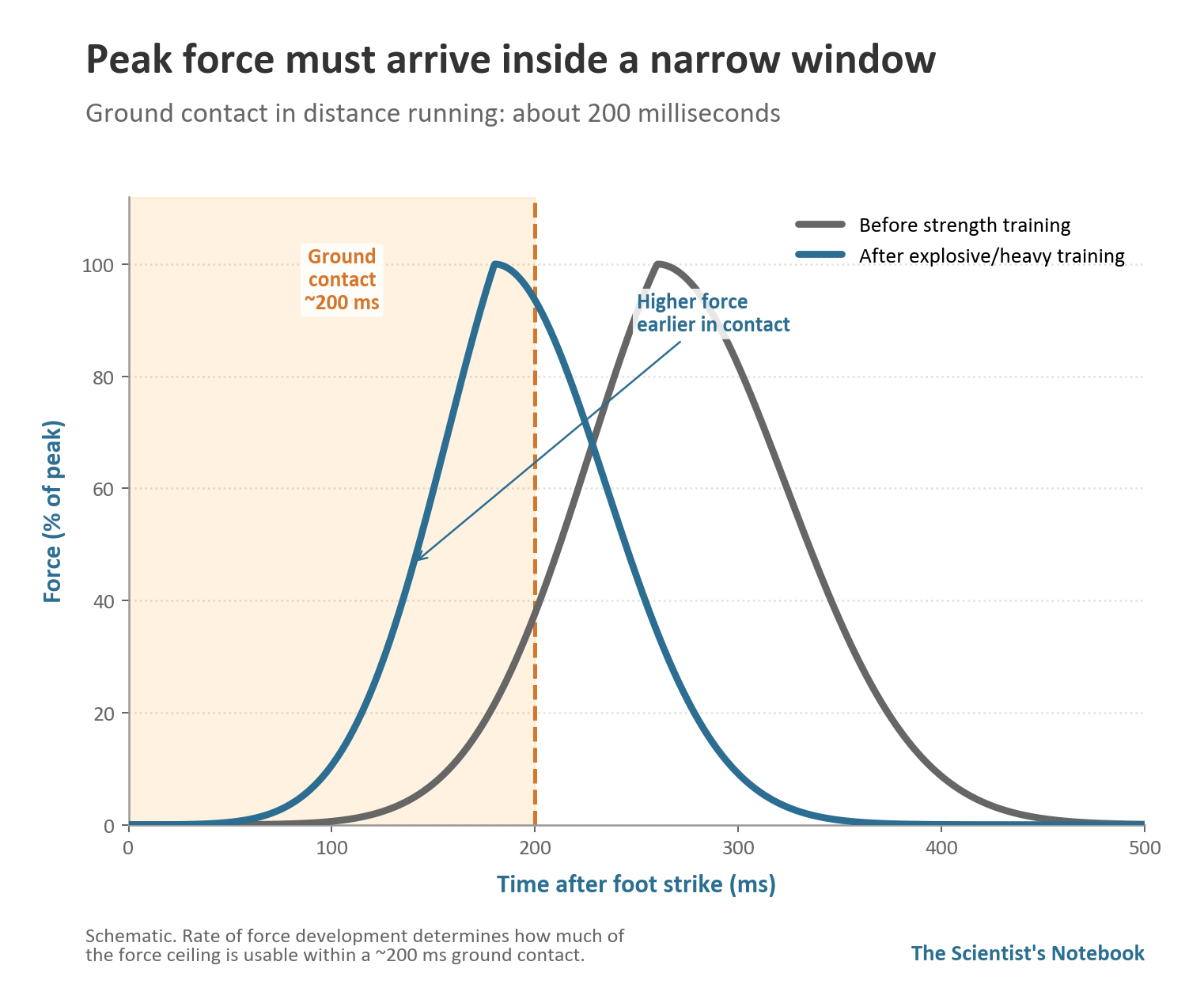
For a distance runner or cyclist, the practical currency is not the maximum force a muscle can eventually generate but the rate of force development, meaning how much force can be expressed in the first fraction of a second of a contraction.
Ground contact in distance running lasts only a couple hundred milliseconds, so an athlete who reaches peak force faster within that window holds the same pace with less effort.
Explosive work and plyometrics sharpen this early phase, while heavy lifting raises the ceiling the explosive work then learns to approach.
Scientist's Insight: Strength training for endurance is less about a bigger engine and more about teaching the existing one to fire cleanly and on demand.
Foundational Principle 2: Tendons store and return energy like springs
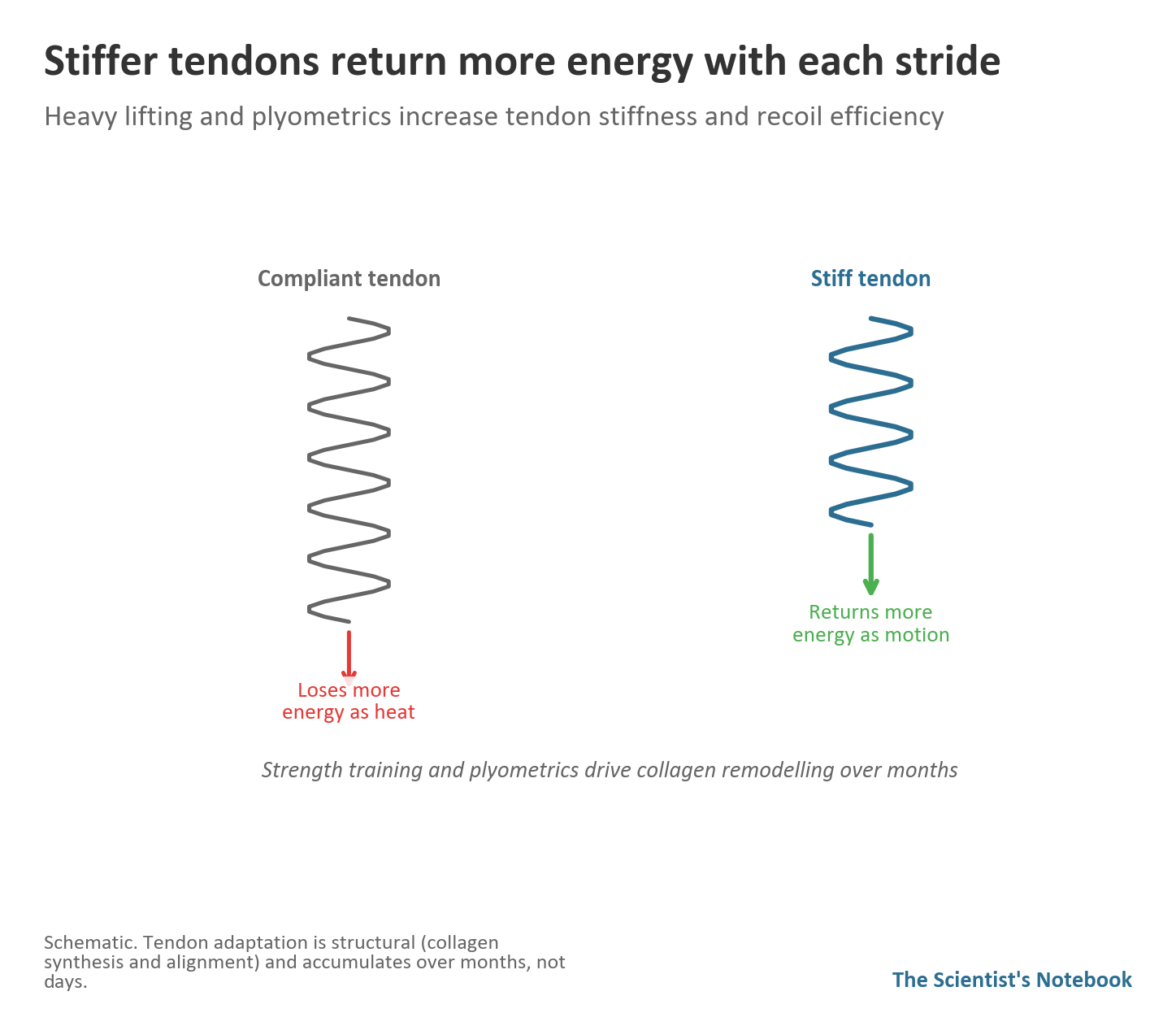
Muscle is only half of the propulsion story. The tendons that connect muscle to bone behave like springs, stretching to absorb energy as a foot lands and recoiling to return some of it during push off.
A stiffer, better tuned tendon wastes less of the stored energy as heat and returns more of it as useful work, which lowers the metabolic cost of each stride or stroke.
Heavy resistance training and plyometric work both drive measurable increases in tendon stiffness and in the efficiency of this recoil. Athletes from sports that demand heavy elastic loading show tendons that lose strikingly little energy across each stretch and return cycle.
The adaptation is structural, built from changes in how collagen is synthesized and aligned, and it accumulates over months rather than days.
Scientist's Insight: A well conditioned tendon is free propulsion, returning borrowed energy the muscle would otherwise pay for metabolically.
Foundational Principle 3: Fiber types shift toward durable power
Endurance training alone gradually biases muscle toward the slow, fatigue resistant type one fibers, which is excellent for steady aerobic work but leaves little for surges and finishes.
High intensity strength and explosive training recruit the faster type two fibers and nudge the least durable of them, the type two X fibers, toward the more versatile type two A phenotype.
These intermediate fibers keep much of the power of fast fibers while gaining the oxidative, fatigue resistant qualities of slow fibers. The result is a muscle that still sustains efficient aerobic work yet retains a reserve of durable power for the moments that decide races.
This also helps explain why strength trained athletes preserve efficient mechanics deeper into a hard effort, when an untrained competitor's form falls apart.
Scientist's Insight: The goal is not to convert slow fibers into fast ones but to keep the fast fibers durable, so power survives the full length of an event.
Reading the signals
Lever 1: Maximal force versus explosive force
The data: Resistance programs for endurance athletes cluster into two families. Heavy loads above roughly eighty percent of a single repetition maximum, lifted for few repetitions with long rests, primarily drive neural recruitment and tendon stiffness.
Lighter loads moved at high velocity, along with plyometric jumps, primarily drive the rate of force development and the stretch shortening cycle.
Reviews comparing these families against economy and time trial outcomes find that both produce meaningful improvements, and that combining them produces the broadest effect, with heavy loading most consistent in cycling.
Where athletes tend to land: Many endurance programs in the literature blend the two, with a base of heavy multi joint lifting through the preparatory months and a layer of explosive or plyometric work added as competition approaches.
The combination appears in the research more often than either method alone, reflecting that the two families address complementary qualities rather than competing for one adaptation.
Lever 2: The concurrent training interference effect
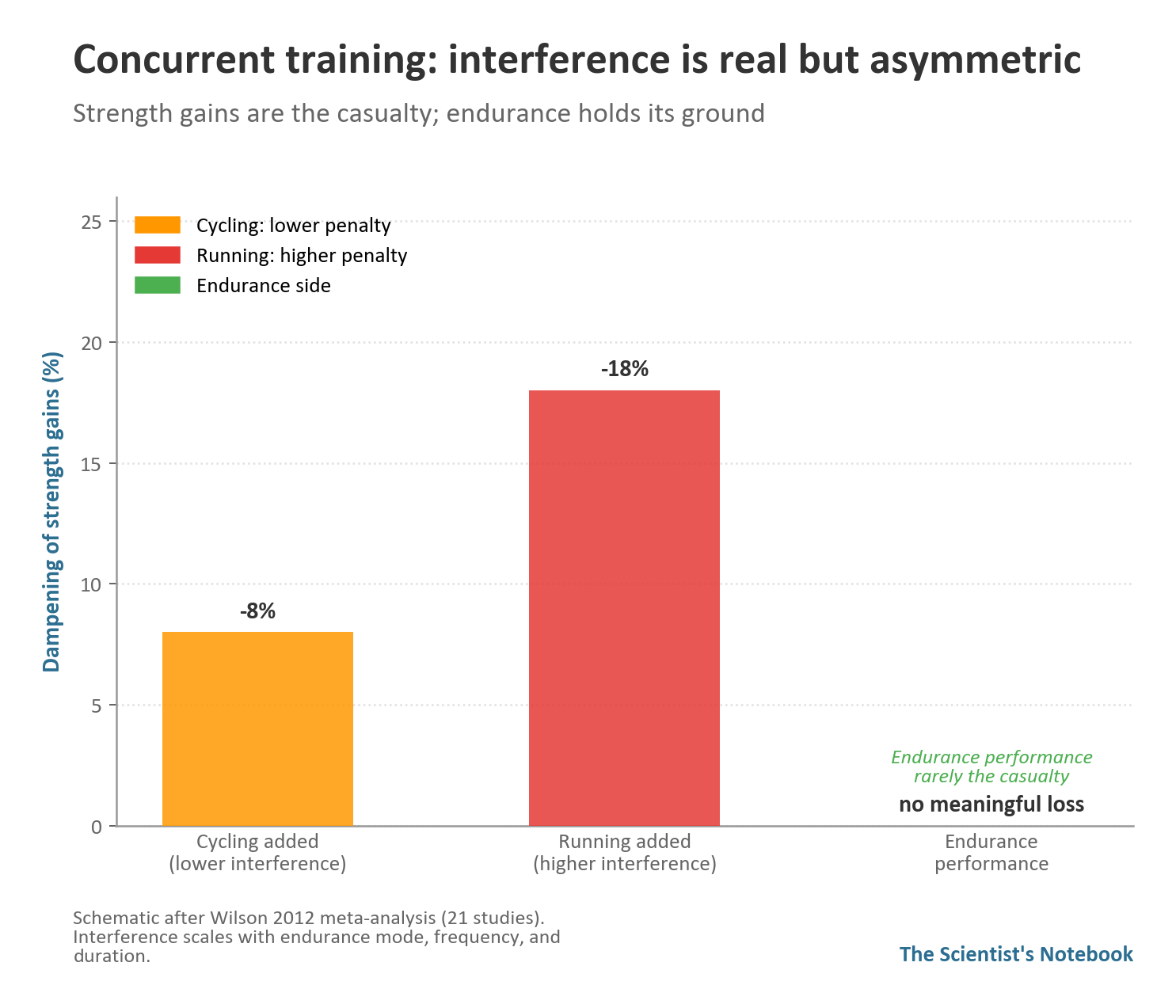
The data: The interference effect, first documented when heavy endurance training was shown to blunt strength gains, is genuine but smaller than its reputation.
A meta analysis of concurrent training reported that strength gains were dampened rather than erased when aerobic work was added, and that the penalty scaled with the frequency and duration of endurance training and was larger when the aerobic mode was running rather than cycling.
 Thomas Mortelmans
The proposed mechanisms include competing molecular signals and simple accumulated fatigue. The interference runs mainly from endurance into strength, not the reverse, so endurance performance itself is rarely the casualty.
Where athletes tend to land: In the studies, interference fades when the two stimuli are separated in time, when total load is managed by trading some aerobic volume for strength work rather than stacking everything on top, and when the aerobic mode is gentler on the body.
The literature frames the interference effect as a reason to program thoughtfully rather than a reason to abandon the weight room, since the endurance side of the ledger holds its gains.
Lever 3: Minimal hypertrophy and the weight question
The data: The most persistent fear among endurance athletes is that lifting will add slowing mass. The evidence points the other way.
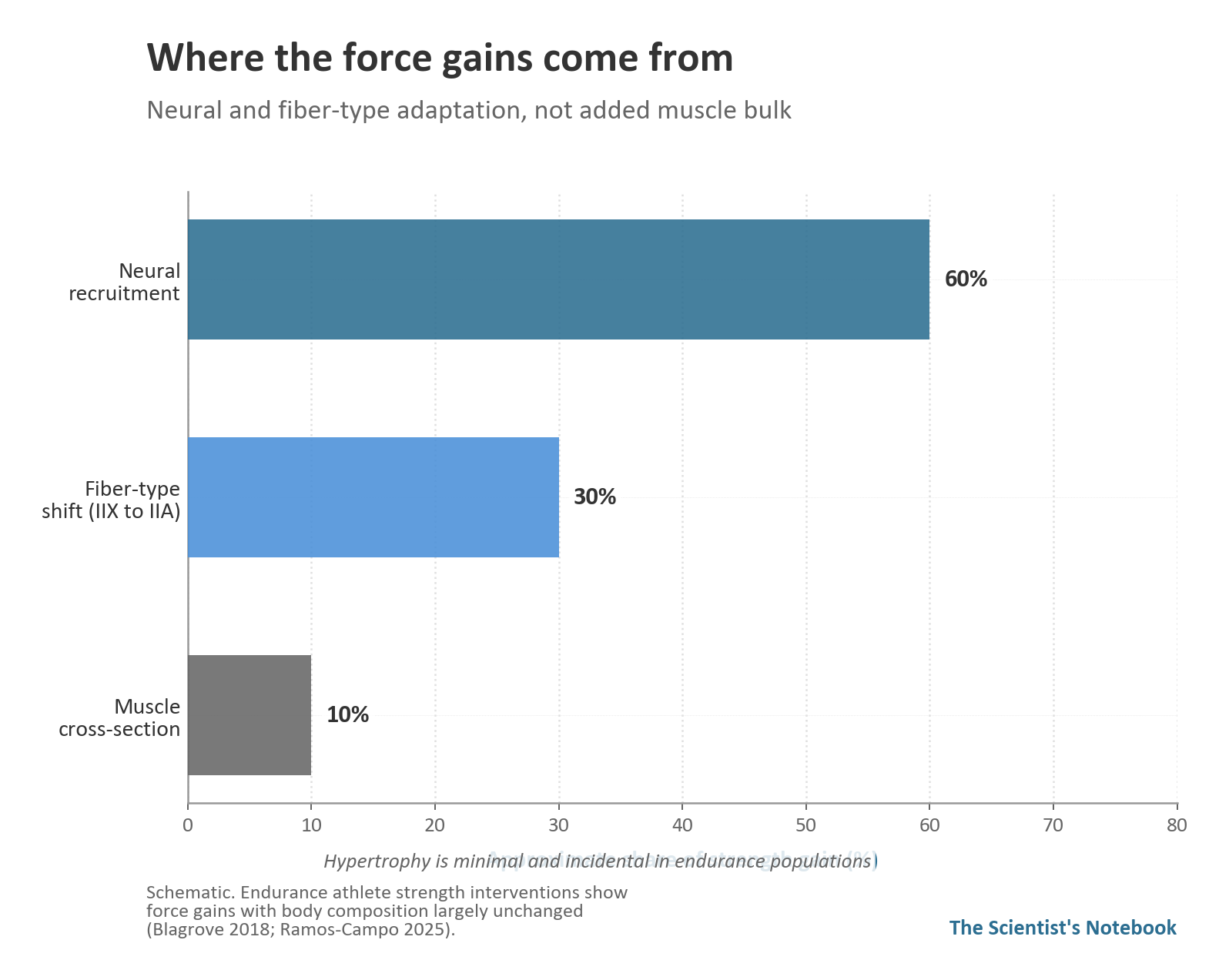
In endurance populations the force gains come predominantly from neural adaptation and the shift toward durable fast fibers, with body composition typically unchanged across these interventions.
Where muscle cross sectional area does rise modestly, as in some cycling trials, it accompanies improved performance rather than degrading it, because the added tissue feeds power without meaningfully changing mass.
Thomas Mortelmans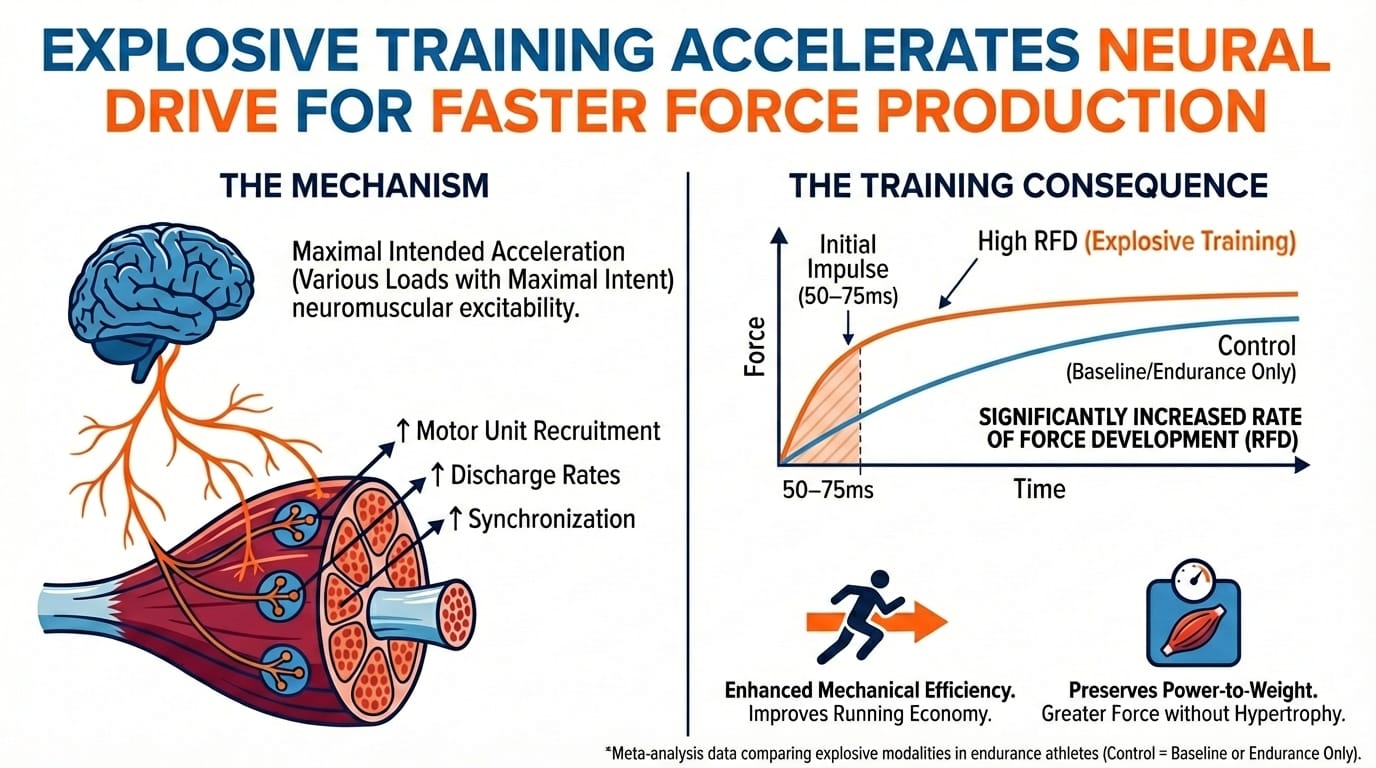
Related reading
Where athletes tend to land: The studied athletes generally finish strength interventions stronger without becoming heavier, which is why reviews describe hypertrophy in this context as minimal and incidental. Important caveat: this pertains to interventions that are strength-focussed (6-8 reps) and shorter in durations (e.g. 4-8 weeks). For longer interventions, hypertrophic changes might occurs and also significantly contribute to the force adaptations.
The high volume lifting that drives large size gains in bodybuilders is largely absent from the endurance literature, where low repetition heavy work and fast explosive work dominate and size is a side effect rather than a target.
Method and a worked example
The studies behind these conclusions share a recognizable structure, and understanding it makes the findings easier to weigh.
Method
- Establish a trained baseline. Researchers recruit athletes who already have a meaningful endurance history, often defined by months of training, weekly volume, or a minimum aerobic capacity, so results reflect adaptation in real endurance athletes rather than novices improving at everything at once.
- Assign groups and a control. Participants are randomized into a group that adds resistance training to their normal endurance work and a control group that continues endurance training alone, which isolates the effect of the added strength stimulus.
- Apply a defined strength protocol. The intervention specifies load, repetitions, and weeks of duration, commonly heavy lifting, explosive work, plyometrics, or a blend performed once or twice weekly alongside ongoing aerobic training.
- Measure the right outcomes. The key readouts include running or cycling economy, time trial performance, maximal force, the rate of force development, and frequently a muscle biopsy to track fiber type composition and cross sectional area.
- Interpret against the control. The comparison against the endurance only group reveals whether the strength stimulus changed performance and which variables moved, with biopsies clarifying whether gains were neural, structural, or both.
Consider a generic composite drawn from these patterns rather than any one athlete. A recreational cyclist with a few seasons of steady riding adds two heavy lower body sessions each week through the off season while trimming a little aerobic volume to make room.
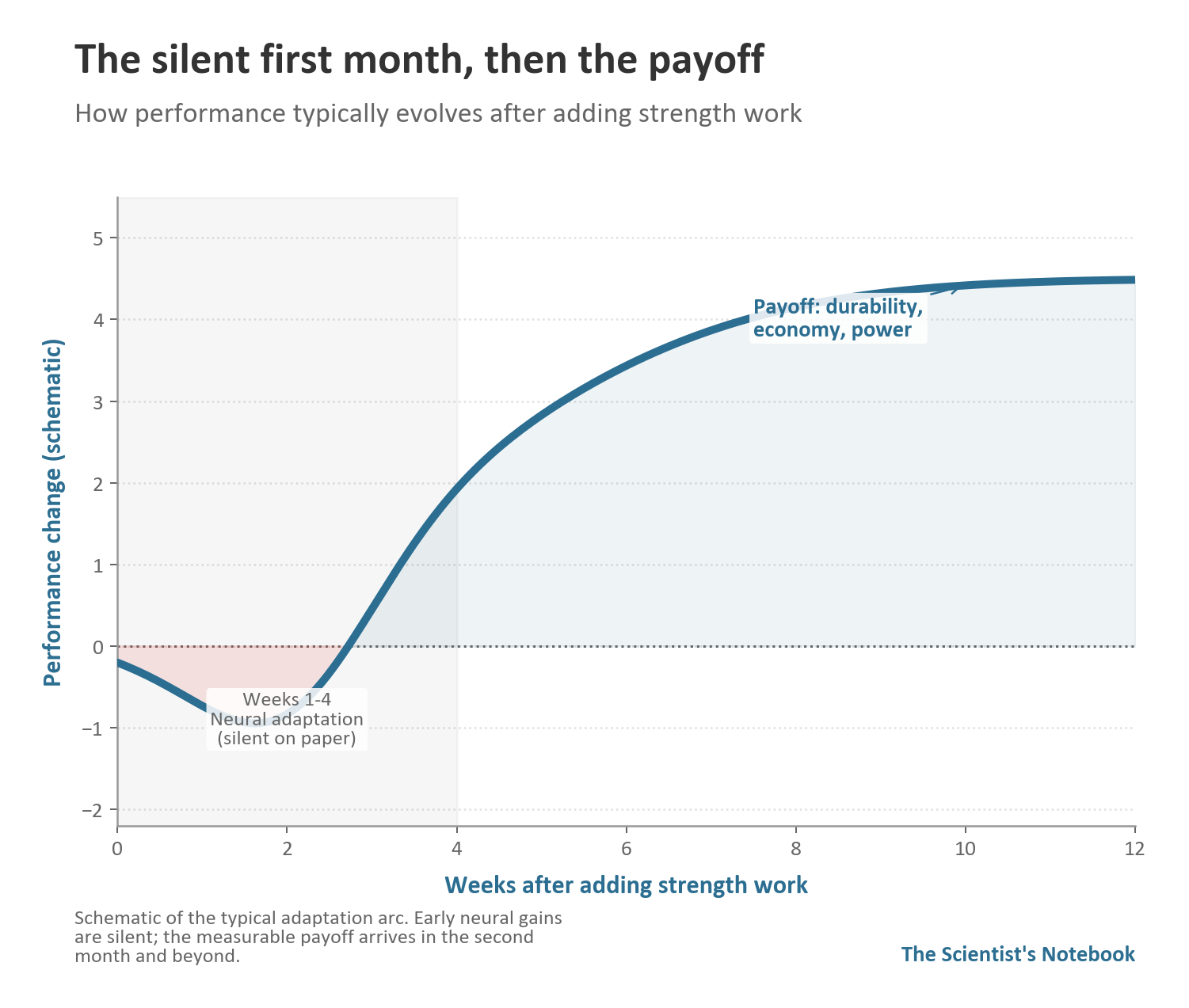
The first weeks bring a familiar story: legs that feel heavy on the bike, rides where power feels harder to find, and the quiet worry that the experiment is backfiring. Nothing improves on paper for nearly a month, because the early adaptation is neural and silent.
By the second month the picture turns. Force in the leg press climbs, the same submaximal pace feels easier, and a forty minute effort holds more power than before.
A biopsy in the matching research would likely show the durable fiber shift rather than larger muscles, and body weight barely moves.
The arc is rarely linear: a dip before the lift, a plateau in the middle, and a real payoff that arrives in the durability of a long, hard effort rather than in any single dramatic session.
Where this leaves us
Pulled together, the strength story for endurance athletes is a story about quality rather than quantity. The aerobic engine is built by aerobic training, and nothing about lifting replaces that.
Free calculator
What heavy and explosive work add is a different layer entirely: a nervous system that expresses force faster, tendons that return more of the energy they absorb, and a fiber profile that keeps its power when the effort grows long.
These adaptations explain why performance improves even when maximal oxygen uptake does not, and why the benefit so often shows up in the final third of a race rather than the laboratory.
The old fears have mostly dissolved under scrutiny. The interference effect is real but modest, running chiefly from endurance into strength and leaving endurance performance intact, and it shrinks when training is spaced and load is managed.
Thomas Mortelmans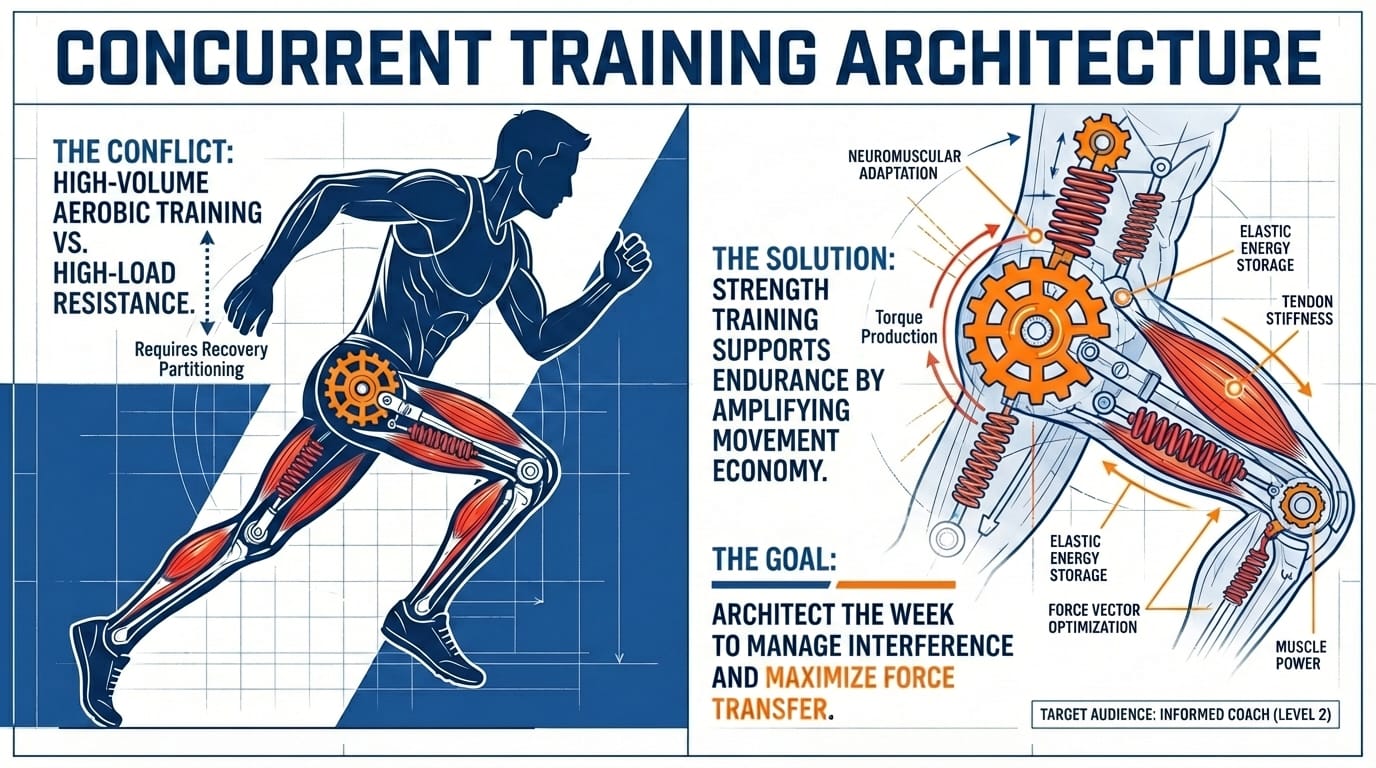
Related reading
The dreaded weight gain rarely appears, because the force comes from the nervous system and from durable fibers rather than from bulk. What remains is a complementary tool that asks for thoughtful programming and rewards patience, its gains invisible for weeks before they surface.
For the curious athlete, the value of this evidence is a clearer mental model. Strength work is not a betrayal of endurance training but a quiet partner to it, addressing the parts of performance that miles and watts alone cannot reach.
Best regards,
Dr. Thomas Mortelmans
Limits of Application: The evidence base leans heavily on short interventions of a few weeks to a few months, often in recreational or moderately trained athletes and frequently in men, so the magnitude and durability of these effects in elite, female, masters, and very long duration athletes remain less certain.
Individual responses vary widely, biopsy and economy findings do not always move together, and none of this describes a specific program for any individual. It is an account of what the literature observes, not medical or coaching advice for a particular athlete.
References
- Ramos-Campo DJ, Andreu-Caravaca L, Clemente-Suarez VJ, Rubio-Arias JA. The Effect of Strength Training on Endurance Performance Determinants in Middle- and Long-Distance Endurance Athletes: An Umbrella Review of Systematic Reviews and Meta-Analysis. J Strength Cond Res. 2025. PMID 40153564. Umbrella review of seventeen systematic reviews finding moderate to large gains in running economy with strength training while maximal oxygen uptake is maintained.
- Beattie K, Kenny IC, Lyons M, Carson BP. The effect of strength training on performance in endurance athletes. Sports Med. 2014. PMID 24532151. Systematic review concluding that strength training improves economy, velocity at maximal oxygen uptake, muscle power, and time trial performance in trained endurance athletes.
- Ronnestad BR, Mujika I. Optimizing strength training for running and cycling endurance performance: A review. Scand J Med Sci Sports. 2014. PMID 23914932. Review linking endurance gains to delayed type two fiber activation, improved neuromuscular efficiency, fiber type conversion, and musculo-tendinous stiffness.
- Llanos-Lagos C, Ramirez-Campillo R, Moran J, Saez de Villarreal E. Effect of Strength Training Programs in Middle- and Long-Distance Runners' Economy at Different Running Speeds: A Systematic Review with Meta-analysis. Sports Med. 2024. PMID 38165636. Meta-analysis quantifying small to moderate running economy improvements from high load, combined, and plyometric methods across different speeds.
- Blagrove RC, Howatson G, Hayes PR. Effects of Strength Training on the Physiological Determinants of Middle- and Long-Distance Running Performance: A Systematic Review. Sports Med. 2018. PMID 29249083. Review of twenty-four studies showing economy and performance gains while body composition is left unchanged by strength training.
- Nugent FJ, Flanagan EP, Darragh I, Daly L, Warrington GD. The Effects of High-Repetition Strength Training on Performance in Competitive Endurance Athletes: A Systematic Review and Meta-Analysis. J Strength Cond Res. 2023. PMID 37235540. Meta-analysis indicating high-repetition strength work offers little advantage over low-repetition heavy work in endurance athletes.
- Wilson JM, Marin PJ, Rhea MR, Wilson SMC, Loenneke JP, Anderson JC. Concurrent training: a meta-analysis examining interference of aerobic and resistance exercises. J Strength Cond Res. 2012. PMID 22002517. Twenty-one-study meta-analysis showing interference scales with endurance frequency and duration and is larger for running than cycling.
- Hickson RC. Interference of strength development by simultaneously training for strength and endurance. Eur J Appl Physiol Occup Physiol. 1980. PMID 7193134. The original demonstration that adding heavy endurance training blunts strength development without reducing aerobic capacity gains.
- Vikmoen O, Ellefsen S, Troen O, Hollan I, Hanestadhaugen M, Raastad T, Ronnestad BR. Strength training improves cycling performance, fractional utilization of VO2max and cycling economy in female cyclists. Scand J Med Sci Sports. 2016. PMID 25892654. Trial in female cyclists showing heavy strength training improved performance alongside a fiber shift toward type two A.
- Ronnestad BR, Hansen EA, Raastad T. Strength training affects tendon cross-sectional area and freely chosen cadence differently in noncyclists and well-trained cyclists. J Strength Cond Res. 2012. PMID 22201692. Study showing strength training alters tendon cross-sectional area and cycling economy differently in recreational versus well-trained cyclists.
- Aagaard P, Andersen JL, Bennekou M, Larsson B, Olesen JL, Crameri R, Magnusson SP, Kjaer M. Effects of resistance training on endurance capacity and muscle fiber composition in young top-level cyclists. Scand J Med Sci Sports. 2011. PMID 21362056. Trial in elite cyclists showing concurrent training raised rate of force development and longer endurance capacity alongside a type two A fiber shift.
- Vikmoen O, Ronnestad BR. A Comparison of the Effect of Strength Training on Cycling Performance between Men and Women. J Funct Morphol Kinesiol. 2021. PMID 33803041. Review finding that male and female cyclists benefit similarly from concurrent strength training, with muscle cross-sectional area an important adaptation.
- Wilson JM, Loenneke JP, Jo E, Wilson GJ, Zourdos MC, Kim JS. The effects of endurance, strength, and power training on muscle fiber type shifting. J Strength Cond Res. 2012. PMID 21912291. Review of how training modality drives interconversion among type one, type two A, and type two X muscle fibers.
- Hunter SK, Angadi SS, Bhargava A, Harper J, Hirschberg AL, Levine BD, et al. The Biological Basis of Sex Differences in Athletic Performance: Consensus Statement for the American College of Sports Medicine. Med Sci Sports Exerc. 2023. PMID 37772882. Consensus statement detailing the anatomical and hormonal basis of sex differences in strength, power, and endurance performance.
- Wu H, Brooke-Wavell K, Fong DTP, Paquette MR, Blagrove RC. Do Exercise-Based Prevention Programs Reduce Injury in Endurance Runners? A Systematic Review and Meta-Analysis. Sports Med. 2024. PMID 38261240. Meta-analysis finding exercise-based injury prevention reduces running injury risk only when interventions are supervised.
---
If you have 60 seconds, I would value your anonymous feedback. You can share it here.
---
Health disclaimer
This post discusses endurance-training science for educational purposes. It is not medical advice, not a diagnosis, and not a substitute for clinical care. Individual response to training, sleep deprivation, and multi-day exertion varies substantially, and what applies to a research cohort or a world-class athlete may not apply to you. Consult a qualified physician, sports medicine specialist, or registered dietitian before changing your training, fuelling, or sleep strategy if you have a cardiovascular, metabolic, psychiatric, or sleep-related condition; are recovering from injury or illness; are pregnant; are on medication that affects heart rate, hydration, glucose regulation, or sleep; or have concerns about exercise tolerance. Ultra-endurance events impose real physiological and psychological loads. Persistent chest pain, fainting, acute confusion beyond the predictable late-race window, severe dehydration, sustained loss of coordination, or any mental-health symptoms that outlast the immediate post-event dip warrant professional care and are not signals to push through. No outcome is guaranteed. The protocols, anchors, and case material in this post are descriptive, drawn from peer-reviewed evidence and a guest contributor's lived experience, and should be treated as inputs to an informed conversation with your own coach and clinicians, not as prescriptions.
Keep going
Daily intake targets follow from what was actually trained, not from a generic table. Gradescale computes them from your own sessions.
Training plans built on the same evidence base:
Thomas MortelmansJoin our Discord community:
Thomas MortelmansFound this useful?
Get articles like this and free training calculators in your inbox every week.
Recommended reads
If this was useful, these are the other research-driven newsletters I actually read.




Member discussion