#Entry 031: Load Balance, Decoded: What Tomorrow's Workout Should Actually Look Like
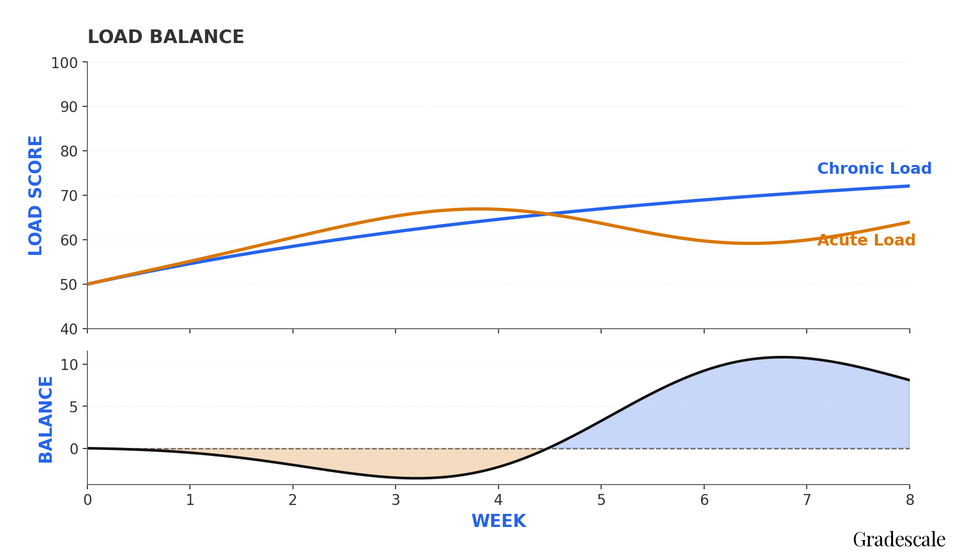
You looked at your dashboard this morning. Load Balance reads −18. Your training plan says hard intervals. Your legs say nothing useful. Now what?
Most athletes treat Load Balance like a thermometer. They read it, feel some way about it, then go train whatever the plan said. The number is more useful than that. It's a decision input. Once you can match Load Balance ranges to session types, you stop arguing with your plan and start adapting it.
That's the promise. Most athletes never collect on it.
This is a deep walkthrough of how to do that.
What Load Balance actually measures
Load Balance is the difference between your chronic load and your acute load. In plain English:
- Chronic load = your fitness, smoothed over the last 42 days.
- Acute load = your fatigue, smoothed over the last 7 days.
Subtract acute from chronic. One number. Positive means you're more rested than your fitness can absorb; negative means you're carrying more fatigue than your current fitness comfortably handles, which sounds technical but plays out as heavy legs on intervals you should be flying through.
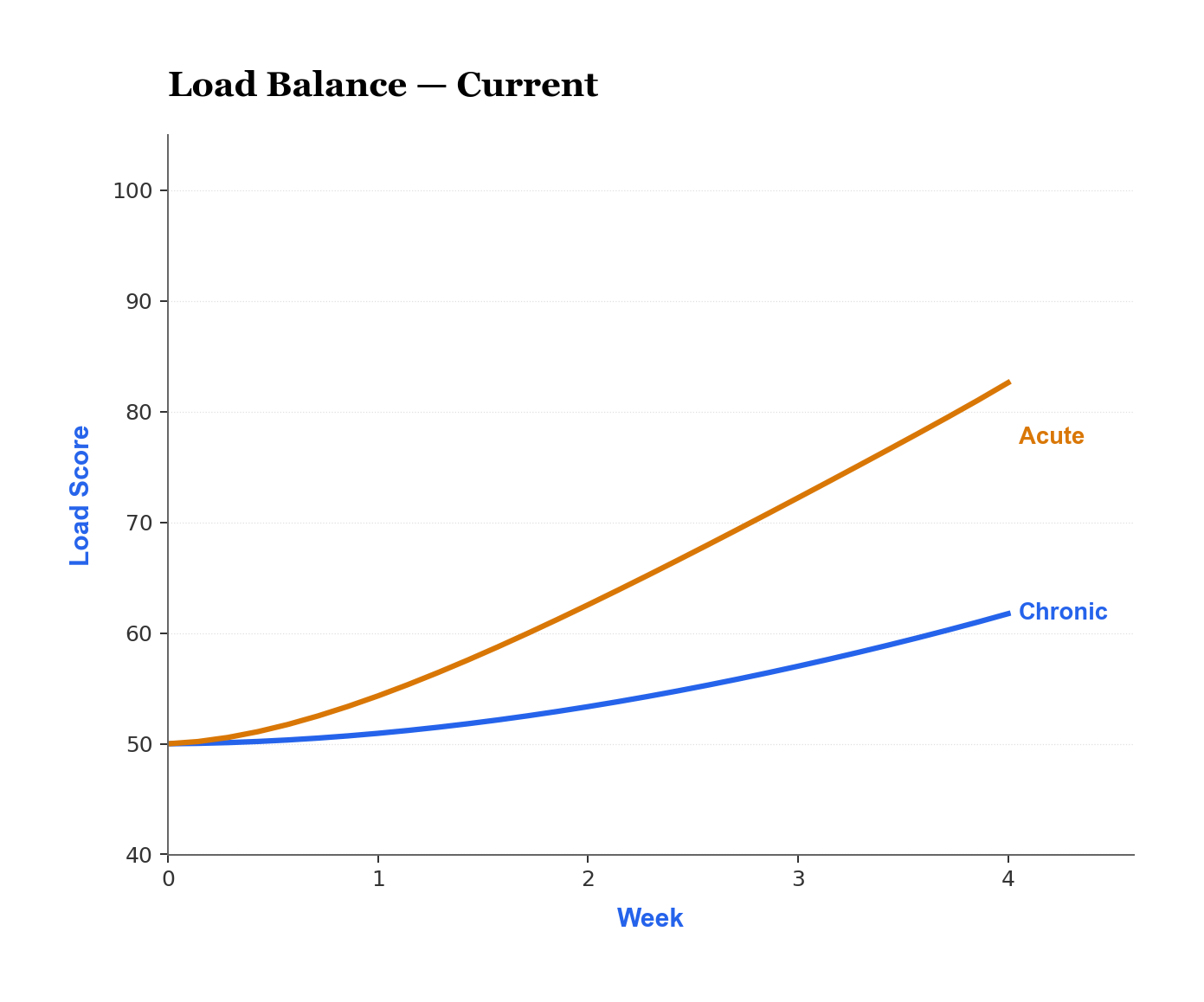
The number drifts day to day. A hard ride pushes acute load up, which pulls Load Balance down. A rest day lets acute decay faster than chronic, which pulls it back up.
The four bands that matter
Across years of looking at thousands of these charts, the same four ranges keep showing up as decision points, each one suggesting a different flavour of session:
- +15 to +25, peaked. You've shed enough fatigue that you're freshness-limited, not fitness-limited. Race window.
- 0 to +15, fresh. Good for hard quality work. Intervals, threshold blocks, race-pace simulations.
- −10 to 0, neutral. Tempo, longer endurance, technical work. Hard intervals are still possible but the cost is higher.
- Below −10, accumulated fatigue. Easy aerobic only, or rest. Going hard here is how athletes turn good blocks into injuries.
Two qualifications:
1. The bands shift with how big a load you carry. A pro at chronic load 110 and Load Balance −15 is different from an amateur at chronic load 50 and Load Balance −15.
2. Subjective check-in matters. A −5 Load Balance with terrible sleep is functionally a −15 day.
The decision tree
Now the useful part. Match what your plan said with what Load Balance says. The cell shows what to actually do.
| Plan said | Load Balance > +5 | 0 to +5 | −10 to 0 | < −10 |
|---|---|---|---|---|
| Hard intervals | Do them, push | Do them | Modify (lower) | Swap for easy |
| Tempo | Do them, push | Do them | Do them | Easy or rest |
| Threshold | Do them | Do them | Modify (lower) | Easy or rest |
| Long endurance | Do them | Do them | Do them | Reduce duration |
| Easy / recovery | Do them | Do them | Do them | Do them |
| Rest | Rest | Rest | Rest | Rest |
A few rules of thumb that fall out of this, useful when you're staring at the dashboard half-dressed at 6 a.m. and don't want to think:
- Easy days carry the lowest additional training stress. Load Balance estimates training stress only and cannot establish that training is medically or mechanically safe for you. Load Balance can never argue you
out of an easy spin or recovery jog.
- Rest days are sacred. A planned rest day at +20 Load Balance
isn't an opportunity for sneaking in extra volume. Recovery is the adaptation; skipping it short-circuits the gains.
- Below −10 is when good athletes break themselves. That's the
band where ego training overrules the data, where you tell yourself a hard session will somehow erase the previous hard session, where the legs feel passable on the warm-up and lie to you for the first interval. Bigger deficits don't mean you need to "earn back the work." They mean you already over-spent.
What "modify" means in the table
When the table says modify a hard session, it doesn't mean cancel. It means lower the demand:
- Cut interval count by 30%.
- Cap intensity at the bottom of the prescribed zone instead of the top.
- Replace one of the work intervals with a longer rest.
- Stop the session early if the second interval feels harder than the first should.
The point is to keep the kind of session intact (a tempo day stays a tempo day) but reduce the cost, so the neuromuscular pattern, the fuelling rehearsal, and the mental shape of the day all survive while the recovery debt does not. You still get most of the adaptation. You don't dig the hole deeper. That's the trade.
Gradescale: Your physiology, decoded. Join the waitlist now.
 Thomas Mortelmans
The rest-day argument
A Load Balance situation that confuses everyone: you wake up at +18, your plan says rest, and your legs feel great. Should you ride?
The honest answer: rest. Here's why.
Adaptation requires the absence of training stimulus as much as it requires the stimulus itself. Your body is converting yesterday's work into tomorrow's fitness right now. Adding a ride, even an easy one, adds new stimulus that competes for the same recovery budget.
The exception is narrow. An unplanned long easy spin before a peaking week, in the build phase, when you have lots of headroom. That's volume work, not training stress. Go ride.
How to read a multi-week trend
A single Load Balance number is one slice. The trend tells you what the plan is actually doing.
Look for these patterns:
Healthy build phase. Load Balance trends downward as you stack work, but not in a straight line. It dips during hard weeks (down to −5 to −10) and partially recovers during easy weeks. Chronic load slowly climbs. That's normal, healthy progression.
Buried. Load Balance keeps drifting more negative without recovery weeks, acute load sits consistently higher than chronic, and the chart looks like a slow leak with no patch in sight. You've been outpacing your recovery for weeks. Plan a deload now.
Stalled. Load Balance hovers around 0 with chronic load flat. You're not stressing the system enough. Add volume or intensity.
Tapering. Load Balance climbs from −5 to +15 over 7–14 days while chronic load stays roughly flat. If it climbs from −5 to +25, you're tapering too aggressively and will probably feel flat on race day.
Why your watch's "recovery score" is a different thing
Most fitness watches show some kind of recovery score. Garmin Body Battery, Fitbit Daily Readiness, Apple Health metrics. These read heart-rate variability and resting heart rate from the wrist.
Load Balance reads training stress from your power and pace data.
The two metrics describe different layers of the same animal. A healthy build phase sometimes shows a low watch-recovery-score (because HRV is suppressed by yesterday's hard session) but a fine Load Balance (because you're still inside the band you planned). Don't pick one metric. Read both. Let them argue.
What changes Load Balance fastest
In order from biggest to smallest effect on tomorrow's number:
1. A long, hard race effort (3–6 hours). Pushes acute load up by 25–80 points overnight, depending on duration.
2. A 2-hour threshold session. 15–30 points.
3. A 90-minute interval session. 10–20 points.
4. A 1-hour easy ride. 1–3 points.
5. A rest day. Load Balance climbs by 1–5 points (acute decays faster than chronic).
How fast does Load Balance recover?
Approximately:
- After a hard race effort: 7–14 days to return to baseline, assuming easy training in between.
- After a single threshold session: 2–4 days.
- After a hard interval block: 3–5 days.
- After accumulated negative Load Balance over a build month: 10–14 days of dialed-back volume.
If your usual recovery times feel longer than these, your chronic load might be overcooked relative to your actual fitness, which often happens after a long pause when the model still remembers the volume from three months ago and slowly forgets it. The model thinks you're fitter than you are. That usually corrects itself within a few weeks of consistent training. Be patient.
The most-common mistake athletes make
It's not chasing big positive Load Balance numbers (although that mistake exists). It's chasing big negative ones.
The narrative goes: "I went all in this block. Load Balance is −25. That means I'll be flying once I taper." That's not how the model works. Load Balance below −15 isn't a deeper deposit into the bank. It's the bank rejecting your transaction. Days at −25 are days the body is in survival mode, not adaptation mode.
The athletes who execute the best taper are the ones who go into the build phase with chronic load already high and Load Balance oscillating in the −10 to +10 range. They don't crash. They periodise.
The takeaway
Load Balance isn't a verdict on your training. It's a planning input. Once you can map ranges to session types, fresh days get the hard work and deficit days get the easy work, and the heroic mismatches between what your body needs and what your plan says start to disappear.
A few weeks of adjusting work this way and you'll trust both your data and your fatigue more than either alone. Try it for a block. The dashboard pays back the time fast.
Want to see your own Load Balance, with daily check-in integrated and a built-in decision-tree prompt for tomorrow's session? The free Gradescale account shows the trend, and the readiness card surfaces the recommendation automatically.
Found this useful?
Get articles like this and free training calculators in your inbox every week.
Recommended reads
If this was useful, these are the other research-driven newsletters I actually read.



Member discussion