Body Roundness Index (BRI) Calculator
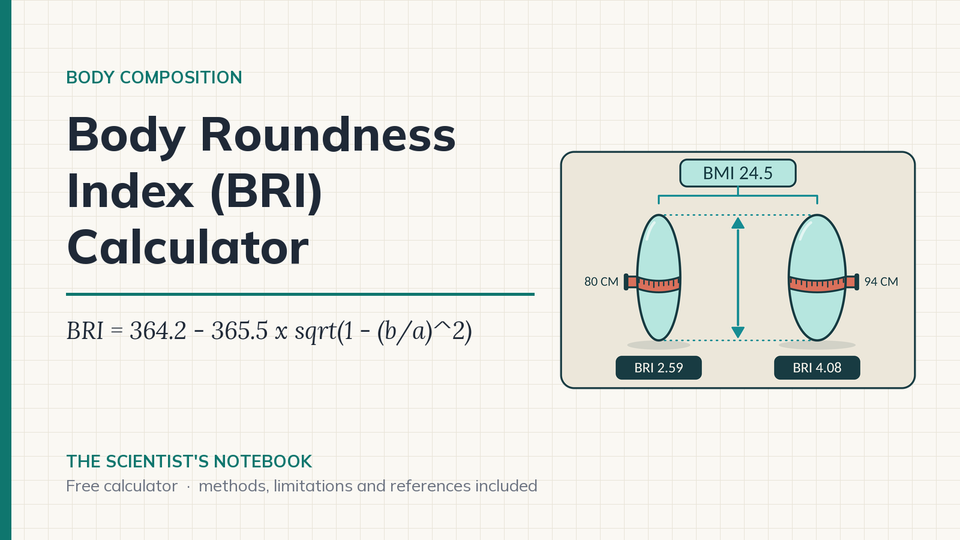
The Body Roundness Index (BRI) models your torso as an ellipse whose length is your height and whose width is set by your waist, then turns the shape of that ellipse into one number. It needs the same two tape measurements as waist-to-height ratio, and it is built on exactly that ratio.
In short: The Body Roundness Index (BRI) treats the body as an ellipse set by height and waist circumference and turns its eccentricity into one number: BRI = 364.2 - 365.5 x eccentricity (Thomas 2013). It is a rescaled waist-to-height ratio, so a ratio of 0.5 gives a BRI of 3.36. It needs only a tape measure.
How is the Body Roundness Index calculated?
Thomas 2013 treated the body as an ellipse with a major axis equal to height and a minor axis equal to waist circumference divided by π. In centimetres:
- Semi-major axis a = 0.5 × height.
- Semi-minor axis b = waist / (2π).
- Eccentricity e = √(1 − (b / a)2).
- BRI = 364.2 − 365.5 × e.
The constants only rescale eccentricity, which lives between 0 and 1, into a range that starts near 1. Because b / a equals waist-to-height ratio divided by π, BRI rises whenever your waist-to-height ratio rises, and it does not depend on any other input. A waist-to-height ratio of 0.5 gives a BRI of 3.36, and a ratio of 0.6 gives 5.43.
The bands shown come from the NHANES analysis of Zhang 2024 (32 995 US adults, 1999 to 2018): BRI below 3.4, 3.4 up to 4.5, the middle quintile of 4.5 to 5.5, above 5.5 up to 6.9, and 6.9 or more. The authors compared the two outer groups with the middle quintile.
Worked example. Waist 96 cm, height 175 cm. a = 87.5 cm. b = 96 / 6.2832 = 15.279 cm. b / a = 0.17462, squared 0.03049. e = √(1 − 0.03049) = 0.98464. BRI = 364.2 − 365.5 × 0.98464 = 364.2 − 359.88 = 4.32, in the 3.4 to below 4.5 band. For waist 82 cm and height 178 cm the same steps give 2.65.
How can athletes use their BRI?
- Add shape to a body-composition log. BMI can sit unchanged through a winter block while your waist moves. Log BRI beside weight and track the direction over months, not days.
- Compare with waist-to-height ratio. Use the Waist-to-Height Ratio calculator for the 0.5 boundary and the waist size at half your height. BRI is the same information on a different scale, so a change in one is a change in the other.
- Cross-check against a fat estimate. The Relative Fat Mass calculator uses the same two measurements to estimate body fat percentage. Compare the story the two give before you trust either.
What are the limits of the Body Roundness Index?
- BRI is a monotonic rescaling of waist-to-height ratio. It adds no information beyond waist and height, and in the Rico-Martin 2020 meta-analysis it was not significantly better than BMI, waist circumference or waist-to-height ratio at identifying metabolic syndrome (AUC above 0.7, with waist-to-height ratio and waist circumference performing best).
- The 3.4 and 6.9 edges describe a U-shaped association with all-cause mortality in one US cohort (hazard ratios 1.25 and 1.49 against the 4.5 to 5.5 group). They are population reference groups, not medical thresholds, and the cohort was not made of trained endurance athletes.
- Thomas 2013 never saw a BRI below 1 in NHANES. Below 1 the calculator flags the reading, and at 0 or below (a waist under about 0.265 of your height) it asks you to re-measure instead of showing a number. A waist equal to or larger than the height is refused as a typing error.
- Thomas 2013 built the index to predict body fat and visceral fat from shape. The authors reported only a slight improvement over BMI and waist circumference in predicting body fat, and the elliptical model is a simplification of a body.
- The healthy roundness zones in the original web tool vary with age, sex and height and were derived from BMI-based body fat ranges. This page does not apply them.
- Mean US adult BRI went from 4.80 in 1999 to 5.62 in 2018. A middle quintile of 4.5 to 5.5 is therefore a population statistic, and not a target.
- Waist measurement protocols differ, and the tape position changes the index. Use one landmark every time.
⚠️ HEALTH & TRAINING GUIDANCE
A shape index from two tape measurements is a population tool and carries individual error. Talk to a qualified health or sports medicine professional before changing training or nutrition based on this number.
ℹ️ IMPORTANT DISCLAIMER
This calculator is for educational purposes only and does NOT constitute medical advice. Consult qualified professionals before making changes. Individual physiology varies. You assume all risk. Must be 18+.
Frequently asked questions
How is the Body Roundness Index calculated?
Take half your height as the long semi-axis a and waist / (2 pi) as the short semi-axis b. Eccentricity e is the square root of 1 minus (b / a) squared, and BRI = 364.2 - 365.5 x e. A waist of 96 cm at a height of 175 cm gives e = 0.98464 and a BRI of 4.32.
Which BRI values does the calculator compare against?
The bands come from Zhang 2024, an NHANES analysis of 32 995 US adults from 1999 to 2018: below 3.4, 3.4 up to 4.5, the middle quintile of 4.5 to 5.5, above 5.5 up to 6.9, and 6.9 or more. Against the middle group, the hazard ratio for all-cause mortality was 1.25 under 3.4 and 1.49 at 6.9 or more. These are population reference groups, not targets.
Is BRI better than BMI or waist-to-height ratio?
Not clearly. BRI adds no information beyond waist and height. In the Rico-Martin 2020 meta-analysis it identified metabolic syndrome with an AUC above 0.7 but was not significantly better than BMI, waist circumference or waist-to-height ratio, and waist-to-height ratio and waist circumference performed best.
Why does the calculator refuse some readings?
Thomas 2013 never observed a BRI below 1 in NHANES, so a value under 1 is shown with a warning to check the tape. At a waist under about 0.265 of your height the formula gives 0 or less, so the calculator asks you to re-measure instead of showing a number. A waist equal to or larger than your height is refused as a typing error.
Related calculators
- BMI Calculator
- Body Fat Calculator (US Navy Method)
- Body Surface Area (BSA) Calculator
- Fat-Free Mass Index (FFMI) Calculator
- All calculators on The Scientist's Notebook