Body Surface Area (BSA) Calculator
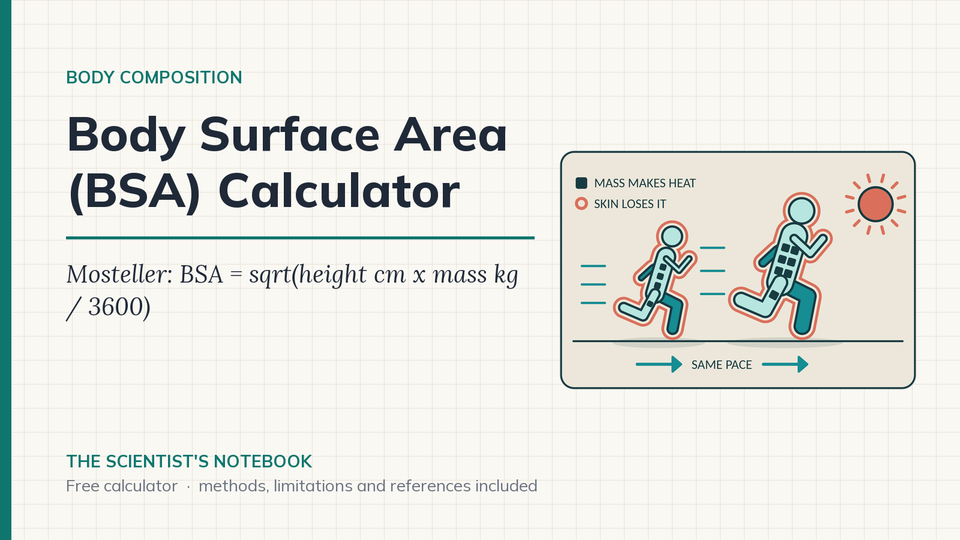
Body surface area (BSA) is the estimated area of your skin in square metres, worked out from height and body mass. For an endurance athlete the useful second number is surface area per kilogram, because heat is made by your mass and lost through your surface.
In short: Body surface area (BSA) is the estimated area of your skin in square metres, worked out from height and body mass. The calculator runs the Du Bois, Mosteller, Haycock and Gehan and George formulas and adds surface area per kilogram, because heat is made by your mass and lost through your surface. At 178 cm and 70 kg, Du Bois gives 1.871 m2 and 267 cm2/kg.
How is body surface area calculated?
With height H in centimetres and body mass W in kilograms, the calculator evaluates four published formulas and returns the result in m2.
- Du Bois (1916): 0.007184 × H0.725 × W0.425
- Mosteller (1987): √(H × W / 3600)
- Haycock (1978): 0.024265 × H0.3964 × W0.5378
- Gehan and George (1970): 0.0235 × H0.42246 × W0.51456
You choose one for the headline number (there is no default) and see all four in the details. Surface area per kilogram = BSA × 10 000 / W, in cm2/kg. The formulas have different origins: Du Bois came from 9 subjects, Haycock from 81 people from premature infants to adults, and Mosteller produced a simple formula that is easy to remember and to work out on a pocket calculator (Verbraecken 2006). In 1868 adult patients, the formulas compared, these four included, correlated at 0.97 or higher with each other (Verbraecken 2006).
Worked example. Height 178 cm, body mass 70 kg. Du Bois: 0.007184 × 42.82 × 6.083 = 1.871 m2. Mosteller: √(178 × 70 / 3600) = √3.461 = 1.860. Haycock 1.859 and Gehan and George 1.867. Surface area per kilogram with Du Bois = 1.871 × 10 000 / 70 = 267 cm2/kg. At the same height, 65 kg gives 279 cm2/kg, 75 kg gives 257, and 100 kg gives 218.
How should I use the result?
- Read your heat budget in ratio form. Running heat production depends on body mass and heat loss on surface area, so intercepts between the two depend on how big you are (Dennis and Noakes 1999). Their model had a 45 kg runner holding thermal balance at 19.1 km/h at 35 °C and 60 % relative humidity, while a 75 kg runner could hold only 12.2 km/h. A higher cm2/kg helps you shed heat. It is one input among several, so use the Heat Adjustment calculator for pacing in warm races.
- Compare athletes fairly. Cramer and Jay 2014 put two groups of 8, averaging 91.5 kg and 67.6 kg, through the same trials. At the same heat production the larger group warmed up less (0.78 vs 1.14 °C at 600 W), and at the same watts per kilogram they warmed up alike (0.79 vs 0.85 °C at 6.5 W/kg). When you compare yourself with a training partner, compare per kilogram.
- See what a body mass change does. The what-if table shows BSA and cm2/kg at 5 kg lighter and heavier. Losing mass raises your surface area per kilogram. The Weight Impact calculator covers the performance side of the same change.
What are the limits of body surface area formulas?
- These are population formulas. Du Bois used 9 subjects in 1916, and Haycock's 81 subjects ranged from premature infants to adults. None of the four measures your own skin area, and none accounts for how your body composition or limb length shifts the real value.
- In obese patients, Du Bois under-estimated BSA by up to 3 % in men and 5 % in women in the Verbraecken 2006 comparison. A warning appears when your BMI is 30 or above and Du Bois is selected, and when the four formulas differ by more than 3 % for your size. That 3 % trigger is a TSN choice, set at the largest Du Bois bias Verbraecken 2006 reported in obese men; it is not a published threshold.
- Surface area per kilogram is one factor in heat strain. In Havenith 1995 (27 adults at 35 °C and 80 % humidity) the surface-to-mass ratio explained about half as much of the end-exercise rectal temperature as VO2max did. Acclimatisation, hydration, pace and humidity are not in this number.
- The heat studies cited here used small samples: 16 highly trained runners in Marino 2000, two groups of 8 in Cramer and Jay 2014, and 27 adults of mixed fitness in Havenith 1995. Heat production in the Dennis and Noakes example is a model estimate, not a measurement on those two athletes.
- This calculator is not for drug dosing. Clinical dosing follows the protocol and judgement of the prescribing team.
- Adults only. Before anything is calculated, height and body mass are checked against the input ranges shared by every TSN calculator, 120 to 230 cm and 30 to 300 kg, with a note outside 140 to 210 cm or 40 to 200 kg. These are data-entry checks set by TSN, not physiological norms.
⚠️ HEALTH & TRAINING GUIDANCE
This number does not tell you how much heat your body can safely handle. Heat illness depends on acclimatisation, hydration, pace and conditions. Talk to a qualified sports medicine professional before changing training or racing plans in the heat based on this estimate.
ℹ️ IMPORTANT DISCLAIMER
This calculator is for educational purposes only and does NOT constitute medical advice. Consult qualified professionals before making changes. Individual physiology varies. You assume all risk. Must be 18+.
Frequently asked questions
Which of the four formulas should I use?
Pick one and use it every time you compare numbers. In 1868 adult patients the formulas compared by Verbraecken 2006, these four included, correlated at 0.97 or higher with each other. Du Bois came from 9 subjects in 1916 and under-estimated BSA in obese patients by up to 3 % in men and 5 % in women, so the tool adds a note when your BMI is 30 or above and Du Bois is selected.
Why does surface area per kilogram matter in the heat?
Running heat production depends on body mass and heat loss on surface area, so a higher cm2/kg helps you shed heat. In the Dennis and Noakes 1999 model at 35 °C and 60 % relative humidity, a 45 kg runner held thermal balance at 19.1 km/h while a 75 kg runner could hold only 12.2 km/h. Those are model estimates, not measurements.
How do I compare myself with a bigger or smaller training partner?
Compare per kilogram. Cramer and Jay 2014 put two groups averaging 91.5 kg and 67.6 kg through the same trials. At the same heat production the larger group warmed up less (0.78 vs 1.14 °C at 600 W), and at the same watts per kilogram they warmed up alike (0.79 vs 0.85 °C at 6.5 W/kg).
Can I use this BSA for drug dosing?
No. This calculator is not for drug dosing. Clinical dosing follows the protocol and judgement of the prescribing team. The formulas give population estimates from height and body mass, and none of them measures your own skin area.
What inputs does the calculator accept?
Adults only. Height must be 120 to 230 cm and body mass 30 to 300 kg, with a note outside 140 to 210 cm or 40 to 200 kg. These are data-entry checks set by TSN, not physiological norms. You also choose the formula for the headline number, because there is no default.
Related calculators
- BMI Calculator
- Body Fat Calculator (US Navy Method)
- Body Roundness Index (BRI) Calculator
- Fat-Free Mass Index (FFMI) Calculator
- All calculators on The Scientist's Notebook
References
- Du Bois & Du Bois · 1916 · Archives of Internal Medicine · not indexed in PubMed · doi
- Mosteller · 1987 · New England Journal of Medicine · PMID 3657876 · doi
- Haycock et al. · 1978 · Journal of Pediatrics · PMID 650346 · doi
- Gehan & George · 1970 · Cancer Chemotherapy Reports · PMID 5527019
- Verbraecken et al. · 2006 · Metabolism · PMID 16546483 · doi
- Dennis & Noakes · 1999 · European Journal of Applied Physiology and Occupational Physiology · PMID 10048634 · doi
- Marino et al. · 2000 · Pflugers Archiv · PMID 11211124 · doi
- Cramer & Jay · 2014 · Journal of Applied Physiology · PMID 24505102 · doi
- Havenith et al. · 1995 · European Journal of Applied Physiology and Occupational Physiology · PMID 7607204 · doi