Body Fat Calculator (US Navy Method)
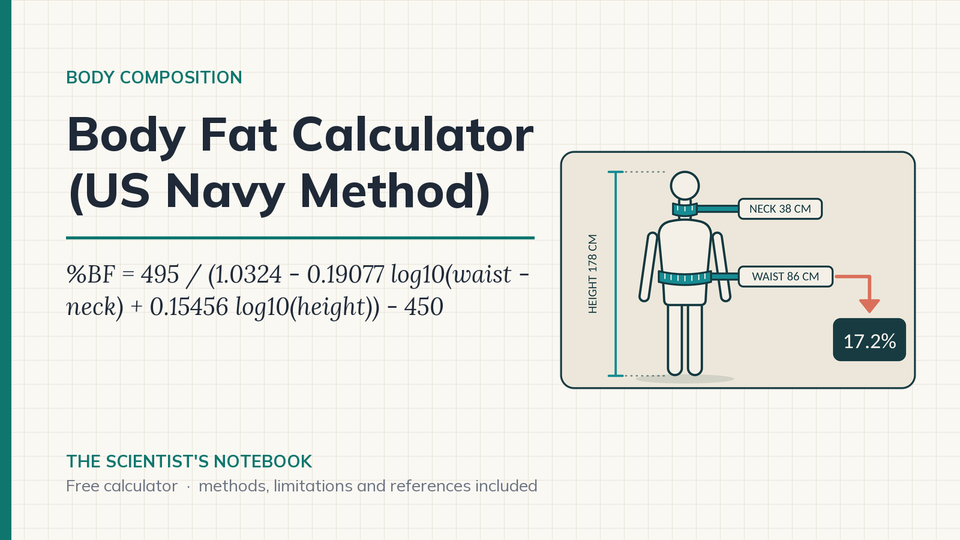
You need a tape measure and two minutes. The US Navy circumference equations turn height, neck and waist (plus hip for women) into a body fat estimate, and the result is placed against the percent body fat ranges that Gallagher and colleagues linked to the BMI cut-points.
In short: The US Navy method estimates body fat from a tape measure. Men enter height, neck and waist, and women add the hip. A log-linear equation predicts body density and the Siri relation turns it into percent fat. For a 178 cm man with a waist of 86 cm and a neck of 38 cm it gives 17.2 percent. Validation studies report errors of several percentage points, so use it to follow your own trend.
How is body fat calculated from a tape measure?
The Navy equations were published by Hodgdon and Beckett in 1984. They predict body density from log-transformed circumferences, then convert density to percent fat with the Siri relation. All lengths are in centimetres.
Men: %BF = 495 / (1.0324 − 0.19077 × log10(waist − neck) + 0.15456 × log10(height)) − 450
Women: %BF = 495 / (1.29579 − 0.35004 × log10(waist + hip − neck) + 0.22100 × log10(height)) − 450
- waist: cm, at the navel for men and at the narrowest point for women.
- neck: cm, just below the larynx.
- hip: cm, at the widest point over the buttocks (women only).
- height: cm, barefoot.
- If you also enter body mass, the tool splits it: fat mass = mass × %BF / 100, fat-free mass = mass − fat mass.
The reference ranges are the sex- and age-specific percent fat values that correspond to BMI 18.5, 25 and 30 in Gallagher 2000, Table 4 (four-compartment model, African American and white adults combined). For ages 20 to 39 the cut values are 8, 20 and 25 percent in men and 21, 33 and 39 percent in women. For ages 40 to 59 they are 11, 22 and 28 in men and 23, 34 and 40 in women. For ages 60 to 79 they are 13, 25 and 30 in men and 24, 36 and 42 in women. They describe where a value sits against the BMI scheme. They are not health thresholds.
Worked example. A 35-year-old man, 178 cm tall, waist 86 cm, neck 38 cm, body mass 75 kg. waist − neck = 48 cm, log10(48) = 1.6812, log10(178) = 2.2504. Density term = 1.0324 − 0.19077 × 1.6812 + 0.15456 × 2.2504 = 1.0595. %BF = 495 / 1.0595 − 450 = 17.2 percent. That is inside the 8 to 19.9 percent range linked to BMI 18.5 to 24.9 for men aged 20 to 39. Fat mass is 75 × 0.172 = 12.9 kg and fat-free mass is 62.1 kg.
How should I use the result?
- Track change, not the single number. The IOC working group review notes that no body composition method is a universal gold standard, and that single field methods remain useful for profiling change (Ackland 2012). Measure on the same morning, relaxed, before eating, with the same tape, and compare your own series across a training block.
- Check what a BMI reading is made of. If the BMI calculator puts you in the overweight band, a body fat estimate and the fat-free mass index show whether the mass is mostly lean. For a second method, try the skinfold calculator.
- Sanity-check energy intake. With fat-free mass in hand, you can set protein and energy intake against it in the calorie calculator. See also lean body mass for equations that need no tape.
What are the limits of the Navy method?
- It is an estimate with a large error. In 31 college men measured against a three-compartment model, the Navy and Air Force circumference equation had a total error of 5.2 percent fat, which the authors classed as unacceptable (Moon 2008).
- The equations read higher than skinfolds in at least one large sample. Among 1,191 male civil service employees the Navy and Air Force equation averaged 20.4 percent fat against 18.4 percent from skinfolds. Across the three military tape equations tested, the correlation with skinfolds was 0.76 to 0.79 (Babcock 2006).
- Tape position matters. For the man in the worked example, one extra centimetre at the waist adds 0.75 points of body fat. For a woman of 165 cm with waist 75, hip 98 and neck 32 it adds 0.50 points. Hydration, a recent meal and posture all move the circumferences.
- The Gallagher ranges come from a convenience sample of 1,626 adults with BMI up to 35, and ethnic group was a significant predictor. The tool uses the combined African American and white table. The paper's separate table for Asian adults differs by up to 5 points, mostly upward: the BMI 18.5 edge for men aged 20 to 39 is 13 percent there, not 8. The tool shows no range for ages under 20 or over 79.
- The ranges were not built on athletes. Gallagher and colleagues excluded people in physical training programmes and wrote that their lowest ranges have large confidence intervals and should be applied cautiously. A lean rider reading "below the range linked to BMI 18.5" is outside the data the ranges came from, which is why the tool adds a caution there.
- The ranges tie body fat to BMI categories. They do not say what body fat is right for an athlete, and the band names describe the BMI link only.
- Hodgdon and Beckett fitted the equations on US Navy personnel in the early 1980s. Neither validation study above tested trained endurance athletes, so these data cannot say how much the error grows at the lean end.
- Before anything is calculated, each entry is checked against input ranges shared by every TSN calculator, for example 120 to 230 cm for height and 40 to 200 cm for the waist. These are data-entry checks set by TSN, not physiological norms. The waist must be larger than the neck (for women, waist plus hip larger than the neck), or the equation has no answer. An estimate under 2 percent or over 70 percent points to a tape or unit mistake, so the tool shows no number and asks you to check the readings.
⚠️ HEALTH & TRAINING GUIDANCE
Individual results vary significantly. A tape-measure estimate does not assess your health. Consult a sports medicine professional or registered dietitian before changing your eating, body composition or training based on these estimates.
ℹ️ IMPORTANT DISCLAIMER
This calculator is for educational purposes only and does NOT constitute medical advice. Consult qualified professionals before making changes. Individual physiology varies. You assume all risk. Must be 18+.
Frequently asked questions
How accurate is the US Navy body fat method?
In 31 college men measured against a three-compartment model, the Navy and Air Force tape equation had a total error of 5.2 percent fat, which the authors classed as unacceptable (Moon 2008). In 1,191 male civil service employees it averaged 20.4 percent fat against 18.4 percent from skinfolds (Babcock 2006). Treat one reading as a rough estimate and compare readings taken the same way.
Where do I measure the waist, neck and hip?
Men measure the waist at the navel and women at the narrowest point. The neck is measured just below the larynx and the hip at the widest point over the buttocks. Measure relaxed, on the same morning and with the same tape: for the man in the worked example, one extra centimetre at the waist adds 0.75 points of body fat.
What do the reference ranges mean?
They are the percent body fat values that Gallagher 2000 linked to BMI 18.5, 25 and 30 by sex and age band, taken from Table 4 of the paper. For men aged 20 to 39 the edges are 8, 20 and 25 percent. They show where a value sits against the BMI scheme. They do not say what body fat is right for an athlete.
Why does the calculator sometimes show no number?
If the waist is not larger than the neck (for women, waist plus hip larger than the neck), the equation has no answer. An estimate under 2 percent or over 70 percent points to a tape or unit mistake, so the calculator asks you to check the readings instead of showing a figure.
Does the Navy method work for lean athletes?
It was fitted on US Navy personnel, and neither validation study cited here tested trained endurance athletes. Gallagher 2000 also excluded people in physical training programmes. When an estimate falls below the range linked to BMI 18.5, the calculator adds a caution and points to a DXA scan or skinfolds by a trained tester as a second reading.
Related calculators
- BMI Calculator
- Body Roundness Index (BRI) Calculator
- Body Surface Area (BSA) Calculator
- Fat-Free Mass Index (FFMI) Calculator
- All calculators on The Scientist's Notebook
References
- Hodgdon et al. · 1984 · Naval Health Research Center Reports 84-11 and 84-29 · not indexed in PubMed
- Gallagher et al. · 2000 · Am J Clin Nutr · PMID 10966886 · doi
- Moon et al. · 2008 · Dyn Med · PMID 18426582 · doi
- Babcock et al. · 2006 · Mil Med · PMID 16532876 · doi
- Ackland et al. · 2012 · Sports Med · PMID 22303996 · doi