Waist-to-Hip Ratio Calculator
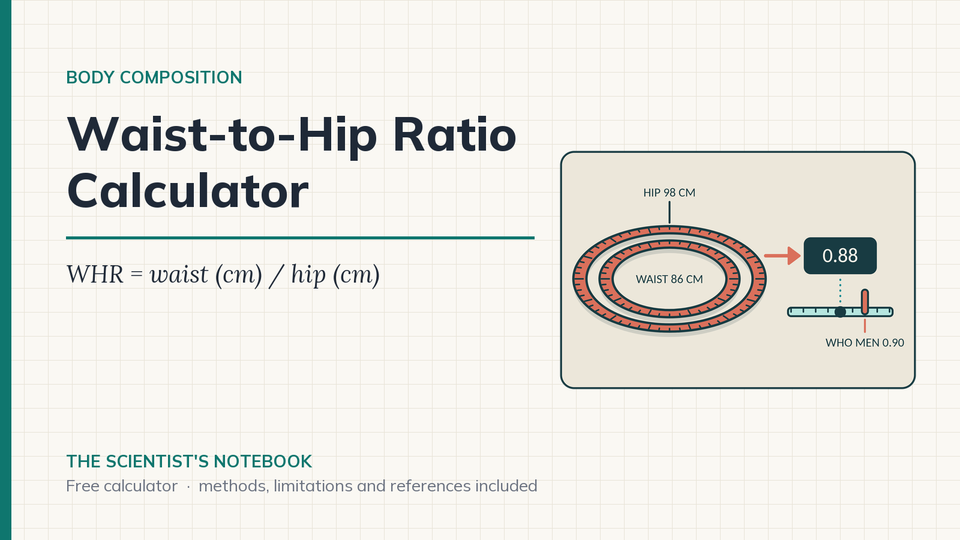
Waist-to-hip ratio is two tape measurements and one division. This calculator compares the result with the WHO reference values, 0.90 for men and 0.85 for women, and also shows where your waist sits against the 1995 waist action levels.
In short: Waist-to-hip ratio is waist circumference divided by hip circumference. The WHO reference values are 0.90 for men and 0.85 for women, and a ratio at or above them sits above a population reference line. It describes the shape of your middle, not how much fat or muscle you carry, and it needs only a tape measure.
How is waist-to-hip ratio calculated?
WHR = waist circumference (cm) / hip circumference (cm), rounded to two decimals.
- Waist: the WHO protocol measures at the midpoint between the lower margin of the last palpable rib and the top of the iliac crest, standing relaxed, tape snug and horizontal.
- Hip: the widest part of the buttocks, with the tape level all the way round.
- Cut-off: 0.90 for men and 0.85 for women. These are older WHO values: the 2008 expert consultation report lists them in its annex and traces them to the WHO 1999 diabetes report, which used them to define abdominal obesity. The 2008 consultation did not set new cut-offs. The tool reports a ratio as at or above or below the value, using the two-decimal ratio you see.
- Waist levels: 94 and 102 cm for men, 80 and 88 cm for women. Lean and colleagues published them as action levels in 1995, and the WHO 2008 report lists them in the same annex.
- Waist at the cut-off: cut-off × hip. It is the waist that would give a ratio exactly on the line at your current hip measurement. It is arithmetic, not a target.
Worked example. A man with a waist of 86 cm and hips of 98 cm: 86 / 98 = 0.8776, shown as 0.88. That is 0.02 below the 0.90 cut-off. The waist that would give exactly 0.90 at a 98 cm hip is 0.90 × 98 = 88.2 cm. His waist of 86 cm is under the first waist level of 94 cm. Because 0.88 sits within 0.02 of the line, the tool also asks him to repeat the measurement.
How can athletes use their waist-to-hip ratio?
- Add a second lens to BMI. A muscular rider can read as overweight on BMI with a ratio well under the cut-off. In the INTERHEART case-control study, BMI showed a modest association with myocardial infarction and the waist-to-hip ratio a much stronger one (Yusuf 2005). Neither is a prediction for one person.
- Track it across a training block. The ratio needs only a tape. Measure at the same site, the same time of day and with the same tape. If both circumferences change, the ratio can stay flat. Pair it with waist-to-height and the body fat calculator to see which number moved.
- Check your measuring before you check the number. If your ratio lands within 0.02 of the line, repeat the measurement three times and use the average. At a hip of 100 cm, 1 cm of tape error moves the ratio by 0.01.
What are the limits of waist-to-hip ratio?
- The ratio describes shape. A lean rider with narrow hips and a heavier rider with wide hips can land on the same number, so it tells you nothing about kilograms of fat or muscle.
- The cohort evidence is association, not individual prediction. INTERHEART (12,461 cases and 14,637 controls in 52 countries) gave an odds ratio of 2.52 (95% CI 2.31 to 2.74, adjusted for age, sex, region and smoking) for the top versus bottom quintile of waist-to-hip ratio. For BMI the figure was 1.44 (1.32 to 1.57) before adjustment and 1.12 once waist-to-hip ratio was added (Yusuf 2005). In EPIC (359,387 people, 14,723 deaths), the relative risk of death for the highest quintile of waist-to-hip ratio was 1.68 (1.53 to 1.84) in men and 1.51 (1.37 to 1.66) in women, after adjusting for BMI (Pischon 2008).
- One cut-off per sex is a simplification. The studies above report a gradient across quintiles, not a step at 0.90 or 0.85.
- Measurement site matters less than people argue. A review of 120 studies found the waist site (minimal waist, midpoint, umbilicus) had no substantial influence on the association with morbidity and mortality, so pick one and keep it (Ross 2008).
- The tool is for adults aged 18 and over. It has no separate cut-offs for older adults, pregnancy or growing teenagers.
- A ratio at or above the cut-off places your two tape readings above a population reference line. It is not a medical assessment, and a health professional is the right person to interpret it.
⚠️ HEALTH & TRAINING GUIDANCE
Individual results vary significantly. A tape-measure ratio does not assess your health. Consult a physician or sports medicine professional if you have questions about your measurements or before changing your training or eating based on these estimates.
ℹ️ IMPORTANT DISCLAIMER
This calculator is for educational purposes only and does NOT constitute medical advice. Consult qualified professionals before making changes. Individual physiology varies. You assume all risk. Must be 18+.
Frequently asked questions
How do you calculate waist-to-hip ratio?
Divide waist circumference by hip circumference in the same unit. A man with a waist of 86 cm and hips of 98 cm gets 86 / 98 = 0.8776, shown as 0.88. That is 0.02 below the 0.90 reference value, and the waist that would give exactly 0.90 at a 98 cm hip is 88.2 cm.
What are the WHO reference values for waist-to-hip ratio?
They are 0.90 for men and 0.85 for women. The WHO 2008 expert consultation report lists them in its annex and traces them to the WHO 1999 diabetes report. The 2008 consultation set no new cut-offs. This calculator applies the values inclusively, to the rounded ratio you see on screen.
Is waist-to-hip ratio better than BMI?
In the INTERHEART case-control study (12,461 cases and 14,637 controls in 52 countries), the top versus bottom quintile of waist-to-hip ratio gave an odds ratio for myocardial infarction of 2.52, against 1.44 for BMI before adjustment (Yusuf 2005). That is a population association, not a prediction for one person, and neither number assesses your health.
Where should I measure my waist and hips?
The WHO protocol measures the waist midway between the last palpable rib and the top of the iliac crest, and the hip at the widest part of the buttocks, standing relaxed with the tape snug and level. A review of 120 studies found the waist site had no substantial influence on the associations (Ross 2008), so keep one site. At a 100 cm hip, 1 cm of tape error moves the ratio by 0.01.
Related calculators
- BMI Calculator
- Body Fat Calculator (US Navy Method)
- Body Roundness Index (BRI) Calculator
- Body Surface Area (BSA) Calculator
- All calculators on The Scientist's Notebook
References
- World Health Organization · 2011 · Waist circumference and waist-hip ratio: report of a WHO expert consultation, Geneva, 8-11 December 2008 · not indexed in PubMed
- World Health Organization · 1999 · Definition, diagnosis and classification of diabetes mellitus and its complications: report of a WHO consultation · not indexed in PubMed
- Yusuf et al. · 2005 · Lancet · PMID 16271645 · doi
- Pischon et al. · 2008 · N Engl J Med · PMID 19005195 · doi
- Lean et al. · 1995 · BMJ · PMID 7613427 · doi
- Ross et al. · 2008 · Obes Rev · PMID 17956544 · doi