BMR Calculator
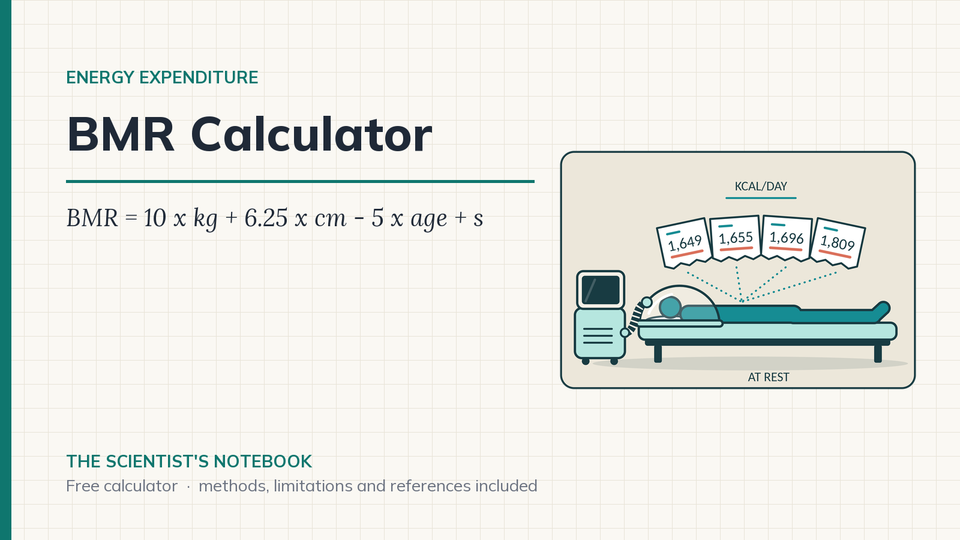
Basal metabolic rate is the energy your body spends at rest. It is the starting number for almost every fueling calculation, so it helps to know which equation produced it and how far off it can be.
In short: BMR is the energy your body spends at complete rest. This calculator uses Mifflin-St Jeor, 10 x kg + 6.25 x cm - 5 x age, then +5 for males or -161 for females, and compares it with three other published equations. Even the best equation misses measured resting rate by more than 10 % in some people.
How is BMR calculated?
The headline value is the Mifflin-St Jeor equation. It uses body mass, height, age and sex, and returns kilocalories per day:
BMR = 10 x mass + 6.25 x height - 5 x age + s
- mass in kilograms, height in centimetres, age in years
- s = +5 for males and -161 for females
Three more equations appear in the detail table so you can see the spread:
- Revised Harris-Benedict (Roza and Shizgal 1984). Male: 88.362 + 13.397 x mass + 4.799 x height - 5.677 x age. Female: 447.593 + 9.247 x mass + 3.098 x height - 4.330 x age.
- Katch-McArdle: 370 + 21.6 x lean body mass. These are the same coefficients as the Cunningham 1991 general equation.
- Cunningham 1980: 500 + 22 x lean body mass.
The two lean-mass equations need body fat. Lean body mass = mass x (1 - body fat % / 100). If you leave body fat empty, the calculator shows only the first two equations and does not guess a value.
If you pick an activity multiplier (1.2, 1.375, 1.55, 1.725 or 1.9), the page also shows Mifflin-St Jeor x that factor as a rough maintenance figure. These factors are conventions from exercise physiology textbooks, not the output of one trial. For comparison, the FAO/WHO/UNU 2004 report puts a sedentary or light lifestyle at a physical activity level of 1.40 to 1.69 times BMR, so the 1.2 and 1.375 multipliers sit below its lowest band and the result shows a warning when you pick them. The training-aware figure lives in the calorie calculator, which models training sessions separately.
Worked example
Male, 30 years, 70 kg, 175 cm, 15 % body fat, moderate activity multiplier (1.55).
- Mifflin-St Jeor: 700 + 1093.75 - 150 + 5 = 1648.75, shown as 1649 kcal/day
- Revised Harris-Benedict: 88.362 + 937.79 + 839.825 - 170.31 = 1696 kcal/day
- Lean body mass: 70 x 0.85 = 59.5 kg
- Katch-McArdle: 370 + 21.6 x 59.5 = 1655 kcal/day
- Cunningham 1980: 500 + 22 x 59.5 = 1809 kcal/day
- Maintenance estimate: 1648.75 x 1.55 = 2556 kcal/day
The four equations span 1649 to 1809 kcal/day, a spread of 9.7 % of the Mifflin-St Jeor value.
How should I use my BMR result?
- Sanity-check a fueling plan. Compare your planned daily intake with the resting figure. Resting energy is the cost of staying alive before any movement, not an intake target. Start the plan from the calorie calculator and use this page to see how much of that total is resting cost.
- Pick the equation that matches your data. If you have a body fat value from a method you trust, compare the Katch-McArdle and Cunningham lines with the Mifflin-St Jeor line. In 37 endurance athletes the Cunningham equation predicted measured resting rate best (Thompson and Manore 1996). In Jagim 2018 it had the smallest mean underestimate and was the best fit for the women, while the Harris-Benedict equation had the lowest error for the men, so no single equation wins for every athlete.
- Re-run it when body mass changes. After a long build or a lean-down, a change of several kilograms moves the weight-based equations by about 9 to 13 kcal/day per kilogram (exactly 10 for Mifflin-St Jeor). Re-entering your numbers keeps the baseline current. For long-session carbohydrate planning, pair it with the carb calculator.
How accurate is a BMR estimate?
- All four are population equations. In the Frankenfield 2005 review, Mifflin-St Jeor put more people within 10 % of measured resting rate than the other common equations, but the review still reported noteworthy errors for individuals.
- Roza and Shizgal reported a precision of about 14 % for the Harris-Benedict family in normally nourished adults.
- In 50 collegiate athletes, all five equations tested underestimated measured resting rate; the smallest mean difference was -165 kcal/day (Jagim 2018). Expect the weight-based equations to read low for large, lean athletes.
- The lean-mass equations are only as good as the body fat input. At 70 kg, a 1 percentage point error in body fat shifts Katch-McArdle by about 15 kcal/day.
- Mifflin-St Jeor was fitted on adults aged 19 to 78. This calculator accepts ages 18 to 100 and warns outside the fitted range.
- The calculator refuses inputs that cannot describe one adult body: a body mass and height pair outside a BMI of 10 to 150, a body fat value that leaves a lean mass index outside 8 to 40, or any equation result below 500 kcal/day. It shows what to check instead of a number.
- Pregnancy, breastfeeding, thyroid conditions, some medications and illness change resting energy use in ways these equations do not model.
- Measured resting metabolic rate by indirect calorimetry is the reference. An estimate cannot replace it.
⚠️ HEALTH & TRAINING GUIDANCE
Resting energy estimates are population averages and individual results vary significantly. Talk with a registered dietitian or physician before changing how much you eat based on these numbers.
ℹ️ IMPORTANT DISCLAIMER
This calculator is for educational purposes only and does NOT constitute medical advice. Consult qualified professionals before making changes. Individual physiology varies. You assume all risk. Must be 18+.
Frequently asked questions
Which BMR equation is the most accurate?
No single equation wins for everyone. In the Frankenfield 2005 review, Mifflin-St Jeor put more people within 10 % of measured resting rate than the other common equations. In 37 endurance athletes the Cunningham equation predicted best, and in 50 collegiate athletes the Harris-Benedict equation had the lowest error for the men. The calculator shows all four side by side so you can see the spread.
Why do Katch-McArdle and Cunningham need body fat?
Both start from lean body mass, which is body mass x (1 - body fat % / 100). Katch-McArdle is 370 + 21.6 x lean mass and Cunningham 1980 is 500 + 22 x lean mass. If you leave body fat empty, the calculator shows only Mifflin-St Jeor and revised Harris-Benedict and does not guess a value.
Do BMR equations work for athletes?
They tend to read low. In 50 collegiate athletes, all five equations tested underestimated measured resting rate, and the smallest mean difference was 165 kcal/day. Large, lean athletes should expect the weight-based equations to sit below their measured value. Indirect calorimetry is the reference when you need a measured number.
How do I turn BMR into daily calories?
Multiply it by an activity multiplier. The calculator offers 1.2, 1.375, 1.55, 1.725 or 1.9. These are textbook conventions, not measurements, and the FAO/WHO/UNU 2004 report puts a sedentary or light lifestyle at 1.40 to 1.69 times BMR, so the two lowest factors read low. For a training-aware total, use the calorie calculator.
What ages does the BMR calculator accept?
Adults aged 18 to 100. Mifflin-St Jeor was fitted on adults aged 19 to 78, so the result carries a warning outside that range. The calculator also refuses inputs that cannot describe one adult body and any equation result below 500 kcal/day.
Related calculators
- Cycling Calorie Calculator
- Running Calorie Calculator
- Swimming Calorie Calculator
- Walking Calories Calculator
- All calculators on The Scientist's Notebook
References
- Mifflin et al. · 1990 · Am J Clin Nutr · PMID 2305711 · doi
- Roza & Shizgal · 1984 · Am J Clin Nutr · PMID 6741850 · doi
- Cunningham · 1980 · Am J Clin Nutr · PMID 7435418 · doi
- Cunningham · 1991 · Am J Clin Nutr · PMID 1957828 · doi
- Frankenfield et al. · 2005 · J Am Diet Assoc · PMID 15883556 · doi
- Thompson & Manore · 1996 · J Am Diet Assoc · PMID 8537566 · doi
- Jagim et al. · 2018 · J Strength Cond Res · PMID 28682934 · doi
- FAO/WHO/UNU · 2004 · Human energy requirements. FAO Food and Nutrition Technical Report Series 1 · not indexed in PubMed (physical activity level bands, Table 5.3)