Walking Calories Calculator
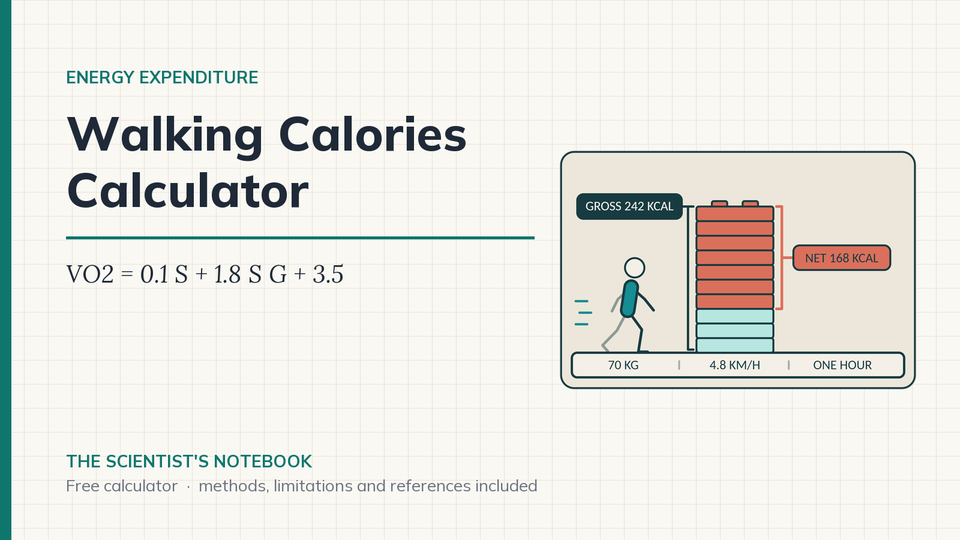
Walking is cheap on energy per minute and it adds up over a day, a hike or a long ultra. This calculator estimates the kilocalories of a walk from your speed, the slope, your body mass and the time, and it shows both the gross cost and the extra cost above resting.
In short: The calculator uses the ACSM walking equation, which turns speed and grade into oxygen use, at about 5 kcal per litre of oxygen. A 70 kg walker at 4.8 km/h on flat ground for 60 minutes uses about 242 kcal gross, or 168 kcal above resting. An uphill grade adds 1.8 x speed x grade to the oxygen cost.
How are walking calories calculated?
The main estimate uses the ACSM walking equation, which converts speed and grade into oxygen use. With speed S in metres per minute and grade G as a fraction (5 % = 0.05):
net VO2 (mL/kg/min) = 0.1 x S + 1.8 x S x G
gross VO2 = net VO2 + 3.5
The 3.5 is resting oxygen uptake, which defines 1 MET. Energy follows from about 5 kcal per litre of oxygen: kcal per minute = VO2 x body mass (kg) / 1000 x 5. Multiply by the minutes for the total. Gross kcal uses the gross VO2 and includes what you would have burned sitting. Net kcal uses the net VO2 and is the extra cost of walking.
Worked example. A 70 kg walker covers 4.8 km/h (80 m/min) on flat ground for 60 minutes. Net VO2 is 0.1 x 80 = 8.0 mL/kg/min, gross is 11.5 mL/kg/min, which is 3.3 MET. Gross energy is 11.5 x 70 / 1000 x 5 = 4.03 kcal per minute, or 241.5 kcal (about 242) for the hour. Net energy is 168 kcal. Put the same walker on a 5 % grade at 5 km/h for 30 minutes and the grade term alone adds 1.8 x 83.3 x 0.05 = 7.5 mL/kg/min, giving 203 kcal gross and 166 kcal net in half the time.
On flat ground the result table also shows a cross-check from the Compendium of Physical Activities, where energy is MET x body mass (kg) x hours (gross) or (MET - 1) x body mass x hours (net). It lists both the 2011 values (interpolated between the listed speeds, for example 3.5 MET for 2.8 to 3.2 mph, placed at 3.0 mph, and 4.3 MET at 3.5 mph) and the 2024 adult values (banded, for example 2.8 to 3.4 mph = 3.8 MET and 3.5 to 3.9 mph = 4.8 MET). The Compendium has no value for walking on an arbitrary grade, so those rows disappear once you enter a slope.
How should I use the walking calorie estimate?
- Plan food for a hike or a walking-heavy event. Enter your average moving speed and the average grade of the route and read the gross figure for the day's energy. Compare it with your intake using the calorie calculator and the carb calculator.
- Count recovery walks honestly. A relaxed 60-minute walk at 4.8 km/h is about 170 kcal above resting for a 70 kg person. That is the figure to add to your day, not the 240 kcal gross, because the rest is energy you spend anyway.
- Compare walking up a hill with running it. In long events, athletes often walk the steep parts. Use the grade input to see what a climb at walking speed costs, then check the equivalent effort on the flat with the grade-adjusted pace calculator.
How accurate is the walking calorie estimate?
- The equation tends to underestimate. Across 127 literature values for level walking at 0.4 to 1.9 m/s, the ACSM equation underpredicted nearly all of them, with a standard error of 4.51 mL/kg/min against 1.13 for a height-weight-speed equation (Ludlow and Weyand 2016). Treat your figure as a floor.
- It can also be close. In 24 adults walking 1600 m at 1.41 m/s (5.1 km/h), the ACSM equation was within 14.4 kJ of the measured 340 kJ (Hall 2004). The size of the error depends on speed, height and the person.
- Validity range. ACSM gives the walking equation for 3.0 to 6.0 km/h. The calculator accepts 2 to 8 km/h and 0 to 25 % and flags speeds outside that range. It also flags grades above 15 %, my own cut-off: above that slope the efficiency of uphill walking reached that of pure concentric muscle work in Minetti 2002, so the figure for a scramble is only a rough guide. Every field is required: a blank grade is an error, so enter 0 for flat ground. Body mass must be 30 to 300 kg and the walk 1 to 1440 minutes. Any combination above 50 kcal per minute is refused as an input mistake, because no walker sustains it.
- Downhill is not modelled. In 10 runners on a treadmill, walking cost per metre was lowest on a -10 % slope (0.81 J/kg/m against 1.64 on the level) and rose again on steeper descents (Minetti 2002). The equation here applies to uphill and level ground only.
- Load, surface and wind are ignored. A pack, sand, snow or a headwind raise the cost. Walking on a treadmill and outdoors are also not identical.
- MET tables are group averages. The 2024 Compendium changed several walking values from 2011. At the speeds both tables list, the two sets differ by 0 to 0.5 MET. Between those speeds the gap can reach about 1.5 MET, just under 7.2 km/h, because the calculator interpolates the 2011 values while the 2024 values come in speed bands. Both are shown so you can see the spread.
- The 5 kcal per litre convention is approximate. The real value depends on the mix of fat and carbohydrate being burned.
⚠️ HEALTH & TRAINING GUIDANCE
Individual results vary significantly. Energy estimates are population averages. Consult a registered dietitian or sports medicine professional before changing your food intake or activity based on these estimates.
ℹ️ IMPORTANT DISCLAIMER
This calculator is for educational purposes only and does NOT constitute medical advice. Consult qualified professionals before making changes. Individual physiology varies. You assume all risk. Must be 18+.
Frequently asked questions
Should I count net or gross walking calories?
Count net when you add the walk to a daily total that already includes resting energy, as with a recovery walk. A relaxed 60-minute walk at 4.8 km/h is about 170 kcal above resting for a 70 kg person, against 240 kcal gross. For the energy of a whole hiking day, read the gross figure.
How much does walking uphill add?
A lot. The ACSM equation adds 1.8 x speed x grade to the oxygen cost, so a 70 kg walker at 5 km/h on a 5 % grade for 30 minutes uses 203 kcal gross and 166 kcal net. The calculator accepts grades from 0 to 25 % and flags grades above 15 %, where the figure is only a rough guide.
How accurate is the ACSM walking equation?
It tends to read low. Across 127 literature values for level walking at 0.4 to 1.9 m/s, Ludlow and Weyand (2016) found that the ACSM equation underpredicted nearly all of them. In 24 adults walking 1600 m, Hall (2004) found it within 14.4 kJ of the measured 340 kJ. Treat your figure as a floor.
Why does the calculator show two Compendium values?
On flat ground the result table also shows the 2011 and the 2024 Compendium of Physical Activities values as a cross-check. At the speeds both tables list, the two sets differ by 0 to 0.5 MET, and between those speeds the gap can reach about 1.5 MET. Both are shown so you can see the spread.
Which inputs does the walking calorie calculator refuse?
A speed outside 2 to 8 km/h, a grade outside 0 to 25 %, a blank grade, body mass outside 30 to 300 kg, a walk shorter than 1 minute or longer than 1440 minutes, and any result above 50 kcal per minute. Those combinations point to a typing slip or a unit mix-up rather than a real walk.
Related calculators
- BMR Calculator
- Cycling Calorie Calculator
- Running Calorie Calculator
- Swimming Calorie Calculator
- All calculators on The Scientist's Notebook
References
- Hall C et al. · 2004 · Med Sci Sports Exerc · PMID 15570150 · doi
- Ludlow LW, Weyand PG · 2016 · J Appl Physiol · PMID 26679617 · doi
- Ainsworth BE et al. · 2011 · Med Sci Sports Exerc · PMID 21681120 · doi
- Herrmann SD et al. · 2024 · J Sport Health Sci · PMID 38242596 · doi
- Minetti AE et al. · 2002 · J Appl Physiol · PMID 12183501 · doi
- American College of Sports Medicine · ACSM's Guidelines for Exercise Testing and Prescription (walking equation) · not indexed in PubMed