Running Calorie Calculator
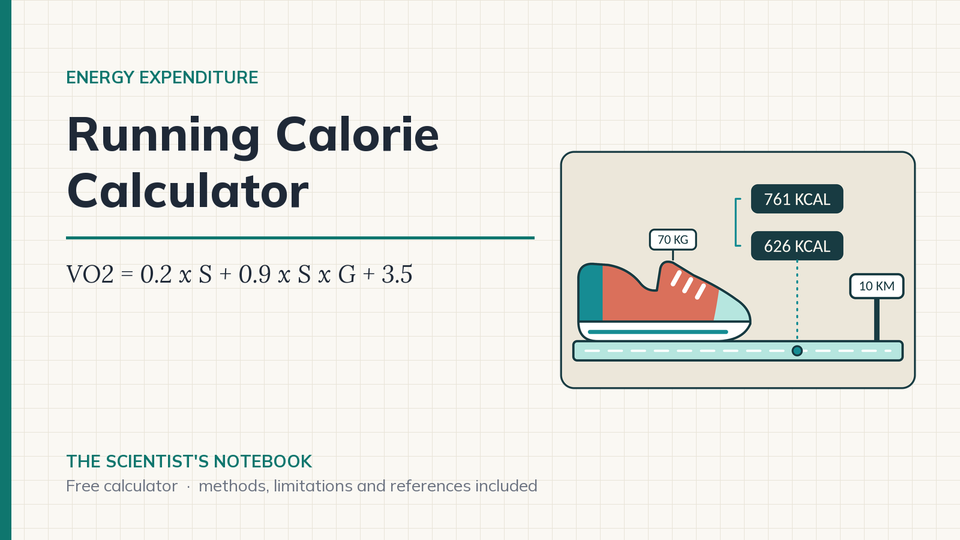
How much energy does a run cost? This calculator estimates it from your distance, time and body mass with three published methods, and shows each as net energy (what running adds) and gross energy (which also contains your resting metabolism for the same minutes).
In short: The calculator estimates run energy three ways from distance, time and body mass. On flat ground, running costs close to 1 kcal per kg per km, so 10 km at 70 kg is about 700 kcal net. The ACSM running equation adds uphill grade, and the 2024 Compendium gives a MET value for your average speed.
How are running calories calculated?
Your distance and duration give the average speed S in metres per minute. Body mass m is in kg and time t in minutes (h = t / 60 in hours).
1. Net cost per kilometre. On flat ground, running costs close to 1 kcal for every kg of body mass for every km, and that figure changes little with speed (Margaria and colleagues, 1963).
- Net kcal = 1.0 x m x distance (km)
- Gross kcal = net + 1.0 x m x h, where 1.0 kcal/kg/h is one MET by the Compendium convention
2. ACSM running equation. It predicts oxygen uptake in mL/kg/min from speed and uphill grade G (as a fraction, 5% = 0.05):
- VO2 = 0.2 x S + 0.9 x S x G + 3.5
- kcal = VO2 x m x t / 1000 x 5 (about 5 kcal per litre of oxygen)
- Net removes the 3.5 resting term. The flat horizontal part, 0.2 x 1000 m x 5 kcal/L, is exactly 1.0 kcal/kg/km, which is why methods 1 and 2 agree on flat net energy.
3. Compendium MET by speed. The 2024 Adult Compendium lists a MET value for running at specific speeds, from 6.5 MET at about 4.1 mph (6.6 km/h) to 23.0 MET at 14 mph (22.5 km/h). The calculator interpolates linearly between the listed speeds.
- Gross kcal = MET x m x h
- Net kcal = (MET - 1) x m x h
Worked example. 70 kg, 10 km in 50 minutes, flat ground. Speed = 12 km/h = 200 m/min, pace 5:00 per km.
- Net cost per km: net = 1.0 x 70 x 10 = 700 kcal. Gross = 700 + 70 x 0.833 = 758 kcal.
- ACSM: VO2 = 0.2 x 200 + 3.5 = 43.5 mL/kg/min. Gross = 43.5 x 70 x 50 / 1000 x 5 = 761 kcal. Net = 40 x 70 x 50 / 1000 x 5 = 700 kcal.
- Compendium: 12 km/h is 7.46 mph, between 7.0 mph (11.0 MET) and 7.5 mph (11.8 MET), so 11.73 MET. Gross = 11.73 x 70 x 0.833 = 684 kcal. Net = 10.73 x 70 x 0.833 = 626 kcal.
With a 5% uphill grade at 10 km/h for 30 minutes (5 km, 70 kg), the ACSM equation gives VO2 = 33.3 + 7.5 + 3.5 = 44.3 mL/kg/min, which is 466 kcal gross and 429 kcal net.
How should I use the running calorie estimate?
- Refuelling after a long run. Net energy is the figure to compare with what you eat after the run, because your resting metabolism is already counted in your daily budget. For carbohydrate during the run itself, use the Carb Calculator and the Glycogen calculator.
- Setting a daily total. If your daily estimate already includes your resting metabolism for the whole day, add the net number for the run. Add the gross number only when the run minutes are not in that estimate. The Calorie Calculator gives the daily side.
- Hills. If your average grade is above zero, the ACSM method is the only one here that takes it into account. For pace on rolling courses, see the Grade Adjusted Pace calculator.
- Comparing runs. Cost per km stays near 1 kcal/kg/km, so a faster run costs more per minute but a similar amount per kilometre. Two runs of the same distance at different paces will land close together.
How accurate is the running calorie estimate?
- The three methods can disagree. In the worked example the net results run from 626 to 700 kcal, a gap of about 11%. Individual running economy decides where you land, and the calculator warns when the methods differ by more than 10%.
- The constant of 5 kcal per litre of oxygen is a rounded convention. Kipp and colleagues (2018) compared 10 published equations that convert gas exchange to energy in 10 male distance runners and found up to 5.2% difference between two widely used ones.
- The ACSM running equation is intended for speeds above 134 m/min (about 8.0 km/h). The calculator warns below that. In a comparison of predictions with measured values in 24 people running 1600 m, Hall and colleagues (2004) concluded the ACSM and Leger equations were the most suitable of those tested.
- A fixed cost per km is an approximation at fast paces. Batliner and colleagues (2018) found that the energy cost per km of sub-elite runners rose by 9.6% across speeds from 3.58 to 5.14 m/s.
- Treadmill running has no air resistance. Jones and Doust (1996) concluded that a 1% grade made treadmill running match the energy cost of outdoor running in nine trained men. Wind, heat, terrain and shoes are not modelled.
- Compendium values are averages of a published set of measurements, not your own. The calculator does not include the extra energy used after exercise.
- Downhill running is not supported, and the grade input stops at 15%.
- The calculator refuses inputs it cannot turn into an honest estimate: body mass outside 30 to 300 kg, a run shorter than 1 minute or longer than 1440 minutes, a distance outside 0.5 to 350 km, an average speed outside 5 to 25 km/h, a blank grade (enter 0 for flat ground), and any result above 50 kcal per minute. A run longer than 100 km gets a warning, because the estimate assumes steady running for the whole distance.
⚠️ HEALTH & TRAINING GUIDANCE
Calorie estimates carry large individual variation. Consult a registered dietitian or sports medicine professional before changing your food intake or training based on these estimates.
ℹ️ IMPORTANT DISCLAIMER
This calculator is for educational purposes only and does NOT constitute medical advice. Consult qualified professionals before making changes. Individual physiology varies. You assume all risk. Must be 18+.
Frequently asked questions
Does running faster burn more calories per kilometre?
Only a little. Cost per km stays near 1 kcal per kg per km, so a faster run costs more per minute but a similar amount per kilometre. A fixed cost is an approximation at fast paces: Batliner and colleagues (2018) found that the energy cost per km of sub-elite runners rose by 9.6% across speeds from 3.58 to 5.14 m/s.
Why do the three running calorie methods give different numbers?
Each method rests on a different set of measurements. For 10 km in 50 minutes at 70 kg, net energy runs from 626 kcal by the Compendium to 700 kcal by the other two, a gap of about 11%. Your own running economy decides where you land, and the calculator warns when the methods differ by more than 10%.
How does the calculator handle hills?
Enter the average uphill grade in percent, or 0 for flat ground. Only the ACSM equation takes grade into account, by adding 0.9 x speed x grade to the oxygen cost. A 5% grade at 10 km/h for 30 minutes at 70 kg gives 466 kcal gross and 429 kcal net. Downhill running is not supported, and the grade input stops at 15%.
Should I count net or gross running calories?
Use net when you add the run to a daily estimate that already counts resting metabolism. Add gross only when the run minutes are not in that estimate. For 10 km in 50 minutes at 70 kg, the ACSM equation gives 761 kcal gross and 700 kcal net.
Which inputs does the running calorie calculator refuse?
Body mass outside 30 to 300 kg, a run shorter than 1 minute or longer than 1440 minutes, a distance outside 0.5 to 350 km, an average speed outside 5 to 25 km/h, a blank grade, and any result above 50 kcal per minute. Those combinations point to a typing slip or a unit mix-up rather than a real run.
Related calculators
- BMR Calculator
- Cycling Calorie Calculator
- Swimming Calorie Calculator
- Walking Calories Calculator
- All calculators on The Scientist's Notebook
References
- Margaria et al. · 1963 · Journal of Applied Physiology · PMID 13932993 · doi
- Hall et al. · 2004 · Medicine & Science in Sports & Exercise · PMID 15570150 · doi
- Herrmann et al. · 2024 · Journal of Sport and Health Science · PMID 38242596 · doi
- Ainsworth et al. · 2011 · Medicine & Science in Sports & Exercise · PMID 21681120 · doi
- Jones & Doust · 1996 · Journal of Sports Sciences · PMID 8887211 · doi
- Kipp et al. · 2018 · Applied Physiology, Nutrition, and Metabolism · PMID 29401411 · doi
- Batliner et al. · 2018 · Sports Medicine - International Open · PMID 30539111 · doi
- American College of Sports Medicine · ACSM's Guidelines for Exercise Testing and Prescription · Wolters Kluwer · PMID not indexed (book)