Swimming Calorie Calculator
In the pool, drag and propelling efficiency set the energy cost of every metre, and both depend on technique, so any swim calorie figure is an estimate with wide margins. This calculator gives a Compendium-based estimate from your stroke and effort, or from your front-crawl pace, and shows net and gross energy.
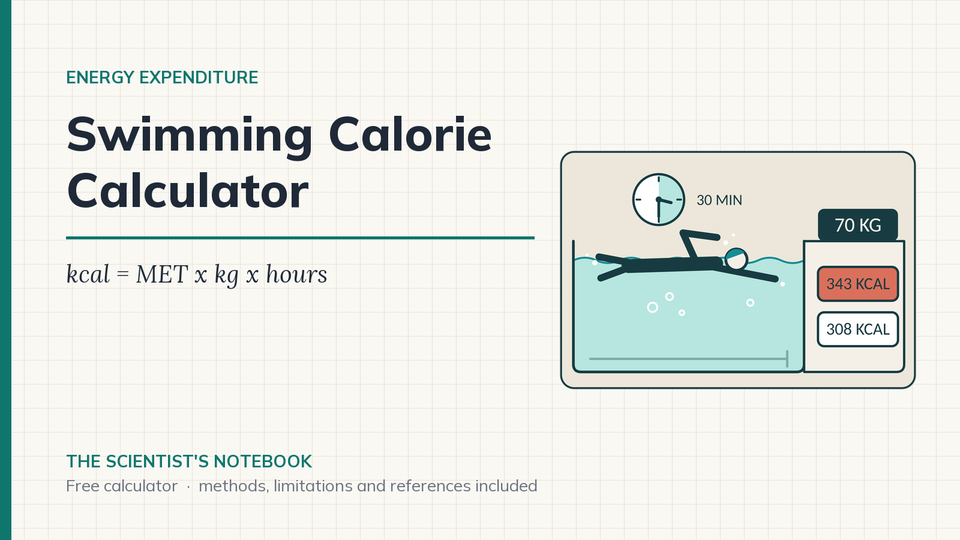
In short: The calculator multiplies a 2024 Compendium MET value by body mass and hours of actual swimming. Fast freestyle laps at 9.8 MET for 30 minutes cost a 70 kg swimmer 343 kcal gross, or 308 kcal net once resting metabolism is taken out. In pace mode it reads the MET from your front-crawl speed instead.
How are swimming calories calculated?
The 2024 Adult Compendium of Physical Activities lists a MET value for each swimming activity. One MET is defined as 1 kcal per kg of body mass per hour. With body mass m (kg) and time swimming h (hours):
- Gross kcal = MET x m x h (includes the resting metabolism of the same hours)
- Net kcal = (MET - 1) x m x h (the part added by swimming)
The calculator offers only entries the Compendium actually lists. That gives, for example, freestyle laps at 5.8 MET (slow, recreational) or 9.8 MET (fast, vigorous), backstroke at 4.8 MET (recreational) or 9.5 MET (training or competition), breaststroke at 5.3 MET or 10.3 MET, butterfly at 13.8 MET, sidestroke at 7.0 MET and open-water swimming at 6.0 MET, or 10.5 MET for a 5 km swim.
Front crawl by pace. The Compendium also lists front crawl by speed: 5.8 MET for slow swimming (30 to 45 yd/min), 8.0 MET at about 50 yd/min, 10.5 MET at about 75 yd/min and 14.5 MET for elite swimmers above 90 yd/min. In pace mode, the calculator turns your distance and time into metres per minute and interpolates linearly between these points. The 5.8 MET entry is placed at the middle of its range, 37.5 yd/min (34.3 m/min), and the 14.5 MET entry at the lower edge of its range, 90 yd/min (82.3 m/min). From 30 to 37.5 yd/min (27.4 to 34.3 m/min) the listed 5.8 MET is used as it stands. Above 90 yd/min the listed 14.5 MET is used, with a warning that the estimate may read low, because the energy cost per metre keeps rising with speed. A pace slower than 27.4 m/min (3:39 per 100 m) or faster than 120 m/min (0:50 per 100 m) is refused as a likely typing or unit slip.
Worked example. 70 kg swimmer, 30 minutes of actual swimming.
- Freestyle laps, fast, vigorous effort, 9.8 MET: gross = 9.8 x 70 x 0.5 = 343 kcal. Net = 8.8 x 70 x 0.5 = 308 kcal.
- Butterfly, 13.8 MET: gross = 483 kcal. Breaststroke at training effort, 10.3 MET: 361 kcal. Backstroke at training effort, 9.5 MET: 333 kcal.
- Pace mode, 1,500 m in 30 minutes: 50 m/min, which is 2:00 per 100 m. Between 8.0 MET (45.7 m/min) and 10.5 MET (68.6 m/min) the interpolated value is 8.47 MET. Gross = 8.47 x 70 x 0.5 = 296 kcal. Net = 7.47 x 70 x 0.5 = 261 kcal, or 17.4 kcal per 100 m.
How should I use the swimming calorie estimate?
- Planning food after a pool session. Net energy is the number to compare with what you eat afterwards, because the resting part of your day is already in your daily estimate. The Calorie Calculator covers the daily side.
- Comparing swim, ride and run. Put the same duration into the Cycling and Running calorie calculators to see how the same hour compares across the three triathlon sports. Treat the gaps as indicative, since each uses a different data source.
- Pairing it with stroke efficiency. A faster average pace at the same stroke rate usually means more distance per stroke. The SWOLF calculator shows that side of your swimming, which the MET value cannot.
- Setting a fuelling plan for a long open-water swim. Use the 6.0 MET and 10.5 MET entries as a range, and check carbohydrate targets with the Carb Calculator.
How accurate is the swimming calorie estimate?
- Swimming economy differs a lot between people. Zamparo and colleagues (2020) reviewed the energy cost of swimming and described how it depends on drag and propelling efficiency, and how it differs between strokes and between swimmers of different age, sex and technical level. A Compendium MET is an average over the measured group, so a technically skilled swimmer and a beginner at the same pace can have very different real costs.
- At any speed the cost per metre is higher in water than on land, which is why swimming MET values look high for how slowly you move.
- Time must be time spent swimming. A one-hour session with long rests at the wall has far fewer swimming minutes than the clock shows.
- Water temperature, wetsuit use, turns, push-offs and drills are not modelled.
- Some combinations do not exist in the Compendium, such as a light-effort butterfly. They are not offered, instead of filling the gap with an invented number.
- Between 34.3 and 82.3 m/min, pace-mode MET is a straight-line interpolation between four published points and is not itself a measured value.
- The calculator refuses inputs it cannot turn into an honest estimate: body mass outside 30 to 300 kg, a swim shorter than 1 minute or longer than 1440 minutes, a distance outside 100 to 30,000 m, a front-crawl pace outside 27.4 to 120 m/min, and any result above 50 kcal per minute.
- The estimate does not include the extra energy used after exercise.
⚠️ HEALTH & TRAINING GUIDANCE
Calorie estimates carry large individual variation. Consult a registered dietitian or sports medicine professional before changing your food intake or training based on these estimates.
ℹ️ IMPORTANT DISCLAIMER
This calculator is for educational purposes only and does NOT constitute medical advice. Consult qualified professionals before making changes. Individual physiology varies. You assume all risk. Must be 18+.
Frequently asked questions
Should I count net or gross swimming calories?
Use net when you add the swim to a daily estimate that already counts resting metabolism, for example when you plan food after a pool session. Gross also contains the resting energy of the same minutes, 1 kcal per kg per hour here. That resting share is the gap between 343 and 308 kcal in the worked example.
How does the calculator use my front-crawl pace?
It divides distance by time swimming to get metres per minute and reads the MET from the four Compendium front-crawl entries: 5.8 MET for slow swimming, 8.0 at about 50 yd/min, 10.5 at about 75 yd/min and 14.5 above 90 yd/min. Between those points it interpolates, so 1,500 m in 30 minutes, 2:00 per 100 m, gives 8.47 MET.
Why do two swimmers at the same pace burn different calories?
Drag and propelling efficiency set the energy cost of every metre, and both depend on technique. A review by Zamparo and colleagues (2020) describes how the energy cost differs between strokes and between swimmers of different age, sex and technical level. A Compendium MET is an average over the measured group, so treat the estimate as a starting point.
Should rest at the wall count as swimming time?
No. Enter only the minutes you actually spent swimming. A one-hour session with long rests at the wall has far fewer swimming minutes than the clock shows, and counting the rests would inflate the estimate.
Which inputs does the swimming calorie calculator refuse?
Body mass outside 30 to 300 kg, a swim shorter than 1 minute or longer than 1440 minutes, a distance outside 100 to 30,000 m, a front-crawl pace outside 27.4 to 120 m/min, and any result above 50 kcal per minute. Those combinations point to a typing slip or a unit mix-up rather than a real swim.
Related calculators
- BMR Calculator
- Cycling Calorie Calculator
- Running Calorie Calculator
- Walking Calories Calculator
- All calculators on The Scientist's Notebook