Cycling Calorie Calculator
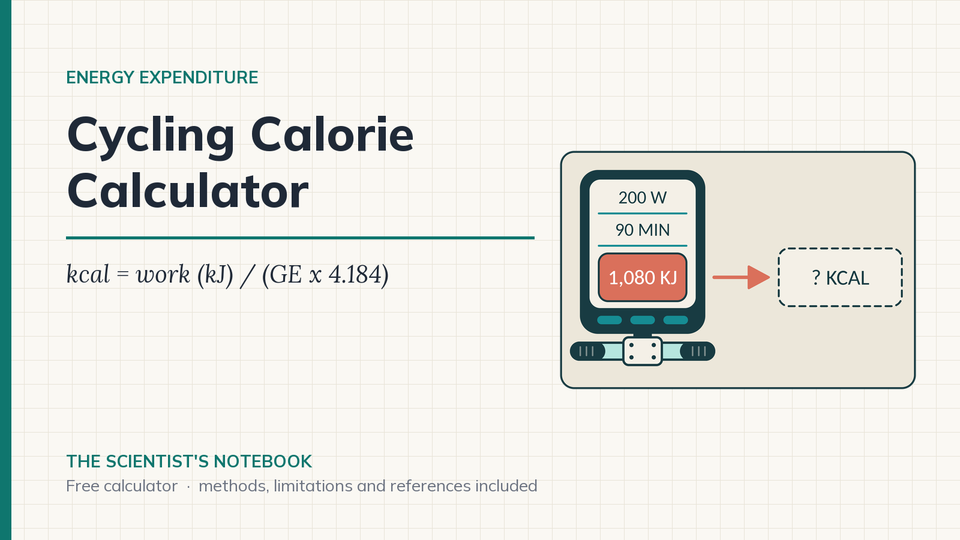
This calculator estimates the energy cost of a ride in two ways: from your average speed with published MET values, or from your average power and a gross efficiency you can set between 20% and 25%. The power route starts from the work your power meter actually recorded.
In short: The calculator estimates ride energy two ways. With a power meter it divides the work in kJ by gross efficiency times 4.184, so 200 W for 90 minutes (1,080 kJ) costs 1,033 to 1,291 kcal at 25% to 20% efficiency. Without power it multiplies a 2024 Compendium MET value for your average speed by body mass and hours.
How are cycling calories calculated?
Power method. A power meter records mechanical work. Your body had to burn more energy than that, because muscle turns only a fraction of its fuel into pedal force. That fraction is gross efficiency (GE): mechanical work divided by metabolic energy.
- Work (kJ) = average power (W) x time (s) / 1000
- Gross energy (kcal) = work (kJ) / (GE x 4.184)
- Net energy (kcal) = gross - 1.0 x body mass (kg) x hours, where 1.0 kcal/kg/h is one MET by the Compendium convention
The conversion factor 4.184 kJ per kcal means that at a GE of 23.9% one kilojoule on the power meter costs about one kilocalorie. That is where the rule of thumb "kJ is roughly kcal" comes from. At 20% one kilojoule costs about 1.2 kcal, and at 25% about 0.96 kcal. The efficiency field starts at 22.5%, the midpoint of the 20% to 25% working range, and you can change it.
MET method. The 2024 Adult Compendium of Physical Activities assigns a MET value to cycling by speed band. The calculator picks the band that contains your average speed.
- Under 10 mph (16.1 km/h): 4.0 MET. 10 to 12 mph: 6.8. 12 to 14 mph: 8.0. 14 to 16 mph: 10.0.
- 16 to 20 mph (25.7 to 32.2 km/h): 12.0. Over 20 mph (32.2 km/h), racing, not drafting: 16.8.
- Gross kcal = MET x mass (kg) x hours. Net kcal = (MET - 1) x mass x hours.
Worked example. 70 kg rider, 90 minutes, 200 W average, 28 km/h average speed.
- Work = 200 x 5,400 / 1000 = 1,080 kJ
- Power method at GE = 22%: gross = 1,080 / (0.22 x 4.184) = 1,173 kcal. Resting energy = 70 x 1.5 = 105 kcal, so net = 1,068 kcal.
- At GE = 25% the gross figure is 1,033 kcal. At GE = 20% it is 1,291 kcal. The efficiency you choose moves the answer by about 260 kcal.
- MET method: 28 km/h = 17.4 mph, band 16 to 20 mph, 12.0 MET. Gross = 12.0 x 70 x 1.5 = 1,260 kcal. Net = 11.0 x 70 x 1.5 = 1,155 kcal.
- Distance = 28 x 1.5 = 42 km, so the MET gross figure works out at 30.0 kcal per km. With a speed entered, the calculator shows distance and energy per km for either method.
How should I use the cycling calorie estimate?
- Fuelling a long ride. Energy cost per hour is the number behind the carbohydrate plan. For the carbohydrate share and the hourly intake, go to the Carb Calculator, and see the Glycogen calculator for how stores cover the gap.
- Comparing two rides of equal length. With a power meter, the kJ total makes rides comparable even when the speed differs because of wind or hills. The MET method cannot do that, since it sees only speed.
- Checking one method against the other. Enter power and speed together. If the two results differ by more than 15% the calculator says so. On a windy day or a drafting group ride, the speed-based number is the one to doubt.
- Estimating a daily total. Add the net number to a daily estimate that already counts resting metabolism. The Calorie Calculator covers the daily side. If you want to turn average power into speed on flat roads, the Power to Speed calculator does it.
How accurate is the cycling calorie estimate?
- Gross efficiency is not a constant. Ettema and Loras (2009) reviewed the literature and reported that about 91% of the variance in energy expenditure is explained by work rate, that GE depends strongly on work rate, and that the higher GE of elite cyclists may be largely explained by their higher work rates.
- Reported values depend on the test. Moseley and Jeukendrup (2001) measured an average GE of 19.8% (SD 0.6) in 17 men, with a coefficient of variation of 4.2% between tests. GE was significantly lower at 95 W and 130 W than at higher power. The 20% to 25% range here covers the usual values but not every rider.
- Efficiency changes with cadence and drifts down as you tire, so a fixed GE over a long ride is an approximation.
- Use average power over the whole ride including coasting. Entering the power of only the moving or hard sections overstates the work.
- The MET method sees only average speed. Headwinds, hills, drafting, road surface and stop-and-go riding change the cost at a given speed. The Compendium bands are steps, so 9.9 mph and 10.1 mph differ by 2.8 MET.
- The Compendium has no listed value between 19 and 20 mph. The calculator keeps that range in the 12.0 MET band.
- The calculator refuses inputs it cannot turn into an honest estimate: body mass outside 30 to 300 kg, a ride shorter than 1 minute or longer than 1440 minutes, an average speed outside 5 to 60 km/h, an average power outside 20 to 1000 W, a gross efficiency outside 15% to 30%, a whole-ride average above 10 W per kg for a ride of 5 minutes or longer, a power so low that the estimate falls to resting energy, and any result above 50 kcal per minute. A gross efficiency outside 20% to 25% is accepted with a warning. A speed or power entered only as a cross-check is checked the same way.
- Both methods estimate the energy of the ride itself. They do not include the extra energy used after exercise, or the cost of heat, altitude or cold.
⚠️ HEALTH & TRAINING GUIDANCE
Calorie estimates carry large individual variation. Consult a registered dietitian or sports medicine professional before changing your food intake or training based on these estimates.
ℹ️ IMPORTANT DISCLAIMER
This calculator is for educational purposes only and does NOT constitute medical advice. Consult qualified professionals before making changes. Individual physiology varies. You assume all risk. Must be 18+.
Frequently asked questions
Is one kJ on a power meter one kcal?
Only at a gross efficiency of about 23.9%. Kilocalories equal work in kJ divided by efficiency times 4.184. At 20% efficiency one kilojoule costs about 1.2 kcal, and at 25% about 0.96 kcal, so the rule of thumb holds only near the middle of the usual range.
What gross efficiency should I enter?
Without a lab test, keep the 22.5% starting value, the midpoint of the 20% to 25% working range, and read the range the calculator shows next to the result. Moseley and Jeukendrup measured an average of 19.8% in 17 men, and efficiency was lower at 95 W and 130 W than at higher power.
Why do the MET and power methods give different numbers?
The MET method sees only average speed, while the power method starts from the work you actually did. Wind, hills, drafting and the efficiency you choose move the two apart. When both are entered and they differ by more than 15%, the calculator tells you. On a windy day or in a group ride, the speed figure is the one to doubt.
Should I count net or gross cycling calories?
Use net when you add the ride to a daily estimate that already counts resting metabolism. Gross also contains the resting energy of the same minutes, 1.0 kcal per kg per hour here, which is 105 kcal for a 70 kg rider over 90 minutes.
Which inputs does the cycling calorie calculator refuse?
An average power above 10 W per kg for a ride of 5 minutes or longer, a power so low that the estimate falls to resting energy, a gross efficiency outside 15% to 30%, and any result above 50 kcal per minute. Those combinations point to a peak power, a typing slip or a unit mix-up rather than a real ride.
Related calculators
- BMR Calculator
- Running Calorie Calculator
- Swimming Calorie Calculator
- Walking Calories Calculator
- All calculators on The Scientist's Notebook
References
- Ettema & Loras · 2009 · European Journal of Applied Physiology · PMID 19229554 · doi
- Moseley & Jeukendrup · 2001 · Medicine & Science in Sports & Exercise · PMID 11283439 · doi
- Herrmann et al. · 2024 · Journal of Sport and Health Science · PMID 38242596 · doi
- Ainsworth et al. · 2011 · Medicine & Science in Sports & Exercise · PMID 21681120 · doi