Glycemic Load Calculator for Endurance Meals
Glycemic load combines how fast a food's carbohydrate raises blood glucose with how much carbohydrate you actually eat. This calculator adds it up across a meal and tells you what the number means around training.
In short: Glycemic load is the glycemic index times the available carbohydrate in grams, divided by 100. The calculator adds the loads across a meal and gives a carbohydrate-weighted meal glycemic index. A load of 10 or below is low, 11 to 19 is medium and 20 or above is high, a convention of the University of Sydney database.
How does the calculator work?
- Item carbohydrate (g) = available carbohydrate per serving x servings. Available means total carbohydrate minus fibre.
- Item glycemic load = glycemic index x item carbohydrate / 100.
- Meal glycemic load = the sum of the item loads.
- Meal glycemic index = meal glycemic load / meal carbohydrate x 100. It is the carbohydrate-weighted mean of the items.
Glycemic index bands: low is 55 or below, medium is 56 to 69, high is 70 or above. Glycemic load bands for a serving or a meal: low is 10 or below, medium is 11 to 19 (anything above 10 and below 20), high is 20 or above, judged on the value shown to one decimal. The index bands are stated in the 2008 international tables. The load bands are the convention of the University of Sydney glycemic index database, the group behind those tables; I could not trace them to a peer-reviewed paper.
You enter the glycemic index yourself. The calculator holds no food list, because index values depend on the reference food and the test conditions. Look them up in the 2008 international tables or the University of Sydney database, and check which food each value was tested on.
The calculator accepts a glycemic index of 1 to 120 and warns above 100, the value of the glucose reference itself. Each item takes up to 500 g of available carbohydrate per serving and up to 20 servings, and a meal holds up to 12 items and 1000 g of carbohydrate. Anything outside those ranges is treated as an entry mistake. Nothing is filled in for you, including the number of servings.
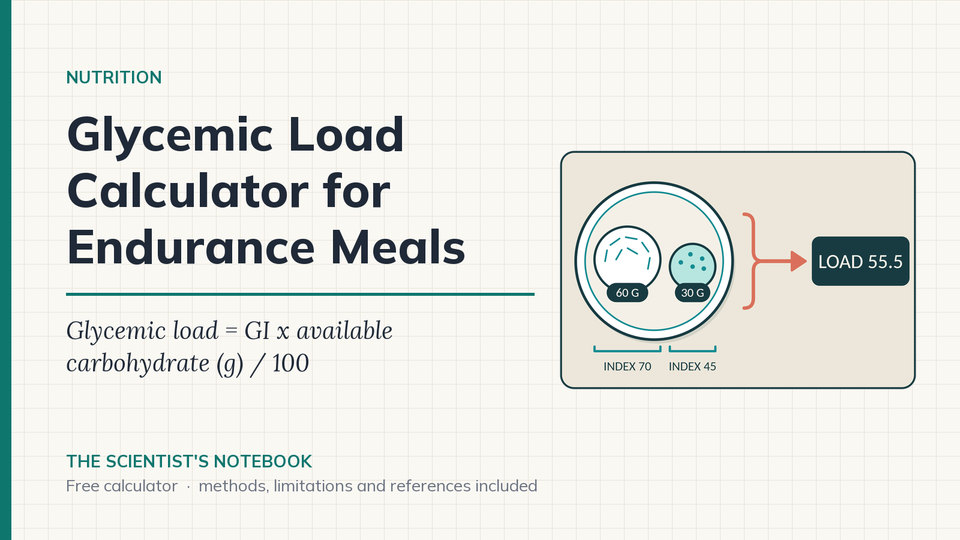
Worked example. Two items, with illustrative numbers. Item A: glycemic index 70 and 60 g of available carbohydrate gives 70 x 60 / 100 = 42.0, which is a high load. Item B: glycemic index 45 and 30 g gives 13.5, a medium load. The meal load is 55.5 for 90 g of carbohydrate. The meal glycemic index is 55.5 / 90 x 100 = 61.7, which sits in the medium band.
How should you use the result?
- Before a long session. A 2017 meta-analysis of 19 studies found no clear benefit of a low-index pre-exercise meal for endurance performance. I treat the load number here as a description of what I ate, and pick the meal I can digest, not the one with the lowest score. Total carbohydrate for the day is a separate question; the daily carbohydrate calculator covers it.
- After a hard session with another one coming. In five trained cyclists, a day of high-index foods gave a larger muscle glycogen gain at 24 hours than a day of low-index foods, at the same 10 g/kg total. If your next hard effort is within a day, this is where the index can matter. The glycogen calculator shows how much you may have to refill.
- During the session. Do not use this. Glycemic index is measured at rest. For grams of carbohydrate per hour while riding or running, use the carbohydrate calculator.
What are the limitations?
- Glycemic index values in tables are averages. Individual responses to the same food differ, and the same person can respond differently on different days.
- Mixing foods changes the response. Fat, protein, fibre, acid, cooking and cooling all shift it, and the calculator only multiplies and adds.
- A meal-level band is a convenience. The published bands were set for a serving, and an athlete's pre-race meal of 100 g or more of carbohydrate can reach a high load without any single item being unusual.
- The recovery result comes from five cyclists. It supports a short-window strategy and does not settle the question for everyone.
- The calculator gives no daily glycemic load target. I could not trace one to a peer-reviewed source.
- Nothing here is guidance for managing diabetes or another metabolic condition. Those decisions belong with a registered dietitian or doctor.
⚠️ HEALTH & TRAINING GUIDANCE
Glycemic index values vary between people and meals. If you manage diabetes or another metabolic condition, talk to a registered dietitian or doctor before changing what you eat based on these numbers.
ℹ️ IMPORTANT DISCLAIMER
This calculator is for educational purposes only and does NOT constitute medical advice. Consult qualified professionals before making changes. Individual physiology varies. You assume all risk. Must be 18+.
Frequently asked questions
How do you calculate glycemic load?
Multiply the glycemic index by the grams of available carbohydrate, which is total carbohydrate minus fibre, and divide by 100. A food with a glycemic index of 70 and 60 g of available carbohydrate has a load of 42.0. For a meal, add the item loads.
What counts as a high glycemic load?
For a serving or a meal, 10 or below is low, 11 to 19 is medium and 20 or above is high, judged on the value shown to one decimal. The load bands are the University of Sydney database convention. The 2008 international tables state the index bands: 55 or below is low and 70 or above is high.
Does a low glycemic index meal before exercise help endurance?
A 2017 meta-analysis of 19 studies found no clear benefit of a low-index pre-exercise meal for endurance performance. Pick the meal you can digest, not the one with the lowest score, and treat the load as a description of what you ate.
When does the glycemic index matter for athletes?
Mostly after a hard session with another one coming within a day. In five trained cyclists, a day of high-index foods gave a larger muscle glycogen gain at 24 hours than a day of low-index foods, at the same 10 g/kg total. During exercise, grams of carbohydrate per hour matter instead.
Why does the calculator have no food list?
Index values depend on the reference food and the test conditions. Look them up in the 2008 international tables or the University of Sydney database, and check which food each value was tested on. The calculator accepts a glycemic index of 1 to 120 and warns above 100.
Related calculators
- Caffeine Dose Calculator for Endurance
- Daily Carbohydrate Intake Calculator
- Creatine Loading and Maintenance Calculator
- Fat Intake Calculator
- All calculators on The Scientist's Notebook
References
- Atkinson FS et al. · 2008 · Diabetes Care · PMID 18835944 · doi
- Salmeron J et al. · 1997 · Diabetes Care · PMID 9096978 · doi
- Burdon CA et al. · 2017 · Sports Med · PMID 27677914 · doi
- Burke LM et al. · 1993 · J Appl Physiol · PMID 8226443 · doi
- Jeukendrup A · 2014 · Sports Med · PMID 24791914 · doi