OpenLab #007: Gut training and the unfinished science of fueling with Dr. Emily Dow
Picture an age group triathlete arriving at a sports-nutrition lab convinced that gels caused her cramps during her A-race. Sit with the dietary log and the training file side by side, and a different picture surfaces: she has not once practiced her race-day intake, and her gut wasn`t prepared for it.
The gut is being asked to absorb 80+ grams of carbohydrate per hour for the first time, in heat, at threshold pace, with five hours of accumulated stress. The cramps are not the gel's fault. They are the predictable consequence of an unrehearsed organ.
The gastrointestinal tract is the most under-trained system in age group endurance sport, and a serious athlete can change that with a few weeks of deliberate work.
A long ride or a long run cannot be separated from the gut feeding it. Yet most age group athletes still treat fueling as a packaging decision, not a training variable. Athletes train their legs for years, then ask the gut to perform on race morning with no rehearsal.
Today, we are honored to have Dr. Dow behind the microscope and help us lift the veil on the unfinished science of fueling.
About our guest: Dr. Emily Dow is a nutrition scientist, registered dietitian, and certified strength and conditioning specialist who holds a PhD in Exercise and Nutritional Sciences from Arizona State University. She is Assistant Professor of Practice in Nutrition and Human Performance at the University of Arizona.
Her scholarly work centres on the microbiota–gut–brain axis and its links to mood regulation, gastrointestinal function, and cognitive health, using clinical trials of resistance training, supplements, educational interventions, and functional foods.
In her own words, she lives between lab and gym, equally obsessed with the messy beauty of human data and real-world one-on-one experimentation. She also runs a private-practice sports dietitian service for youth and recreational athletes.
Treat yourself as your own n=1 experiment, ideally one with fewer wires and more snacks.


The Brief
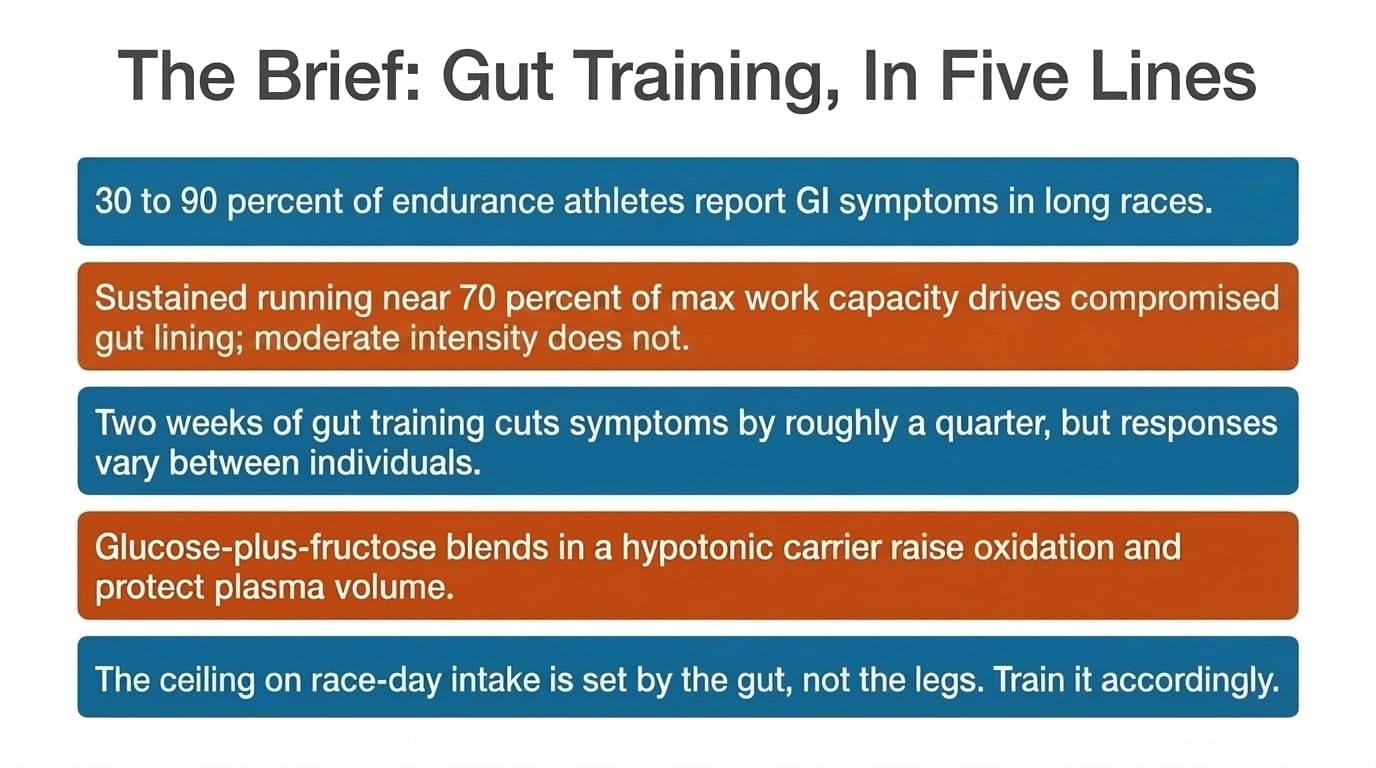
- Repeated exposure of the gut to race-day fueling during training reduces total exercise-induced symptom severity by 26 to 38 percent in two weeks, but the response is highly individual and a small fraction of athletes get worse before they get better.
- A glucose-plus-fructose blend, delivered in a hypotonic carrier and ingested as larger boluses every 20 minutes rather than sips every 5 minutes, produces the highest exogenous carbohydrate oxidation rates while preserving plasma volume.
- On menstrual cycle-associated effects: female athletes consistently report more bloating, cramps, and water retention in the early luteal phase; glycogen storage is also up to 25 percent lower in the mid-follicular phase when daily carbohydrate intake sits below 5 grams per kilogram, and the difference disappears once intake clears 8 grams per kilogram daily.
- The ceiling on race-day intake is set by the gut, not by the legs. Train it accordingly.
Between 30 and 90 percent of marathoners, triathletes, and ultra-distance athletes report gastrointestinal symptoms during competition, depending on event length and intensity, and the most aggressive symptoms cluster in races that exceed three hours.
Join our Discord community:
 Thomas Mortelmans
The Science at a Glance
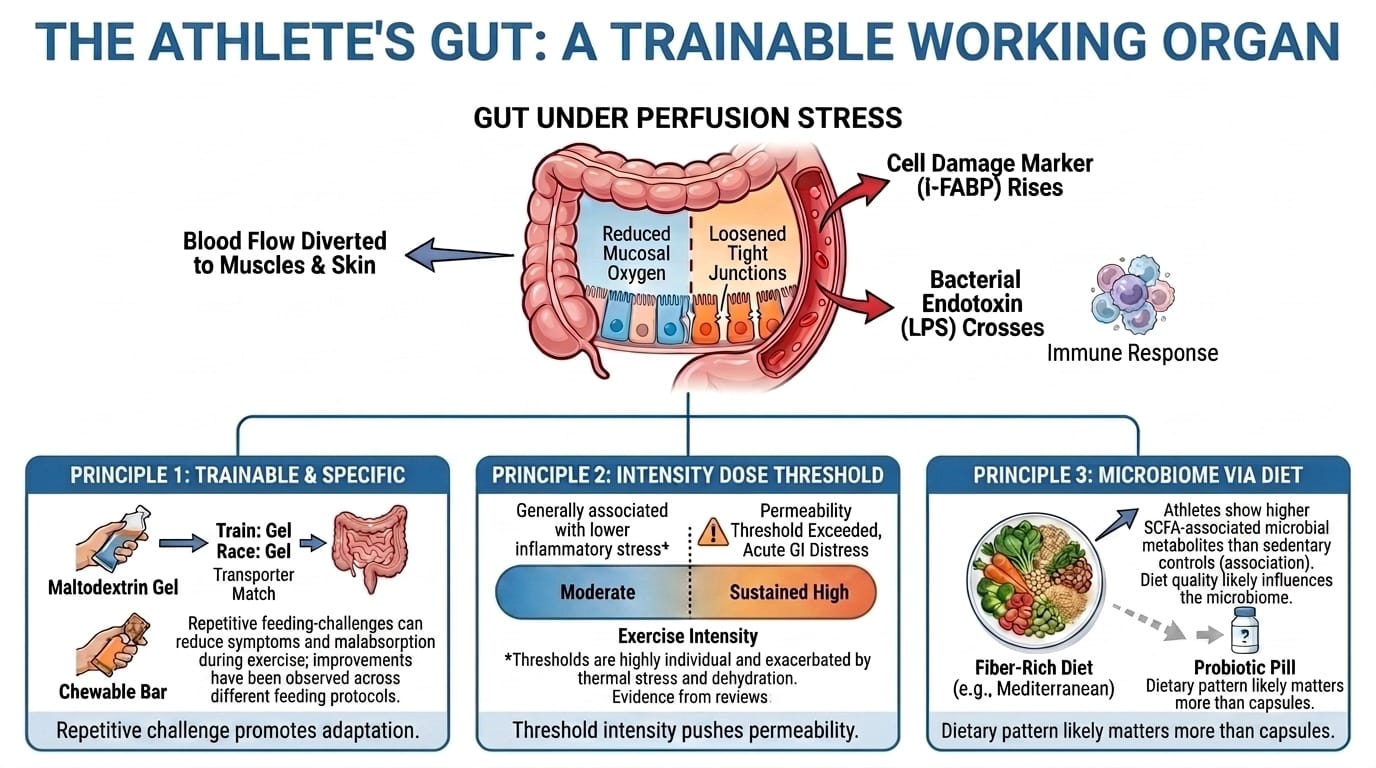
The gut is a working organ during exercise, and like any working organ, it can be over-stressed, under-prepared, or carefully developed.
Firstly, when an athlete starts a long effort, splanchnic blood flow (the blood circulation supplying the abdominal gastrointestinal organs—stomach, intestines, liver, spleen, and pancreas) can drop by up to 80 percent of resting values so working muscles and skin can be perfused.
"I'm equally obsessed with the messy beauty of human data and the real-world experimentation that happens one-on-one with real humans living real lives." — Dr. Emily Dow
The second mechanism is mechanical. Running impacts the abdomen in a way cycling does not, which is why a triathlete can feel fine on the bike and unravel in the first kilometre of the run. Add heat, dehydration, and a pre-race coffee, and the gut is compromised before the first gel arrives.
The third mechanism is osmotic. A 14 percent carbohydrate solution dropped into a heat-stressed, low-perfusion gut creates a gradient the small intestine cannot keep up with. Water moves the wrong direction. Symptoms follow.
Foundational principles:
Principle 1: The gut is trainable, but trainable means specific
Repeated exposure to carbohydrate during exercise upregulates intestinal glucose transporters (SGLT1 has been shown to roughly double in animal models within two weeks of high-carbohydrate feeding), accelerates gastric emptying, and shifts colonic fermentation.
After a 7 to 14 day feeding-challenge protocol, total upper-gut symptoms during exercise drop by roughly a quarter, and breath-hydrogen markers of malabsorption fall in parallel.
The trainable adaptation is substrate-specific. A gut rehearsed on maltodextrin gel is not automatically rehearsed for whole-food bars or a glucose-plus-fructose hydrogel. An athlete can pass a 90 grams per hour gel test in training and cramp on a chewable bar at 60 grams per hour in competition. Train on the exact race-day product. The adaptation is also reversible: athletes who drift into low-carbohydrate or ketogenic patterns lose intestinal absorption capacity within weeks.
Principle 2: Sex and cycle phase shape both fuel storage and gut tolerance
Firstly, the female-specific evidence is sparse but not silent. When carbohydrate intake sits at 4 to 5 grams per kilogram per day, glycogen storage runs 12 to 25 percent lower in the mid-follicular phase than in the mid-luteal phase. That gap disappears once daily carbohydrate clears 8 grams per kilogram.
Secondly, resting metabolic rate also rises by roughly 100 to 200 kilocalories per day during the luteal phase, and many female athletes report increased appetite that funds the higher demand. Bloating, cramps, and water retention cluster in the early luteal week, and gut symptoms during exertion track those same days.
Scientist Insight: Two cycles of symptom logging usually explains more than any textbook chapter. Holding total carbohydrate above 8 grams per kilogram daily closes the follicular-phase storage gap. Most published gut-training studies miss this lever because their cohorts are predominantly male.
Principle 3: The microbiome contributes, but it is downstream of dose and diet
Elite endurance athletes show higher microbial diversity than sedentary controls. Veillonella atypica, found in marathoner stool, metabolises circulating lactate into propionate and lifts treadmill time-to-exhaustion in mouse models. Multi-strain probiotics produce small-to-moderate symptom reductions in trained athletes; the effect is unreliable in the untrained.
Scientist's Insight: Probiotic-as-magic-pill thinking does not survive the data. The dietary pattern matters more than the capsule. An athlete who lives on 12 grams of fibre a day and processed gels will not be rescued by a 10-billion-CFU probiotic. Build the substrate first, then test a strain.
Gradescale: Your physiology, decoded. Join the waitlist now.
 Thomas Mortelmans
The Decision Framework
Race duration and intake target
- Events under 90 minutes are tolerated at 30 to 60 grams of carbohydrate per hour after two in-training rehearsals in the literature's feeding-challenge protocols.
- Events between 90 minutes and three hours converge on 60 to 75 grams per hour with a glucose-plus-fructose ratio near 2:1.
- Events exceeding three hours show clean absorption at 80 to 90 grams per hour only after roughly four weeks of progressive exposure; the ISSN ultra-marathon position stand describes 60 to 90 grams per hour as the upper tolerated range for events over three hours (Burke 2019, PMID 31699159).
- For ultra-endurance work, a 1:0.8 glucose-to-fructose ratio at roughly 110 grams per hour has produced the cleanest absorption signal in cycling trials.
Where athletes tend to land: those who load 90 grams per hour "cold turkey" report worse upper-gut symptoms than those who progress through 60 then 75 first.
Symptom phenotype
- Upper-gut symptoms (nausea, fullness, reflux) co-occur with the gastric-emptying and osmotic-load bottleneck, and the literature describes more dilute solutions and smaller more frequent boluses as the conditions under which symptoms drop.
- Lower-gut symptoms (cramping, urgency, diarrhea) co-occur with the small-intestinal absorption and colonic fermentation bottleneck; multi-transportable carbohydrate, fructose load held below 0.5 grams per kilogram per hour, and a short low-FODMAP trial during the taper have each been associated with symptom reductions (Lis 2018, PMID 30646926).
Where athletes tend to land: athletes with mixed upper-and-lower-gut symptoms whose upper-gut signal resolves first usually see roughly half of the lower-gut chain clear with it.
Heat exposure
- Heat acclimation lowers core temperature and protects splanchnic perfusion at a given pace, which raises the intake the gut can tolerate. The trials stacking heat acclimation and gut training in the same block describe additive symptom reductions versus consecutive-block protocols.
Where athletes tend to land: those training in a cool climate for a hot race who run heat acclimation and gut training concurrently report fewer race-day symptoms than those who run them sequentially.
The Protocol and a Hypothetical Case
Editorial note: the case below is a hypothetical illustration of the physiology. It is NOT a case from Dr. Dow's practice and the athlete is not her patient.
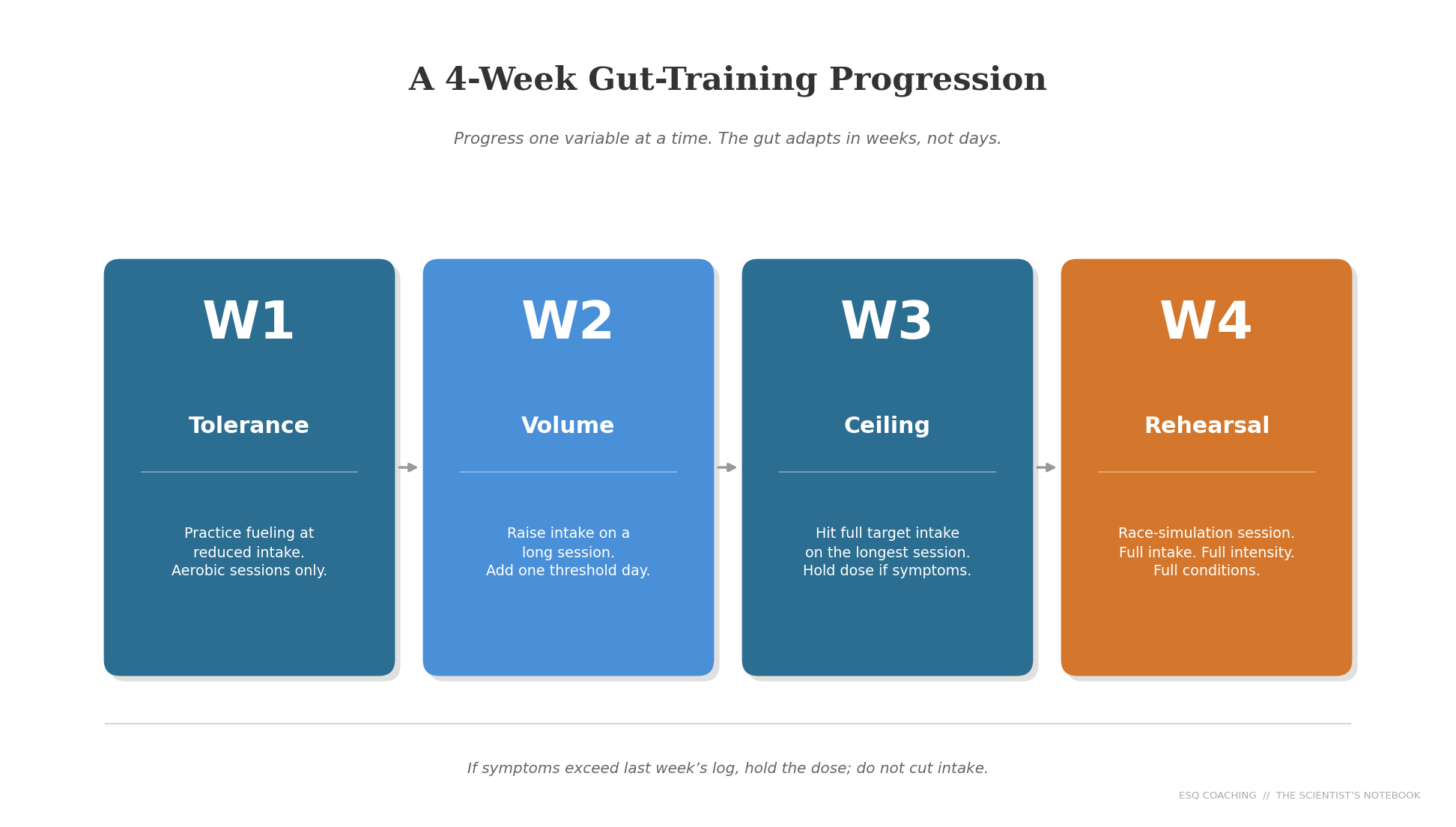
A 4-week gut-training protocol
- Baseline trial: one long session at goal race intensity, with goal race nutrition, in the conditions you can replicate. Log every symptom and the timing.
- Week 1: practice fueling at 60 percent of target intake, twice per week, on aerobic work. Tolerance trumps volume.
- Week 2: raise to 80 percent of target intake on one long session and one threshold session. Repeat the long-session symptom log.
- Week 3: hit full target intake on the longest session. If symptoms exceed last week, hold this dose for an additional week.
- Week 4: race-simulation session at full intake, full intensity, full conditions. If it goes wrong here, race day will not save you.
The protocol assumes the athlete has a fueling product they can stomach at low dose. If they have not, run a 7-day tolerance test on three candidate products before Week 1.
The athlete in this illustration is a generic 38-year-old age group woman racing 70.3 distance, three years in the sport, 12 to 14 hours per week. She finishes with a DNF at her A-race, vomits at kilometre 6 of the run, and walks the rest. She blames the gel brand and orders a different one for the next race.
The diagnostic: the sports-nutrition literature consistently surfaces in cases like this: 1) the morning meal composition, 2) the last training session that paired race-pace with race-day nutrition, and 3) the fibre load the day before. Those three variables drive the lion's share of variance in race-day GI symptoms in the feeding-challenge trials (Costa 2023, PMID 37061651). The gel itself is rarely the issue.
The intervention is unglamorous. 1) Drop the morning fibre load on race day. 2) Move to a lower-residue meal three hours before the start. 3) Restore race-pace fueling rehearsals on every Saturday brick for eight weeks. 4) Hold the fueling product constant; stop chasing brand changes. Layer in a 4-week gut-training block at 75 grams per hour, 2:1 glucose-fructose.
Adaptation in the gut-training space is not clean cut. Even the systematic-review pooled means hide a roughly one-in-four fraction of athletes who get worse before they get better (Costa 2023, PMID 37061651). The trial-derived posture in those cohorts is to hold the dose during a transient flare and let the system catch up, rather than retreat to a lower dose that has already been tolerated.
After implementing this adapted protocol and actually preparing her gut for race day, our athlete finished the next 70.3 with no walking, no vomiting, and the same gel brand she had blamed for the DNF.
The gel had not changed. The gut had.
"My approach is rigorously evidence-based, practically applied, and always laced with a healthy dose of 'we're all figuring it out, so let's stay curious.'" — Dr. Emily Dow (source)
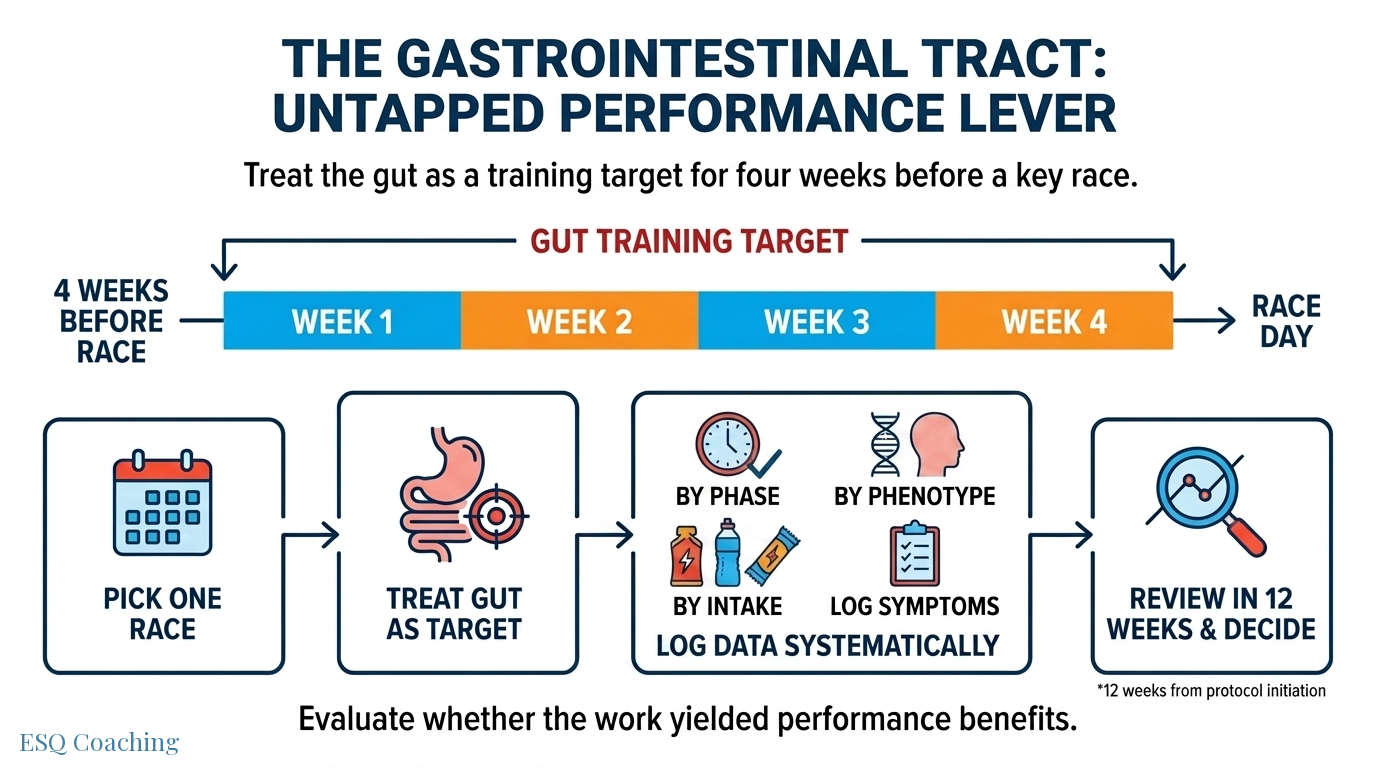
The gastrointestinal tract is arguably one of the cheapest performance levers in age group endurance sport (but yes, you can still buy that fancy aerodynamic wheelset ;) ), and almost nobody trains it on purpose.
Pick one race in your calendar this season. Treat the gut as a training target for the four weeks before it. Log symptoms by phase, by phenotype, and by intake. Then read this back to yourself in 12 weeks and decide whether the work was worth the trouble.
We hope this #OpenLab highlighted how much unfinished business there is in the science of fueling.
Have some great snacks for us,
Cheers,
Dr. Emily Dow and Dr. Thomas Mortelmans
Limits of application
Most feeding-challenge trials enrolled fewer than 30 athletes; the systematic review pools roughly 130 participants. The findings are directionally consistent but not yet large-sample science. The literature recruits healthy, trained, mostly male athletes, and does not extend to irritable bowel syndrome, inflammatory bowel disease, or post-surgical guts. Individual variance is large; a quarter of athletes get worse before they get better. Sex- and cycle-phase confounders remain under-studied. Take the framework, but expect to learn more from your own log than from the citations.
A note on our guest
Dr. Emily Dow is a nutrition scientist and CSCS with a PhD in Exercise and Nutritional Sciences from Arizona State. Her edge is uncommon: she sits at the intersection of the gut-brain axis, female-specific physiology, and applied sports nutrition, and she publishes peer-reviewed work on translating that science to athletes in the field. If this post sharpened how you think about fueling, follow her at dremilydow.com , LinkedIn at emilydow1 and Instagram under @dremilydow
References
- The Effect of Gut-Training and Feeding-Challenge on Markers of Gastrointestinal Status in Response to Endurance Exercise: A Systematic Literature Review. PMID 37061651. Systematic review of 8 trials. Repeated carbohydrate exposure during training reduced gut discomfort by an average 47 percent (2-week protocol).
- Repetitive Feeding-Challenge With Different Nutritional Densities on Markers of Gastrointestinal Function, Substrate Oxidation, and Endurance Exercise Performance. PMID 39914376. RCT of 44 endurance athletes. Both fat and carbohydrate feeding-challenges over 7 days cut total exercise GI symptoms; carbohydrate group dropped 38 percent.
- Is There an Exercise-Intensity Threshold Capable of Avoiding the Leaky Gut?. PMID 33763441. Narrative review. 60 minutes at 70 percent of maximum work capacity reliably increases intestinal permeability and inflammatory cytokines; moderate intensity does not.
- The microbiome of professional athletes differs from that of more sedentary subjects in composition and particularly at the functional metabolic level. PMID 28360096. Sequencing study. Professional athletes show higher microbial diversity and more functional pathways producing short-chain fatty acids than sedentary controls.
- The Hydrating Effects of Hypertonic, Isotonic and Hypotonic Sports Drinks and Waters on Central Hydration During Continuous Exercise: A Systematic Meta-Analysis and Perspective. PMID 34716905. Meta-analysis of 28 studies, 68 drink treatment effects. Hypotonic drinks preserved central hydration during continuous exercise better than isotonic (probability of superiority 0.984).
- International Society of Sports Nutrition Position Stand: nutritional considerations for single-stage ultra-marathon training and racing. PMID 31699159. ISSN position stand on single-stage ultra-marathon nutrition. Carbohydrate intake of 60 to 90 g/h with multi-transportable carbohydrate is the upper tolerated range for events over three hours.
- Effect of a short-term low fermentable oligiosaccharide, disaccharide, monosaccharide and polyol (FODMAP) diet on exercise-related gastrointestinal symptoms. PMID 30646926. Crossover trial in recreational runners. A short-term low-FODMAP diet reduced exercise-related GI symptoms compared with high-FODMAP intake.
- Effect of a Multi-Strain Probiotic Supplement on Gastrointestinal Symptoms and Serum Biochemical Parameters of Long-Distance Runners: A Randomized Controlled Trial. PMID 35954716. RCT in long-distance runners. Multi-strain probiotic for 12 weeks reduced GI symptoms and shifted serum biochemistry; effect size moderate.
- Bovine colostrum supplementation during running training increases intestinal permeability. PMID 22253980. RCT in 30 healthy adult males running three times per week for 8 weeks. The colostrum group raised the urinary lactulose/rhamnose ratio by 251 percent; cited here as a counterpoint to the acute heat-stress data — dose, duration, and timing matter.
- The nutriceutical bovine colostrum truncates the increase in gut permeability caused by heavy exercise in athletes. PMID 21148400. Mechanistic study. Bovine colostrum protected against heat- and exercise-induced increases in intestinal permeability via lactoferrin and growth factors.
- Gastrointestinal Conditions in the Female Athlete. PMID 28886820. Clinical review. Female athletes report cycle-linked GI symptoms; bloating and cramps cluster in early luteal phase and during bleeding.
- Does biological sex impact intestinal epithelial injury, small intestine permeability, gastrointestinal symptoms and systemic cytokine profile in response to exertional-heat stress?. PMID 29790452. Crossover study in trained runners. Biological sex modulated intestinal epithelial injury and GI symptom profile after a 2-hour run; women reported more upper-gut symptoms.
- Dow E et al. (2025). High school athletes' practical knowledge on where to find and order third-party tested nutritional supplements increases after education when compared to a control group. Nutrition Bulletin 50(1):106–119. PMID 39584385. First-author publication by our guest, Dr. Emily Dow (ASU College of Health Solutions). RCT-style education trial in US high school athletes; a 2-week online supplement-safety course raised practical knowledge of third-party-tested supplement sourcing significantly versus control. Cited as direct evidence of Dr. Dow's translational sports-nutrition research stream.
- Dr. Emily Dow — University of Arizona faculty profile (School of Nutritional Sciences and Wellness). Official faculty page. Lists her PhD (Exercise & Nutritional Sciences, ASU 2025), RDN, CSCS credentials, and research focus on the microbiota–gut–brain axis, mood regulation, and gastrointestinal function via clinical trials in athletic and tactical populations.
- Dr. Emily Dow — personal site and consultancy. Guest's homepage. Outlines her speaking topics (performance nutrition, gut-brain axis, female-specific exercise and nutrition, supplement safety) and the n=1 framing she uses with athletes.
If you have 60 seconds, I would value your anonymous feedback: link.
Health disclaimer
This post discusses endurance-training science for educational purposes. It is not medical advice, not a diagnosis, and not a substitute for clinical care. Individual response to training, sleep deprivation, and multi-day exertion varies substantially, and what applies to a research cohort or a world-class athlete may not apply to you.
Consult a qualified physician, sports medicine specialist, or registered dietitian before changing your training, fuelling, or sleep strategy if you have a cardiovascular, metabolic, psychiatric, or sleep-related condition; are recovering from injury or illness; are pregnant; are on medication that affects heart rate, hydration, glucose regulation, or sleep; or have concerns about exercise tolerance.
Ultra-endurance events impose real physiological and psychological loads. Persistent chest pain, fainting, acute confusion beyond the predictable late-race window, severe dehydration, sustained loss of coordination, or any mental-health symptoms that outlast the immediate post-event dip warrant professional care and are not signals to push through.
No outcome is guaranteed. The protocols, anchors, and case material in this post are descriptive, drawn from peer-reviewed evidence and a guest contributor's lived experience, and should be treated as inputs to an informed conversation with your own coach and clinicians, not as prescriptions.
Found this useful?
Get articles like this and free training calculators in your inbox every week.
Recommended reads
If this was useful, these are the other research-driven newsletters I actually read.

Member discussion