Entry #038: Heart Rate Variability for Endurance Athletes: What It Measures, When It Helps, and Where It Is Just Noise
You wake up, reach for your phone, and lie still for sixty seconds while a strap or a camera lens reads your pulse. A number appears, lower than yesterday.
The app paints it amber instead of green, and a small voice asks whether you should still do the hard session you planned.
That single morning number is heart rate variability, and the quiet tension underneath it is this: the measurement is real physiology, but the verdict the app hangs on it is mostly invented. Heart rate variability is not the steadiness of your pulse.
Free calculator
It is the opposite, the tiny constant wobble in the gap between one heartbeat and the next, and a healthy heart wobbles a lot.
The branch of your nervous system that handles rest and recovery produces most of that wobble, which is exactly why athletes watch it.
The problem is that the same wobble shifts with breathing, coffee, last night's wine, room temperature, and whether you were sitting or lying down, often by more than any genuine change in fitness or fatigue.
This piece is about telling the signal from the noise: what the variation reflects, the few situations where watching it earns its keep, and the many mornings where the number is just the number.
The brief
- Heart rate variability is the beat-to-beat variation in the time between heartbeats, and most of that short-term variation is driven by the parasympathetic branch of your nervous system, the part that runs recovery rather than effort.
- A higher resting value generally reflects stronger parasympathetic activity, climbs over months of aerobic training, and falls in the short term with hard sessions, poor sleep, stress, alcohol, and the early stages of illness.
- For short morning recordings the metric that holds up is RMSSD, built from the differences between consecutive beats, because it captures the fast vagal wobble and tolerates a brief recording far better than frequency-based numbers.
- A single day's value carries little information, because biological and measurement noise routinely swamp any real change, so the usable signal lives in a rolling average of roughly seven days, not in this morning's reading.
- A suppressed value is genuinely non-specific: the same dip can follow a hard workout, a sleepless night, a stressful week, or a head cold, and the number alone cannot tell you which.
- Heart rate variability is not a readiness verdict. It is one physiological input, most informative when it agrees or disagrees with how you feel and what your training log says, and least informative read in isolation.
- In some controlled trials, letting the morning trend decide when hard sessions happen produced modestly better outcomes than a fixed plan, mostly by withholding intensity on down days rather than adding volume.
The science at a glance
The heart is not a metronome, and that is the whole point. Even when you lie perfectly still, the interval between heartbeats stretches and shrinks from beat to beat by a few thousandths of a second.
That restlessness is mostly the work of the vagus nerve, the main cable of the parasympathetic system, which can nudge the heart's pacemaker within a single beat, while the sympathetic system acts more slowly.
 Thomas Mortelmans
Related reading
The rapid, jittery part of the variation is a fairly clean readout of how much parasympathetic, recovery-oriented activity is reaching the heart.
Deeply rested, the vagus is loud and the wobble is large; stressed, sick, or freshly hammered by a workout, it quiets and the wobble shrinks.
Aerobic training strengthens that influence over months, so rising long-term variability often tracks a fitter system. The catch is that the same number is pushed around by a dozen things unrelated to fitness, and untangling them is the entire skill.
Foundational Principle 1:
RMSSD is the metric that survives a sixty-second morning recording. The most robust way to quantify the wobble is RMSSD, the root mean square of successive differences.
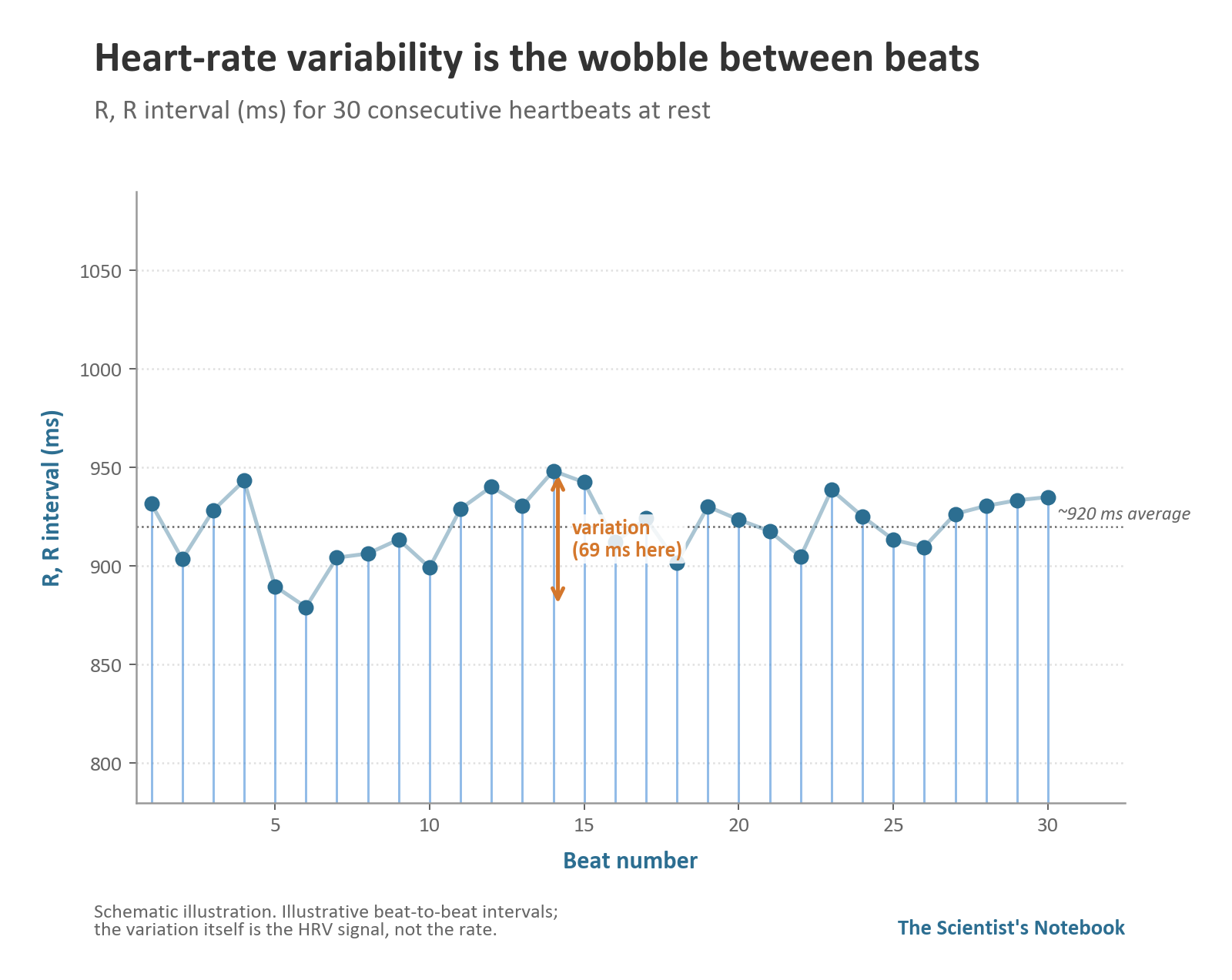
It looks at how different each heartbeat gap is from the one before it, squares those differences, averages them, and takes the square root.
Because it is built from beat-to-beat changes, it isolates the fast vagal flutter and ignores slow drifts that need long recordings, making it stable enough to trust from a short morning sample where older frequency-based methods get unreliable.
Scientist's Insight: The reason RMSSD wins the morning is mathematical, not marketing. The slower frequency bands need several minutes of clean data to resolve, so a one-minute reading estimates them poorly, while RMSSD stabilizes within seconds.
When an app shows a daily score, it is almost certainly RMSSD or a logarithm of it, because nothing else is honest over sixty seconds.
Foundational Principle 2:
Time-domain and frequency-domain are two languages for the same wobble, and the translation leaks.
The variation can be described in the time domain, counting the spread of gaps directly as RMSSD does, or in the frequency domain, sorting it into slow and fast rhythms. The fast, high-frequency band lines up with breathing and reflects vagal activity, much like RMSSD.
The slow, low-frequency band was once sold as a clean measure of sympathetic activity, with a ratio between the two sold as your autonomic balance. That has not held up: the slow band is a tangled mix of influences, and the tidy ratio rests on an assumption the physiology does not support.
Scientist's Insight: When a device reports a stress score or a balance ratio, treat it as a marketing layer, not a measurement. The honest signal is the vagal, high-frequency part, best read through RMSSD.
The slow band and its ratios make a compelling dashboard and a weak foundation.
Foundational Principle 3:
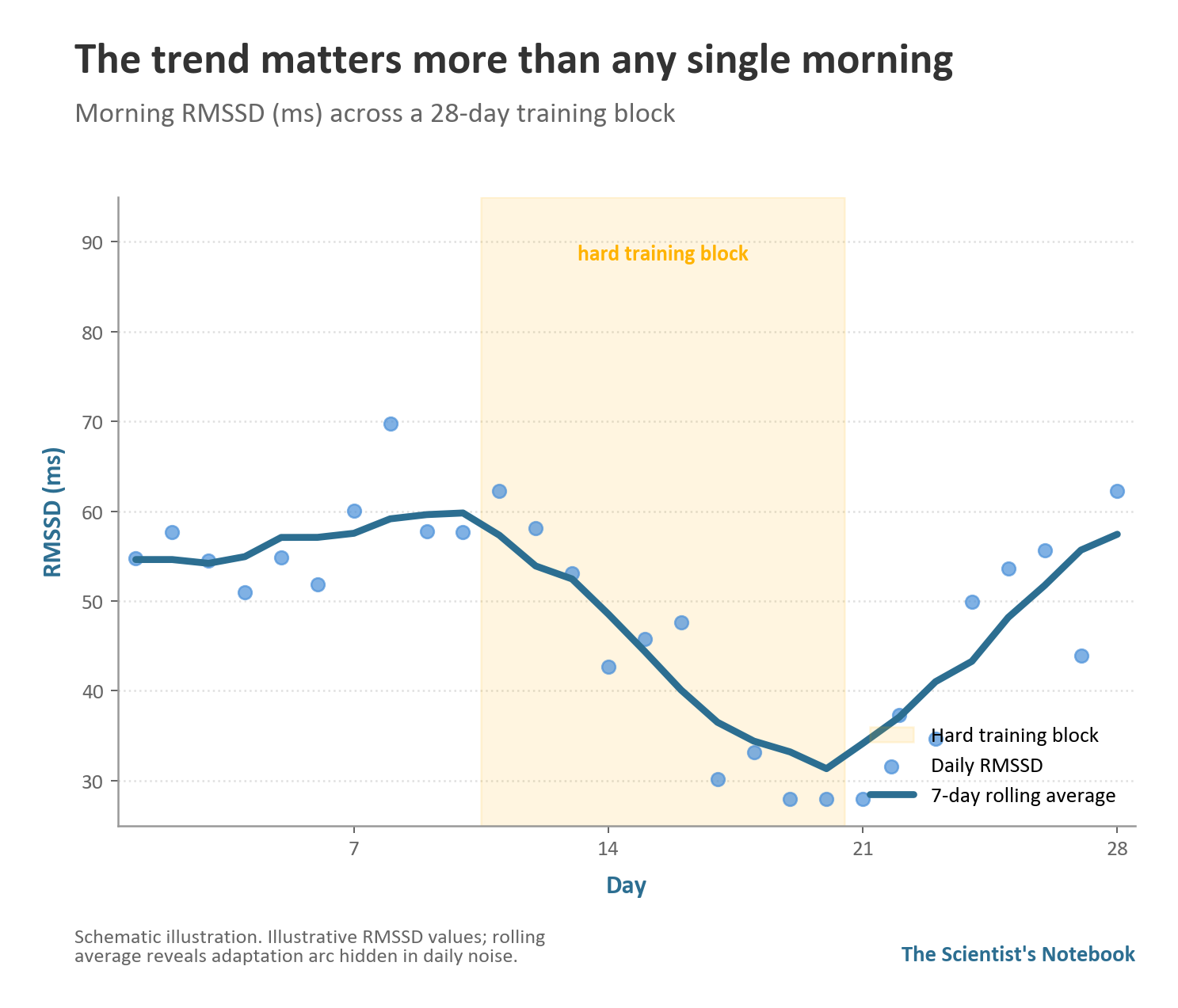
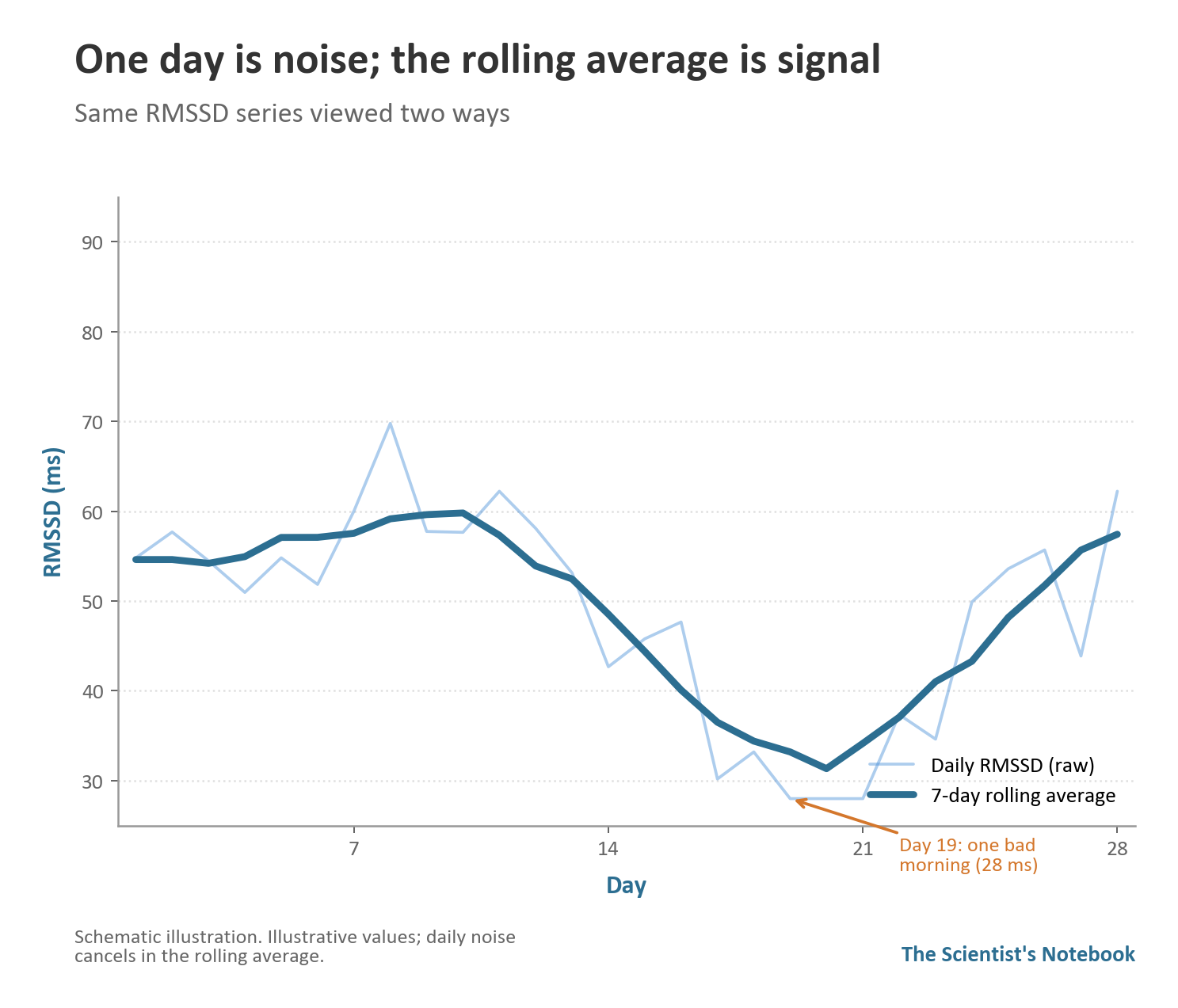
The trend is the measurement, and a single day is mostly noise.
A healthy person's morning value bounces day to day even when nothing meaningful has changed, because sleep, hydration, room temperature, and breathing rhythm all leave fingerprints on it, with device error on top.
The result is a signal-to-noise problem: a real shift in recovery status is often smaller than the random scatter of single readings.
The fix is a rolling average, typically across about seven days, which lets random ups and downs cancel and leaves the slower drift that corresponds to building fatigue or returning freshness.
Scientist's Insight: A suppressed reading does not announce its cause. The same downward step can mean the workout landed as intended, that a virus is brewing, or that you slept badly and breathed shallowly during the recording.
The number is non-specific: it flags that something is going on but cannot name what, and is not a verdict on whether you are ready to train.
Reading the signals
Observational Levers:
This section reports what the literature observes about reading morning variability. It is a map, not a set of instructions.
Measurement Conditions and Their Confounds
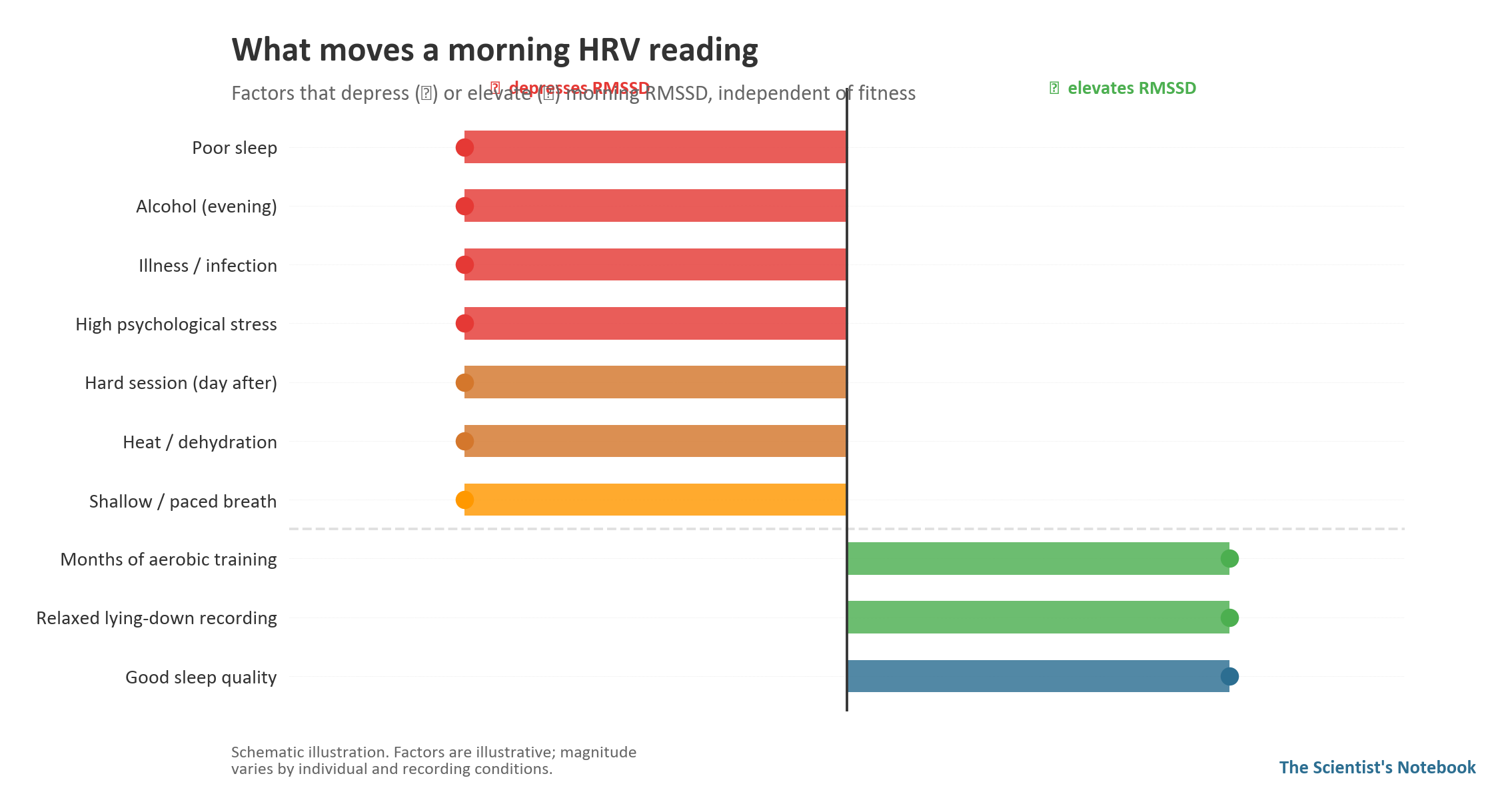
The data: in athletes and healthy adults, the morning value is strongly shaped by recording conditions. Readings taken lying down run higher than seated or standing ones.
Breathing matters most, because the fast wobble is tied to the breath, so slow or deep breathing inflates the number and quick shallow breathing deflates it, independent of vagal tone.
The literature also describes acute depressions after alcohol, caffeine, short sleep, and psychological stress, each able to move a reading by more than a meaningful training change.
Thomas Mortelmans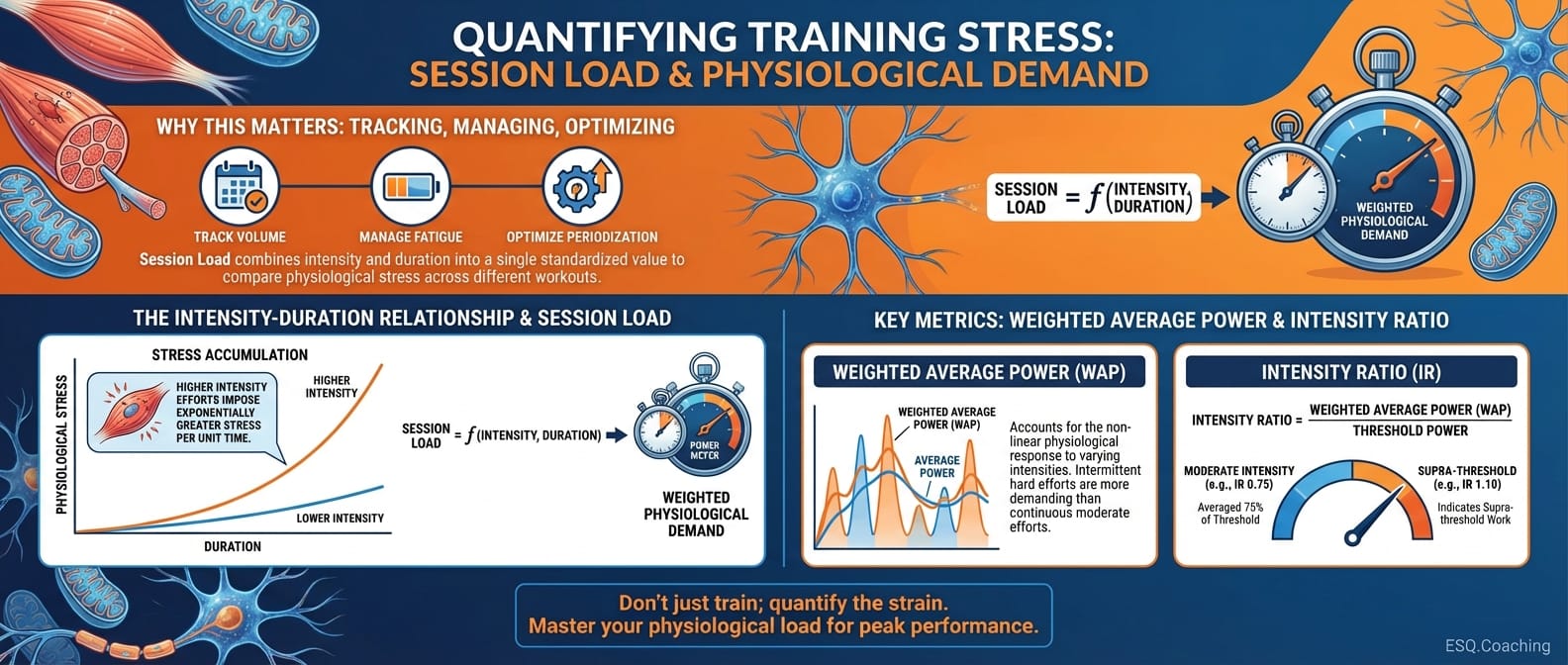
The most reproducible recordings come from a fixed routine: same time of day, on waking, same position, natural unforced breathing.
Where athletes tend to land: those who record consistently, in one position, before coffee, with relaxed breathing tend to show a tidy trend where a real dip stands out.
Those who record whenever convenient, sometimes after coffee, sometimes slowing their breath to chase a higher score, tend to show a jagged series where confounds bury the recovery signal.
What the data does NOT show: it does not show that any one confound is fully correctable after the fact, which is why the literature keeps returning to consistency of routine over precision of device.
The Single Value Versus the Trend
The data: across monitoring studies, the day-to-day reading carries a low ratio of signal to noise, while the smoothed multi-day average tracks genuine shifts in training status far more reliably.
Weekly averaged values rise as low-intensity aerobic training accumulates and are suppressed when time at high intensity climbs.
A related observation is that the variation of values around their own average can itself carry information, with a wider spread tending to appear in less fit or more fatigued athletes.
Where athletes tend to land: those who read the smoothed trend over roughly a week see slow, interpretable arcs, a climb through a base period and a dip into a hard block.
Those who react to each morning's color see contradictions, and over-interpret swings within the normal noise band.
What the data does NOT show: it does not show that the trend predicts a single day's performance. It tracks adaptation and fatigue at the scale of weeks, not for one specific workout.
Whether the Morning Number Earns a Place in Training Decisions
The data: several controlled trials have compared letting the morning trend influence the timing of hard sessions against a fixed plan.
In recreational and moderately trained runners, the variability-guided groups achieved modestly better endurance outcomes while often performing fewer hard sessions, because intensity was withheld on suppressed days and concentrated on preserved ones.
Thomas Mortelmans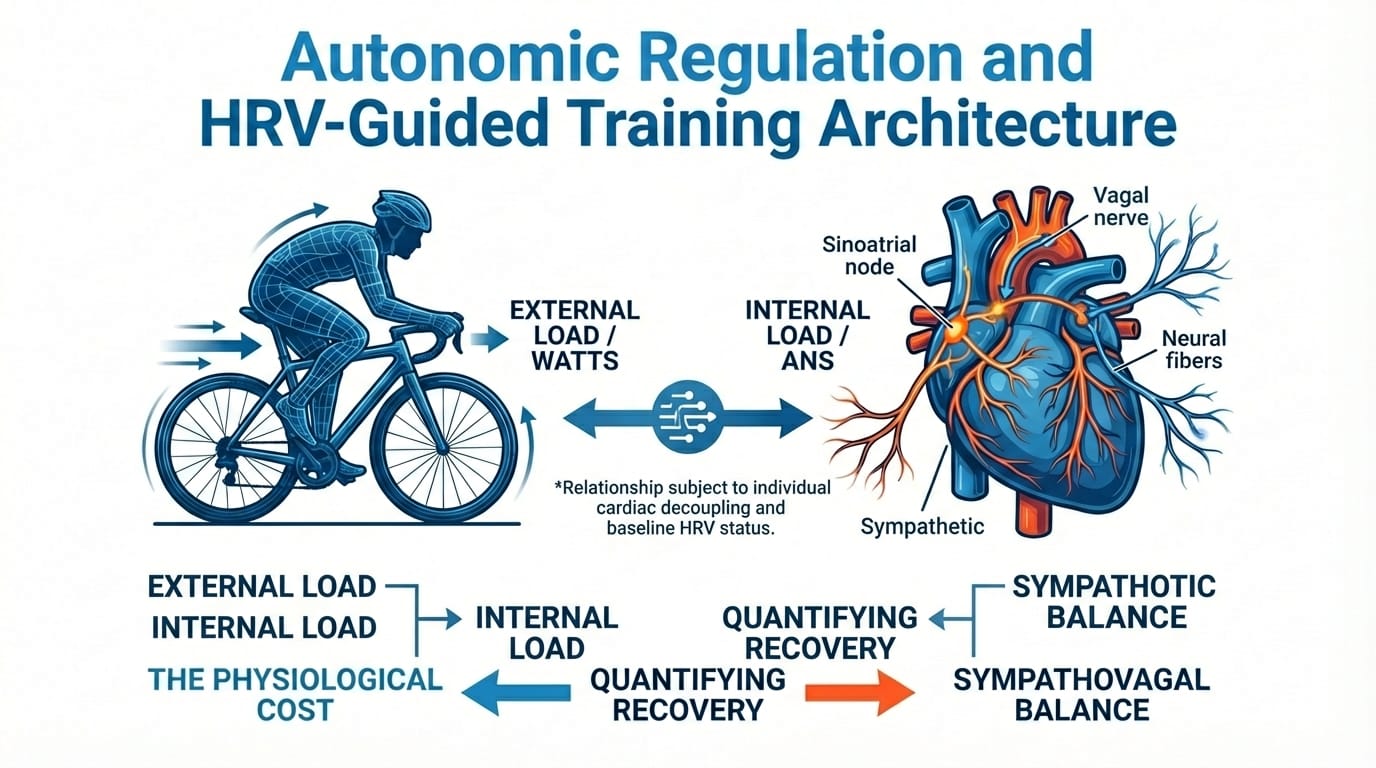
Related reading
The mechanism the authors describe is timing: placing demanding work when the system shows it is ready and easing off when it is not.
Where athletes tend to land: those whose trend gates intensity drift toward more low-intensity work and better-timed hard days. Those on a fixed plan hit prescribed sessions on schedule, sometimes into a dip the guided group would have skipped.
What the data does NOT show: it does not show large or universal gains.
The effects are modest, the trials mostly small, individual responses vary widely, and in highly trained athletes a falling variability can even accompany rising fitness, so the simple reading that down is bad breaks down at the elite end.
Method and a worked example
This is a falsifiable, bounded way to collect a morning RMSSD series worth trusting. It makes no promise about performance, only about producing a recording comparable from one day to the next.
- Record at the same time every morning, on waking, before getting up. The first minutes after waking, before standing, coffee, or screen stress, are the most reproducible window.
- Hold one body position, and lying down is the most stable choice. Position alone shifts the value, so a series mixing lying, sitting, and standing measures posture as much as recovery.
- Breathe naturally and do not pace it. The fast wobble is tied to the breath, so deliberately slowing it inflates the number and corrupts the comparison.
- Use a single device and keep it constant. A chest strap or a validated phone-camera method can each give a usable RMSSD, but their absolute numbers are not interchangeable, so switching mid-series breaks the trend.
- Keep each recording to one to three minutes and read RMSSD, not the stress score. A short window suffices for the beat-to-beat metric and avoids the drift long recordings invite.
- Judge the seven-day rolling average rather than the raw daily value. The smoothed average carries the information; the raw daily figure is mostly there to feed it.
- Read the trend beside the rest of the picture. A move in the average means more when it agrees with sleep, mood, soreness, and the training log, and less when it contradicts a body that feels fine. Tools such as Gradescale fold a signal like this into a wider recovery view rather than letting it stand alone.
Where this leaves us
A morning variability reading is one of the few windows an athlete has into the recovery side of the nervous system, which makes it both genuinely useful and genuinely easy to over-read.
Held lightly, as a trend watched beside sleep, mood, and the training log, it can quietly improve the timing of hard work.
Held tightly, as a daily verdict, it mostly manufactures anxiety out of noise. The number is a flag, not a judge.
Best regards,
Dr. Thomas Mortelmans
Limits of Application:
The research behind morning variability monitoring rests on small studies, wide individual variation, and populations ranging from recreational to elite, so the patterns here are tendencies rather than rules.
The most important boundary is that variability is non-specific and reflects far more than training: a suppressed reading can follow illness, heat, alcohol, travel, life stress, or simply a shallow-breathing recording, and the metric cannot distinguish among them.
The findings on trend-guided training come mostly from endurance running and moderately trained groups and may not transfer to other sports, strength-dominant programs, or the elite end. Nothing here is medical guidance, and a persistent unexplained drop warrants clinical follow-up rather than self-managed adjustment.
Treat the morning number as one input among many rather than a standalone instruction.
References
- Shaffer F, Ginsberg JP. An Overview of Heart Rate Variability Metrics and Norms. Front Public Health. 2017. PMID 29034226. A widely cited primer on the time-domain, frequency-domain, and non-linear metrics, stressing that 24-hour, short, and ultra-short recordings produce values that are not interchangeable.
- Aubert AE, Seps B, Beckers F. Heart rate variability in athletes. Sports Med. 2003. PMID 12974657. A foundational review of how training status, exercise type, sex, and aging shape variability in athletes, and a caution that low-frequency interpretation is not as clean as once assumed.
- Plews DJ, Laursen PB, Stanley J, Kilding AE, Buchheit M. Training adaptation and heart rate variability in elite endurance athletes: opening the door to effective monitoring. Sports Med. 2013. PMID 23852425. Argues for rolling averages over single readings and documents that in elite athletes a falling value can accompany rising fitness, a phenomenon the authors call saturation.
- Stanley J, Peake JM, Buchheit M. Cardiac parasympathetic reactivation following exercise: implications for training prescription. Sports Med. 2013. PMID 23912805. A quantitative review showing parasympathetic recovery after a session takes up to 24 hours after easy work and at least 48 hours after high-intensity work, and is faster in fitter individuals.
- Buchheit M. Monitoring training status with HR measures: do all roads lead to Rome? Front Physiol. 2014. PMID 24578692. Contends that most contradictory findings stem from methodology, and that short daily resting recordings interpreted against the measurement error and training context are the most useful monitoring tool.
- Bellenger CR, Fuller JT, Thomson RL, Davison K, Robertson EY, Buckley JD. Monitoring Athletic Training Status Through Autonomic Heart Rate Regulation: A Systematic Review and Meta-Analysis. Sports Med. 2016. PMID 26888648. A meta-analysis of 27 studies finding that vagal indices rise with positive adaptation but that resting variability is largely unaffected by overreaching, complicating its use as a fatigue marker.
- Vesterinen V, Nummela A, Heikura I, Laine T, Hynynen E, Botella J, Hakkinen K. Individual Endurance Training Prescription with Heart Rate Variability. Med Sci Sports Exerc. 2016. PMID 26909534. A randomized trial in which variability-guided runners improved 3000-meter performance while performing fewer high-intensity sessions than a fixed-plan group.
- Kiviniemi AM, Hautala AJ, Kinnunen H, Tulppo MP. Endurance training guided individually by daily heart rate variability measurements. Eur J Appl Physiol. 2007. PMID 17849143. An early randomized study showing that timing daily training intensity by morning variability improved peak oxygen uptake and maximal running velocity more than a predefined schedule.
- Plews DJ, Scott B, Altini M, Wood M, Kilding AE, Laursen PB. Comparison of Heart-Rate-Variability Recording With Smartphone Photoplethysmography, Polar H7 Chest Strap, and Electrocardiography. Int J Sports Physiol Perform. 2017. PMID 28290720. A validation study finding that smartphone camera and chest-strap RMSSD agree closely with electrocardiography at rest, supporting field use of the simpler tools.
- Flatt AA, Esco MR, Nakamura FY, Plews DJ. Interpreting daily heart rate variability changes in collegiate female soccer players. J Sports Med Phys Fitness. 2016. PMID 26997322. Found that athletes with lower fitness or higher perceived fatigue showed larger daily variability swings, and that the spread of values itself carries monitoring information.
- Quintana DS. Statistical considerations for reporting and planning heart rate variability case-control studies. Psychophysiology. 2016. PMID 27914167. An analysis of 297 effect sizes concluding that variability studies are generally underpowered and that conventional thresholds understate the magnitude of small and large effects.
- Thorpe RT, Strudwick AJ, Buchheit M, Atkinson G, Drust B, Gregson W. Monitoring Fatigue During the In-Season Competitive Phase in Elite Soccer Players. Int J Sports Physiol Perform. 2015. PMID 25710257. Daily variability and perceived fatigue tracked fluctuations in high-intensity running load, while jump height, soreness, and heart rate recovery did not.
- Buchheit M. Sensitivity of monthly heart rate and psychometric measures for monitoring physical performance in highly trained young handball players. Int J Sports Med. 2014. PMID 25429552. Found that infrequent monthly resting heart rate, variability, and mood measures poorly predicted performance changes, arguing for more frequent monitoring.
- Ritz T. Putting back respiration into respiratory sinus arrhythmia or high-frequency heart rate variability: Implications for interpretation, respiratory rhythmicity, and health. Biol Psychol. 2023. PMID 38092221. A review showing that breathing pattern substantially changes the high-frequency signal without necessarily reflecting a change in vagal tone, a major confound for interpretation.
- Plews DJ, Laursen PB, Kilding AE, Buchheit M. Heart-rate variability and training-intensity distribution in elite rowers. Int J Sports Physiol Perform. 2014. PMID 24700160. In Olympic-medal-winning rowers, weekly averaged variability rose with low-intensity training and was suppressed by time spent at high intensity, supporting a polarized model.
---
If you have 60 seconds, I would value your anonymous feedback. You can share it here.
---
Health disclaimer
This post discusses endurance-training science for educational purposes. It is not medical advice, not a diagnosis, and not a substitute for clinical care. Individual response to training, sleep deprivation, and multi-day exertion varies substantially, and what applies to a research cohort or a world-class athlete may not apply to you. Consult a qualified physician, sports medicine specialist, or registered dietitian before changing your training, fuelling, or sleep strategy if you have a cardiovascular, metabolic, psychiatric, or sleep-related condition; are recovering from injury or illness; are pregnant; are on medication that affects heart rate, hydration, glucose regulation, or sleep; or have concerns about exercise tolerance. Ultra-endurance events impose real physiological and psychological loads. Persistent chest pain, fainting, acute confusion beyond the predictable late-race window, severe dehydration, sustained loss of coordination, or any mental-health symptoms that outlast the immediate post-event dip warrant professional care and are not signals to push through. No outcome is guaranteed. The protocols, anchors, and case material in this post are descriptive, drawn from peer-reviewed evidence and a guest contributor's lived experience, and should be treated as inputs to an informed conversation with your own coach and clinicians, not as prescriptions.
Keep going
Zones drawn from a formula and zones drawn from your own threshold are rarely the same. Gradescale builds both from your data so the gap is visible.
Training plans built on the same evidence base:
Thomas MortelmansJoin our Discord community:
Thomas MortelmansFound this useful?
Get articles like this and free training calculators in your inbox every week.
Recommended reads
If this was useful, these are the other research-driven newsletters I actually read.



Member discussion