Skinfold Body Fat Calculator
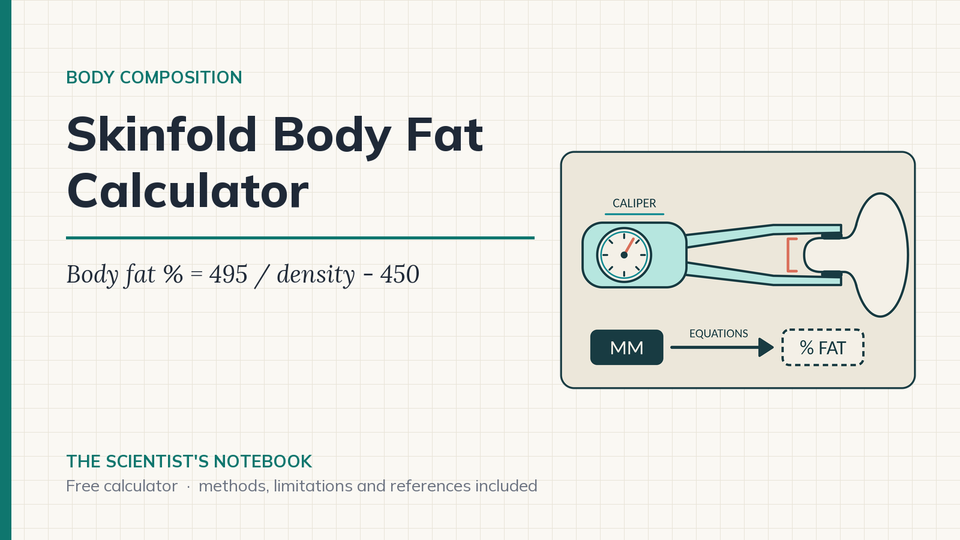
Skinfold calipers turn a few pinches of fat into a body density, and body density into a percent body fat. This calculator runs the Jackson-Pollock 3-site and 7-site equations and the Durnin-Womersley 4-site equation, then the Siri conversion, and shows the sum of folds so you can track your own numbers over time.
In short: The skinfold calculator turns caliper readings into percent body fat. The sum of three, four or seven folds and your age predict body density with the Jackson-Pollock or Durnin-Womersley equations, and the Siri equation converts density to fat: body fat % = 495 / D - 450. A 30-year-old man with chest 10 mm, abdomen 20 mm and thigh 15 mm reads 13.6 %. Track the sum of folds over time.
How is body fat calculated from skinfolds?
Every protocol follows the same two steps. First, the sum of skinfolds S (mm) and, for Jackson-Pollock, age (years) predict whole-body density D (g/mL). Second, the Siri equation turns density into percent body fat.
Step 1, density. Jackson-Pollock is a quadratic in S with a linear age term: D = b0 - b1 x S + b2 x S² - b3 x age.
- Men, 3-site (chest, abdomen, thigh):
D = 1.10938 - 0.0008267 x S + 0.0000016 x S² - 0.0002574 x age - Women, 3-site (triceps, suprailiac, thigh):
D = 1.0994921 - 0.0009929 x S + 0.0000023 x S² - 0.0001392 x age - Men, 7-site (chest, midaxillary, triceps, subscapular, abdomen, suprailiac, thigh):
D = 1.112 - 0.00043499 x S + 0.00000055 x S² - 0.00028826 x age - Women, 7-site (same seven sites):
D = 1.097 - 0.00046971 x S + 0.00000056 x S² - 0.00012828 x age
Durnin-Womersley uses the logarithm of four folds (biceps, triceps, subscapular, suprailiac) and a pair of constants chosen by sex and age band: D = c - m x log10(S). For a man aged 20 to 29, c = 1.1631 and m = 0.0632.
Step 2, percent fat. Siri's two-compartment equation splits the body into fat, at 0.9 g/mL, and fat-free tissue, at 1.1 g/mL: body fat % = 495 / D - 450.
Worked example. A 30-year-old man measures chest 10 mm, abdomen 20 mm and thigh 15 mm. S = 45 mm. D = 1.10938 - 0.0008267 x 45 + 0.0000016 x 45² - 0.0002574 x 30 = 1.0677 g/mL. Body fat = 495 / 1.0677 - 450 = 13.6 %. The calculator returns the same 13.6 %. For a man aged 20 to 39 that is inside the 8 to 19.9 % range Gallagher 2000 linked to BMI 18.5 to 24.9.
If you enter a body mass, fat mass is body mass times the percentage, and fat-free mass is the remainder.
The reference ranges are the sex- and age-specific percent fat values that Gallagher 2000 linked to BMI 18.5, 25 and 30, from Table 4 of the paper (four-compartment model, African American and white adults combined). The Navy body fat calculator uses the same table. For ages 20 to 39 the cut values are 8, 20 and 25 percent in men and 21, 33 and 39 percent in women. For ages 40 to 59 they are 11, 22 and 28 in men and 23, 34 and 40 in women. For ages 60 to 79 they are 13, 25 and 30 in men and 24, 36 and 42 in women. They describe where a value sits against the BMI scheme. They are not health thresholds, and no range is shown under 20 or over 79 years.
How should I use the result?
- Track a trend, not a single number. Measure monthly, same caliper, same person, same time of day. Trends in the sum of folds in millimetres are more stable than the converted percentage, because the conversion adds its own error.
- Check a weight-loss block for lean mass cost. If your scale weight falls but your sum of folds does not, much of the loss may be fat-free mass. Pair the result with the calorie calculator to see whether your intake matches your training load.
- Put body mass in context for climbing and running. Fat-free mass is what you keep when you lose fat. Use the fat-free mass output with the weight impact calculator to see what a change in body mass does to climbing speed.
What are the limits of skinfold equations?
- The estimate carries a standard error of a few percentage points. In 265 male athletes the generalized equations had standard errors of estimate between 2.41 and 3.61 % against underwater weighing (Sinning 1985).
- The same study found that the seven Durnin-Womersley equations overestimated mean body fat by 3.9 to 5.9 percentage points in male athletes, while three Jackson-Pollock equations did not differ significantly from underwater weighing on average. If you are lean and trained, prefer a Jackson-Pollock protocol.
- The Jackson-Pollock equations were built on adults aged 18 to 61 (men) and 18 to 55 (women). Durnin and Womersley measured 481 men and women aged 16 to 72. Outside those ages the calculator still computes a value and flags it as less certain.
- Siri assumes fixed densities for fat and fat-free mass. Hydration, bone mineral and ethnicity move the fat-free density, and this error is separate from caliper technique.
- Site location matters. A caliper placed a centimetre off can change a fold by several millimetres, and different testers disagree. Use the same tester when you can.
- Skinfolds measure subcutaneous fat only. They say nothing about fat around the organs.
- The reference ranges tie body fat to BMI categories. They do not say whether a body fat level is healthy or suitable for you. Gallagher and colleagues excluded people in physical training programmes and wrote that their lowest ranges have large confidence intervals, so a lean athlete reading "below the range linked to BMI 18.5" is outside the data the ranges came from. The tool adds a caution there.
- Before anything is calculated, each fold must be 1 to 80 mm, and age and body mass are checked against input ranges shared by every TSN calculator. These are data-entry checks set by TSN, not physiological norms. An estimate under 2 percent or over 70 percent points to a caliper or unit mistake, so the tool shows no number and asks you to check the readings.
⚠️ HEALTH & TRAINING GUIDANCE
Individual results vary significantly. Consult a sports medicine professional or registered dietitian before making changes to your diet or training based on body composition estimates.
ℹ️ IMPORTANT DISCLAIMER
This calculator is for educational purposes only and does NOT constitute medical advice. Consult qualified professionals before making changes. Individual physiology varies. You assume all risk. Must be 18+.
Frequently asked questions
Which skinfold protocol should I choose?
If you are lean and trained, choose a Jackson-Pollock protocol. In 265 male athletes the Durnin-Womersley equations overestimated mean body fat by 3.9 to 5.9 percentage points against underwater weighing, while three Jackson-Pollock equations did not differ significantly on average (Sinning 1985). Whichever you pick, keep the same protocol, caliper and tester so your readings stay comparable.
How accurate are skinfold body fat estimates?
In 265 male athletes the generalized equations had standard errors of estimate between 2.41 and 3.61 % against underwater weighing (Sinning 1985). The Siri conversion adds its own error, because hydration, bone mineral and ethnicity move the density of fat-free tissue. The sum of folds in millimetres is the more stable number to track.
What do the reference ranges mean?
They are the percent body fat values that Gallagher 2000 linked to BMI 18.5, 25 and 30 by sex and age band, the same table the Navy body fat calculator uses. For men aged 20 to 39 the edges are 8, 20 and 25 percent. They show where a value sits against the BMI scheme. They do not say what body fat is right for an athlete.
Why does the calculator sometimes show no number?
Every site the protocol needs must be filled in, and each fold must be 1 to 80 mm. An estimate under 2 percent or over 70 percent points to a caliper or unit mistake, so the calculator asks you to check the readings instead of showing a figure.
What ages do the skinfold equations cover?
Jackson and Pollock built their equations on men aged 18 to 61 and women aged 18 to 55. Durnin and Womersley measured 481 men and women aged 16 to 72. Outside those ages the calculator still gives a value and flags it as less certain.
Related calculators
- BMI Calculator
- Body Fat Calculator (US Navy Method)
- Body Roundness Index (BRI) Calculator
- Body Surface Area (BSA) Calculator
- All calculators on The Scientist's Notebook
References
- Jackson AS, Pollock ML · 1978 · Br J Nutr · PMID 718832 · doi
- Jackson AS, Pollock ML, Ward A · 1980 · Med Sci Sports Exerc · PMID 7402053
- Durnin JV, Womersley J · 1974 · Br J Nutr · PMID 4843734 · doi
- Siri WE · 1956 · Adv Biol Med Phys · PMID 13354513 · doi
- Sinning WE et al. · 1985 · Med Sci Sports Exerc · PMID 3982266
- Lohman TG · 1981 · Hum Biol · PMID 7239496
- Gallagher D et al. · 2000 · Am J Clin Nutr · PMID 10966886 · doi