Snippet #025: Gut Colonization Delays Fatigue by Preserving Carbohydrate Availability During Endurance Efforts
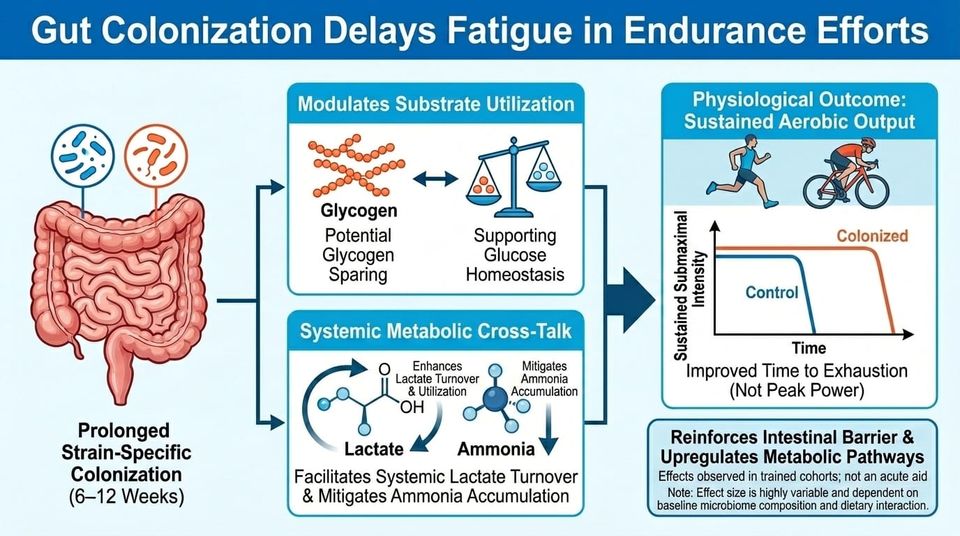
Specific gut bacteria typically require a prolonged supplementation period of six to twelve weeks to induce functional shifts within the digestive tract and systemic host metabolism.
Once established, these microbial populations appear to modulate how the body regulates substrate utilization, potentially preserving carbohydrate availability and supporting glucose homeostasis during prolonged exertion. Emerging evidence suggests this metabolic cross-talk may also facilitate the systemic metabolism of circulating byproducts like lactate and mitigate ammonia accumulation.
The physiological outcome observed in select trials is a targeted improvement in time to exhaustion and sustained aerobic output, rather than increases in top-end speed or anaerobic muscle power.
This mechanistic delay likely explains why acute or short-term probiotic interventions rarely yield measurable endurance benefits. Because sustained host-microbiome interactions are required to reinforce intestinal barrier integrity and upregulate relevant metabolic transport pathways, changes mediated by gut flora operate on an extended physiological timeline, roughly analogous to structural tissue adaptations, rather than functioning as immediate ergogenic aids.
Furthermore, these metabolic adaptations are highly strain-specific, meaning generalized probiotic use lacking targeted efficacy rarely translates to performance changes.
Currently, the most robust clinical data supporting these host-microbe endurance effects is derived primarily from cohorts of trained runners and cyclists.
References
- Scheiman et al. 2019, Meta-omics Analysis of Elite Athletes Identifies a Performance-Enhancing Microbe That Functions via Lactate Metabolism
- Huang et al. 2019, Effect of Lactobacillus plantarum TWK10 on Exercise Physiological Adaptation, Performance, and Body Composition in Healthy Humans
- Jäger et al. 2019, International Society of Sports Nutrition Position Stand: Probiotics
Found this useful?
Get articles like this and free training calculators in your inbox every week.
Recommended reads
If this was useful, these are the other research-driven newsletters I actually read.


Member discussion