Entry #041: Running Economy: The Efficiency Dimension That Separates Two Equal Engines
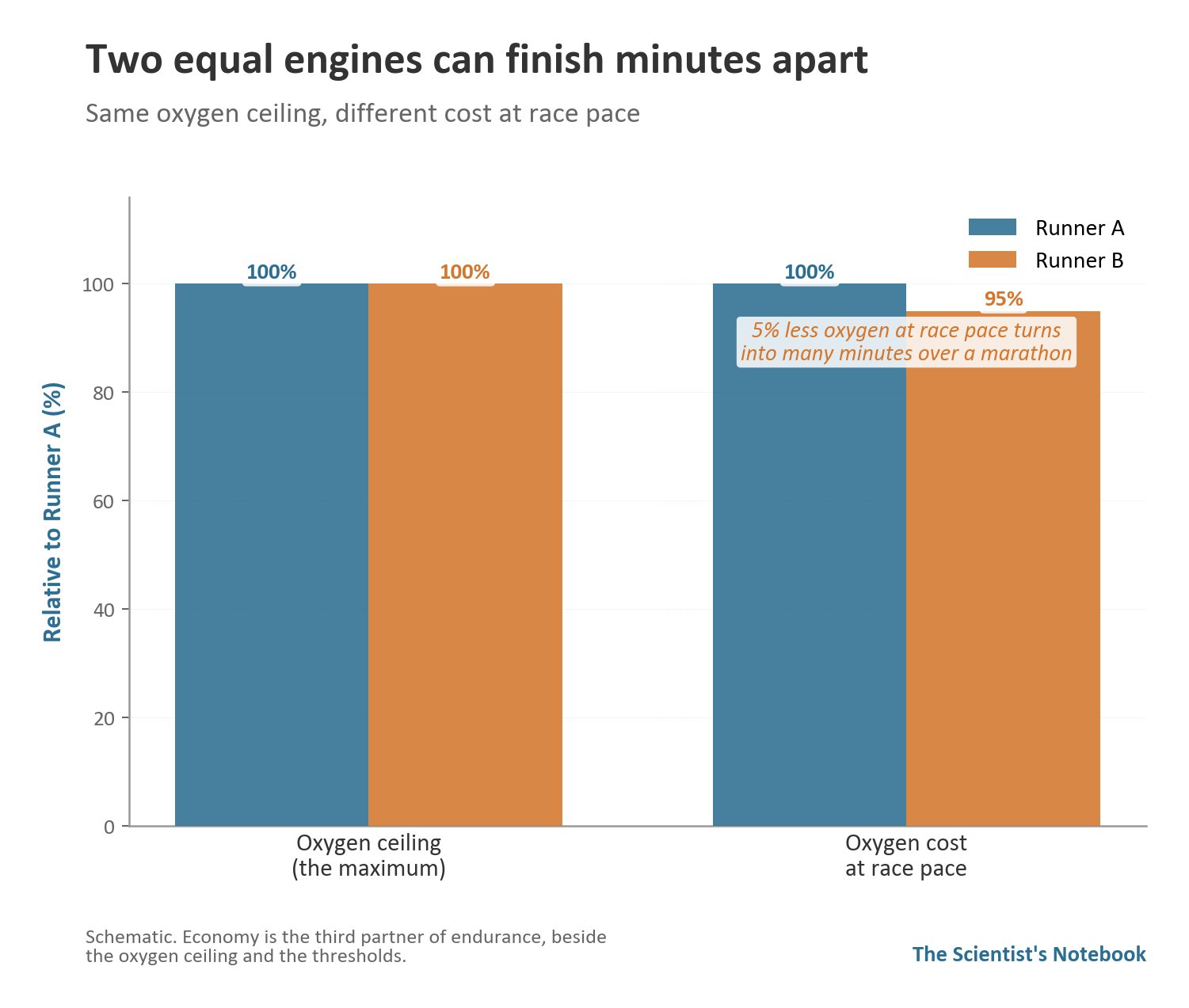
Put two runners side by side who share an identical ceiling for oxygen uptake, the same lactate thresholds, the same training history. On paper they are twins.
Send them over a marathon and one can finish many minutes ahead.
The gap does not come from the size of the engine. It comes from how much fuel that engine burns to hold a given pace, and that is running economy.
Free calculator
Economy is the oxygen cost of running at a fixed submaximal speed, the quiet third partner of endurance alongside the famous oxygen ceiling and the thresholds that set sustainable pace.
Two athletes can draw on the same maximum, yet the more economical one spends less oxygen at race pace and arrives with more left. The appeal of economy is also its difficulty.
It is built from a tangle of tendon springs, muscle fiber types, movement patterns, body mass, and even the shoe on the foot, and only some of those threads can be pulled by training.
This piece is about which threads move, which are fixed by anatomy, and how a few percent of saved oxygen turns into real minutes on the clock.
The brief
- Running economy is the steady-state oxygen cost of holding a given submaximal pace, usually expressed as milliliters of oxygen per kilogram of body mass per kilometer, so a more economical runner uses less oxygen at the same speed.
- Economy is a co-determinant of performance alongside the ceiling for oxygen uptake and the lactate thresholds, and among runners with a similar ceiling it often predicts race results better than the ceiling itself.
- Trained runners of comparable fitness can differ in economy by a striking margin, and that spread is large enough to translate into many minutes across a marathon between otherwise matched athletes.
- The determinants split into the partly trainable (tendon stiffness, neuromuscular coordination, fiber profile) and the largely structural (limb proportions, tendon moment arms), which is why two runners respond unequally to the same work.
- Heavy strength work and plyometric training improve economy without enlarging the oxygen ceiling, by sharpening the elastic recoil of the muscle-tendon spring rather than by adding aerobic capacity.
- Advanced carbon-plate footwear lowers the oxygen cost of submaximal running by roughly two to four percent in pooled studies, a moderate effect that nonetheless reshaped racing.
- Economy is not fixed for a season or a career: it drifts upward over years of high mileage, decays during a long race as fatigue mounts, and varies between runners in ways no single form cue explains.
The science at a glance
Running is a controlled fall repeated thousands of times, and each footfall has a metabolic price. Economy measures that price directly: an athlete runs at a fixed pace below threshold until breathing and heart rate settle, and the steady oxygen draw is recorded.
Two runners holding the identical speed can sit several milliliters of oxygen per kilogram per kilometer apart, and the cheaper one is the more economical.
 Thomas Mortelmans
The number is the visible tip of a deep system, because the oxygen burned at a given pace reflects how muscle, tendon, and nerve cooperate to move the body with the least waste.
The headline finding is that economy is trainable in part and inherited in part, and that the trainable share is large enough to chase.
Foundational Principle 1:
Economy is a separate axis from the size of the aerobic engine. Among elite runners who share a similar oxygen ceiling, the ones who race fastest are typically the ones who run cheapest, and economy can explain a large fraction of the variation in finishing time within such a group.
This is why economy is treated as a co-determinant rather than a footnote. The ceiling sets how much oxygen an athlete can use at maximum; economy sets how little they need at the speeds that fill a race.
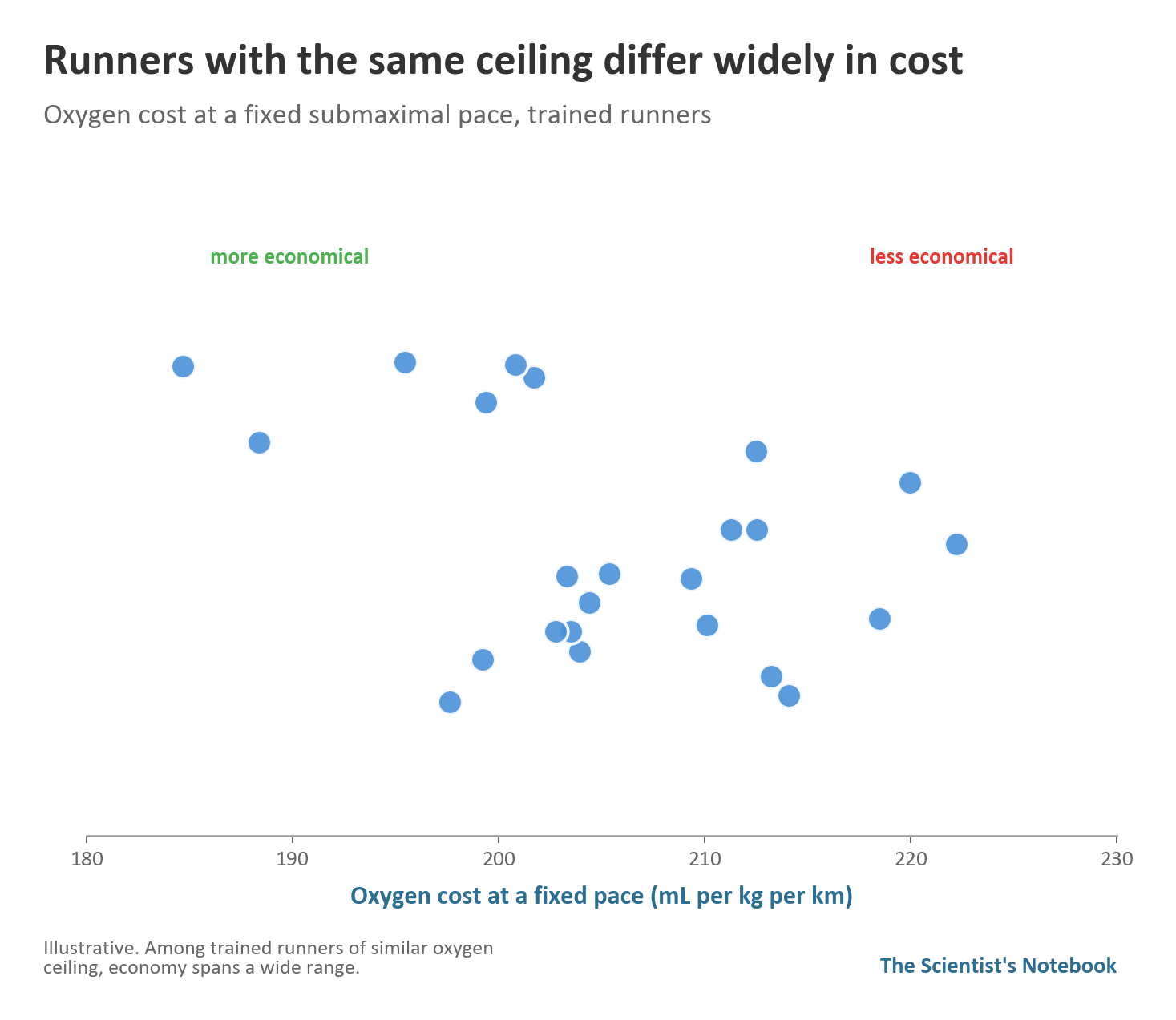
Two runners with the same ceiling but a real gap in economy are not equally matched, whatever the laboratory ceiling suggests.
Scientist's Insight: The oxygen ceiling plateaus relatively early in a career and leans heavily on genetics, so it is a poor place to keep searching for gains in a seasoned runner. Economy keeps moving for years. That asymmetry is why economy attracts so much attention: it is where the trainable headroom lives once the engine has stopped growing.
Foundational Principle 2:
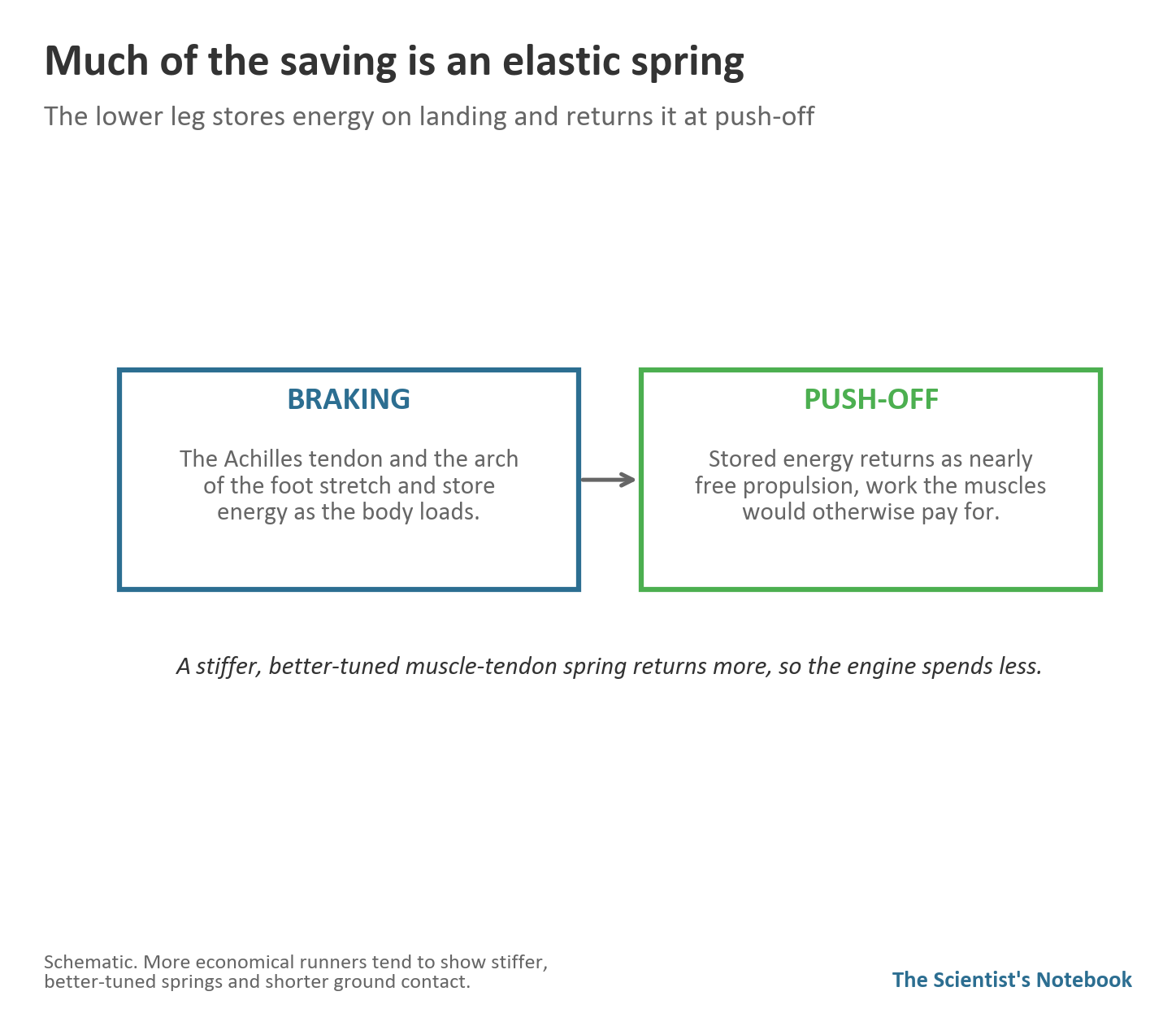
Much of the saving is mechanical, stored and returned as elastic energy. The lower leg behaves like a spring. During the braking phase of each step, the Achilles tendon and the arch of the foot stretch and store energy, then return much of it during push-off as nearly free propulsion.
These structures reclaim a large share of the energy lost and regained in a single stride at moderate pace.
More economical runners tend to show stiffer, better-tuned muscle-tendon units and shorter ground contact times, letting the elastic recoil do work the muscles would otherwise pay for.
Some of this is structural, set by tendon dimensions and limb geometry, and some shifts with training.
Scientist's Insight: Stiffness is not a uniform virtue. The favorable relationship between leg stiffness and economy grows stronger at faster speeds, where elastic return dominates, and a runner can be too stiff as easily as too compliant. The economical setting is a tuned compromise for an individual's anatomy and pace, not a maximum to be pushed without limit.
Foundational Principle 3:
Fiber type, body mass, and small percentages all bear on the cost. Muscle built mainly from slow-twitch oxidative fibers runs cheaper, because those fibers produce force with less oxygen than their fast-twitch counterparts, and economical runners tend toward a higher slow-twitch share.
Where mass sits matters too, since weight carried far out on the limbs costs more to swing than weight held near the center.
The currency here is small: a meaningful change in economy is on the order of a couple of percent, and well-controlled testing must clear that bar before a change is believed.
Footwear lives on the same scale, with advanced plated shoes shaving a few percent off the oxygen cost.
Scientist's Insight: Because the worthwhile changes are so small, measurement discipline is the experiment itself. Footwear, time of day, prior training, and what the runner ate all move the number by amounts comparable to a real training effect. A reported gain smaller than the test's own error is a story, not a result.
Reading the signals
This section reports what the literature observes about the determinants of economy. It is a map of where runners tend to land, not a set of instructions.
Strength and Plyometric Work as an Economy Lever
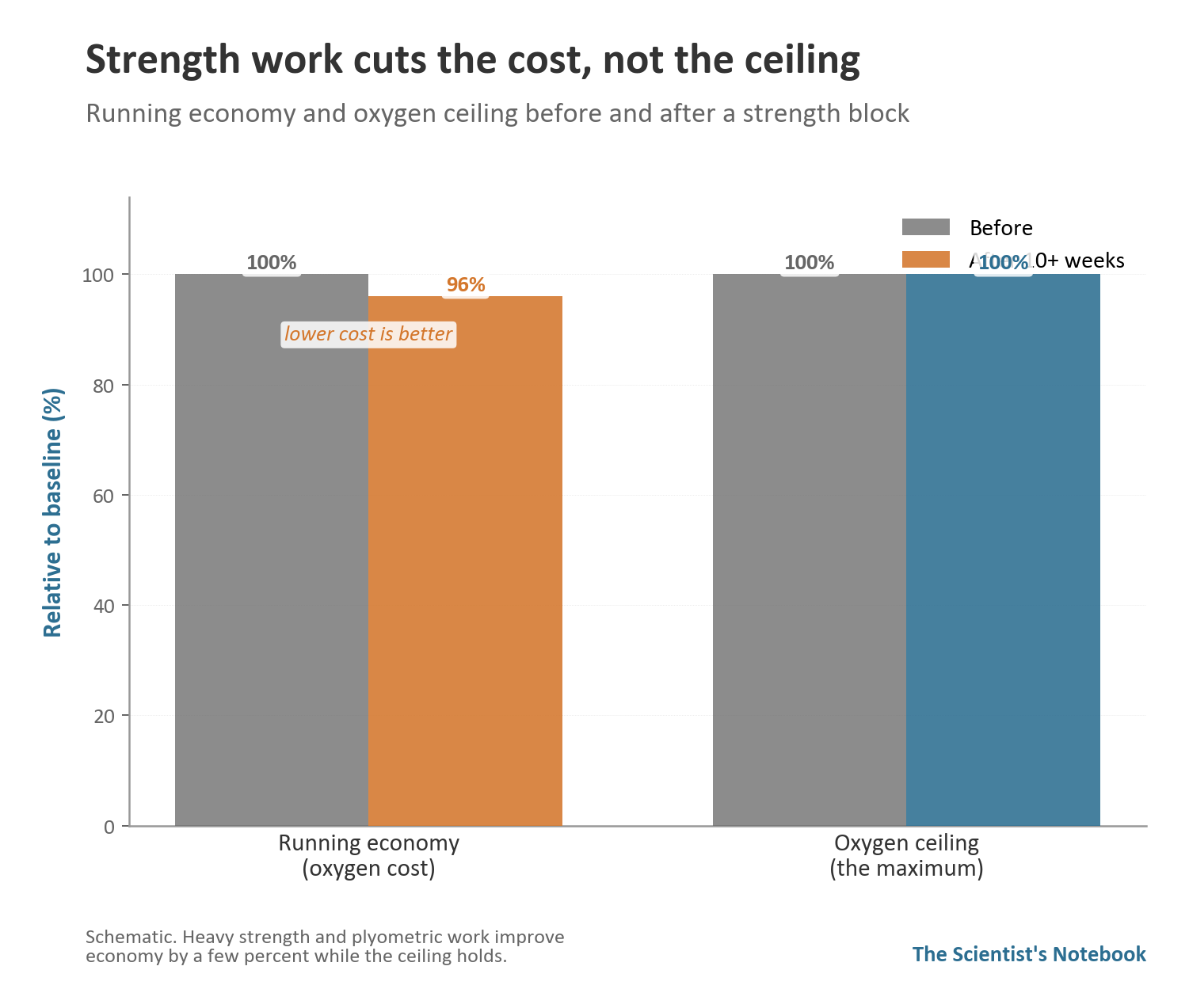
The data: across controlled trials and pooled analyses, heavy resistance training at high loads and plyometric training both improve economy in trained distance runners, and they do so without raising the ceiling for oxygen uptake.
Thomas Mortelmans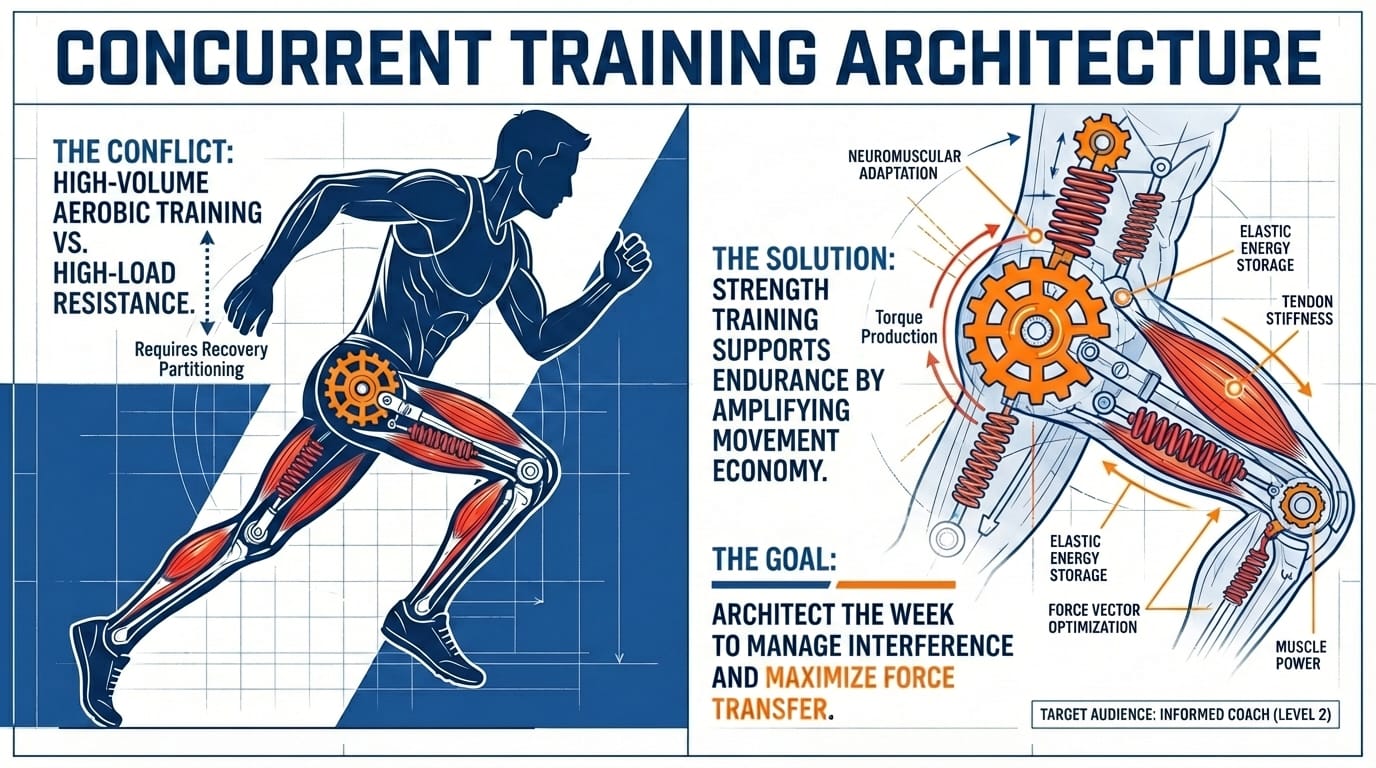
Related reading
The effect tends to be larger when programs run for ten weeks or more, and plyometric work shows its clearest gains at the slower end of the speed range while heavy loads help more at faster paces and in athletes with a high aerobic ceiling.
The proposed mechanism is neuromuscular: stiffer tendons, sharper recruitment, and better use of stored elastic energy rather than any change in aerobic delivery.
Where athletes tend to land: in the populations studied, runners with a history of structured strength and plyometric exposure tend to sit on the cheaper side of the economy distribution for their fitness, while those who run volume alone tend to leave that margin unclaimed.
What the data does NOT show: it does not show that more work keeps paying off, nor that the effect is universal. Responses vary widely between individuals, the gains are single-digit percentages, and plyometric work carries an injury risk that trials control more tightly than ordinary training does.
Accumulated Mileage and Years in the Sport
The data: economy tends to improve with training history, and higher chronic mileage is associated with better economy in trained runners.
The pattern reads as a slow motor-learning effect, the nervous system refining recruitment and timing over thousands of repetitions, with the data describing annual improvements on the order of one to two percent in consistent high-volume athletes that compound over years into a much larger total.
Runners also tend to be most economical at the speeds they train most.
Where athletes tend to land: across longitudinal observation, athletes with many years and high cumulative volume tend to occupy the economical tail, and case histories of elite marathoners describe economy improving deep into a career built on sustained high weekly distance.
What the data does NOT show: it does not show that volume alone explains economy, or that piling on mileage guarantees the gain. The association is between accumulated, speed-varied practice and refined movement, and it coexists with large structural differences that mileage leaves untouched.
Footwear and the Structural Floor
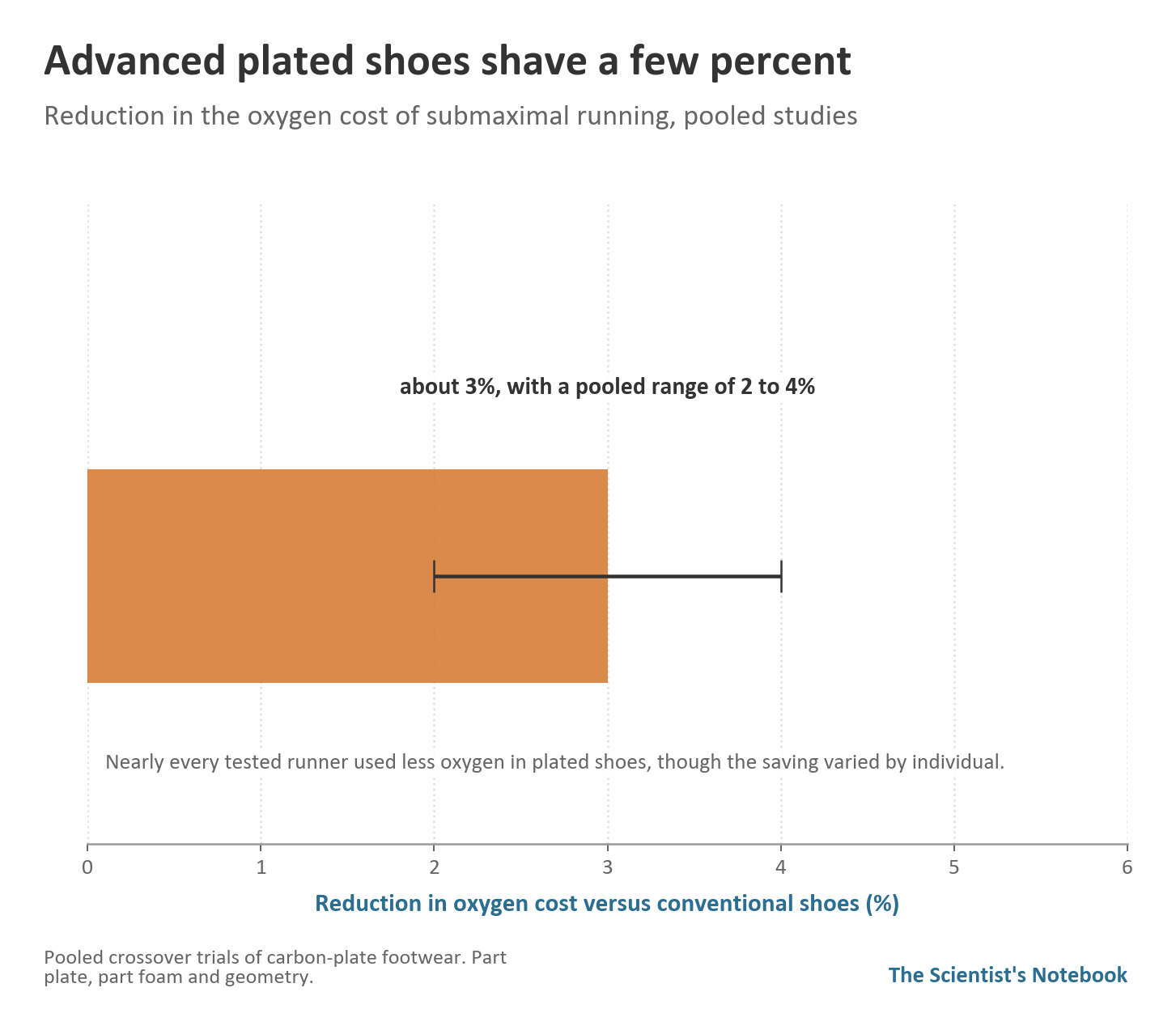
The data: advanced footwear technology, the combination of a stiff embedded plate with resilient compliant foam, lowers the oxygen cost of submaximal running by roughly two to four percent in pooled analyses, with a representative figure near three percent for modern racing shoes.
Part of the benefit comes from the plate's bending stiffness and part from the foam and geometry, and isolating the plate alone yields a smaller but persistent effect.
Beneath footwear sit fixed traits: tendon moment-arm length, limb proportions, and mass distribution that set a structural floor a runner cannot train away.
Where athletes tend to land: in the studied comparisons, nearly every tested runner used less oxygen in advanced plated shoes than in conventional ones, though the saving varied by individual, which is why the same model does not flatter every foot equally.
What the data does NOT show: it does not show that footwear rewrites the determinants of economy, only that it shifts the cost by a few percent on top of whatever anatomy and training have set.
Thomas Mortelmans
Related reading
The structural floor remains, and it explains part of why two trained runners in identical shoes still differ.
Method and a worked example
This is how economy is measured in a laboratory, and where the confounds hide. It describes a procedure, not a prescription, and its value lies in producing a number comparable from one test to the next.
- Run at a fixed submaximal speed below threshold until oxygen uptake stabilizes. The runner holds a constant pace on a treadmill, typically several minutes, until breathing and heart rate settle into a steady state where oxygen draw stops drifting upward.
- Record steady-state oxygen uptake by gas analysis and express it relative to body mass. The plateau value is reported per kilogram, then converted to a per-kilometer cost so the figure is independent of speed and comparable across paces.
- Hold the testing conditions constant across sessions. Footwear, time of day, prior training, nutritional state, treadmill familiarity, and laboratory temperature each move the result, so a comparison is only honest when these are pinned down.
- Treat the measurement error as the threshold of belief. Well-controlled testing in trained runners carries an intrinsic variation of a few percent, so a change must clear roughly that margin before it counts as real rather than noise.
- Read economy beside the oxygen ceiling and the thresholds, not instead of them. A single economy value describes cost at one speed; the full picture needs the engine size and the sustainable-pace markers alongside it.
Consider a generic sub-elite marathoner, a runner who has plateaued for two seasons with a stubbornly fixed ceiling for oxygen uptake and a personal best that will not budge.
The laboratory shows an unremarkable economy for the fitness, sitting mid-pack on oxygen cost at marathon pace. The engine is not the problem; the cost is.
The first months are not a clean upward line. A block of heavy strength work and plyometric exposure is layered onto the usual mileage.
Economy barely moves on the first retest, and a tired week even nudges the cost slightly higher, the normal scatter of a sensitive measurement.
By the second retest the cost has dropped by a couple of percent, the kind of change that finally clears the test's own error.
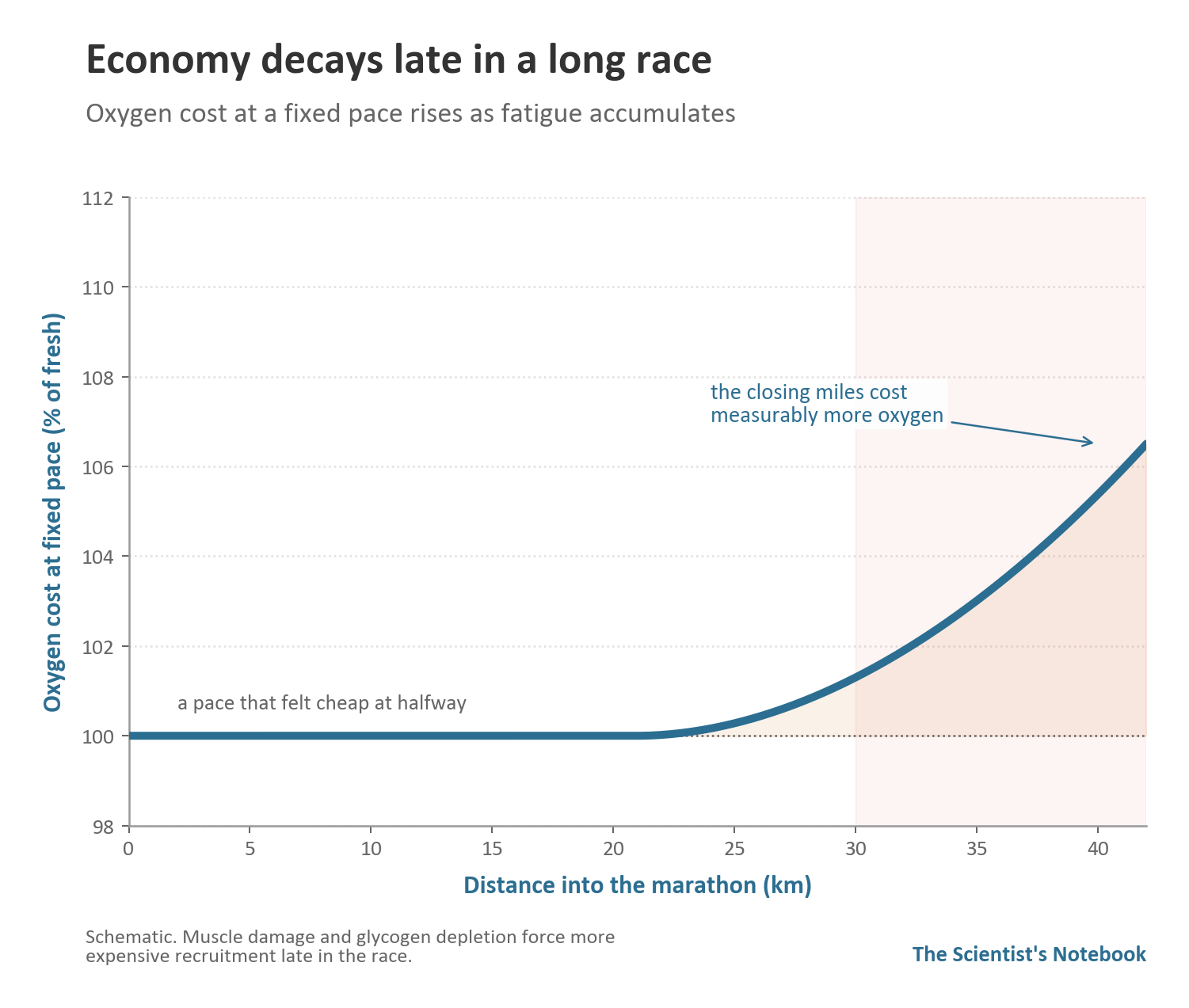
The arc bends the opposite way inside a single race.
Late in the marathon the runner's economy decays as fatigue accumulates, muscle damage and glycogen depletion forcing more expensive recruitment, so a pace that felt cheap at halfway costs measurably more oxygen by the closing miles.
The trained gain and the in-race decay are two faces of the same trait: economy is a moving quantity, improved slowly across a cycle and eroded within hours of hard running, and the runner who holds form longest is the one whose cost rises least when it matters most.
Where this leaves us
Running economy is the part of endurance that does not show up in the headline ceiling, and that is why it rewards attention.
It is where a seasoned runner with a fixed engine still finds minutes, through the slow refinement of an elastic, well-coordinated stride and the strength work that tunes it.
Held as a single lever it disappoints, because the saving is small and the noise is large. Held as one axis among three, beside the oxygen ceiling and the thresholds, it explains why two equal engines so often finish far apart.
The cost of each stride is quiet, but over a marathon it is the difference.
Best regards,
Dr. Thomas Mortelmans
Limits of Application:
The evidence on economy comes largely from treadmill testing of trained and elite runners, and the patterns here are tendencies rather than rules.
The trainable share of economy varies widely between individuals, with clear responders and non-responders to the same strength or plyometric work, so a group-average gain is no promise for any one runner.
Much of economy is structural, set by tendon dimensions, limb proportions, and mass distribution that training cannot reach, which is part of why two equally fit athletes can differ permanently.
Footwear effects are reported from controlled comparisons and reflect modern advanced models rather than every shoe. The numbers describing in-race decay and annual improvement are central tendencies around which real athletes scatter.
Nothing here is a training prescription or medical guidance; treat economy as one input among several rather than a target to be chased in isolation.
References
- Saunders PU, Pyne DB, Telford RD, Hawley JA. Factors affecting running economy in trained distance runners. Sports Med. 2004. PMID 15233599. The foundational review establishing economy as a strong, often superior predictor of distance performance among runners of similar aerobic ceiling, and cataloging the metabolic, biomechanical, and elastic determinants.
- Barnes KR, Kilding AE. Running economy: measurement, norms, and determining factors. Sports Med Open. 2015. PMID 27747844. A comprehensive synthesis of how economy is measured and what drives it, framing the trait as an integrated composite of metabolic, cardiorespiratory, biomechanical, and neuromuscular characteristics unique to each athlete.
- Moore IS. Is There an Economical Running Technique? A Review of Modifiable Biomechanical Factors Affecting Running Economy. Sports Med. 2016. PMID 26816209. Reviews the movement factors linked to cheaper running and concludes that no single universal form exists, so biomechanical determinants are individual rather than prescriptive.
- Barnes KR, Kilding AE. Strategies to improve running economy. Sports Med. 2015. PMID 25164465. Surveys the interventions shown to improve economy, including endurance training, resistance and plyometric work, altitude, and flexibility, and stresses an optimal rather than maximal degree of stiffness.
- Hoogkamer W, Kipp S, Frank JH, Farina EM, Luo G, Kram R. A Comparison of the Energetic Cost of Running in Marathon Racing Shoes. Sports Med. 2018. PMID 29143929. The landmark trial showing prototype plated shoes lowered the energetic cost of running by about four percent on average across high-caliber athletes, independent of speed.
- Arampatzis A, De Monte G, Karamanidis K, Morey-Klapsing G, Stafilidis S, Bruggemann GP. Influence of the muscle-tendon unit's mechanical and morphological properties on running economy. J Exp Biol. 2006. PMID 16916971. Demonstrates that the most economical runners differ in the contractile strength and tendon stiffness of their lower-limb muscle-tendon units, linking economy to elastic mechanical properties.
- Albracht K, Arampatzis A. Influence of the mechanical properties of the muscle-tendon unit on force generation in runners with different running economy. Biol Cybern. 2006. PMID 16628449. A modeling companion showing how tendon compliance and contractile strength alter force generation and energy release, offering a mechanism for the observed economy differences.
- Fletcher JR, Esau SP, MacIntosh BR. Changes in tendon stiffness and running economy in highly trained distance runners. Eur J Appl Physiol. 2010. PMID 20683611. Finds that tendon stiffness and the energy cost of running are labile and change together, supporting tendon properties as a partly trainable determinant of economy.
- Fletcher JR, Esau SP, Macintosh BR. Economy of running: beyond the measurement of oxygen uptake. J Appl Physiol. 2009. PMID 19833811. Argues that caloric unit cost is more sensitive than oxygen cost alone because it accounts for shifting fuel use, refining how economy should be expressed across speeds.
- Beattie K, Carson BP, Lyons M, Rossiter A, Kenny IC. The Effect of Strength Training on Performance Indicators in Distance Runners. J Strength Cond Res. 2017. PMID 27135468. A controlled intervention in which forty weeks of strength training improved economy and reactive strength in competitive runners without added muscle mass.
- Spurrs RW, Murphy AJ, Watsford ML. The effect of plyometric training on distance running performance. Eur J Appl Physiol. 2003. PMID 12627298. Shows that six weeks of plyometric training improved economy and three-kilometer performance while the ceiling for oxygen uptake stayed unchanged, isolating a neuromuscular pathway.
- Beck ON, Kipp S, Roby JM, Grabowski AM, Kram R, Ortega JD. Older Runners Retain Youthful Running Economy despite Biomechanical Differences. Med Sci Sports Exerc. 2016. PMID 26587844. Finds that runners beyond sixty-five retain youthful economy despite lower leg stiffness and altered mechanics, suggesting vigorous running protects muscular efficiency.
- Rodrigo-Carranza V, Gonzalez-Mohino F, Santos-Concejero J, Gonzalez-Rave JM. The effects of footwear midsole longitudinal bending stiffness on running economy and ground contact biomechanics: A systematic review and meta-analysis. Eur J Sport Sci. 2021. PMID 34369282. A meta-analysis showing increased bending stiffness improves economy, with the largest gains from curved plates and at faster speeds, alongside longer stride length and contact time.
- Kobayashi EN, de Toledo RRF, de Almeida MO, Sprey JWC, Jorge PB. Metabolic effects of carbon-plated running shoes: a systematic review and meta-analysis. Front Sports Act Living. 2026. PMID 41586014. Pools crossover trials to estimate that carbon-plated footwear lowers metabolic demand during submaximal running by roughly two to three percent, while cautioning that concurrent foam features contribute.
- Llanos-Lagos C, Ramirez-Campillo R, Moran J, Saez de Villarreal E. Effect of Strength Training Programs in Middle- and Long-Distance Runners' Economy at Different Running Speeds: A Systematic Review with Meta-analysis. Sports Med. 2024. PMID 38165636. A meta-analysis finding heavy-load and combined strength methods improve economy, with plyometric work most effective at slower speeds and heavy loads most effective at higher speeds and higher aerobic ceilings.
---
If you have 60 seconds, I would value your anonymous feedback. You can share it here.
---
Health disclaimer
This post discusses endurance-training science for educational purposes. It is not medical advice, not a diagnosis, and not a substitute for clinical care. Individual response to training, sleep deprivation, and multi-day exertion varies substantially, and what applies to a research cohort or a world-class athlete may not apply to you. Consult a qualified physician, sports medicine specialist, or registered dietitian before changing your training, fuelling, or sleep strategy if you have a cardiovascular, metabolic, psychiatric, or sleep-related condition; are recovering from injury or illness; are pregnant; are on medication that affects heart rate, hydration, glucose regulation, or sleep; or have concerns about exercise tolerance. Ultra-endurance events impose real physiological and psychological loads. Persistent chest pain, fainting, acute confusion beyond the predictable late-race window, severe dehydration, sustained loss of coordination, or any mental-health symptoms that outlast the immediate post-event dip warrant professional care and are not signals to push through. No outcome is guaranteed. The protocols, anchors, and case material in this post are descriptive, drawn from peer-reviewed evidence and a guest contributor's lived experience, and should be treated as inputs to an informed conversation with your own coach and clinicians, not as prescriptions.
Keep going
Paces derived from current fitness rather than a target time are the ones that hold up. Gradescale computes your easy, threshold and interval paces from a recent result.
Training plans built on the same evidence base:
Thomas MortelmansJoin our Discord community:
Thomas MortelmansFound this useful?
Get articles like this and free training calculators in your inbox every week.
Recommended reads
If this was useful, these are the other research-driven newsletters I actually read.

Member discussion