OpenLab #012: The Same Hour, Twice: Norm Alvis on Five Hour Records and the Ninety-Eight Days Between Two of Them
What moves a result when the rider, the event and the velodrome are all held constant. A nine minute read, with Norm Alvis.
On 23 June 2017 Norm Alvis rode 48.112 km in an hour at the Olympic Training Center velodrome in Colorado Springs. It set a US masters record and fell short of the world mark. On 29 September, at the same velodrome, in the same event, in the same body, he rode 49.392 km. Ninety-eight days, a gain of 2.7%, and a world masters best. Asked what he changed, he named one thing.
"The communication was poor and his commitment was off. I stopped working with him and teamed with the best coach I ever had for the hour as a simple project. That change and direction got my head right and the result was far better."
He asked twice that the first coach not be named, and that request is honoured here. The second name he gave without being asked for it.
"That best coach is Dean Golich whom I've known for a long time but he is no longer available as he works with professional NBA players and other very high dollar athletes."
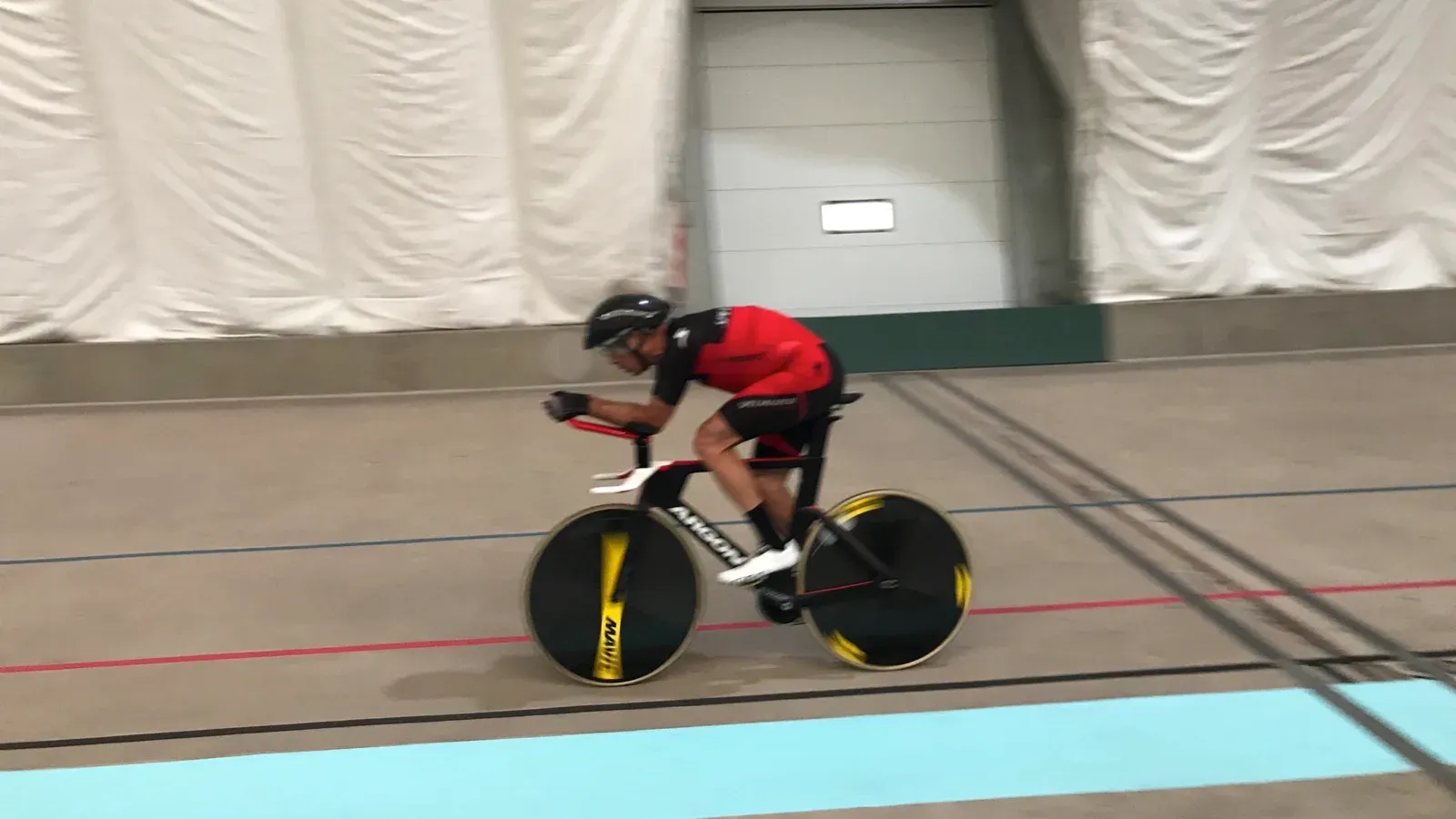
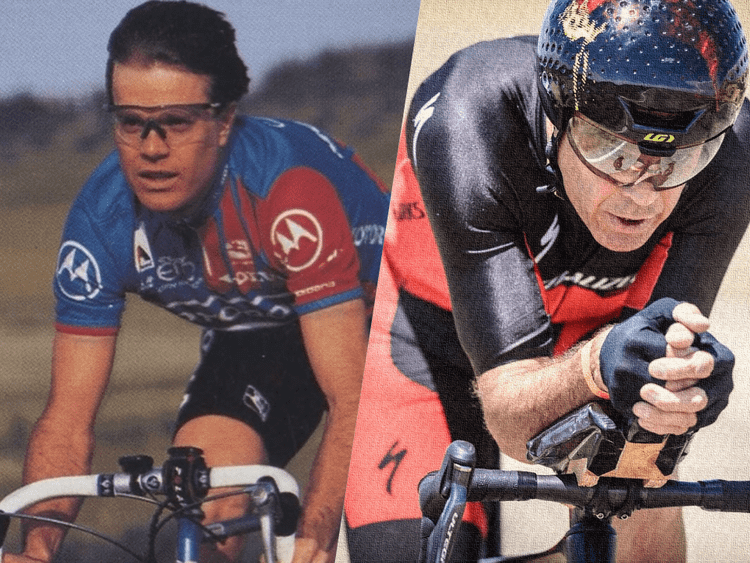
The position he has been iterating on for a decade. Photo: BikeRadar hour record feature.
About our guest
Norm Alvis has been racing for 48 years. He took national time trial titles as a junior in 1981 and as an amateur in 1986, plus national team time trial titles in 1986 and 1987, and rode the team time trial for the United States at the 1988 Seoul Olympics, finishing 10th. Across 1989 to 1998 he raced for 7-Eleven, Motorola and Saturn, rode the 1990 Tour de France and three Giri d'Italia, and won the US national professional road race in 1995. He has ridden the hour five times across twenty-four years: a US elite record in 1997 and four masters records since. In 2025, and again in 2026, he won four masters national track titles in a year. He is 63, at morepowertothepedals.com.
Why this piece
The companion piece argued that pairing a proven method to a particular person is the hard part, and ended where the evidence ran out: nobody has randomised trained athletes to a coach. This one goes to the closest thing available instead. Twice in 1997 and four times since, Norm has ridden the same event at the same two velodromes. In 2017 he rode it twice in one summer.
The Brief
- Two hour rides 98 days apart, same rider, same track, same event: 48.112 km, then 49.392 km.
- The confounds are as large as the finding: n = 1, unblinded, and the June ride was itself three weeks of overload delivered in one hour.
- Modelling of the hour record attributes about 60% of the distance gained from 1967 to 1996 to technology and 40% to physiology.
- In a wind tunnel, changing five professionals' positions cut drag 14%, and the aero helmet did not favour all of them.
- Velodrome measurement tracks the wind tunnel at r = 0.88, so his phone-and-tape method was an instrument rather than a compromise.
- Across twenty-four years his own distance fell 4.11%, from 51.505 km to 49.387.
The Science at a Glance
An hour record is unusually legible as a physiological problem, because almost nothing about it is tactical. Modelling the world records from 1967 to 1996 against wind-tunnel data, body size and crank dynamometer measurements, and then adjusting each ride for equipment and altitude, Bassett and colleagues put the cost of beating the 1996 mark at over 440 W held for an hour at sea level. Their decomposition of where the previous three decades of distance had come from splits it 60% technology, 40% physiology, and their model predicts an optimal elevation for an attempt of about 2000 m for an unacclimatised rider (Bassett 1999).
That number is worth holding carefully. It describes one historical series, in a window of radical and now partly-outlawed equipment change, and it forecasts nothing. It is quoted here because Norm states his own remaining ambition in precisely its terms.
"For 20 years I've had the ambition to eclipse my elite record as a master as a beautiful demonstration of the evolution of technology. I still believe I can do it even at age 63."
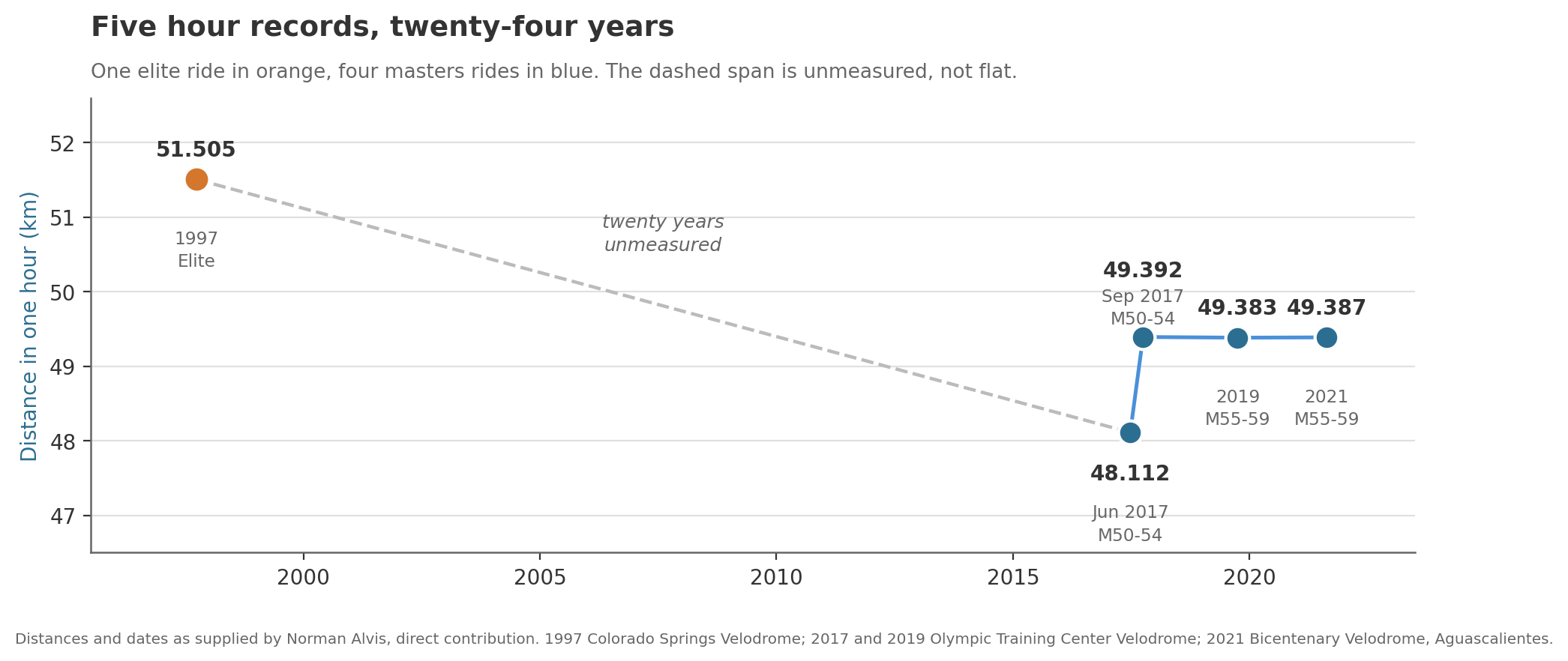
Five rides, twenty-four years. The dashed span is unmeasured, not flat.
To clear his own 1997 mark he needs 4.29% on his best masters ride, at 63, having lost 4.11% over the twenty-four years since. Whether the equipment term is large enough to cover that is the open question of his remaining career, and Bassett's 60% is a description of somebody else's era rather than a promise about his. Asked what a brilliant attempt would need, his own list starts with the same variable the companion piece could not find a trial for.
"The combination of good coaching, "peaked" form, the right track and travel, top equipment and a dialed in position. It takes more support than I've been able to coalesce. Yet, I am still hopeful that I can do this."
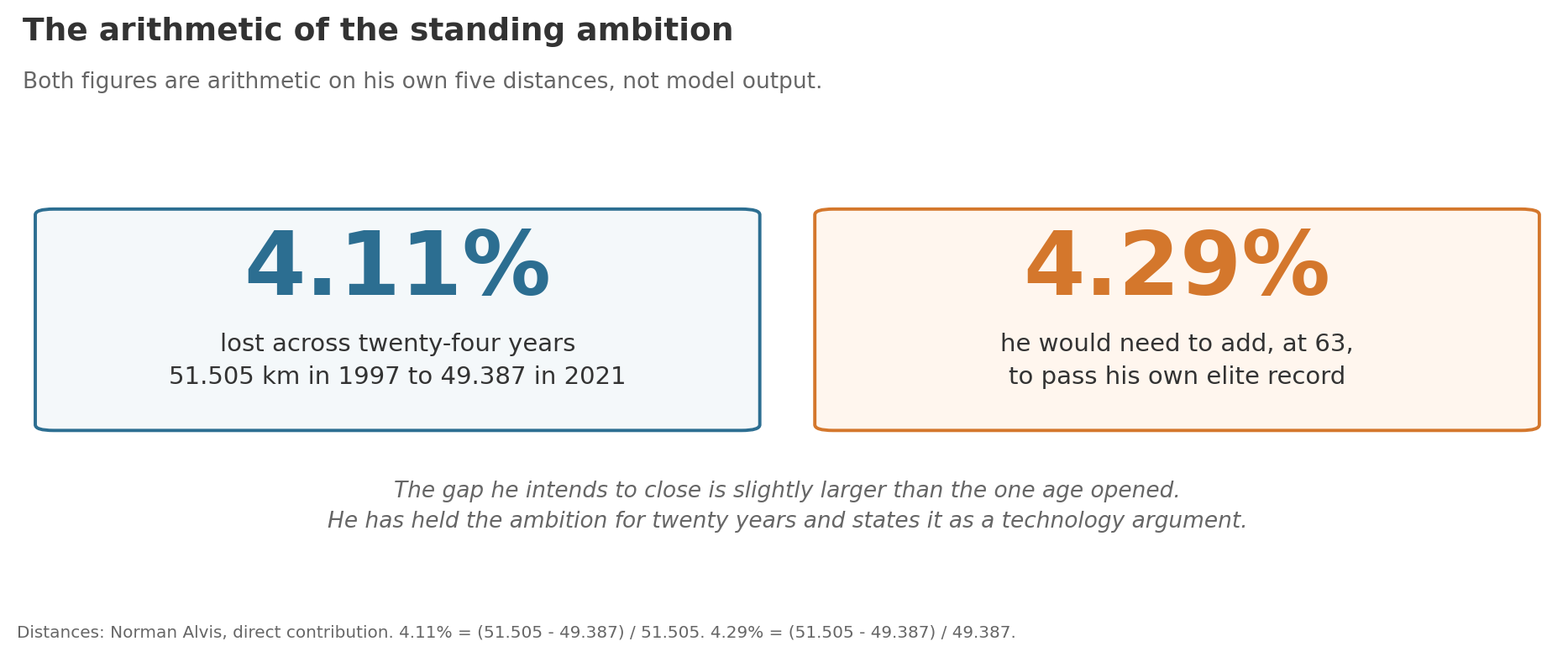
Twenty-four years, minus 4.11%. The gap he intends to close is larger than the one age opened.
Gradescale: Your physiology, decoded. Join the waitlist now.
 Thomas Mortelmans

Foundational Principles
The instrument was not the limitation
Norm described his position work with some embarrassment: tape on the garage floor to mimic the track lines, an iPhone propped up for video, no wind tunnel.
"I used both of these methods because I didn't have access to a wind tunnel for both location and cost."
Twelve professionals were measured both ways, in a wind tunnel and on a velodrome with a portable power meter. The two agreed at r = 0.88, the velodrome slightly underestimating drag area, and repeated velodrome runs returned r = 0.99 for the steady-state protocol. Small position changes moved drag area 4.6% (García-López 2013). Above 14 m/s, about 50 km/h, roughly 90% of mechanical power output goes to overcoming air, which is the range his 1997 ride sat in at 14.31 m/s (Debraux 2011).
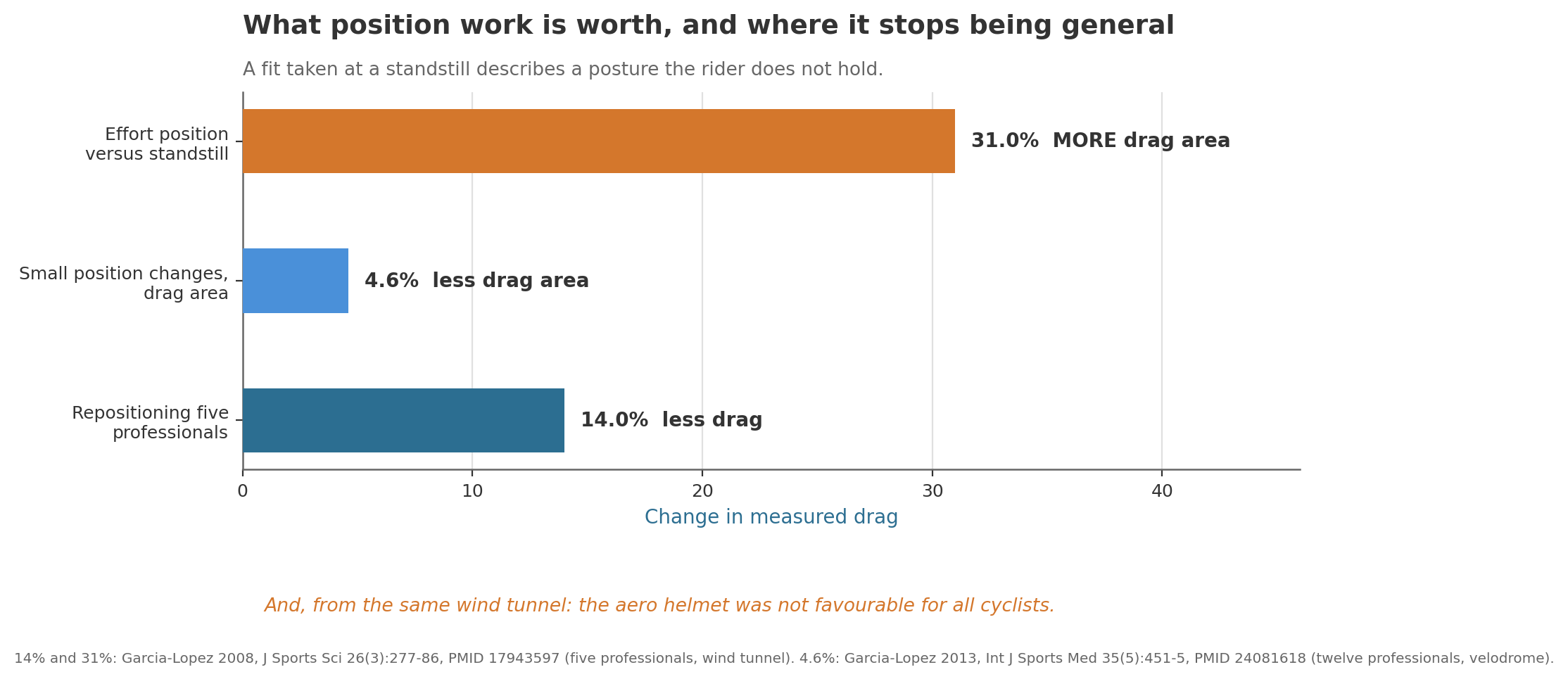
What position work is worth, and where it stops being general.
Scientist's Insight: what a wind tunnel buys is convenience and resolution, not validity. The constraint on him was not the method. It was that no measurement, taken any way, told him where to put his head.
"What I recognize is that in order to keep my head down I must learn to drive using peripheral vision not a direct view of what is in front of me. The direct view simply requires me to raise my head to see the path directly in front of me."
No paper here tests that. It is a motor-control problem dressed as an aerodynamic one, and it is his, unsupported and worth more than a loosely matched citation would be.
A proven device that suits some riders and not others
Five professionals in a wind tunnel, four time-trial positions each. Repositioning them cut drag 14%, and drag area ran 31% higher in the effort position than the static one, which is a warning about every fit performed at a standstill. The authors also record, flatly, that the aero helmet was not favourable for all cyclists (García-López 2008).
 Thomas Mortelmans
Observational Levers
Where a disagreement with a coach sits
Norm rides to a plan he did not write and argues with parts of it.
"My coach comes up with the general training plan and workouts. I force him to add certain things that I feel are important. He wouldn't prescribe them otherwise."
The thing he forces in is cadence work. The literature does not settle it. One study of six elite cyclists found the most economical cadence rising with workload, from 60 rpm at rest to 80 rpm at 350 W (Foss 2004); another found trained riders about equally economical across a wide cadence range (Harnish 2006). Conflict of this kind appears in the coach-athlete literature as an ordinary feature of the relationship rather than a fault in it, on a topic its authors describe as under-researched (Wachsmuth 2018).
What the field measurement can and cannot resolve
Those iterating on position alone sit inside a measurement limit. A field protocol that produced 23% and 26% drag reductions between sprint positions also reported poor between-days reliability, and its authors flagged their own result for caution (Merkes 2019). A real effect can be smaller than the noise that measured it. A position change can be genuine and still be invisible to the protocol sent to look for it.
The Protocol
What the evidence supports, as observations rather than instructions:
- Position, not equipment, carries the larger measured effect in these studies: 14% from repositioning five professionals, against an aero helmet that suited some of them and not others.
- A fit taken at a standstill describes a posture the rider does not hold. Drag area ran 31% higher under effort.
- Track measurement is a valid substitute for a wind tunnel, and a poor substitute for repeating it. Validity and reliability are separate properties.
- Among the determinants of endurance performance, maximal oxygen uptake is the one most altered by age, while economy and the sustainable fraction hold up better; the review's own headline lever is maintaining the training stimulus (Lepers 2016).
The case: ninety-eight days, and what they cannot settle
Held constant across the two 2017 rides: the rider, his age to within a season, the event, the velodrome, the altitude, the equipment class. Changed: the coach, and 98 days. That is a strong design by the standards of a life and a weak one by the standards of a trial. It is n = 1 and unblinded. The June ride was itself a serious training stimulus. Some part of 1.280 km is simply the fitness that three more months buys.
And the coach-athlete literature, which is the only literature that speaks to the variable he names, measures relationship quality and athlete satisfaction, not distance. Communication strategies and relationship quality reinforce each other over six weeks (Davis 2019). None of that converts to 1.280 km, and this piece is not going to pretend it does. What he describes is narrower and easier to credit: competence is not the variable that separated his coaches.
"Some coaches I've worked with were likely well-informed but we lacked rapport."
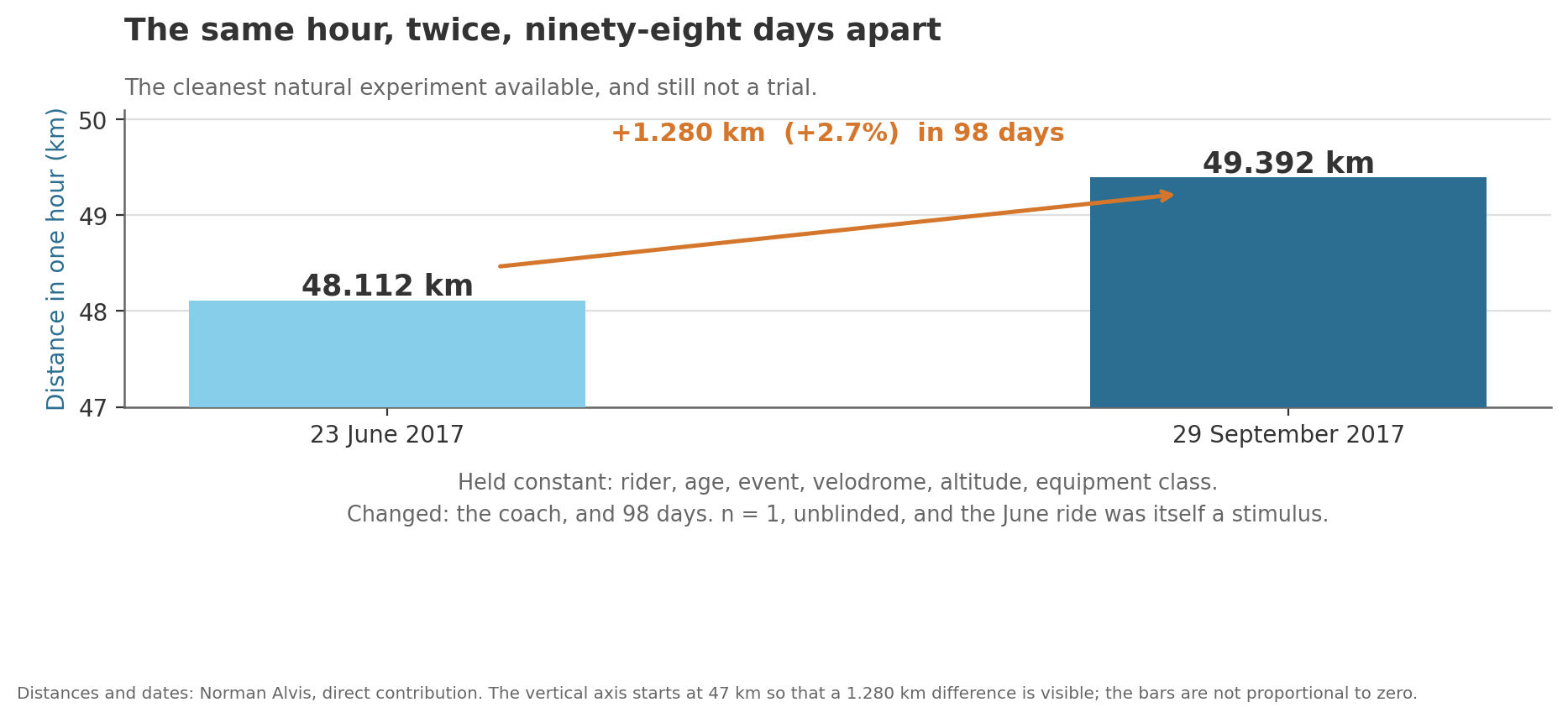
The cleanest natural experiment available, and still not a trial.
What he offers instead is a mechanism, and it is not the one the question expected. Asked what four decades of feel gave him that a power number would not, he rejected the premise.
"There is a nuance here. Candidly, "feel" misses the point. The overwhelming influence is form and attention."
Form first, then attention, then the decisions attention makes possible.
"I reached exceptional form through good training and a peaking process that was on point. With such a high level of form the athlete has more attention, more confidence and a better ability to make good decisions."
Feel is downstream of all three rather than a substitute instrument. He attaches his own limit to it.
"But the catch is most people don't ever get to this. I can tell you it has only happened for me a handful of times in my career. I only recognize it now looking back on the past 50 years of racing."
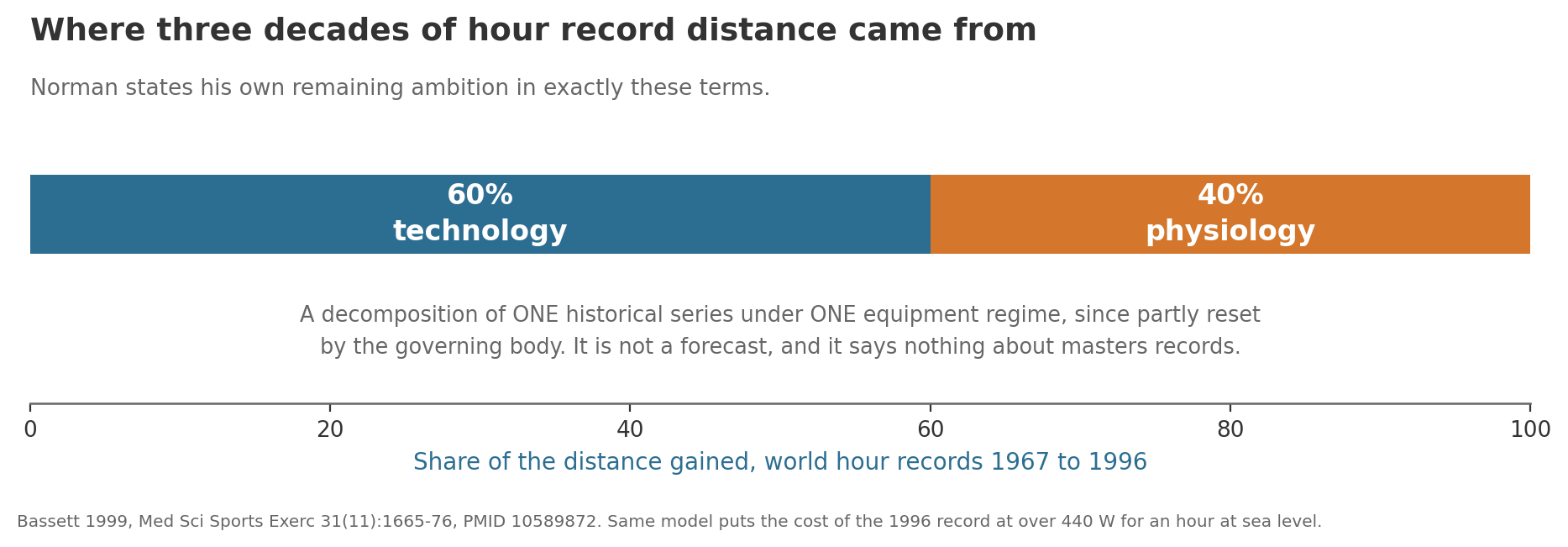
Where three decades of hour record distance came from, in one historical window.
Best regards,
Norm Alvis and Dr. Thomas Mortelmans
Limits of Application
The two 2017 rides are one case, unblinded, with the coach change confounded by 98 days of training and by the June ride's own stimulus. The aerodynamic studies enrolled five, eight, eleven and twelve trained or professional men, none of them near 63, and none on the specific question of holding a head position by steering on peripheral vision.
Bassett's model is a model: it decomposes a historical series under one equipment regime and does not forecast, and the record categories were subsequently reset. The coach-athlete work measures satisfaction and relationship quality rather than performance. The fastest track did not produce his best ride, which is the companion piece's argument arriving as a velodrome.
"The last two records for the Masters 55-59 category were a test of how good the track in Aguascalientes is. While dramatically smoother and faster the traveling and the conditions there have been a real impediment to performance."
The week producing those four national titles a year is not a professional one, and he is precise about why.
"Total volume is about 10 hours a week as that is all that fits."
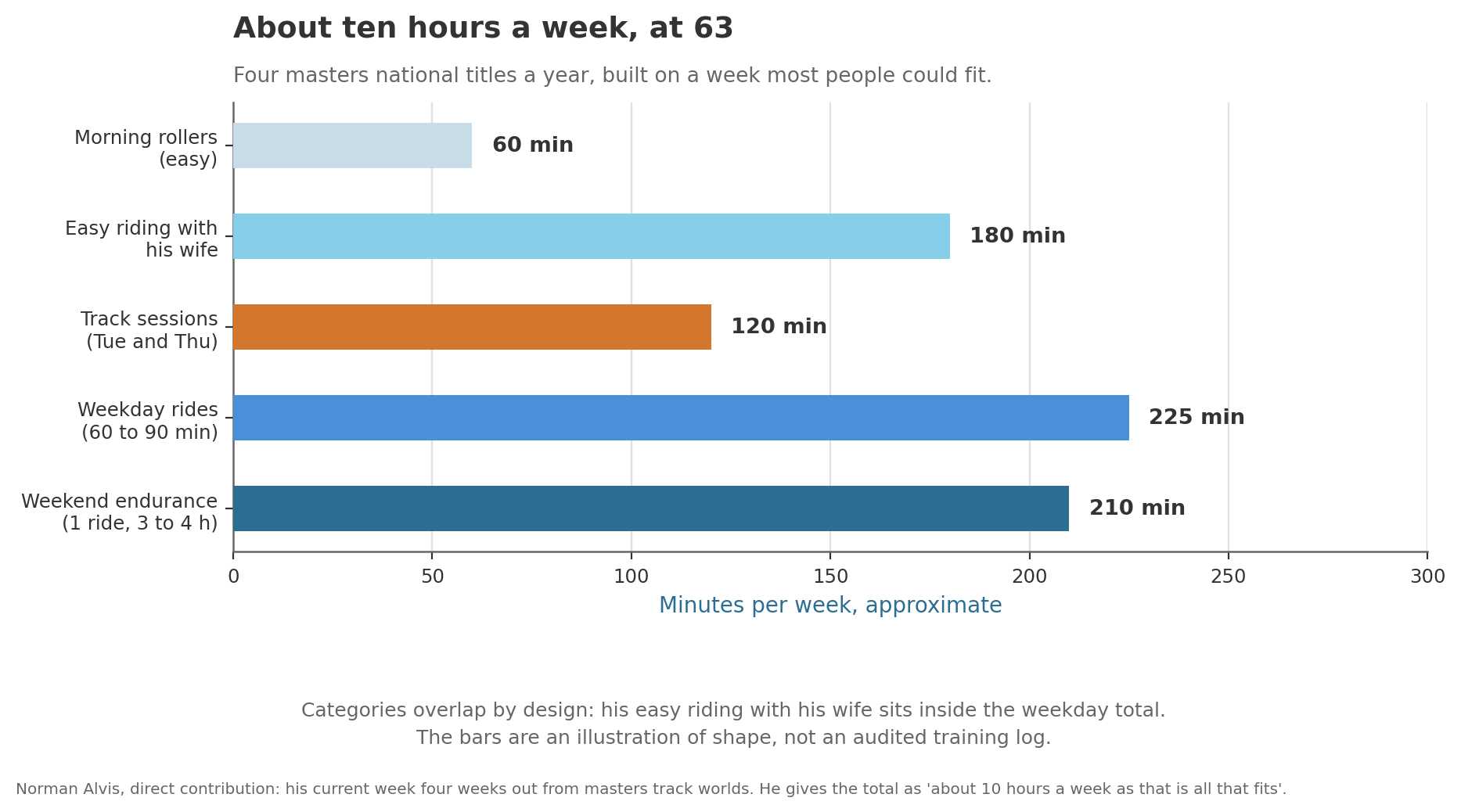
Four masters national titles a year, built on a week most people could fit.
A note on our guest
Norm is at morepowertothepedals.com. He makes one large claim about his 1997 ride and hedges it himself in the same sentence, which is how it appears here and how it will stay.
"The 1997 Elite Hour Record of 51.505km in Colorado Springs remains an all-time all-category best in the world for an outdoor track, something only I recognize…"
He is still going after it, at 63, and he knows exactly how that reads.
"A little crazy, no?"
From the Lab: the peaking question
He asked for this one twice, so it exists. Lab Report 003 (to be published at a later date) takes the applied version: the taper literature agrees on volume down and intensity held, and the trial producing the largest peak also pushed 11 of its 23 overloaded athletes past the line where the peak disappears. Both groups reported the same fatigue. What separated them was a performance test, not a sensation. He says he recognised exceptional form only in retrospect, and the report does not pretend to fix that.
References
- Bassett DR, Kyle CR, Passfield L, Broker JP, Burke ER. Comparing cycling world hour records, 1967-1996: modeling with empirical data. Med Sci Sports Exerc 1999;31(11):1665-76. PMID 10589872 · doi:10.1097/00005768-199911000-00025 What it shows: models track cycling power from wind-tunnel and field data, puts the cost of the 1996 record at over 440 W for an hour at sea level, and attributes about 60% of the distance gained since 1967 to advances in technology and 40% to physiological improvement.
- García-López J, Rodríguez-Marroyo JA, Juneau CE, Peleteiro J, Córdova Martínez A, Villa JG. Reference values and improvement of aerodynamic drag in professional cyclists. J Sports Sci 2008;26(3):277-86. PMID 17943597 · doi:10.1080/02640410701501697 What it shows: wind tunnel testing of five professionals across four time-trial positions. Repositioning cut drag 14%, drag area was 31% higher under effort than at a standstill, and the aero helmet did not favour every rider.
- García-López J, Ogueta-Alday A, Larrazabal J, Rodríguez-Marroyo JA. The use of velodrome tests to evaluate aerodynamic drag in professional cyclists. Int J Sports Med 2013;35(5):451-5. PMID 24081618 · doi:10.1055/s-0033-1355352 What it shows: velodrome drag-area measurement agreed with the wind tunnel at r = 0.88 in twelve professionals, with high within-protocol reliability, and detected position changes of 4.6%.
- Debraux P, Grappe F, Manolova AV, Bertucci W. Aerodynamic drag in cycling: methods of assessment. Sports Biomech 2011;10(3):197-218. PMID 21936289 · doi:10.1080/14763141.2011.592209 What it shows: review of thirty years of drag assessment. Above 14 m/s about 90% of mechanical power output goes to overcoming air, and inexpensive field methods return valid results against the wind tunnel.
- Merkes PFJ, Menaspà P, Abbiss CR. Reducing aerodynamic drag by adopting a novel road-cycling sprint position. Int J Sports Physiol Perform 2019;14(6):733-38. PMID 30427244 · doi:10.1123/ijspp.2018-0560 What it shows: a forward-standing sprint position cut drag area 23% and 26% against seated and standing, but between-days reliability of the field measurement was poor and the authors flag their own result for caution.
- Lepers R, Stapley PJ. Master athletes are extending the limits of human endurance. Front Physiol 2016;7:613. PMID 28018241 · doi:10.3389/fphys.2016.00613 What it shows: reviews age-related decline across endurance sports, finds it smaller in cycling than running or swimming, and identifies maintaining a high training stimulus as the single most important limiter of the rate of decline.
- Foss Ø, Hallén J. The most economical cadence increases with increasing workload. Eur J Appl Physiol 2004;92(4-5):443-51. PMID 15232702 · doi:10.1007/s00421-004-1175-5 What it shows: in six elite road cyclists the most economical cadence rose from 60 rpm at rest to 80 rpm at 350 W, with best short-effort performance at the most economical cadence.
- Harnish C, King D, Swensen T. Effect of cycling position on oxygen uptake and preferred cadence in trained cyclists during hill climbing at various power outputs. Eur J Appl Physiol 2006;99(4):387-91. PMID 17165053 · doi:10.1007/s00421-006-0358-7 What it shows: eight trained cyclists climbing at three intensities were about equally economical at high or low cadences, suggesting a limit to the benefit of raising cadence.
- Wachsmuth S, Jowett S, Harwood CG. On understanding the nature of interpersonal conflict between coaches and athletes. J Sports Sci 2018;36(17):1955-62. PMID 29343176 · doi:10.1080/02640414.2018.1428882 What it shows: interviews with 22 coaches and athletes. Treats conflict as an ordinary part of the coach-athlete relationship affecting coaching quality and performance, and notes how little research exists on it.
- Davis L, Jowett S, Tafvelin S. Communication strategies: the fuel for quality coach-athlete relationships and athlete satisfaction. Front Psychol 2019;10:2156. PMID 31607989 · doi:10.3389/fpsyg.2019.02156 What it shows: two studies, the second longitudinal over six weeks, finding communication and relationship quality reinforce each other over time. The measured outcome is satisfaction, not performance.
- Tanaka H, Seals DR. Endurance exercise performance in Masters athletes: age-associated changes in performance and physiological function. J Physiol 2008;586(1):55-63. PMID 17717011 · doi:10.1113/jphysiol.2007.141879 What it shows: peak endurance performance holds to around 35, declines modestly to 50 or 60, then falls more steeply, largely through falling maximal oxygen uptake and reduced training volume. See also reference 6.
- Louis J, Hausswirth C, Easthope C, Brisswalter J. Strength training improves cycling efficiency in master endurance athletes. Eur J Appl Physiol 2011;112(2):631-40. PMID 21638070 · doi:10.1007/s00421-011-2013-1 What it shows: three weeks of knee-extensor training raised maximal voluntary contraction 17.8% in masters athletes against 5.9% in young ones, erasing the age gap in cycling efficiency.
- Campbell D. An interview with American cycling legend Norm Alvis. Cycling West, 8 June 2026. cyclingwest.com What it shows: long-form interview covering the junior years, the European seasons and the return to masters racing.
- Former Tour pro sets masters hour record. BikeRadar. bikeradar.com What it shows: equipment and preparation feature on the September 2017 world masters hour record, including the taped floor lines and the iPhone position work.
- Alvis N. More Power to the Pedals. morepowertothepedals.com What it shows: Norm's own site, carrying his racing history, his five hour records and his current masters campaigns.
What changed between Norm Alvis’s two 2017 hour records?
He rode 48.112 km on 23 June 2017 and 49.392 km on 29 September, at the same velodrome, in the same event, 98 days apart, a gain of 2.7%. The one change he names is the coach. The confounds are as large as the finding: n = 1, unblinded, and the June ride was itself a training stimulus with 98 more days of preparation attached to it.
Frequently asked questions
How much of the hour record’s progress came from equipment rather than the rider?
Modelling the world hour records from 1967 to 1996 against wind-tunnel data, body size and field power measurements, Bassett and colleagues attributed about 60% of the distance gained to advances in technology and 40% to physiological improvement. It decomposes one historical series under one equipment regime, since partly reset, and it is not a forecast.
Do you need a wind tunnel to improve a cycling position?
Drag area measured on a velodrome with a portable power meter agreed with wind-tunnel measurement at r = 0.88 across twelve professionals, with high within-protocol reliability, and detected position changes of about 4.6%. A wind tunnel buys convenience and resolution rather than validity.
Does aerodynamic equipment help every rider equally?
Not in the measurement. Wind-tunnel testing of five professional cyclists cut drag by 14% through repositioning alone, and drag area ran 31% higher in the effort position than at a standstill. The same study records that the aero helmet was not favourable for all cyclists.
Do experienced endurance athletes race on feel?
Norm Alvis rejects the framing. He says feel misses the point and that the overwhelming influence is form and attention, with a high level of form producing more attention and better decisions. He attaches his own limit: it has happened for him a handful of times in his career, and he recognised it only looking back.
How much performance does a masters cyclist lose over twenty-four years?
Across his own five hour records, Norm Alvis went from 51.505 km in 1997 to 49.387 km in 2021, a loss of 4.11%. Reviews of masters endurance performance find age-related declines smaller in cycling than in running or swimming, and identify maintaining a high training stimulus as the single most important limiter of the rate of decline.
If you have 60 seconds, I would value your anonymous feedback. You can share it here.
Health disclaimer
This article reports what studies observed in the populations they enrolled, alongside one athlete's account of his own career. It is not training advice and it is not medical advice. The two 2017 hour rides are a single unblinded case. The coach change is confounded by 98 days of additional training and by the June ride's own stimulus, and nothing here establishes that changing coach produces 1.280 km. The coach-athlete research cited measures relationship quality and athlete satisfaction rather than performance. The aerodynamic studies enrolled five, eight, eleven and twelve trained or professional men, none of them near 63, and none tested holding a head position by steering on peripheral vision. An hour record attempt is a maximal effort sustained for an hour: consult a physician before maximal or near-maximal testing, particularly with any cardiovascular, metabolic or respiratory condition.
Found this useful?
Get articles like this and free training calculators in your inbox every week.
Recommended reads
If this was useful, these are the other research-driven newsletters I actually read.
Member discussion