Water Intake and Exercise Fluid Calculator
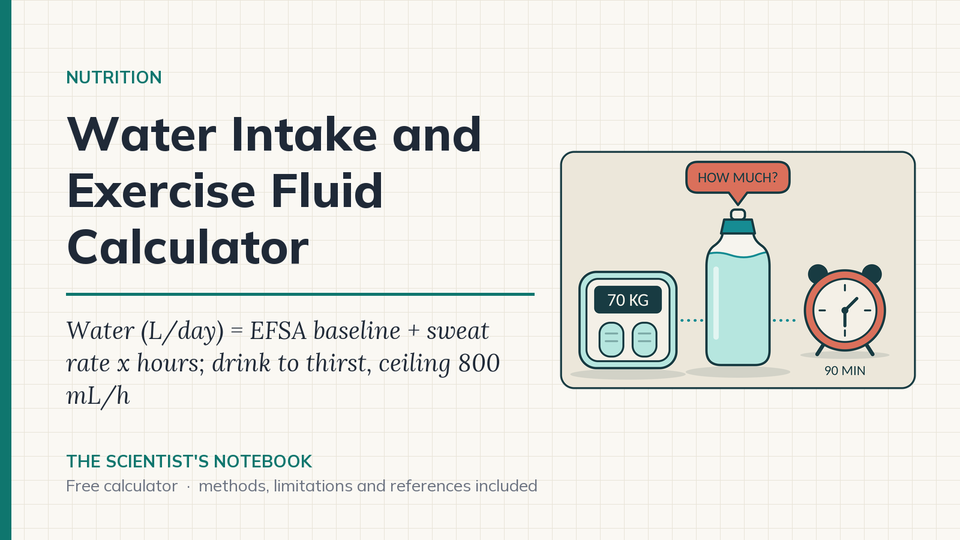
This calculator adds your measured or typical sweat loss to the EFSA adequate intake of water, and caps how fast it will ever suggest you drink during exercise. Drinking too little and drinking too much both have a cost, and this tool is built to keep you clear of the second one.
In short: The calculator adds your sweat loss to the EFSA adequate intake of total water: 2.5 L a day for men, 2.0 L for women, 2.3 L in pregnancy and 2.7 L while breastfeeding. The sweat rate comes from a weigh-in or the 15.3 mL/kg/h athlete average. During exercise it never suggests more than 800 mL per hour, or more than you sweat.
How does the calculator work?
Daily baseline. EFSA sets adequate intakes of total water, which includes drinks and the moisture in food: 2.5 L per day for men, 2.0 L for women, 2.3 L in pregnancy and 2.7 L while breastfeeding. These are population reference values for adults, not a personal requirement.
Sweat loss. Two ways to get a sweat rate:
- Weigh-in method: sweat rate (mL/h) = [(mass before - mass after) x 1000 + fluid drunk (mL) - urine (mL)] / hours of the test. One kilogram of lost mass is counted as about 1000 mL.
- Athlete average: 15.3 mL per kg of body mass per hour, the mean from 506 athletes tested in 15 to 50 degrees C. The standard deviation was 6.8, and the range ran from 3.3 to 69.7 mL/kg/h.
Total for the day = EFSA baseline + sweat rate x session hours / 1000.
Hourly range during exercise. The ACSM position stand uses a water deficit of 2 % of body mass as the point to avoid exceeding. So the allowance is 0.02 x body mass in mL. The low end of the range is the sweat rate minus that allowance spread over the session, never below zero. The high end is the smaller of your sweat rate and 800 mL/h. If the low end would exceed 800 mL/h, the calculator stops at 800 and tells you so.
What you enter. The calculator is for adults aged 18 and older. It accepts a body mass of 30 to 300 kg and a session of up to 1440 minutes; enter 0 minutes for a day without exercise. Below 40 kg or above 200 kg, or for a session shorter than 5 or longer than 600 minutes, it still gives a result, with a warning that the value is outside the usual range. A weigh-in test must last at least 20 minutes, with up to 5 L drunk and up to 3 L of urine. A measured sweat rate above 3.5 L/h is treated as an entry error and gives no result, and one above 2.6 L/h asks you to re-check the numbers. Nothing is filled in for you, including the sweat rate source.
Worked example, athlete average. A 70 kg man rides for 90 minutes. Sweat rate = 15.3 x 70 = 1071 mL/h. Session sweat loss = 1071 x 1.5 = 1607 mL (rounded). Total water for the day = 2.5 + 1.61 = 4.1 L. Without any drinking he would lose 2.3 % of his body mass. The 2 % allowance is 1400 mL, or 933 mL per hour of riding, so the low end of the range is 1071 - 933 = 138 mL/h and the high end is 800 mL/h.
Worked example, weigh-in. The same rider weighs 70.0 kg before and 69.0 kg after a 60 minute test, having drunk 0.5 L and passed no urine. Sweat rate = (1000 + 500) / 1 h = 1500 mL/h. For a 90 minute session that is 2250 mL lost, 4.75 L for the day, and an hourly range of 567 to 800 mL/h.
How should you use the result?
- Measure once, then reuse. Do the weigh-in on a normal session in the conditions you actually race in. A rate measured in a cool 60 minute ride does not carry over to a hot 4 hour day. The heat adjustment calculator shows how much the same effort changes in warm weather.
- Treat the range as a boundary, not a target. Thirst is the first signal. The range tells you where drinking on a schedule stops being useful: above the high end you are drinking faster than the tool will ever suggest.
- Weigh after long sessions. If you finish heavier than you started, you drank more than you lost. Take that as a reason to drink less next time, and talk to a clinician if you had any of the symptoms listed above.
- Fluid is one part of fuelling. For carbohydrate per hour, see the carbohydrate calculator.
What are the limitations?
- EFSA adequate intakes are population values for adults. They count water from food as well as drinks, so they are not a number of glasses.
- The athlete average has a standard deviation of 6.8 mL/kg/h around a mean of 15.3, so for any one person it can be wrong by a large margin. A weigh-in is better.
- The weigh-in method counts all lost body mass as sweat. It ignores respiratory water loss and the mass of fuel burned, so it is less reliable for very short tests.
- In 488 Boston Marathon runners with a finish-line blood sample, 13 % had a serum sodium of 135 mmol/L or lower and 0.6 % had 120 mmol/L or lower. Weight gain during the race (odds ratio 4.2) and racing times over 4 hours (odds ratio 7.4 versus under 3.5 hours) were associated with it.
- The 800 mL/h ceiling is a conservative setting chosen for this tool, not a number taken from the 2015 consensus statement, which recommends drinking according to thirst.
- Climate, altitude and clothing change sweat rate. The calculator does not apply multipliers for them, because a measured sweat rate in your conditions already includes them.
- Sodium is not modelled. Sweat sodium concentration varies a lot between people, and replacing it is a separate question.
🚨 CRITICAL SAFETY WARNING - Overdrinking and Low Blood Sodium
Drinking more than you lose during long exercise can cause exercise-associated hyponatremia, a low blood sodium level that can be life-threatening. This calculator gives population estimates. It cannot tell you how much your own body needs on a given day.
EMERGENCY SYMPTOMS - Stop drinking extra fluid and seek immediate medical attention if you experience:
- Nausea or vomiting
- Severe or worsening headache
- Confusion, disorientation, or unusual behaviour
- Swelling of the hands or feet, or weight gain during exercise
- Wheezing or breathlessness at rest
- Seizure or loss of consciousness
Do NOT use this calculator, and speak to your clinician first, if you:
- Have kidney disease, heart failure, or liver disease
- Have been told to restrict fluids, or have a sodium or antidiuretic hormone disorder
- Take diuretics, lithium, antidepressants, or other medication that affects fluid or sodium balance
- Are under 18 years of age
PREGNANCY AND BREASTFEEDING: For pregnancy or breastfeeding the tool uses the EFSA adequate intake (2.3 or 2.7 L per day) plus your sweat loss, and shows a warning. Agree any exercise hydration plan with your midwife or doctor before using these numbers.
LIMITS BUILT INTO THIS TOOL:
- Hourly ceiling: 800 mL per hour. The tool never shows a drinking rate above it.
- Never drink faster than you sweat. The upper end of the hourly range is capped at your sweat rate.
- Drink to thirst. The 2015 consensus statement recommends thirst, not a schedule, as the default.
Measure, do not guess: Sweat rates ranged from 0.26 to 5.73 L per hour in one dataset of 506 athletes. Weigh yourself before and after sessions to find your own rate. For long events, plan sodium and fluid with a sports medicine professional.
ℹ️ IMPORTANT DISCLAIMER
This calculator is for educational purposes only and does NOT constitute medical advice. Consult qualified professionals before making changes. Individual physiology varies. You assume all risk. Must be 18+.
Frequently asked questions
How much water should I drink a day?
EFSA sets adequate intakes of total water, which counts drinks and the water in food: 2.5 L a day for men, 2.0 L for women, 2.3 L in pregnancy and 2.7 L while breastfeeding. These are population reference values for adults, not a personal requirement. Exercise adds your sweat loss on top.
How do I measure my sweat rate?
Weigh yourself before and after a session of at least 20 minutes, and note what you drank and any urine. Sweat rate is the mass lost, counted as about 1000 mL per kilogram, plus fluid drunk minus urine, divided by the hours. A rider who goes from 70.0 kg to 69.0 kg in 60 minutes after drinking 0.5 L sweats about 1500 mL/h.
Can you drink too much during exercise?
Yes. Drinking more than you lose during long exercise can cause exercise-associated hyponatremia, a low blood sodium level that can be life-threatening. In 488 Boston Marathon runners with a finish-line blood sample, 13 % had a serum sodium of 135 mmol/L or lower. Weight gain during the race and racing times over 4 hours were associated with it. The 2015 consensus statement recommends drinking according to thirst.
Why is the hourly range capped at 800 mL?
The 800 mL/h ceiling is a conservative setting chosen for this tool, not a number taken from the 2015 consensus statement. The upper end of the range is also never above your sweat rate. If staying within a 2 % body mass loss would need more than 800 mL per hour, the tool says so and does not raise the rate.
How accurate is the athlete average sweat rate?
It is 15.3 mL per kg of body mass per hour, the mean from 506 athletes tested in 15 to 50 degrees C. The standard deviation was 6.8 and the range ran from 3.3 to 69.7 mL/kg/h, so for any one person it can be wrong by a large margin. A weigh-in in your own conditions is better.
Related calculators
- Caffeine Dose Calculator for Endurance
- Daily Carbohydrate Intake Calculator
- Creatine Loading and Maintenance Calculator
- Fat Intake Calculator
- All calculators on The Scientist's Notebook
References
- EFSA Panel on Dietetic Products, Nutrition and Allergies · 2010 · EFSA Journal 8(3):1459, Scientific Opinion on Dietary Reference Values for water · not indexed in PubMed · doi
- Hew-Butler T et al. · 2015 · Clin J Sport Med · PMID 26102445 · doi
- Sawka MN et al. · 2007 · Med Sci Sports Exerc · PMID 17277604 · doi
- Baker LB et al. · 2016 · J Sports Sci · PMID 26070030 · doi
- Almond CS et al. · 2005 · N Engl J Med · PMID 15829535 · doi
- McDermott BP et al. · 2017 · J Athl Train · PMID 28985128 · doi