Protein Timing Calculator
Once you know your daily protein, the next question is how to split it. This calculator spreads a daily total over the day in servings sized to published per-serving doses, and shows where a pre-sleep serving fits.
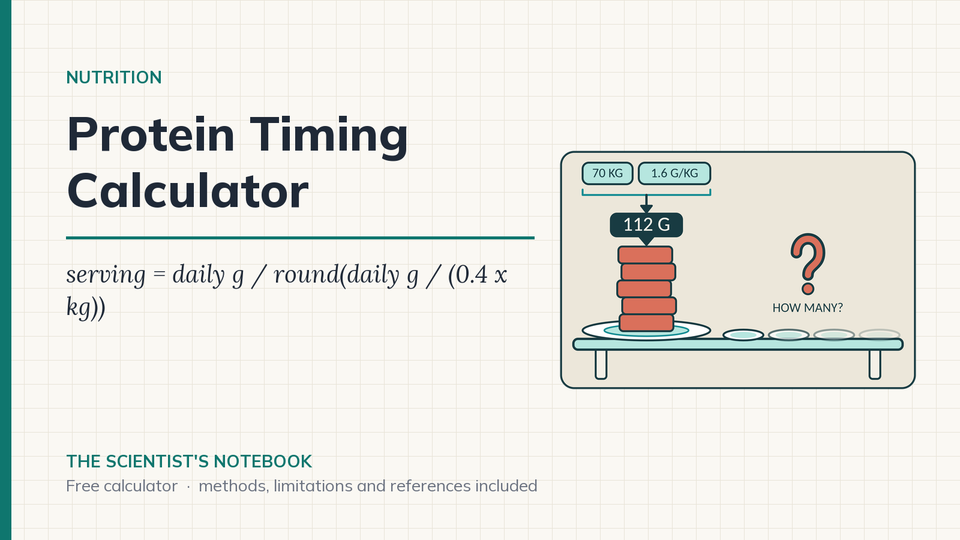
In short: The calculator multiplies your body mass by a daily g/kg target and splits the total into 3 to 6 servings of about 0.4 g/kg each. A 70 kg athlete at 1.6 g/kg/day gets 112 g as four servings of 28 g. Servings below the Moore 2015 plateau dose of 0.24 g/kg, or 0.40 g/kg from age 65, are flagged.
How does the calculator split my protein?
- Daily total (g) = body mass (kg) x g/kg/day. The four targets are 0.8 (adult RDA), 1.2 (low end of the sports nutrition range), 1.6 (the Morton 2018 break point) and 2.0 g/kg/day (top of the ISSN range). You can also type your own gram total, for example from the protein intake calculator.
- Servings = clamp(round(total / (0.4 x mass)), 3, 6) unless you pick a count. Schoenfeld and Aragon (2018) proposed 0.4 g/kg per meal across at least four meals to reach 1.6 g/kg/day, which this rule reproduces.
- Serving (g) = total / servings, split in whole grams so the servings add up to the total exactly.
- Reference doses for the flags. In the Moore 2015 analysis, muscle protein synthesis plateaued at 0.24 +/- 0.06 g/kg in younger men (about 22 years) and 0.40 +/- 0.19 g/kg in older men (about 71 years), given as means +/- 95 % confidence interval. Per kg of body mass the age difference just missed statistical significance (p = .055); per kg of lean body mass it was clear (0.60 vs 0.25 g/kg, p < .01). From age 65 the calculator uses the older value. The ISSN position stand gives 0.25 g/kg or an absolute 20 to 40 g per serving, spaced every 3 to 4 hours.
- Upper figure. 0.55 g/kg per serving is what you get when you split 2.2 g/kg/day over four meals (Schoenfeld and Aragon). It is a derived number, not a measured ceiling, and the calculator words its flag that way.
- Pre-sleep serving (optional). The last serving is held between 30 and 40 g, the range in the ISSN position stand. Res (2012) gave 40 g of casein 30 minutes before sleep to young men after an evening resistance session.
If you enter a first and a last meal time, serving times are spread evenly between them. If you enter only one of the two, the calculator asks for both rather than inventing the other.
Worked example
70 kg athlete, 1.6 g/kg/day. Total = 70 x 1.6 = 112 g. Servings = round(112 / 28) = 4. Each serving = 112 / 4 = 28 g, or 0.40 g/kg. The 0.4 g/kg reference serving is 28 g, and the 0.55 g/kg figure is round(0.55 x 70) = 39 g.
Same athlete at 2.0 g/kg/day with a pre-sleep serving: total 140 g over 5 servings. The last serving is held at 30 g, the other four share 110 g as 28, 28, 27 and 27 g. The day adds up to 140 g.
How do I use the result?
- Plan a long-ride day. A four-hour ride pushes the first real meal later. Put the serving closest to the ride after it, and keep the rest roughly 3 to 4 hours apart. Carbohydrate during the ride matters more for performance, so size that in the carb calculator first.
- Fix a top-heavy day. If most of your protein lands at dinner, put your current meals into the plan and see how far the evening serving sits above 0.55 g/kg. Moving 15 to 20 g to breakfast can be simpler than adding a meal.
- Decide whether a pre-sleep serving earns a place. If you train in the evening and your last meal is early, the pre-sleep option shows what a 30 to 40 g serving does to the other servings. Check the extra energy against your plan in the calorie calculator.
What are the limits?
- The per-serving doses come mostly from acute studies in young men using fast-digesting protein. Mixed meals digest more slowly, so the plateau may sit higher, as Schoenfeld and Aragon note.
- The Moore 2015 plateau values are group estimates with wide 95 % confidence intervals (+/- 0.19 g/kg in older men), from a retrospective analysis of the authors' own studies. They do not tell you where your own plateau sits.
- Total daily protein is the main driver of adaptation. Distribution is a refinement, and the evidence that it changes long-term muscle gain on top of an adequate total is limited.
- The post-exercise window is wider than once assumed (Aragon and Schoenfeld 2013). The calculator shows a suggested slot, not a deadline.
- The pre-sleep evidence is mostly from young, healthy men doing resistance training, including a longer training study (Snijders 2015). How well it carries over to endurance training is less clear.
- The calculator does not look at protein source, leucine content, other meals or total energy intake. The ISSN position suggests 700 to 3000 mg of leucine per serving, which is not computed here.
- If you have been told to limit protein, follow that advice and do not use these servings.
⚠️ HEALTH & TRAINING GUIDANCE
Serving sizes are study-based averages and individual results vary significantly. Consult a registered dietitian or physician before changing how you eat, especially if you have a kidney, liver or metabolic condition.
ℹ️ IMPORTANT DISCLAIMER
This calculator is for educational purposes only and does NOT constitute medical advice. Consult qualified professionals before making changes. Individual physiology varies. You assume all risk. Must be 18+.
Frequently asked questions
How much protein should I eat per meal?
Schoenfeld and Aragon (2018) proposed 0.4 g/kg per meal across at least four meals, which reaches 1.6 g/kg/day. The ISSN position stand gives 0.25 g/kg or 20 to 40 g per serving, every 3 to 4 hours. The calculator uses 0.4 g/kg to choose how many servings you need.
Is there a limit to how much protein one meal can use?
The calculator does not use a measured ceiling. Its 0.55 g/kg figure comes from splitting 2.2 g/kg/day over four meals (Schoenfeld and Aragon 2018). Because it is a derived number, a serving above it is flagged as a prompt to add a meal, not as a hard limit.
Do older adults need bigger protein servings?
In Moore 2015, muscle protein synthesis plateaued at about 0.40 g/kg in older men (about 71 years) and 0.24 g/kg in younger men (about 22 years). Per kg of body mass the difference just missed statistical significance (p = .055). From age 65 the calculator flags servings below 0.40 g/kg.
Should I eat protein before sleep?
Res 2012 gave 40 g of casein 30 minutes before sleep to young men after an evening resistance session. The calculator can hold an optional pre-sleep serving at 30 to 40 g, the range in the ISSN position stand, and takes it out of your daily total.
Does protein timing matter more than total protein?
No. Total daily protein is the main driver of adaptation, and the evidence that distribution changes long-term muscle gain on top of an adequate total is limited. Set the total first with the protein intake calculator, then split it here.
Related calculators
- Caffeine Dose Calculator for Endurance
- Daily Carbohydrate Intake Calculator
- Creatine Loading and Maintenance Calculator
- Fat Intake Calculator
- All calculators on The Scientist's Notebook
References
- Schoenfeld & Aragon · 2018 · J Int Soc Sports Nutr · PMID 29497353 · doi
- Moore et al. · 2015 · J Gerontol A Biol Sci Med Sci · PMID 25056502 · doi
- Res et al. · 2012 · Med Sci Sports Exerc · PMID 22330017 · doi
- Jager et al. · 2017 · J Int Soc Sports Nutr · PMID 28642676 · doi
- Aragon & Schoenfeld · 2013 · J Int Soc Sports Nutr · PMID 23360586 · doi
- Snijders et al. · 2015 · J Nutr · PMID 25926415 · doi
- Morton et al. · 2018 · Br J Sports Med · PMID 28698222 · doi
- Thomas et al. · 2016 · Med Sci Sports Exerc · PMID 26891166 · doi
- Institute of Medicine · 2005 · Dietary Reference Intakes for Energy, Carbohydrate, Fiber, Fat, Fatty Acids, Cholesterol, Protein, and Amino Acids. National Academies Press · not indexed in PubMed