Entry #039: W′ and the Anaerobic Battery: What Happens Above Critical Power

There is a moment in almost every hard race where the body stops feeling like it belongs to you. The legs flood, the breath ragged, the gap to the wheel ahead stretching no matter how much you ask.
Athletes call it hitting a wall, but the wall is not a place on the road. It is an internal account running toward zero.
Above a certain intensity, the body draws on a finite store of work that cannot be refilled while you keep spending it. When that store empties, the effort collapses on a schedule you could have predicted in advance.
That store has a name: W' (pronounced "W prime"). The intensity above which you start spending it is called critical power.
Together they describe a rechargeable battery that sits on top of your sustainable effort, with a known size, a known drain rate, and a known recharge rate. This piece is about that battery and the specific physiology of spending and reconstituting W' inside a race.
The brief
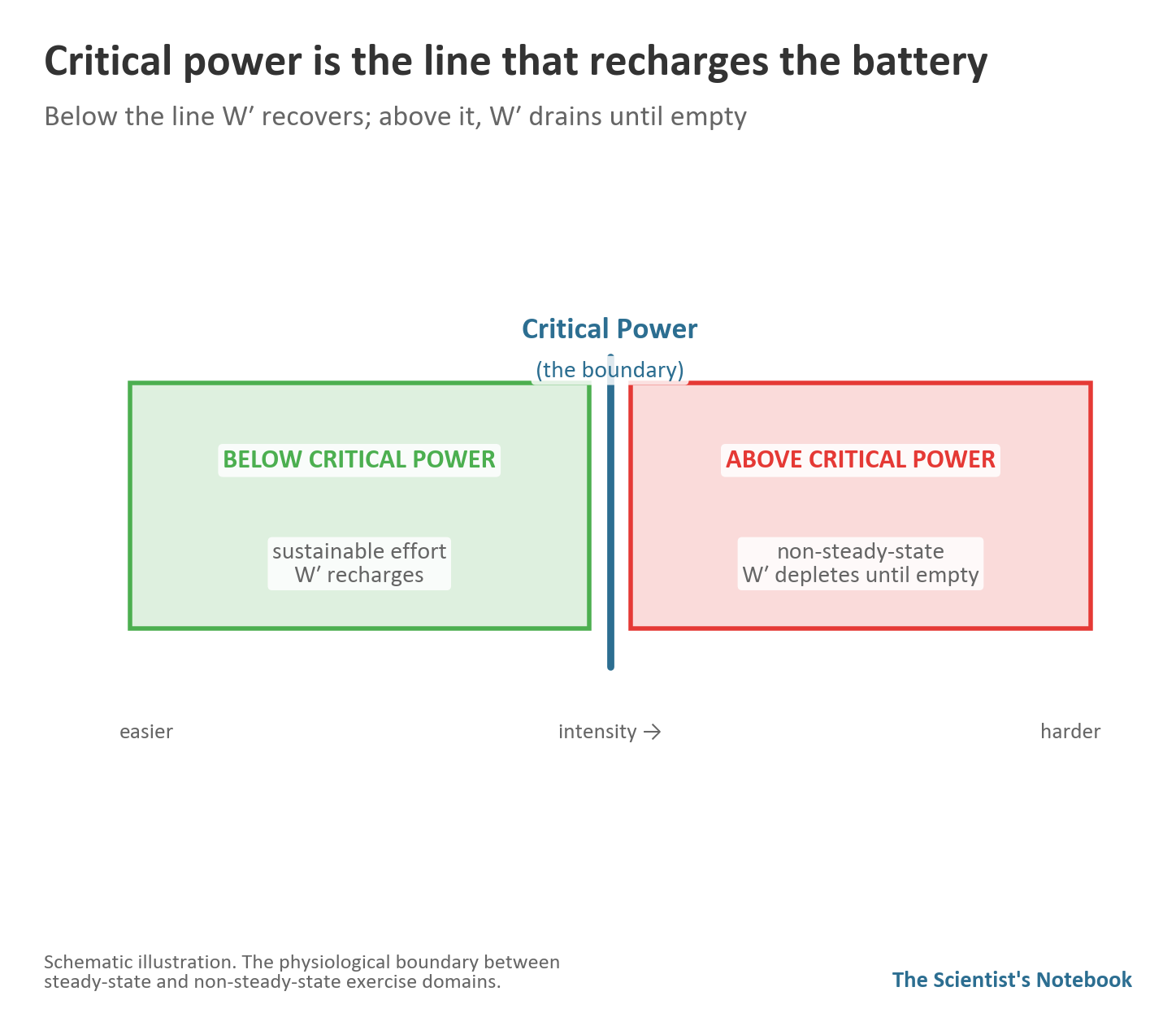
Critical power is the highest intensity your aerobic engine can hold in a true steady state. Below it, the internal chemistry of the muscle settles and stays settled.
Above it, nothing settles, and a finite reserve begins to drain. That reserve is W', and in trained cyclists it typically holds between 10 and 30 kilojoules of work, a span wide enough that two athletes with identical sustainable power can race completely differently.
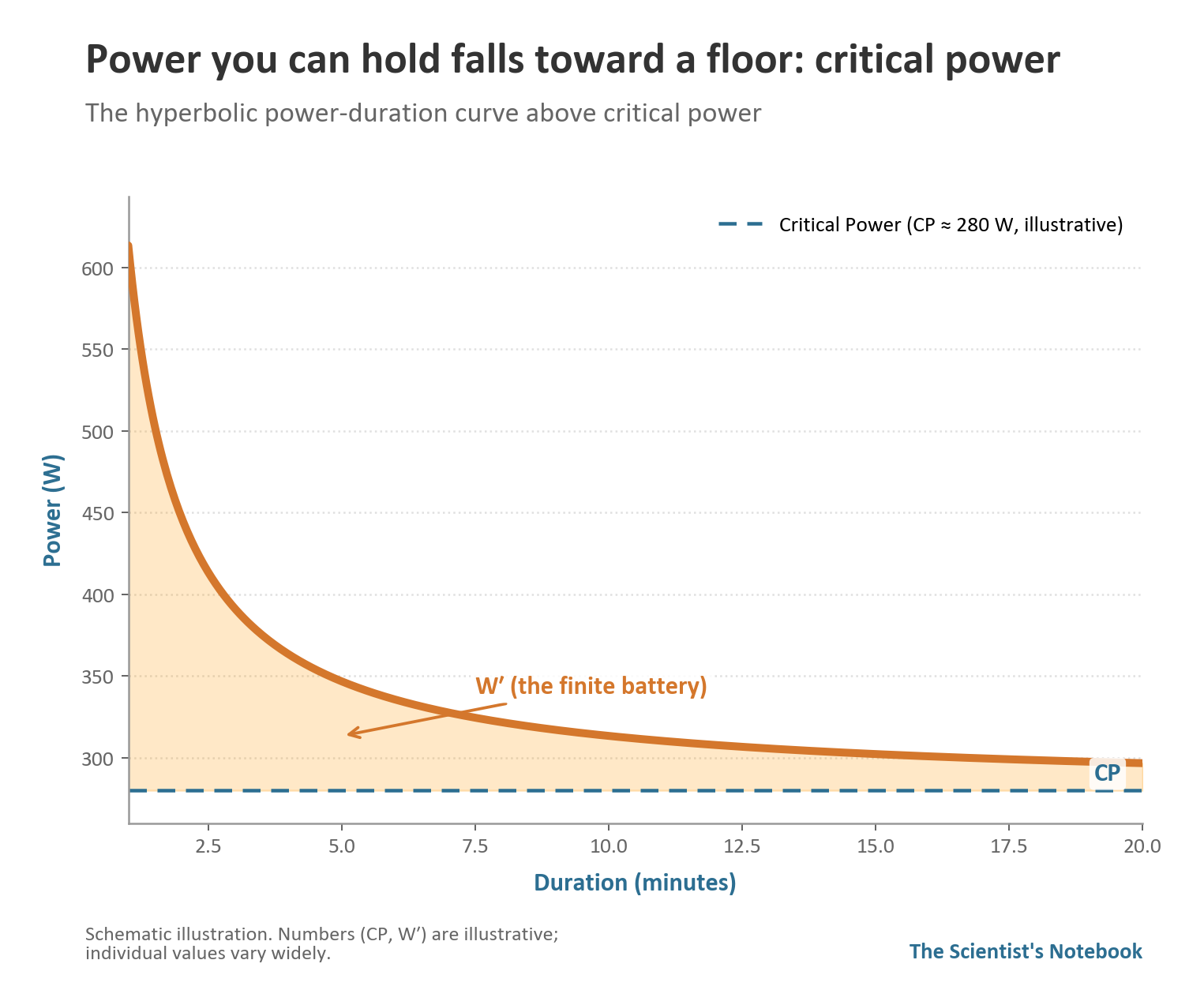
The relationship between how far above critical power you ride and how long you last is not linear, it is hyperbolic. Ride just 10 watts above the line and the reserve trickles away over many minutes.
Ride 100 watts above it and the same reserve is gone in well under a minute. The product of "watts above the line" and "seconds you can hold them" stays remarkably constant, and that constant is W' itself.
When the reserve reaches zero, tolerance ends. In one classic study, a fixed severe effort lasted around 384 seconds, and the total work performed above critical power at the point of failure matched the independently measured size of W' almost exactly.
The battery emptied on cue.
The recharge is what most athletes underestimate. W' refills only when you drop below critical power, and the refill follows a curve, not a straight line.
The deeper you dropped the intensity during recovery, the faster the reserve came back: in intermittent cycling, dropping recovery efforts well below the line extended total tolerable work by as much as 219 percent compared with continuous severe riding.
Recover lightly and you reload a large fraction of the battery. Recover hard and you barely reload at all.
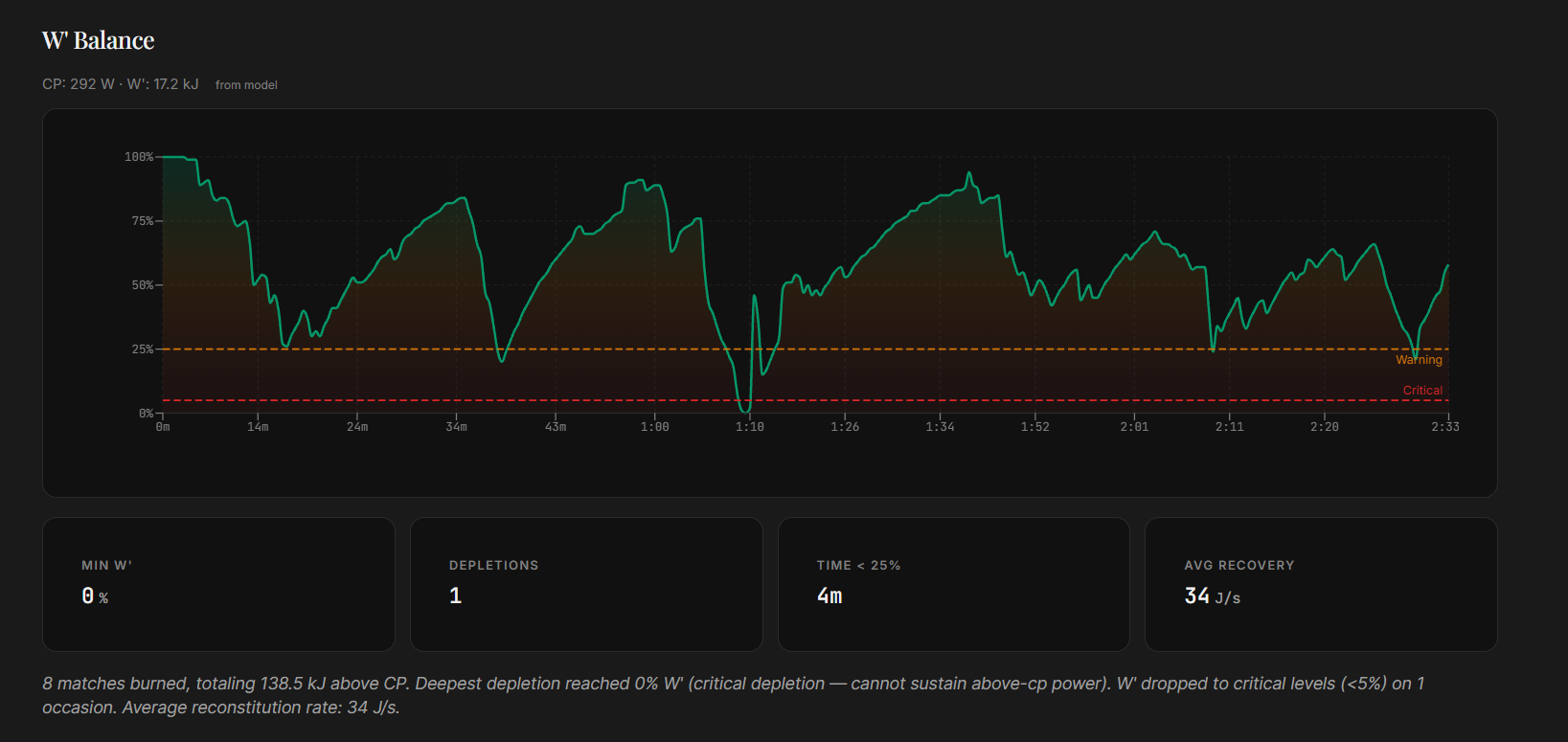
This is why pacing above critical power is a budgeting problem. You hold a finite number of matches, each surge burns some of them, easy spells return a few, and the race is won by whoever still has a match left when it matters.
Tools like Gradescale model this critical-power and W' relationship from an athlete's own efforts, turning that abstract budget into something you can actually see.
Gradescale: Your physiology, decoded. Join the waitlist now.
 Thomas Mortelmans
The science at a glance
Foundational Principle 1: Critical power is a real metabolic border, not a line on a chart
Researchers have peered into the working quadriceps with magnetic resonance spectroscopy while people exercised just below and just above the threshold. Below critical power, the muscle's phosphocreatine, inorganic phosphate, and acidity all reach stable plateaus within the first 3 minutes and hold there.
Above critical power, none of those variables stabilize. Phosphocreatine keeps falling, phosphate keeps climbing toward roughly five to six times its resting level, and acidity keeps rising until the effort cannot continue.
That difference is the whole concept. Critical power is the dividing line between intensities where the body can reach a chemical steady state and intensities where it cannot.
It is not the same as the lactate threshold, which sits lower, and not the maximal aerobic ceiling, which sits higher. It is its own boundary, defined by whether homeostasis is reachable at all.
Deeper Principle: The maximal lactate steady state and critical power are close cousins but not twins. Careful work places the maximal lactate steady state slightly below critical power, with critical power marking the true upper edge of the sustainable domain. The two get conflated constantly, yet only critical power cleanly separates the sustainable from the unsustainable.
Scientist's Insight: When an effort feels like it has found a rhythm you could hold "forever," you are almost certainly below critical power. When it feels like a countdown began the moment you started, you are above it.
The body reports the boundary in real time, in the language of accumulating discomfort.
Foundational Principle 2: W' is a finite reserve, and its size is deeply personal
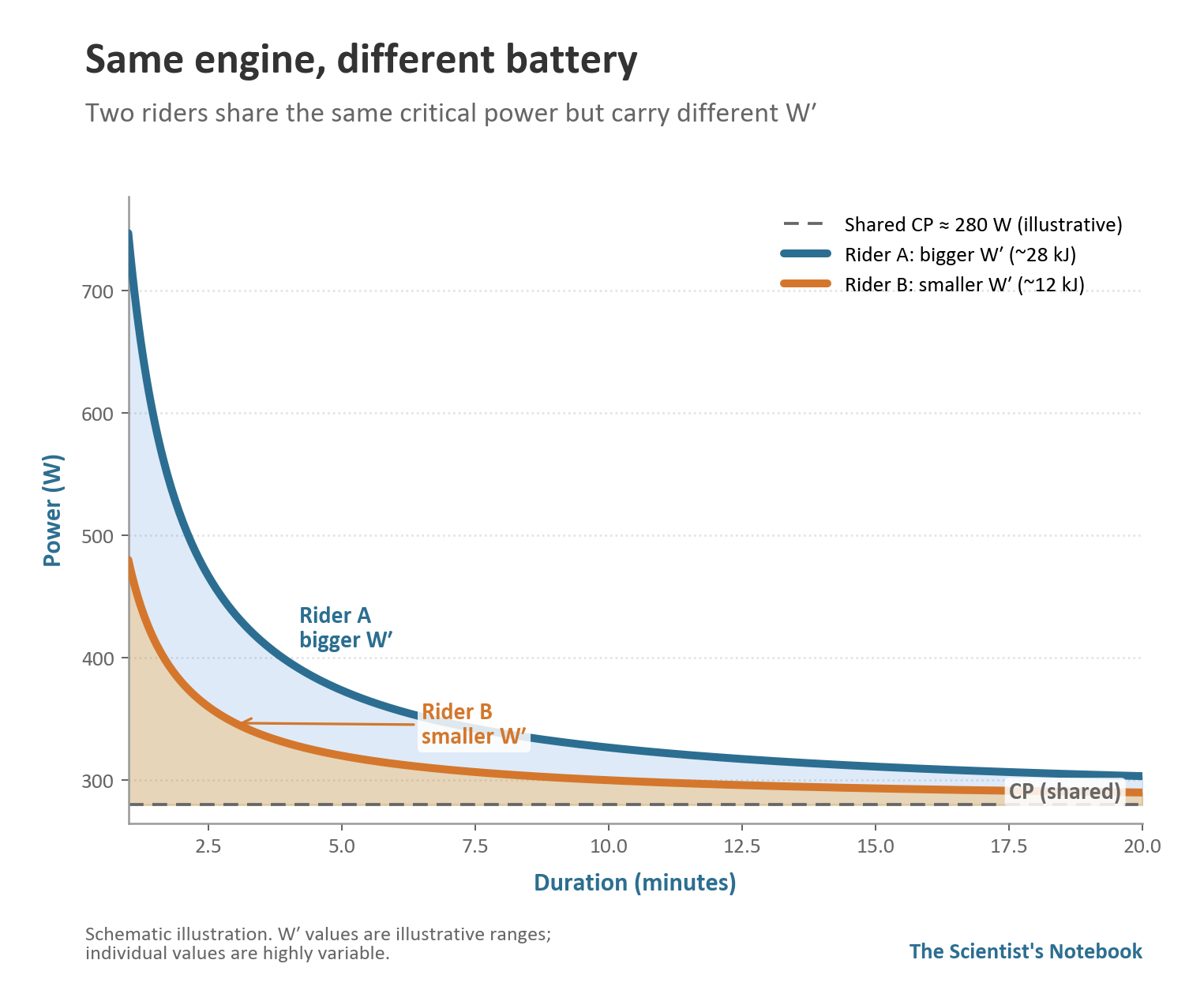
Above critical power, the work you produce comes partly from your aerobic engine running flat out and partly from a separate, limited account. That account is W', measured in kilojoules, and across trained athletes it commonly lands between 10 and 30 kilojoules.
A reserve near the top of that range is enormous in tactical terms, the difference between a rider who can launch three attacks and one who gets only one.
The early literature called W' the "anaerobic work capacity" and treated it as a fixed tank of stored anaerobic fuel. Modern measurements complicate that picture.
W' draws on rapidly available phosphate stores, on glycolysis, and on the consequences of recruiting less efficient muscle fibers as the effort drags on.
It behaves less like a fuel tank and more like the total tolerable disturbance the muscle can accumulate before force production fails. The size of that disturbance varies from person to person and is only loosely related to aerobic fitness.
Deeper Principle: The magnitude of W' has been linked to the progressive rise in oxygen cost during severe exercise, the so-called slow component. The harder a person leans on inefficient fast-twitch fibers, the more oxygen uptake drifts upward and the more the finite reserve seems tied to that drift. W' is not a clean anaerobic tank sitting apart from aerobic metabolism. The two are woven together.
Scientist's Insight: A large W' is not a free gift.
Athletes who increase critical power through endurance work often see W' shrink, because the same adaptations that raise the sustainable ceiling compress the range over which the reserve operates. Aerobic power and battery size frequently trade against each other.
 Thomas Mortelmans
Foundational Principle 3: The power-duration curve above critical power is hyperbolic, and that shape is the engine of prediction
For efforts above critical power, tolerable time equals the size of your reserve divided by how far that power sits above the critical line. The relationship holds across species, across muscles, and across exercise modes, and it produces a steep curve.
Free calculator
Because the reserve is fixed, every extra watt above the line is spent faster than the last. An effort 10 watts over critical power might be tolerable for many minutes.
The same reserve at 50 watts over the line lasts a fraction as long, and at 100 watts over it the reserve can be exhausted in under a minute.
The total work above the line stays constant even as the duration collapses, which is what makes the size of W' measurable.
Deeper Principle: The hyperbolic model fits best in the range of roughly 2 to 15 minutes of effort, the window where most decisive racing happens. Push far outside that window and the simple two-parameter model strains, which is why researchers continue to refine it with alternative mathematical forms. Inside the racing window it is a sharp and trustworthy tool.
Scientist's Insight: This is why small pacing errors above critical power are punished so harshly. Going 20 watts too hard does not cost you twenty watts of comfort, it changes the slope of your countdown.
The hyperbola turns modest overreach near the threshold into a dramatic loss of tolerable time.
Reading the signals
What follows are not instructions. They are patterns the research has observed, the levers that explain why races above critical power unfold the way they do.
Lever 1: Where the reserve gets spent
W' is spent wherever the effort rises above critical power: the climbs, the attacks, the bridges, and the surges into the wind.
In stochastic field efforts that mimic real competition, the reserve drains during every interval above the line, and the model can predict with useful accuracy the moment it tends toward zero. The spend is concentrated in the explosive moments, not the steady ones.
Athletes tend toward a pattern of repeated small withdrawals. Each surge above the line, each acceleration out of a corner, each effort to close a gap draws down the same single account.
The reserve does not distinguish between a long sustained climb and a series of short sharp digs, it sees only total work above the line.
In trained cyclists, the work performed above critical power at the point of failure converges on the individually measured size of W', the experimental signature of a genuinely finite store.
Lever 2: Critical power as the line that recharges the battery
The reserve refills only when intensity drops below critical power. In intermittent cycling studies where the work intervals were identical but the recovery intensity varied, tolerance improved in direct proportion to how far below the line recovery fell.
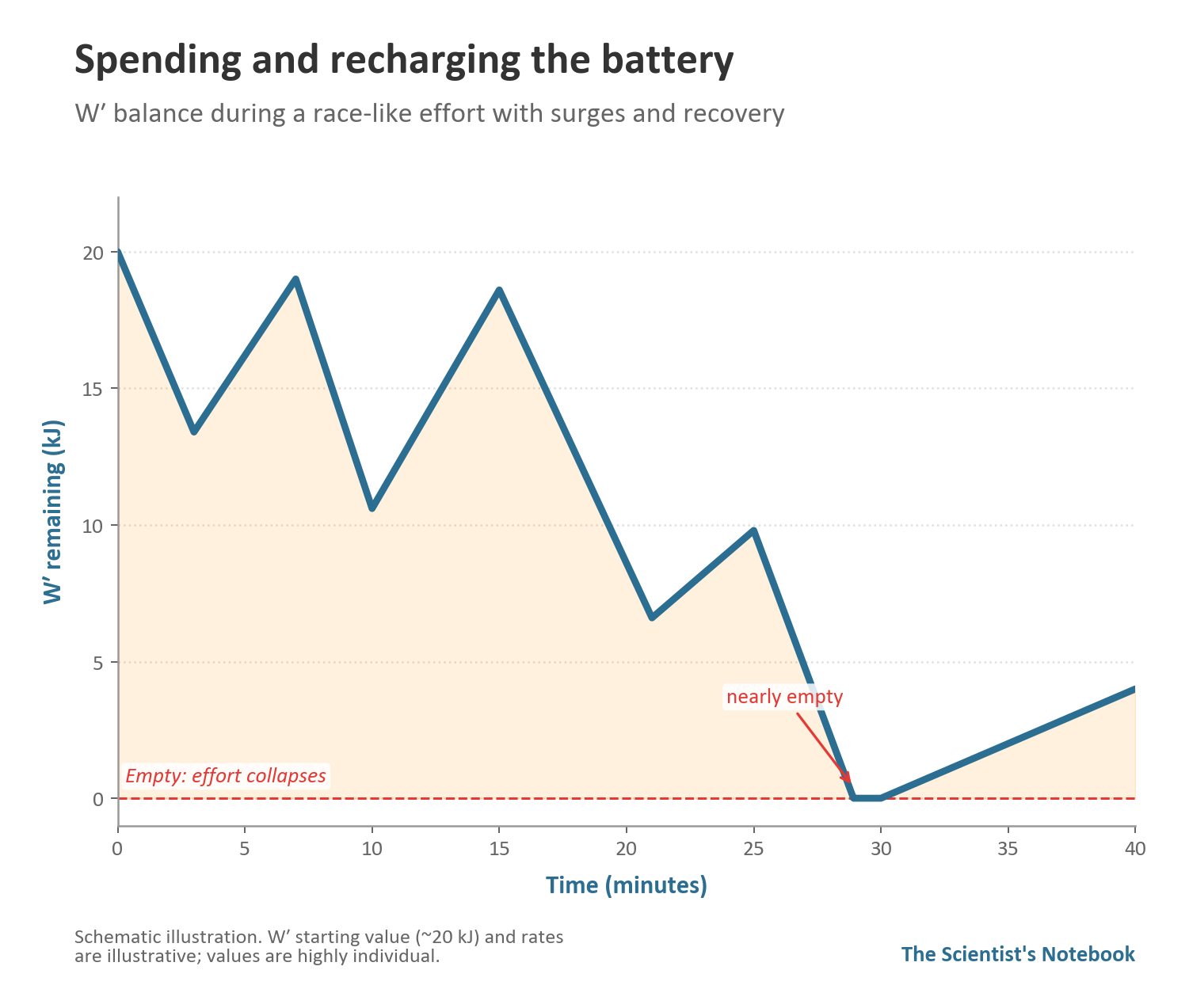
Recovery efforts set well below critical power extended total tolerable work by up to 219 percent compared with riding continuously above the line, while recovery efforts only slightly below the line returned much less.
The recharge is curved rather than constant and highly individual. The time constant of reconstitution varies widely between athletes and tracks with aerobic characteristics: athletes with higher critical power and stronger oxidative capacity reload their reserve faster.
The line is not just the level above which you spend, it is the level below which you earn it back, and how quickly you earn it back is itself trainable and measurable.
Lever 3: Same critical power, different W', different race
Consider two riders with identical critical power, say 300 watts apiece, one carrying a reserve of 15 kilojoules and the other 25 kilojoules. On paper they have the same sustainable engine, yet in the data they behave like different athletes entirely.
The rider with the larger W' carries more matches into the finale. Where the small-reserve rider can answer one attack before entering the countdown, the large-reserve rider can answer several, or launch their own and still have something left.
Research linking these parameters to muscle properties offers a clue. Critical power tracks with the proportion of highly oxidative, fatigue-resistant fibers, while the size of the reserve does not map cleanly onto fiber type and instead reflects a broader capacity to tolerate metabolic disturbance.
Two engines of equal sustainable output can sit atop reserves of very different size. This is why a flat power number fails to tell the whole tactical story, and why athletes with the same threshold experience the decisive moments of a race so differently.
Method and a worked example
How critical power and W' are estimated
The estimation method is elegant precisely because it needs so little. The two parameters fall out of a handful of maximal efforts.
- Perform several all-out efforts of differing durations, typically three to five of them, each held to genuine failure. Durations spread across roughly 2 to 15 minutes work best, for example a long effort near twelve minutes, a middle one near five, and a short one near two and a half.
- Record the average power sustained in each effort and the exact time held.
- For each effort, compute the total work done, which is simply average power multiplied by duration in seconds.
- Plot total work against time. The points fall close to a straight line. The slope of that line is critical power, and the height at which it intercepts the work axis is W'.
- Alternatively, a single 3-minute all-out effort can approximate both: the power averaged over the final 30 seconds approximates critical power, and the work performed above that level approximates the reserve. This shortcut estimates the sustainable line reliably but pins down the reserve less precisely.
The whole exercise rests on a small number of honest, maximal data points. Sandbag any one of the efforts and both parameters shift.
A generic case: the crit racer who spent too early
Consider a generic criterium racer with a critical power of 300 watts and a reserve of 20 kilojoules. On a tight, twisting course she accelerates out of roughly forty corners per race, each surge lifting her well above her sustainable line for a few seconds.
Early in the race she answers an attack, chasing at 400 watts for 40 seconds. That effort sits 100 watts above her line, withdrawing 100 watts times 40 seconds, or 4 kilojoules, a fifth of her reserve, gone in under a minute.
The next several corners come fast, and she fails to drop far enough below 300 watts to recharge meaningfully. Her battery limps.
By the closing laps her reserve is near empty, and when the winning move goes she has perhaps 2 kilojoules left.
She lifts to 400 watts to follow, but now she has only enough reserve for about 20 seconds at that intensity before the countdown ends.
Thomas Mortelmans
Related reading
The gap opens. The race was not lost in that final acceleration. It was lost across forty corners of small unrecovered withdrawals, in the simple fact that she spent above her line more often than she earned it back below it.
A rider with the same 300-watt critical power but a 28-kilojoule reserve, or one who had soft-pedaled two corners earlier in each lap, would have had a match left to strike.
Where this leaves us
The anaerobic battery becomes more useful the more honestly you respect its edges. Critical power is the line that defines whether your physiology can settle.
W' is the finite reserve you spend above it and earn back below it.
A race above the line is a budgeting exercise, and the athlete who understands their reserve size, drain rate, and recharge conditions holds a quiet advantage over one racing on feel alone.
Best regards,
Dr. Thomas Mortelmans
Limits of Application: The numbers here are illustrative ranges from group studies, not personal prescriptions. Individual values for critical power and W' vary widely with fitness, fatigue, heat, and altitude.
The two-parameter model is sharpest for efforts of roughly two to fifteen minutes and grows less reliable for very short sprints and multi-hour events, where fuel depletion and other fatigue mechanisms enter that the battery picture does not capture.
W' reconstitution is curved and highly individual, so any single recharge rate is an approximation. Estimates are only as good as the maximal efforts behind them, and a held-back test yields misleading parameters.
None of this is medical or coaching advice; it is a description of what the published physiology observes.
References
- Poole DC, Burnley M, Vanhatalo A, Rossiter HB, Jones AM. Critical Power: An Important Fatigue Threshold in Exercise Physiology. Med Sci Sports Exerc. 2016. PMID 27031742. Establishes critical power as a genuine physiological boundary separating intensities where homeostasis can be stabilized from those where it cannot, and frames W' as the finite work available above it.
- Jones AM, Vanhatalo A. The 'Critical Power' Concept: Applications to Sports Performance with a Focus on Intermittent High-Intensity Exercise. Sports Med. 2017. PMID 28332113. Extends the model to real racing, showing W' is spent above critical power and reconstituted below it, with reconstitution curvilinear and highly variable between individuals.
- Jones AM, Vanhatalo A, Burnley M, Morton RH, Poole DC. Critical power: implications for determination of VO2max and exercise tolerance. Med Sci Sports Exerc. 2010. PMID 20195180. Lays out the hyperbolic power-duration equation and defines critical power as the highest sustainable rate of oxidative energy transfer, with the limit of tolerance arriving when W' is depleted.
- Vanhatalo A, Jones AM, Burnley M. Application of critical power in sport. Int J Sports Physiol Perform. 2011. PMID 21487156. Reviews critical power as the boundary between steady-state and non-steady-state domains and surveys how training, pacing, and prior exercise alter the power-time parameters.
- Skiba PF, Chidnok W, Vanhatalo A, Jones AM. Modeling the expenditure and reconstitution of work capacity above critical power. Med Sci Sports Exerc. 2012. PMID 22382171. Introduces the W' balance model, demonstrating exponential reconstitution of W' during recovery and accurate prediction of W' exhaustion in a competitive cyclist during a road race.
- Chidnok W, DiMenna FJ, Bailey SJ, Vanhatalo A, Morton RH, Wilkerson DP, Jones AM. Exercise tolerance in intermittent cycling: application of the critical power concept. Med Sci Sports Exerc. 2012. PMID 22033512. Shows that lower-intensity recovery intervals reconstitute W' and extend tolerable work by up to 219 percent, directly tying recovery intensity to battery refilling.
- Vanhatalo A, Doust JH, Burnley M. Determination of critical power using a 3-min all-out cycling test. Med Sci Sports Exerc. 2007. PMID 17473782. Validates the single-visit 3-minute all-out protocol, where end-test power approximates critical power and the work above it approximates W'.
- Jones AM, Wilkerson DP, DiMenna F, Fulford J, Poole DC. Muscle metabolic responses to exercise above and below the "critical power" assessed using 31P-MRS. Am J Physiol Regul Integr Comp Physiol. 2008. PMID 18056980. Direct in-muscle evidence that phosphocreatine, phosphate, and pH stabilize below critical power but spiral continuously above it until task failure.
- Morton RH. The critical power and related whole-body bioenergetic models. Eur J Appl Physiol. 2006. PMID 16284785. A performance-based review of the critical power model and its more detailed derivatives, examining the mathematical assumptions behind the two-parameter framework.
- Vanhatalo A, Black MI, DiMenna FJ, et al. The mechanistic bases of the power-time relationship: muscle metabolic responses and relationships to muscle fibre type. J Physiol. 2016. PMID 26940850. Links critical power to the proportion of oxidative type I fibers while showing W' does not map onto fiber type, explaining why equal sustainable power can sit atop different reserves.
- Skiba PF, Clarke DC. The W' Balance Model: Mathematical and Methodological Considerations. Int J Sports Physiol Perform. 2021. PMID 34686611. Clarifies the integral and differential forms of the W' balance model and the distinct assumptions each makes about depletion and reconstitution during intermittent exercise.
- Galbraith A, Hopker J, Lelliott S, Diddams L, Passfield L. A single-visit field test of critical speed. Int J Sports Physiol Perform. 2014. PMID 24622815. Demonstrates that critical speed and the running analogue of W' can be estimated reliably in the field from a few maximal efforts on a single day.
- Pringle JSM, Jones AM. Maximal lactate steady state, critical power and EMG during cycling. Eur J Appl Physiol. 2002. PMID 12458364. Compares critical power with the maximal lactate steady state, finding critical power sits slightly above it and marks the upper edge of sustainable exercise.
- Hill DW. The critical power concept. A review. Sports Med. 1993. PMID 8248682. A foundational review of the hyperbolic power-duration relationship, defining critical power and the work capacity parameter and how predicting trials estimate them.
- Jones AM, Burnley M, Black MI, Poole DC, Vanhatalo A. The maximal metabolic steady state: redefining the 'gold standard'. Physiol Rep. 2019. PMID 31124324. Argues that critical power, not the maximal lactate steady state, represents the true boundary separating exercise in which physiological homeostasis can be maintained from exercise in which it cannot.
---
If you have 60 seconds, I would value your anonymous feedback. You can share it here.
---
Health disclaimer
This post discusses endurance-training science for educational purposes. It is not medical advice, not a diagnosis, and not a substitute for clinical care. Individual response to training, sleep deprivation, and multi-day exertion varies substantially, and what applies to a research cohort or a world-class athlete may not apply to you. Consult a qualified physician, sports medicine specialist, or registered dietitian before changing your training, fuelling, or sleep strategy if you have a cardiovascular, metabolic, psychiatric, or sleep-related condition; are recovering from injury or illness; are pregnant; are on medication that affects heart rate, hydration, glucose regulation, or sleep; or have concerns about exercise tolerance. Ultra-endurance events impose real physiological and psychological loads. Persistent chest pain, fainting, acute confusion beyond the predictable late-race window, severe dehydration, sustained loss of coordination, or any mental-health symptoms that outlast the immediate post-event dip warrant professional care and are not signals to push through. No outcome is guaranteed. The protocols, anchors, and case material in this post are descriptive, drawn from peer-reviewed evidence and a guest contributor's lived experience, and should be treated as inputs to an informed conversation with your own coach and clinicians, not as prescriptions.
Thomas Mortelmans
Related reading
Keep going
Drag area is the one term in the equation an athlete can actually change. Gradescale estimates your CdA from a single steady effort and shows the inversion it used.
Training plans built on the same evidence base:
Thomas MortelmansJoin our Discord community:
Thomas MortelmansFound this useful?
Get articles like this and free training calculators in your inbox every week.
Recommended reads
If this was useful, these are the other research-driven newsletters I actually read.




Member discussion