OpenLab #011: What Fits: Norm Alvis on Four Decades of Pairing Proven Training With a Changing Life

Individualisation, and why the same proven method lands differently on different lives. A nine minute read, with Norm Alvis.
In August 1989 Norm Alvis arrived in the European professional peloton, and it went well. He had broken his collarbone that March, missed most of the American season, and came to his first professional races fresher than the men around him. Then the team gave him everything a young rider asks for: Tirreno, Paris Roubaix, the Giro, the Tour, the World Championships. More than a hundred race days in a season, which left no time to train after January camp and a body worn out by the end of it.
"No one guided me through this. No one gave me any context. The peer response was that I was a tough guy and as one of those hard men I did plenty of extra miles throughout the year at the conclusion of some races. That is what hard men did."
Nothing about his physiology changed when he crossed the Atlantic. Everything around it did, and he is precise about which part failed.
"What was mismatched was everything around the racing program and how to take care of myself beyond what I had learned about training from my amateur days on the national team."
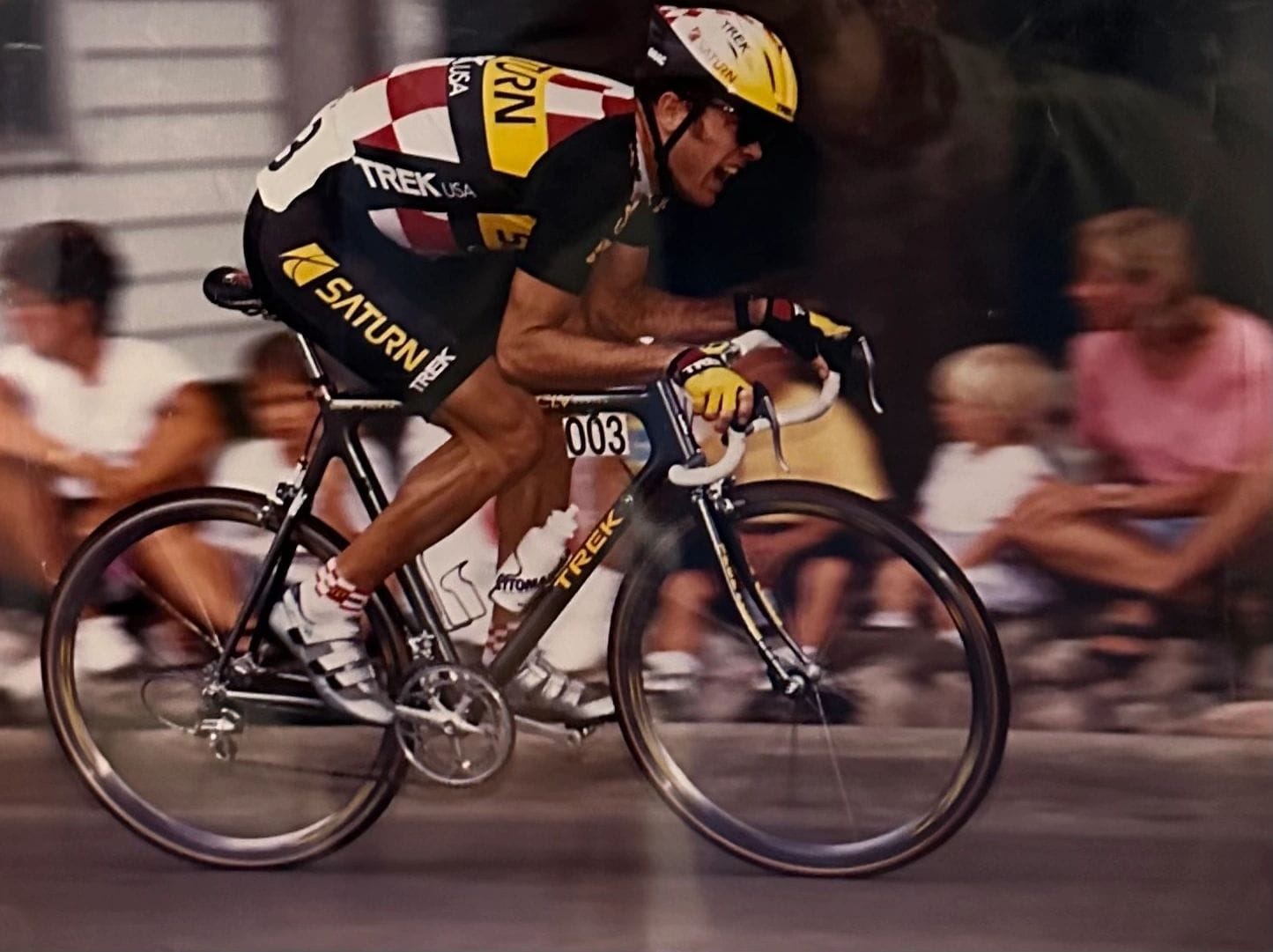
Norm Alvis in the Saturn years. Photo: morepowertothepedals.com
About our guest
Norm Alvis has been racing for 48 years. He took national time trial titles as a junior in 1981 and as an amateur in 1986, plus national team time trial titles in 1986 and 1987, and rode the team time trial for the United States at the 1988 Seoul Olympics, finishing 10th. Across 1989 to 1998 he raced for 7-Eleven, Motorola and Saturn, rode the 1990 Tour de France and three Giri d'Italia, and won the US national professional road race in 1995.
In 1997 he set a US elite hour record of 51.505 km, and has since set four masters hour records. In 2025, and again in 2026, he won four masters national track titles in a year: scratch, points, individual pursuit and team pursuit. He is 63, at morepowertothepedals.com.
Why this piece
Norm proposed it. His argument: we differ by circumstance and by personality, pairing proven methods to a situation is the art rather than the science, and that argues for a coach. What follows tests it against the evidence, then against his own four decades. In three places his answers contradicted what this piece assumed. Those are the best parts.
Gradescale: Your physiology, decoded. Join the waitlist now.
 Thomas Mortelmans
The Brief
- Roughly 47% of the variation in fitness gained from one standardised block tracked with family, so differences between people on the same program are real and partly familial.
- In one trial every athlete labelled a non-responder responded once the weekly dose rose. There, "non-responder" described a pairing rather than a person.
- Asked how much of a shared program his professional teams rode, Norm's answer was that there was no program at all.
- Two sport-science bodies report jointly that no marker for telling productive overload from having gone too far is generally accepted.
- In a taper study 11 of 23 trained athletes crossed that line and lost the peak, while feeling much like the group that got it right.
- What he says a coach supplies is an outside reading of a state the athlete cannot read from the inside.
The Science at a Glance
The uncomfortable half of his argument: individual difference is not a figure of speech. In the HERITAGE Family Study, 481 sedentary adults from 98 families completed a standardised twenty-week program. Some gained almost nothing; others more than a litre per minute of maximal oxygen uptake. Model fitting returned a maximal heritability of 47%, an upper bound including shared household environment as well as genes (Bouchard 1999). So "each of us is unique" carries a number, and it describes why people differ from one another rather than how much progress waits inside any one of them.
The comfortable half arrived eighteen years later. Seventy-eight adults trained six weeks at one to five sessions per week. At sixty minutes a week, 69% were non-responders. At 120, 40%. At 180, 29%. At 240 and 300, none. Those non-responders added two sessions, and non-response was abolished in every one of them (Montero and Lundby 2017).
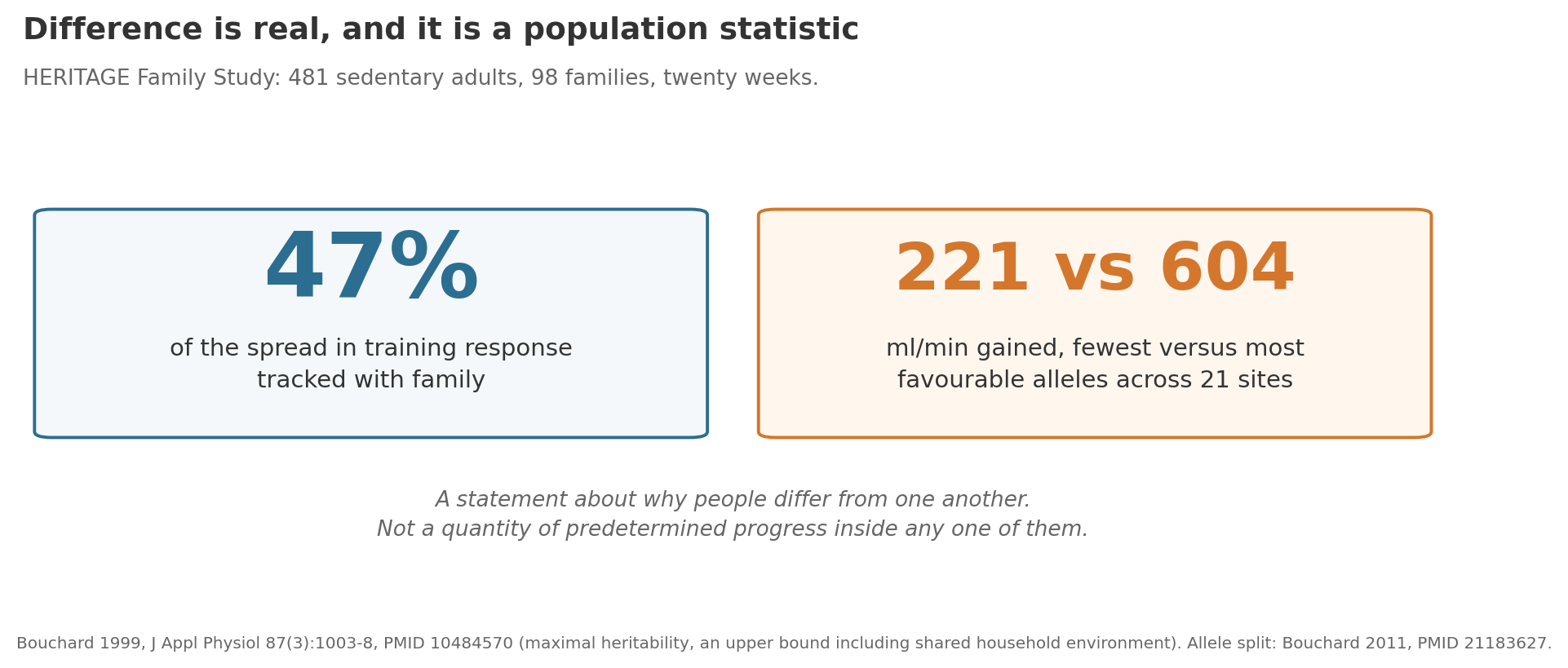
Difference between people is real, and it describes a population.
Both hold at once. Familial factors shape the size of a response; the dose decides whether there is one.
The obvious next question was what happened when a squad rode the same program. Put to Norm, it fell over.
"This question makes no sense to the me of my euro-pro career. There was no team plan and I don't recall riders having a specific training plan."
January training camp, in his description, was a negotiation in a car park: someone proposing a departure time, someone else a road, everyone riding off. Winter was whatever the riders who lived near each other decided, and the ambition was distance, because distance was what professionals did. One name comes up as the exception.
"A few riders appeared to be smarter about their work. Andy Hampsten was in that category. I recall Dr. Max Testa writing a program for him. I don't recall any others having a plan."
The trainability trials hand everyone an identical program and watch who responds. His era handed nobody a program and watched who survived. Both are failures of fit, from opposite directions, and only one has been studied.
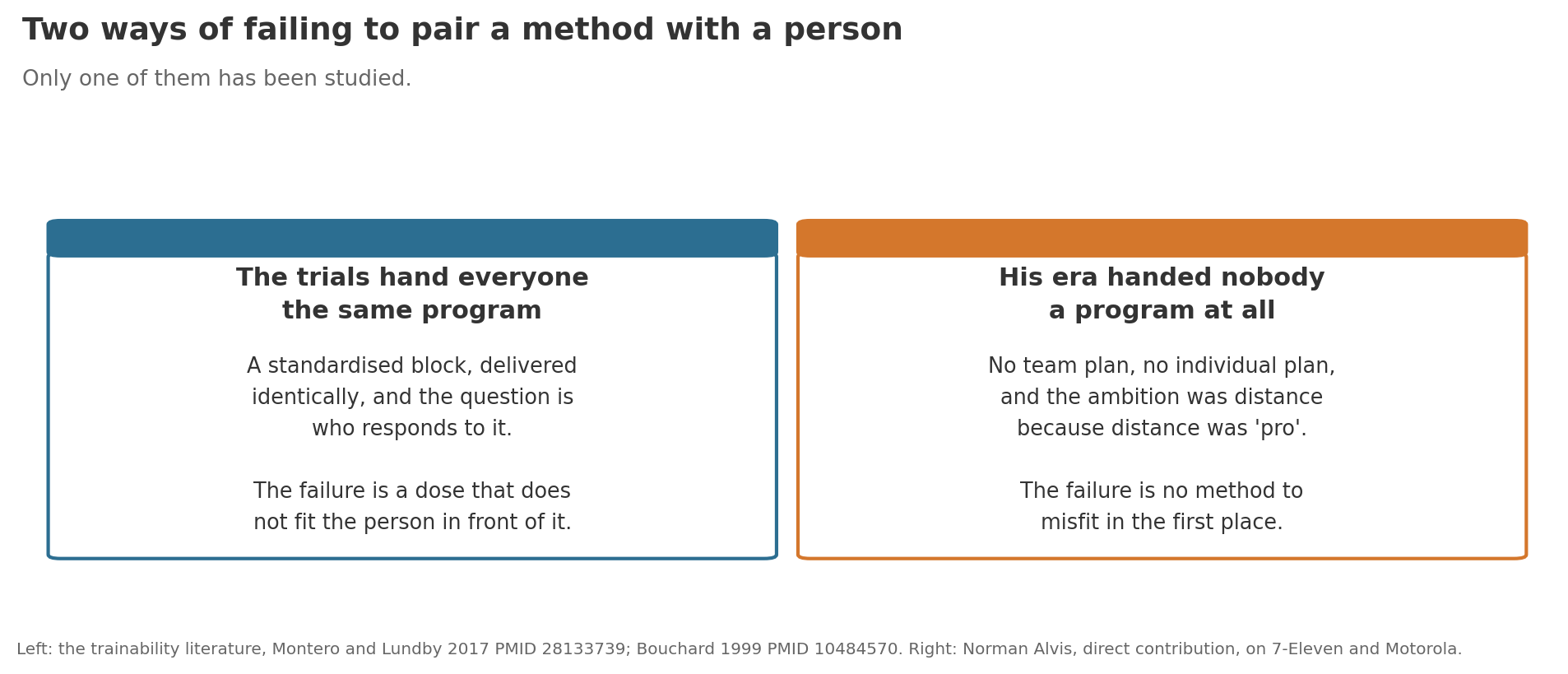
Two ways of failing to pair a method with a person.
Foundational Principles
The dose has to fit a life, and the life keeps changing
The dose-ladder result reads easily as an argument for training more. Set beside a life with other demands on it, it says something narrower: the dose has to clear a threshold to produce anything, and the arrangement that clears it has to be one the athlete can repeat.
Norm was asked about a widely quoted line of his, about rising at half past four to ride rollers in the garage. He did not recognise the framing.
"If I was riding rollers at 4:30 in the morning it was because of school or work."
Not devotion. Scheduling. At 63 the arithmetic is unchanged: about ten hours a week, "as that is all that fits", two to four of them ridden alongside his wife on an e-bike, which is how they arrive at the same easy pace together.
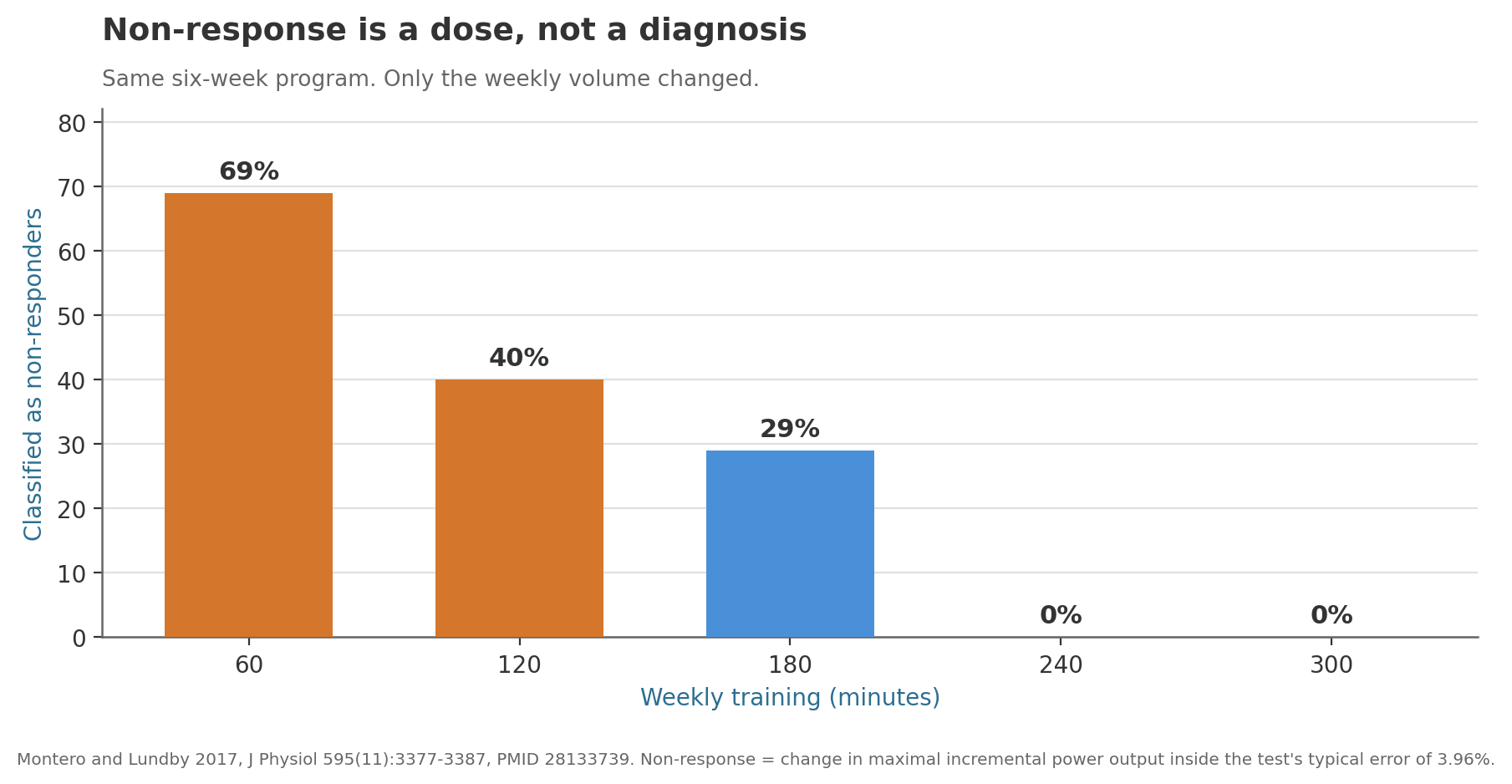
Same six-week program. Only the weekly volume changed.
Scientist's Insight: the trials raised the dose until a response appeared, in participants whose only job was to be in the trial. Every athlete outside one solves a harder problem, where the binding constraint is the week rather than the body.
The line you cannot see from the inside
Norm named personality alongside circumstance, and when asked to describe someone else he used himself instead.
"As a kid both of my parents had farms. My mother and stepfather had a plum orchard. I worked alongside Mexican migrant workers and their ethic and physical endurance made a huge impression. My dad had what we call a gentleman's cattle ranch. I labored there throughout my childhood as well. If I was soaked with sweat and covered in dirt it was a good day. To this day, if I see a pile of dirt, rock or mulch on the street I'm nearly compelled to get my shovel and come over and help. I adore labor. Consequently, until I understood the context I always overtrained."
One trial describes the cost of that trait precisely. Thirty-three trained triathletes did three weeks of deliberate overload then a four-week taper. Eleven of the twenty-three overload participants tipped into functional overreaching: performance down, fatigue high. Twelve were merely acutely fatigued, tired but still performing. The merely tired group produced the largest peak in the study, around 2.6% above both other groups, and was the only overload group whose maximal oxygen uptake rose from baseline. The overreached group lost that adaptation entirely and reported infections at 70% against 20% and 10% (Aubry 2014).
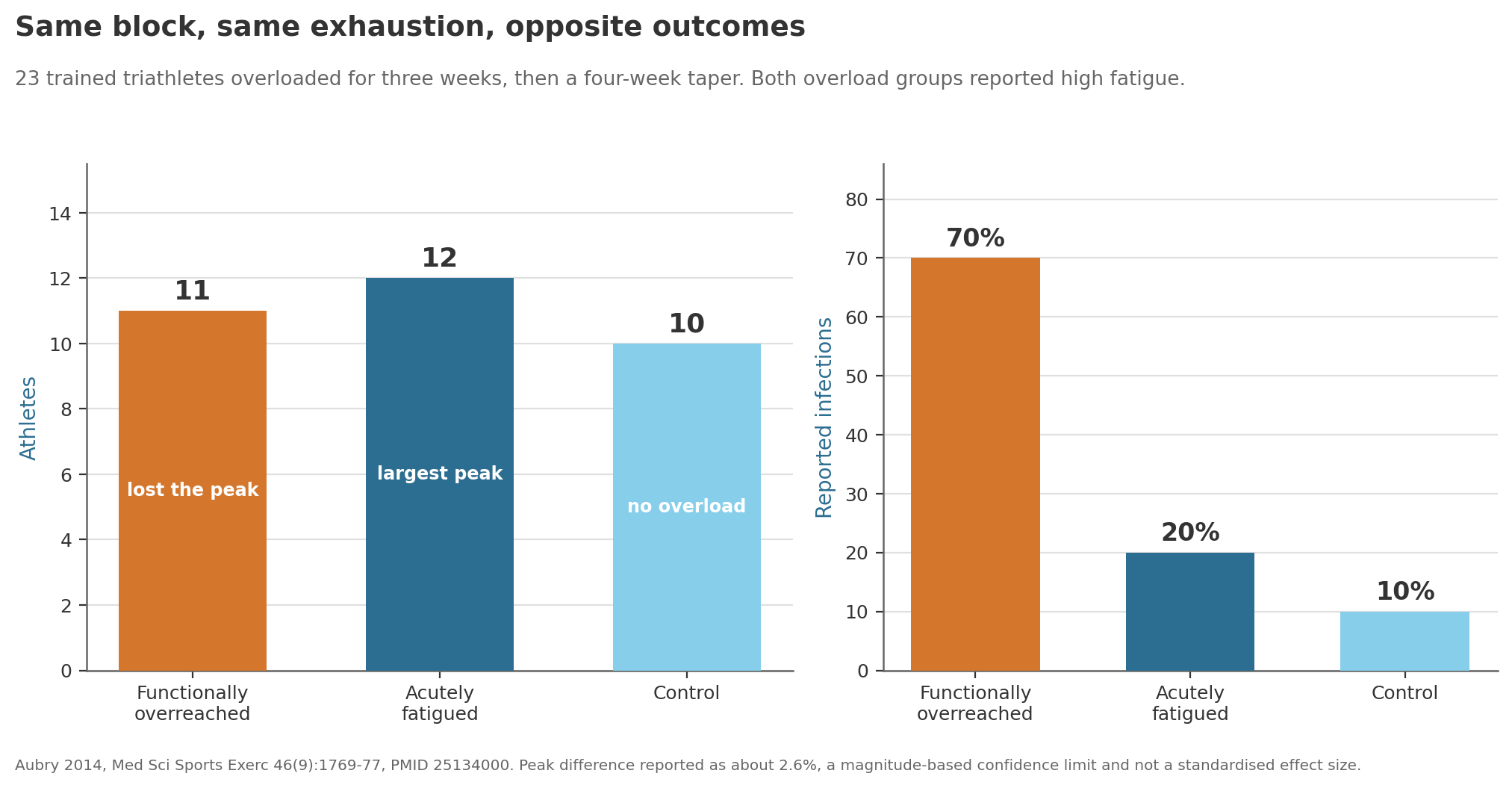
Same block, same exhaustion. One group peaked and one lost the adaptation.
Both groups did the same work and both were wrecked by it. What separated them was a performance test, not a sensation, and nearly half the group was on the wrong side of it. Nor does an instrument settle it: surveying the hormonal, performance, psychological, biochemical and immune markers in use, the European College of Sport Science and the American College of Sports Medicine jointly found none meeting all the criteria for general acceptance (Meeusen 2013).
Against that, here is what Norm says a coach is for.
"A coach is an expert and objective viewer and voice. That is foremost in my mind. Too many times in my career I was simply too tired or overwrought to see what was happening."
Scientist's Insight: that a coach improves outcomes for a seriously training athlete has not been tested, and this piece cannot claim it has. What the evidence establishes is narrower and still substantial. The judgement is real, expensive to get wrong, and the athlete making it is the instrument whose calibration is in question. His claim is not that a coach knows more. It is that a coach is not the one who is tired.
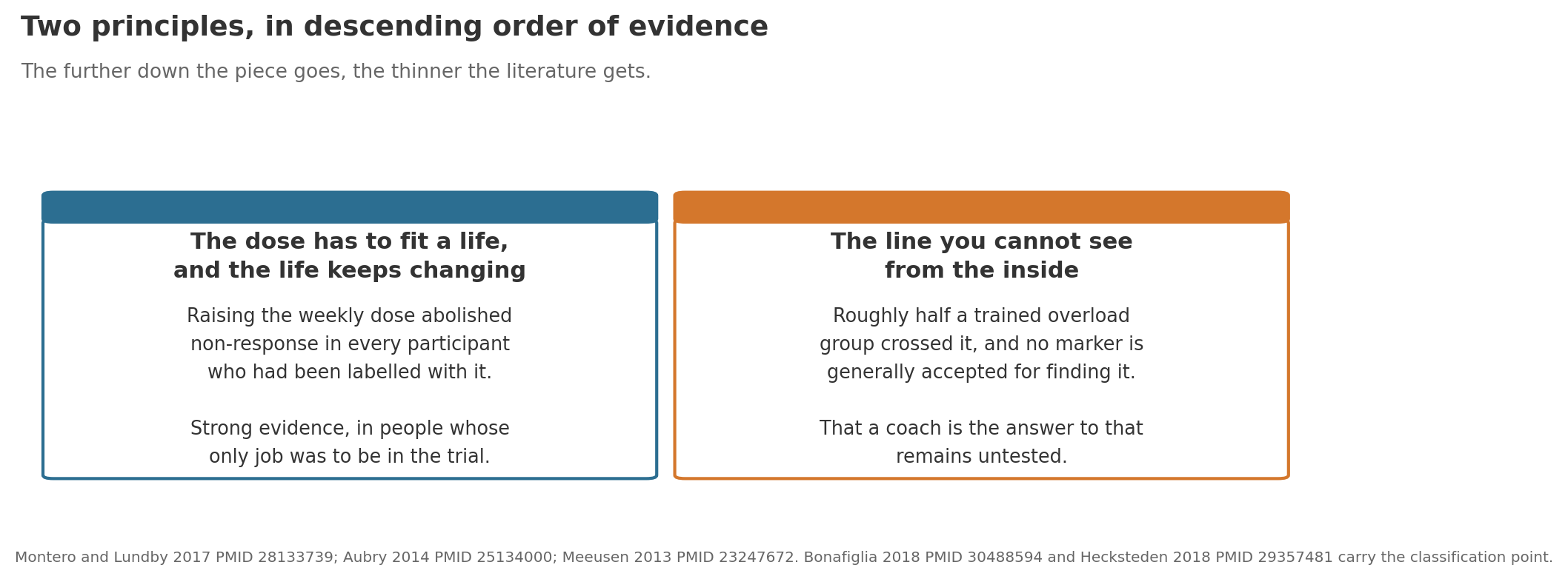
The further down the piece goes, the thinner the literature gets.
Observational Levers
Where the week actually sits
Those who abandon a plan in busy weeks often show the low-dose pattern from the trial above. The observational signature is a week that reads as hard and totals as light, a monthly figure under the threshold that produced change, assembled from sessions that each felt demanding (Montero and Lundby 2017).
What the athlete is drawn towards
Those who describe effort as intrinsically satisfying, rather than as the price of a result, sit in Norm's account on the overreached side of the split above. One case backs that pattern, and he is it. The trial establishes the two states exist and differ in outcome. It says nothing about which athletes land in which.
The Protocol
What the evidence supports, as observations rather than instructions:
- Response is assessed across more than one measurement. Retesting through a year left only 11 of 20 athletes consistently classified (Hecksteden 2018); a label read off a single test pair describes an episode, not a trait (Bonafiglia 2018).
- Where no change appears, the trial evidence describes dose as the first variable altered. In the block that eliminated non-response, weekly totals ran from 180 to 300 minutes.
- Fatigue alone does not distinguish the state that peaks from the state that does not. In the taper study the separation was made by a performance test (Aubry 2014).
- The arrangement behind Norm's records is repeatable at about ten hours a week, a different constraint from the one the trials optimised.
The case: a man who kept choosing the harder version
One trait runs through his whole account and changes sign depending on what surrounds it. In 1990 it made him a useful professional and wore him out inside a season. Afterwards it made him someone who, by his own description, overtrained until he understood why. It is still running: he crashed in sprint training last year, broke eight ribs, missed a single day of riding, and was at a masters team pursuit camp a week later. He notes it was excruciating and that he did not get dropped.
The correction, when it came, came from outside him.
"There have been a few times when I was strongly influenced by a coach and rose to exceptional form."
A few times, in forty-eight years of racing. He offers it as a low number.
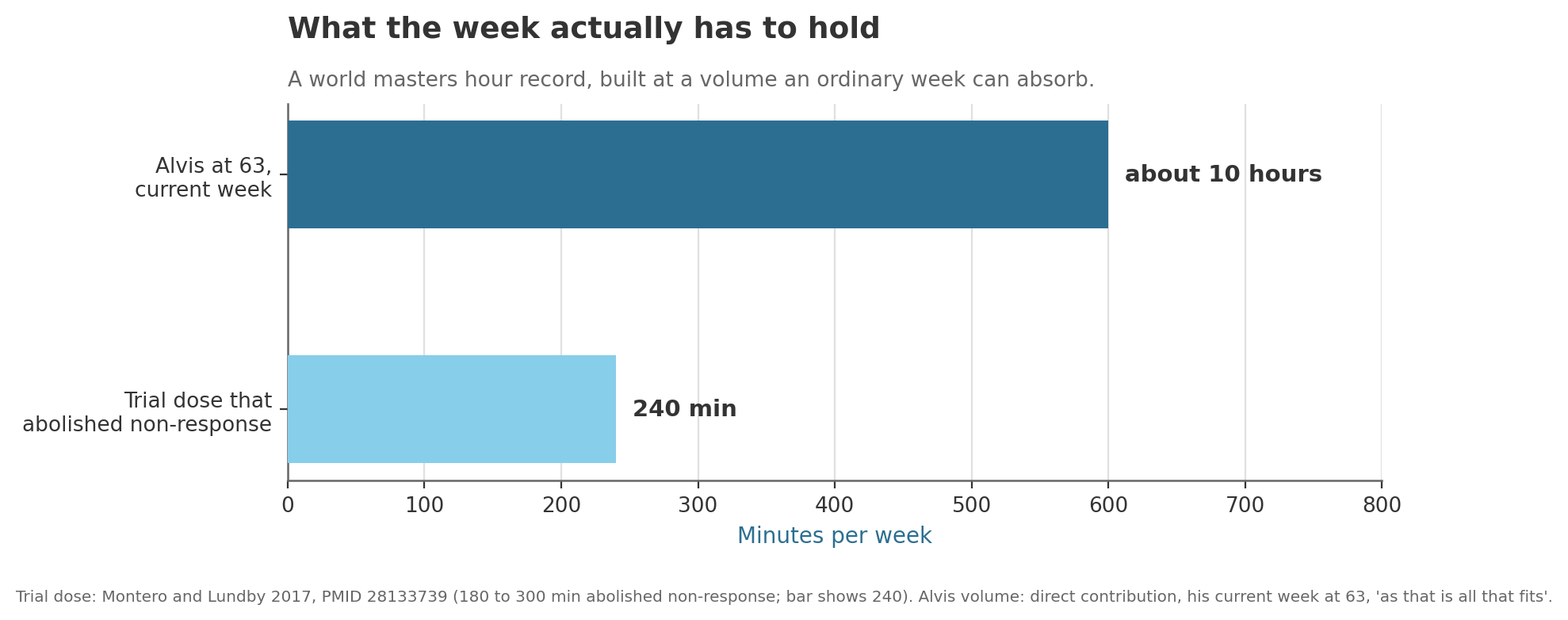
A world masters hour record, built at a volume an ordinary week can absorb.
His argument was that the science is proven and the art is the fit. The evidence agrees further than it usually does with a claim that broad. Trainability is unevenly distributed, the label most used for that unevenness described a dose that was too small, and the state deciding whether a hard block pays off cannot be read from any accepted marker. What it does not supply is his conclusion. That a coach is the mechanism remains his claim, made by someone forty-eight years inside the problem, which is a different kind of warrant from a trial rather than a weaker one.
And then, having argued for an interview that fit is everything, he was asked when finding his own way had cost him.
"I would always have been better off to follow standard guidance. I used to think I was smarter than I actually was or more special than I actually was. However, the trajectory or journey would have been different and I may not have learned what I have now."
Best regards, Dr. Thomas Mortelmans
Limits of Application
The responder literature is built almost entirely on sedentary, untrained or recreationally active adults, well below the ceiling of a former professional, over six to twenty weeks. Masters athletes do adapt: knee-extensor work raised maximal voluntary contraction 17.8% in master endurance athletes against 5.9% in young ones (Louis 2011). What nobody has run on them is the dose-escalation design, and nobody has randomised trained athletes to a coach. That trial is indexed as male-only, and its second block was completed only by those already classified as non-responders. The taper study enrolled 33 trained male triathletes and reports group differences as magnitude-based confidence limits, not standardised effect sizes. The 47% describes variance within one population at one dose and predicts nothing about an individual. Norm's results are a single case, and the personality pattern has no controlled evidence behind it.
A note on our guest
Norm's vantage point is longitudinal: the same body, the same event, across four decades of completely different circumstances. He is at morepowertothepedals.com. He also asked, twice and unprompted, to go deeper on how form is built and recognised, which is the subject of the next piece in this pair.
"I would say, review your objective; it's probably not aligned with your work."
References
- Bouchard C, et al. Familial aggregation of VO2max response to exercise training: results from the HERITAGE Family Study. J Appl Physiol 1999;87(3):1003-8. PMID 10484570 · doi:10.1152/jappl.1999.87.3.1003 What it shows: 481 sedentary adults from 98 families did the same twenty-week program; the spread in gains tracked with family, with a maximal heritability estimate of 47%.
- Montero D, Lundby C. Refuting the myth of non-response to exercise training. J Physiol 2017;595(11):3377-87. PMID 28133739 · doi:10.1113/JP273480 What it shows: non-response fell from 69% to zero as weekly training rose from 60 to 300 minutes, and was abolished in every previously non-responding participant after two extra sessions.
- Aubry A, Hausswirth C, Louis J, Coutts AJ, Le Meur Y. Functional overreaching: the key to peak performance during the taper? Med Sci Sports Exerc 2014;46(9):1769-77. PMID 25134000 · doi:10.1249/MSS.0000000000000301 What it shows: of 23 triathletes doing an overload block, 11 became functionally overreached and lost the taper peak; the merely fatigued group peaked around 2.6% higher and reported far fewer infections.
- Meeusen R, et al. Prevention, diagnosis, and treatment of the overtraining syndrome: joint consensus statement of the European College of Sport Science and the American College of Sports Medicine. Med Sci Sports Exerc 2013;45(1):186-205. PMID 23247672 · doi:10.1249/MSS.0b013e318279a10a What it shows: reviews the hormonal, performance, psychological and immune markers in use and finds none that meet all criteria for general acceptance.
- Bonafiglia JT, et al. Moving beyond threshold-based dichotomous classification to improve the accuracy in classifying non-responders. Physiol Rep 2018;6(22):e13928. PMID 30488594 · doi:10.14814/phy2.13928 What it shows: argues that classifying responders off a single change score against zero misstates who actually failed to adapt.
- Hecksteden A, et al. Repeated testing for the assessment of individual response to exercise training. J Appl Physiol 2018;124(6):1567-79. PMID 29357481 · doi:10.1152/japplphysiol.00896.2017 What it shows: retesting the same athletes through a training year left only 11 of 20 consistently classified across methods.
- Bouchard C, et al. Genomic predictors of the maximal O2 uptake response to standardized exercise training programs. J Appl Physiol 2011;110(5):1160-70. PMID 21183627 · doi:10.1152/japplphysiol.00973.2010 What it shows: identified a set of variants associated with the size of the training response in the HERITAGE cohort.
- Astorino TA, Schubert MM. Individual responses to completion of short-term and chronic interval training. PLoS One 2014;9(5):e97638. PMID 24847797 · doi:10.1371/journal.pone.0097638 What it shows: found wide individual variation in fitness change after interval training, including participants whose measured capacity did not move.
- Metcalfe RS, et al. Exploring interindividual differences in insulin sensitivity adaptations to sprint interval training. Eur J Sport Sci 2022;23(9):1950-60. PMID 36093904 · doi:10.1080/17461391.2022.2124385 What it shows: reports that apparent individual differences in metabolic adaptation partly reflect measurement error rather than true biological variation.
- Bonet JB, et al. Inter-individual different responses to continuous and interval training in recreational middle-aged women runners. Front Physiol 2020;11:579835. PMID 33192585 · doi:10.3389/fphys.2020.579835 What it shows: middle-aged women runners responded differently to two training formats, with some improving on one and not the other.
- Tanaka H, Seals DR. Endurance exercise performance in Masters athletes. J Physiol 2008;586(1):55-63. PMID 17717011 · doi:10.1113/jphysiol.2007.141879 What it shows: peak endurance performance holds to around 35, declines modestly to 50 or 60, then falls more steeply, largely through falling maximal oxygen uptake and reduced training volume.
- Louis J, et al. Strength training improves cycling efficiency in master endurance athletes. Eur J Appl Physiol 2011;112(2):631-40. PMID 21638070 · doi:10.1007/s00421-011-2013-1 What it shows: three weeks of knee-extensor training raised maximal voluntary contraction 17.8% in masters athletes against 5.9% in young ones, erasing the age gap in cycling efficiency.
- Campbell D. An interview with American cycling legend Norm Alvis. Cycling West, 8 June 2026. cyclingwest.com What it shows: long-form interview covering his junior years, the European seasons and his return to masters racing; source of the race-journals quote.
- Former Tour pro sets masters hour record. BikeRadar. bikeradar.com What it shows: equipment and preparation feature on the September 2017 world masters hour record, including the rollers and iPhone position work.
- Alvis N. More Power to the Pedals. morepowertothepedals.com What it shows: norman's own site, carrying his racing history, current masters campaigns and contact details.
Does a coach improve outcomes for an athlete who is already training seriously?
No trial has randomised trained athletes to a coach, so the direct question is unanswered. What the evidence establishes is the judgement a coach is being asked to make. In one taper study, 11 of 23 overloaded triathletes crossed into functional overreaching and lost the peak while 12 stayed merely fatigued and produced the largest peak in the trial. Both groups reported high fatigue, and two sport-science bodies report jointly that no marker separating the two states is generally accepted.
Frequently asked questions
Is a non-responder to exercise training a real category of person?
In one trial, non-response fell from 69% of participants at 60 minutes of training a week to zero at 240, and every participant previously labelled a non-responder responded once two sessions were added. Repeat testing across a training year left only 11 of 20 athletes consistently classified. The label described a dose and a measurement window rather than a person.
How much of the difference in training response is familial?
In the HERITAGE Family Study, 481 sedentary adults from 98 families completed the same twenty-week program, and model fitting returned a maximal heritability of 47%. That figure is an upper bound including shared household environment, and it describes why a population varies rather than how much progress waits inside any one person.
Can an athlete tell when a hard training block has gone too far?
In a four-week taper study, 11 of 23 overloaded triathletes became functionally overreached, lost the taper peak, showed no rise in maximal oxygen uptake and reported a 70% infection rate. The 12 who stayed merely fatigued produced the largest peak in the trial. Both groups reported high fatigue, so what separated them was a performance test rather than a sensation.
Did professional cycling teams in the early 1990s ride a shared training program?
Norm Alvis, who raced for 7-Eleven, Motorola and Saturn between 1989 and 1998, says there was no team plan and that he does not recall riders having a specific training plan. He names one exception, Andy Hampsten, whose program he recalls Dr Max Testa writing.
What does a coach supply that an athlete with the same information cannot?
In Norm Alvis’s account, an expert and objective view at the moments when he was too tired or overwrought to see what was happening. That is a claim about degraded self-assessment under fatigue rather than about motivation or information, and it is his claim rather than a tested finding.
If you have 60 seconds, I would value your anonymous feedback. You can share it here.
Health disclaimer
This article reports what training studies observed in the populations they enrolled. It is not training advice and it is not medical advice. The responder and trainability research described here was conducted in untrained, sedentary or recreationally active adults across blocks of six to twenty weeks. None of it was conducted on trained masters athletes, and its transfer to them is an assumption rather than a finding. The overreaching trial enrolled 33 trained male triathletes and reports its group differences as magnitude-based confidence limits rather than standardised effect sizes. Norm Alvis's own results are a single case, which establishes possibility rather than frequency. Norm describes returning to a masters team pursuit training camp one week after breaking eight ribs. It appears here as characterisation of the trait this article is about, not as an example to follow. Training through a fracture carries real risk and is a decision for a clinician rather than for an article.
Found this useful?
Get articles like this and free training calculators in your inbox every week.
Recommended reads
If this was useful, these are the other research-driven newsletters I actually read.


Member discussion