Introducing the Calculator Library: 29 Peer-Reviewed Tools, One Transparent Workbench

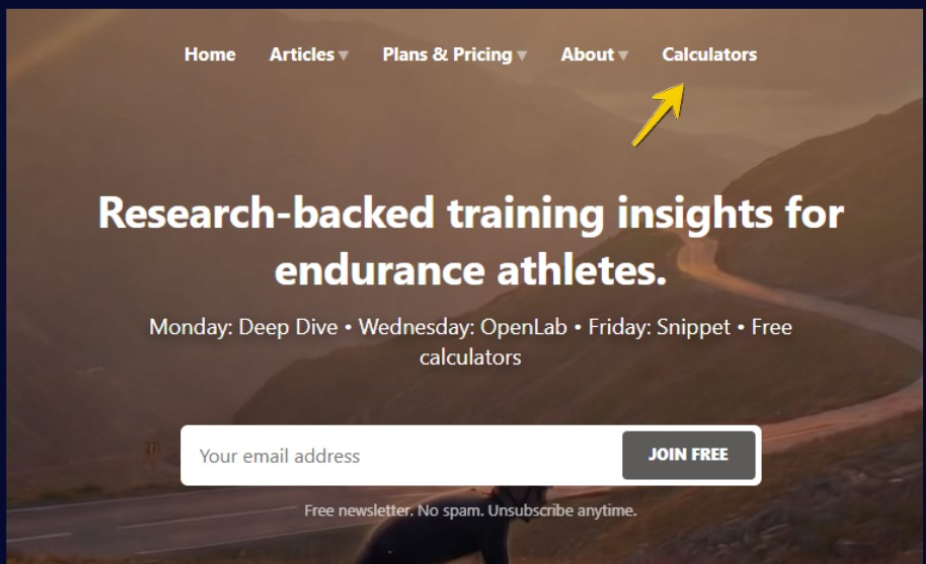
The Scientist's Notebook is releasing what I believe is the largest free, source-cited collection of endurance calculators on the internet. Twenty-nine tools, seven categories, one shared philosophy: every number you see is traceable to a formula, a paper, or a dataset you can look up yourself.
The problem this solves
The calculator landscape for endurance athletes has three failure modes.
The first is opacity. You enter your numbers, you get a result, and you have no idea whether it came from the Riegel exponent, the Cameron model, a polynomial fit on someone's Strava data, or a hallucinated constant. For a sport where the difference between Zone 2 and Zone 3 can rewrite a whole training block, "trust me" is not a methodology.
The second is fragmentation. Critical power lives on one site. Training zones on another. Heat adjustment on a third, usually tucked behind a pop-up. If you are trying to plan a race, you end up stitching together four tabs and three pricing tiers to answer one physiological question.
The third is cost. The best analytical engines (INSCYD, Xert, WKO5) are excellent, and they deserve their price tag. But an athlete who just wants to know whether their FatMax (! approximately, this is no substitute for lab-testing) sits in the fat-dominant part of their threshold profile should not need a 20 USD monthly subscription to find out.
The Calculator Library is an attempt to fix all three.
What is in the collection
Twenty-nine tools are now live at the-scientists-notebook.com/calculators, organized into seven sections. Before you do a deep dive and possible get overwhelmed, here is the map.
1. Holistic Performance Assessment (the Snapshots)
Four "one-stop" workflows that take a minimal input (usually two time trials or two maximal efforts) and return a full physiological report. The Cycling Snapshot gives you CP, W′, VO₂max, Coggan power zones, a power profile percentile against the pro peloton, FatMax, speed at threshold, and per-session load estimates.
The Running, Swimming, and Triathlon Snapshots do the same for their respective disciplines, with the triathlon version combining all three threshold systems into predicted Sprint-through-Ironman splits.
If you are new to the library, start here. Each Snapshot is a guided path through the deeper tools underneath.
2. Performance Testing
Nine tools for measuring physiological limits and setting training zones. This is the analytical core.
- Critical Power / Critical Velocity / CSS: two-parameter CP model from paired maximal efforts, returning threshold plus anaerobic capacity (W′ or D′).
- Lactate Threshold: multi-method detection (DMax, LT1/LT2 inflection, individual anaerobic threshold) from progressive step-test data.
- VO₂max Estimator: uses the Sitko et al. (2022) equation validated on road cyclists, from a 5-minute maximal effort.
- Training Zones: Coggan 7-zone, Seiler 3-zone polarized, and Daniels running zones from a single threshold input.
- Power Profile: percentile ranking across 5s, 1min, 5min, and 20min power, against both Cycling Analytics population data and Valenzuela and Mateo-March pro cyclist reference values.
- FatMax and Substrate Utilization: fat oxidation curve from Achten and Jeukendrup (2003), with crossover point.
- VLaMax Estimator: glycolytic rate estimation from sprint and threshold data, conceptually aligned with the INSCYD framework.
- Age-Grading: WMA age-grading tables so a 47-year-old 10K in 38:00 can be compared fairly to a 27-year-old 10K in 34:00.
- Fractional Utilization: the ratio of threshold to MAP, which tells you whether you are physiologically a diesel or a sprinter and sets realistic expectations for what targeted training can move.
3. Training Tools
Five tools for the block-to-block work of structuring a season.
- Session Load Calculator: computes TSS-equivalent load from power, heart rate, or pace.
- Taper Advisor: week-by-week volume and intensity prescriptions drawn from the meta-analytic consensus on tapering (Bosquet, Mujika).
- Race Time Predictor: Riegel and Cameron models side by side, so you can see the disagreement rather than hide it in a single point estimate.
- Interval Workout Builder: session prescriptions for any target zone, with sets, durations, and rest periods derived from your own threshold.
- Weight vs Performance Impact: quantifies what a ±2 kg change does to your 10K pace or your 8% climb speed, using the Daniels running formula and cycling physics.
4. Race Day and Conditions
Four tools for translating lab numbers into the real world.
- Heat and Humidity Adjustment: pace correction from Ely et al. (2007), with a separate adjustment factor for acclimated vs unacclimated athletes.
- Altitude Performance Adjustment: Peronnet et al. (1991) model, accounting for VO₂max decline and reduced air density (the latter actually helping cyclists on descents).
- Grade-Adjusted Pace: the Minetti et al. (2002) metabolic cost curve, the same model Strava uses internally for GAP.
- Glycogen Depletion and Wall Predictor: Rapoport (2010) metabolic model, combining glycogen stores with intake rate to predict the point where the tank empties.
5. Nutrition
Two tools that convert intensity and duration into fueling.
- Carbohydrate Fueling: race-day carb intake by duration, intensity, temperature, and gut tolerance, with a GI-risk flag for athletes pushing past 90 g/h.
- Calorie and Macro Calculator: TDEE plus macro split from training volume, with meal timing guidance around sessions.
6. Cycling Tools
Three physics-heavy utilities.
- Power-to-Speed Calculator: the full Martin et al. (1998) model, including aerodynamic drag, rolling resistance, gradient, and wind. Invertible in both directions.
- Climbing Speed and VAM: vertical ascent meters per hour from climb data, and the inverse prediction of climb time from target W/kg.
- Gear Ratio and Speed: chainring, cassette, cadence, and wheel size into speed. Useful for race-specific gearing decisions.
7. Utilities
Two quick-reference converters.
- Pace Converter across min/km, min/mile, km/h, mph, and m/s.
- SWOLF Calculator for swimming efficiency tracking.
The methodology principle
Every calculator in the library obeys three rules.
Rule one: the formula is named. If a tool uses Riegel, the tool says "Riegel". If it uses Minetti 2002, it says "Minetti 2002". When a calculator blends models, both names appear, and when they disagree (the Riegel-Cameron divergence above marathon distance is the classic example) both outputs are shown. You get the uncertainty, not a false consensus.
Rule two: the input is physiological, not demographic. The calculators do not ask your gender as a primary input. They ask for your data: your critical power, your lactate curve, your 5-minute maximum. A 67 kg female cyclist with an FTP of 4.1 W/kg and a 62 kg male cyclist with an FTP of 4.1 W/kg have more physiologically in common than either does with their demographic median. The tools treat them accordingly.
Rule three: reference ranges cite their dataset. When the Power Profile says you are in the 73rd percentile, it tells you which dataset. When the VAM calculator rates a climb as "pro-level", it tells you the Valenzuela threshold for that rating. No hand-waving. No "this is what strong riders look like" without a source.
How to read the outputs
A few technical notes for power users.
The CP model assumes proper effort distribution in your two time trials. If your 3-minute test was paced and your 12-minute test was not, the CP estimate will be biased upward and the W′ estimate will be biased downward. The library flags this when the two data points are geometrically incompatible, but it cannot catch every case.
The FatMax estimator is derived, not measured. True FatMax requires a graded test with indirect calorimetry. The Achten and Jeukendrup (2003) model gives a population-fitted estimate that is directionally correct for most aerobic athletes but should not be used to argue with your sports scientist if you have an actual measurement.
The Heat Adjustment model assumes cardiovascular-limited endurance performance (5K and longer). For sub-3-minute efforts, thermoregulation does not have time to matter, and the model will slightly overstate the effect.
The Glycogen Depletion model uses standard assumptions for muscle and liver glycogen stores (approximately 400 to 500 g total in a trained athlete). If you have been low-carb for the week leading into your race, your starting tank is smaller, and the wall arrives earlier than the model predicts.
These caveats are not buried. Each calculator's methodology note states them explicitly.
What I built this for
I work by day on regulatory-grade characterization of drug-device combination products, which is a discipline that does not tolerate un-sourced numbers. I found the absence of that standard in the endurance-calculator world slightly absurd.
An age-group athlete training 12 hours a week is entitled to the same source discipline as a pharmaceutical submission. The physics does not care whether you are optimizing a polypropylene syringe or a threshold interval session.
The library is the answer to that asymmetry. Every tool is free, every formula is cited, and every output is reproducible. If you disagree with a result, you can trace it back to the paper it came from and argue with the paper, not with me.
What comes next
Reader-requested tools. The current 29 are my best guess at what matters. The next ones should come from the people actually using the library. If there is a calculation you keep doing by hand, or a paper you want turned into a tool, send it in via comment on this newsletter, instagram DM or an e-mail to thomasmortelmans@the-scientists-notebook.com.
Start here
If you are not sure where to begin, run one of the Snapshots. They are the fastest way to see the full library in action on your own data.
Cycling Snapshot · Running Snapshot · Swimming Snapshot · Triathlon Snapshot
The full library lives at the-scientists-notebook.com/calculators.
No paywall. No sign-up. No hidden exponents.
Once again, welcome to the Family.
— Thomas
Found this useful?
Get articles like this and free training calculators in your inbox every week.
Recommended reads
If this was useful, these are the other research-driven newsletters I actually read.
Member discussion